
Fibreglass vs Stainless Steel: Which Should Your Sculpture Be?
2026-09-10
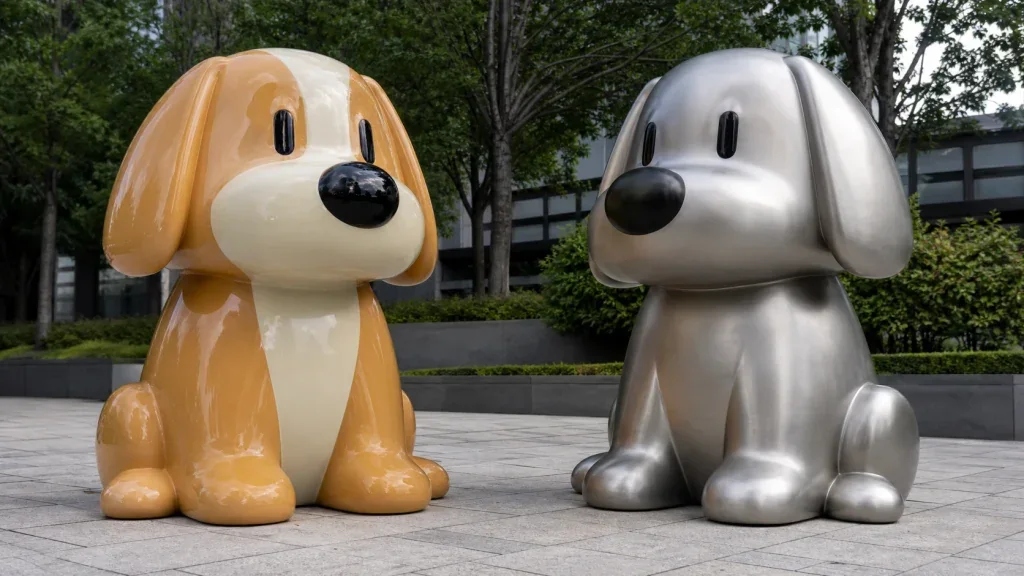
This is the question our materials page answers in table form, so here is the reasoning behind it. Almost every cartoon sculpture we build comes down to two materials, and they are good at different things.
The short answer
Fibreglass is the value choice and the colour-accurate one. Stainless steel is the long-life choice and the one for smooth, geometric or architectural forms. At the same size, detailed stainless work costs roughly 2.5 to 4 times the fibreglass equivalent — but for a simple form the two are closer than most people expect.
What each one really costs
These are surveyed ranges for a single piece above 1.5 m, gathered from overseas retail listings, studio quotes and B2B export quotes:
| Size | FRP Fibreglass | Stainless — smooth forms | Stainless — fine detail |
|---|---|---|---|
| 1.5–2.0 m | $1,500–$4,900 | $1,200–$4,900 | $8,000–$12,000 |
| 2.0–3.0 m | $3,800–$15,000 | $3,090–$12,090 | By quote |
| 3.0 m + | $8,000–$35,000 | $28,000–$55,000 | By quote |
* This price is for rough reference only; a detailed quote will be provided based on the specific details of each project.
Two things in that table surprise people. The first is that smooth stainless steel starts below fibreglass — a simple, rounded form in brushed steel does not need much hand-work. The second is how steeply detailed steel climbs: as soon as the surface has to carry fur, feathers or a face, stainless stops being competitive.
Where fibreglass wins
- Colour. Fibreglass is finished with multi-layer automotive paint and a UV clear coat. It reproduces a specific coat, a specific set of markings, a logo or a uniform exactly. A metal patina cannot match a pigment, and that is the single biggest reason we recommend fibreglass for cartoon work.
- Faces and hands. A refined, painted face in fibreglass lands around $8,000–$15,000. The same thing in stainless steel is far more expensive and loses likeness easily, because every plane has to be formed in sheet and then polished.
- Budget and weight. Above 1.5 m, fibreglass typically costs 50–70% less than stainless for the same shape, and a fibreglass piece of the same size moves with far less equipment.
- Repeat pieces. If you need ten or more identical sculptures, the mould is amortised and the unit price drops 40–60%.
Where stainless steel wins
- Time outdoors. Stainless lasts 50+ years with no recoating. Fibreglass is good for 15–20 years before the clear coat needs refreshing.
- The coast. Within about 5 km of salt water, specify 316 rather than 304. It costs 20–35% more and it is the difference between spotting and pitting.
- Abstract and geometric work. Smooth, simple forms are where steel is at its most competitive, and where its finish does the most for a piece.
- Architectural presence. A brushed or mirror finish reads as permanent in a way paint does not.
The one rule that decides it
Ask what the piece has to do that the other material cannot. If the answer is hold an exact colour or carry a realistic face, it is fibreglass. If the answer is sit outdoors for fifty years or look like metal, it is stainless steel.
One more thing worth settling before you choose a material: whether the result counts as art. It changes what you are actually paying for, and it is not a marketing question.
Two things to specify either way
Every piece above 1.5 m needs an internal steel frame. Above 2 m that frame should be drawn by a structural engineer, and above 3 m the sculpture is normally built in sections and welded on site. The frame is typically 10–20% of the cost, and it is the line a cheap quote leaves out.
For stainless, specify sheet thickness in writing — outdoor work should be no thinner than 2–3 mm. For fibreglass, specify the clear coat.
More from the Workshop

Ready to Start?
Send us photos and get a free, honest quote within 24 hours — no obligation.
Get a Free Quote