
Life-Size Cartoon Character Statues: What to Expect
2026-09-18
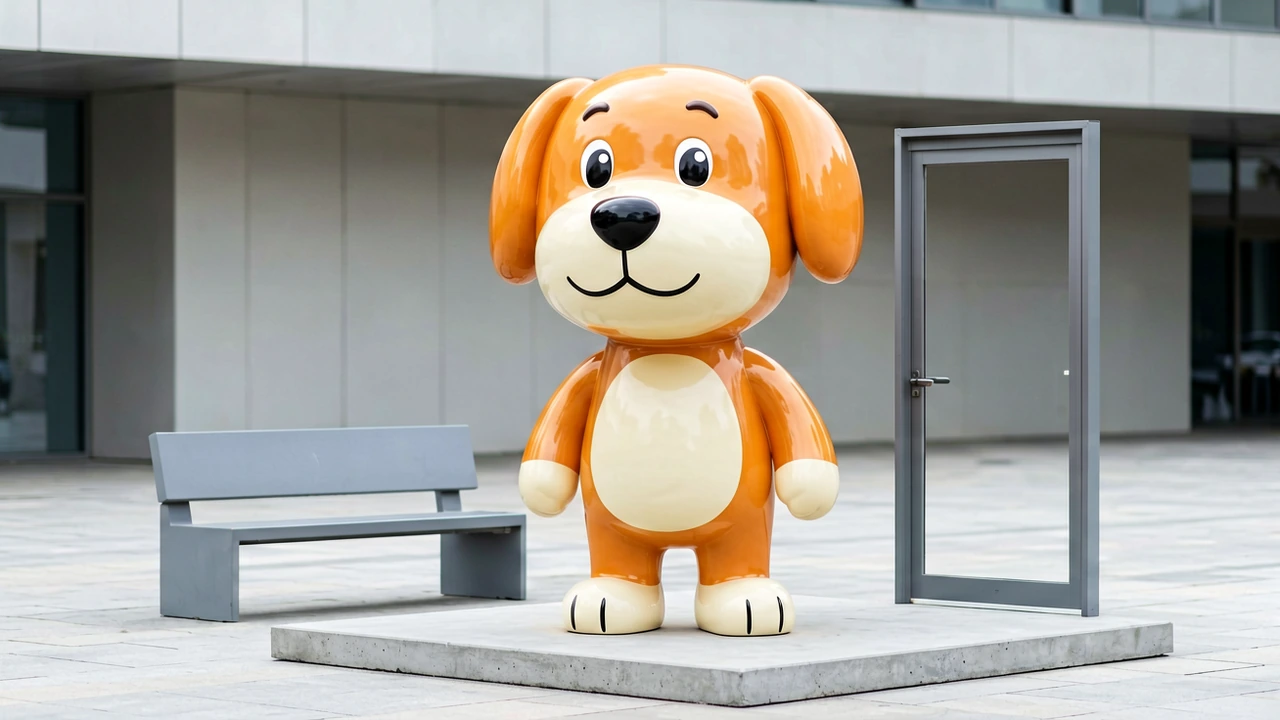
A life-size cartoon character statue is an awkward thing to price, because a cartoon character has no real size. A mascot lives in a logo; a pet drawn as a cartoon lives in a frame that is whatever height the artist felt like. So when someone asks for a “life-size” version, the first honest answer is that life-size has to be decided, not looked up — and that single decision drives everything downstream: cost, engineering, freight, and where the piece can stand.
This guide sets out what to expect from a life-size cartoon character commission in fibreglass, built from 1.5 m upwards. It is written for the person who already has a character in mind — a dog, a mascot, a figure from the family story — and wants to know what actually happens between the idea and the thing standing in the garden. The size and price table sits on the life-size cartoon sculpture page; below is everything that table cannot tell you.
What “life-size” means when the subject is a cartoon
There is no master mould to measure. A cartoon character is a drawing language, not a body, and a life-size cartoon statue is therefore a translation: we agree a height that suits both the character and the place it will stand, then keep the character’s proportions intact at that height.
In practice life-size comes down to three separate questions:
- The character’s own canon. If the figure appears at a consistent height in its own world — a mascot, a show character, a game character — that height is the starting point, adjusted so the piece reads correctly to a human standing next to it.
- Human scale. Most private commissions land between 1.5 m and 2.0 m, because that is the range where a person beside the statue clearly reads as smaller than it. That is the whole point of life-size: the scale relationship, not the millimetres.
- The site. A figure in a front garden is judged from three metres away; one on a plaza is judged from thirty. The further back the viewer stands, the more the piece has to grow to hold the same presence.
What life-size does not mean is one-to-one with a photograph. A faithful reproduction of a single snapshot usually reads flatter and smaller than the client expected, which is why we discuss height and proportion before any modelling begins rather than after.
Why life-size cartoon statues are built in fibreglass
Almost every large cartoon figure we make is FRP fibreglass — glass-fibre laminate laid up in a mould over an internal steel frame, then finished in multi-layer automotive paint and sealed under a UV clear coat. At 1.5 m and above, three properties decide the argument.
Weight. A 2 m fibreglass figure is light enough to move on a pallet, re-position by hand with two people, and re-spray in place. The same form fabricated in metal weighs several times as much and needs plant to shift it.
Colour. Cartoon characters are defined by flat, exact colours — a specific orange, a specific cream, a jersey stripe that has to match. Paint reproduces an exact colour; a patina or a brushed metal finish does not. For anything that must match a brand palette or a real pet’s coat, fibreglass is not a compromise but the only sensible answer.
Repairability. A scratched fibreglass surface is a local repair and a re-coat; a chipped cast-metal surface is a much longer conversation. Over a 15–20 year outdoor life, the ability to bring the finish back is worth more than any theoretical hardness advantage.
The full comparison of what we build in — and the materials we only list so you can recognise them — is on the materials page. If you are specifically weighing fibreglass against metal, the long version of that argument is in fibreglass vs stainless steel.
What a life-size cartoon character statue costs
Price scales with height far more steeply than it scales with detail, because everything structural — the frame, the mould, the crate, the freight — grows with the piece. As a working reference:
| Finished height | FRP fibreglass | What changes at this size |
|---|---|---|
| 1.5–2.0 m | $900–$5,900 | A standard frame; a two-person lift; ships in one piece. |
| 2.0–3.0 m | $5,000–$15,000 | Engineered frame, heavier base, sectioned crate. |
| 3.0 m and above | $15,000–$150,000+ | Structural calculations, on-site assembly, rigging. |
The internal steel frame alone is typically 10–20% of the total and it scales with height, not with how complicated the character looks. That is the line item a cheap quote quietly leaves out, and it is the difference between a statue that holds its shape for a decade and one that slowly sags. Figures above are reference only; the life-size page and a written quote both carry the real numbers.
How long a life-size commission takes
A 1.5–2.0 m fibreglass figure runs six to nine weeks end to end. Above 2 m, expect 20–40% longer, because the frame is engineered rather than improvised and the piece is built and packed in sections.
- Days 0–1. Photo review and a fixed written quote — not an estimate.
- Weeks 1–2. 3D model, rendered from every angle, and your approval. This is the cheap stage to be fussy about.
- Weeks 2–5. Full-size build over the steel frame, then the mould.
- Weeks 5–8. Laminate, filling and sanding, then paint, hand detail and clear coat.
- Week 8–9. Crating, freight, and installation or a fixing specification.
Our full sequence, with what each stage asks of you, is on the process page. For the week-by-week version, see how long a custom cartoon sculpture takes; for the workshop detail inside each stage, see the fiberglass sculpture process.
How we keep the cartoon character at full size
This is where life-size projects succeed or fail. Enlarging a cartoon eight times does not automatically give you a bigger cartoon — it gives you a big object that has lost the drawing language that made the character recognisable. Three decisions keep it intact.
Proportion first: the head carries the character
Cartoon proportion means an oversized head, simplified limbs and one exaggerated feature that does the character’s work at a glance. At life size that exaggeration is usually held at roughly 1.4× natural proportion. Push it much further and the piece becomes a caricature; remove it and the piece becomes a generic animal with a paint job.
Fewer, larger shapes — not more detail
Surface detail that reads beautifully on a 20 cm figurine disappears at 2 m, and detail added to compensate turns the silhouette to noise. So we strip it: the ear set, the line of the back, the tail carriage and the eyes do the work, and painting handles the rest. At plaza scale a viewer sees the silhouette long before any marking.
Gloss keeps the cartoon language
A high-gloss automotive finish reads as “toy”, which is exactly the grammar a cartoon character is drawn in. A matte or stone-effect finish reads as sculpture and immediately makes the piece more serious and less playful. Both are legitimate; only one is cartoon. The style families we work in — from vinyl-toy to clay-look — are laid out in the guide to cartoon art styles.
Where a life-size cartoon character statue belongs
- Shopfront or mall entrance. A figure at 2 m that stops foot traffic, photographs well and takes a knock without losing the finish.
- Public plaza or park. Built above 2.5 m, on an engineered frame, with a plinth specified for the ground it stands on.
- Private garden. Usually 1.5–1.8 m, judged from a terrace or a path rather than a street, and often standing where a real pet used to spend its afternoons.
- Indoors, close up. Reception areas, studios and children’s spaces, where the piece is touched as much as looked at.
- Events and touring. A fibreglass figure light enough to be crated and moved repeatedly is a genuine advantage over metal.
Past work at every one of these scales is catalogued in our case studies.
What changes above 2.5 m
Below roughly 2.5 m a fibreglass figure is a large object. Above it, the piece becomes a small structure, and four things change:
- The frame is engineered. Above 2 m the internal steel frame is drawn and documented, not improvised, because a frame that flexes produces a mould that distorts — and paint cannot rescue a distorted mould.
- The base becomes a design problem. Wind load, ground conditions and the intended plinth all have to be settled before the piece is quoted.
- Delivery is planned up front. Large figures are built in sections and assembled on site; the access route has to be checked before the crate is booked.
- Installation is included in the conversation. We can arrange installation directly or supply a fixing and plinth specification for your own contractor.
What to send us before you commission
You do not need a brief. You need images and a setting:
- Two or three photographs of the subject — a front view, a profile, and anything that shows the characteristic that matters most. Old photographs and phone video are fine; we are reading shapes, not resolution.
- The setting, photographed in daylight, with something of known size in frame.
- The height you have in mind, or the job the piece has to do — we will suggest a height from that.
- Any hard brand or colour reference if the figure has to match an existing palette.
What a single photograph gives us well, and what it cannot give us at all, is set out in turning a photo into a statue. For the specific checklist a lot of clients ask for first, see what to send for a custom dog statue.
What a life-size quote should include
If any of the following is missing from a quote, ask why, because these are precisely the items that turn a cheap figure into an expensive surprise:
- The laminate and paint specification, and the type of UV clear coat.
- The internal steel frame, stated as a percentage of the total.
- Structural calculations, where the piece is over 2 m.
- Door-to-door freight, and who pays import duty.
- Who handles rigging and installation.
- The warranty period — and what it actually covers.
We reply to every enquiry in writing within 24 hours. Send the photographs and the setting, and you will get an honest read on what is buildable, what height we would choose, and what it will cost — start on the quote page.
What surprises first-time buyers
- Life-size usually ends up bigger than first asked. Once the piece is seen against a doorway rather than imagined in a room, the height tends to rise. Better that than a figure that disappears in its setting.
- The frame is a real share of the price. Frames are invisible in the finished statue, and they are 10–20% of it.
- Exact colours take time. Matching a specific coat or mascot palette means mixing and testing layers, not choosing from a swatch book.
- Real light changes the piece. A render is flat and even; a gloss figure outdoors reflects its surroundings. Expect the installed statue to be more dramatic than the render, and judge the paint in daylight.
- Freight is not trivial. A 2.5 m crate crossing a border is a logistics job with its own timeline.
None of this is a reason to hesitate. A life-size cartoon character statue built in fibreglass is a durable, repairable, repaintable piece that will still be recognisably itself in twenty years — which is more than can be said for most large-format character work. Decide the height with the setting in front of you, keep the cartoon proportion exaggerated, and let the engineering stay quietly out of sight. Start from the life-size cartoon sculptures page, or get a quote with the photographs you already have.
More from the Workshop
Ready to Start?
Send us photos and get a free, honest quote within 24 hours — no obligation.
Get a Free Quote