
Turn Photo into Statue: How We Create 3D Sculptures
2026-09-18
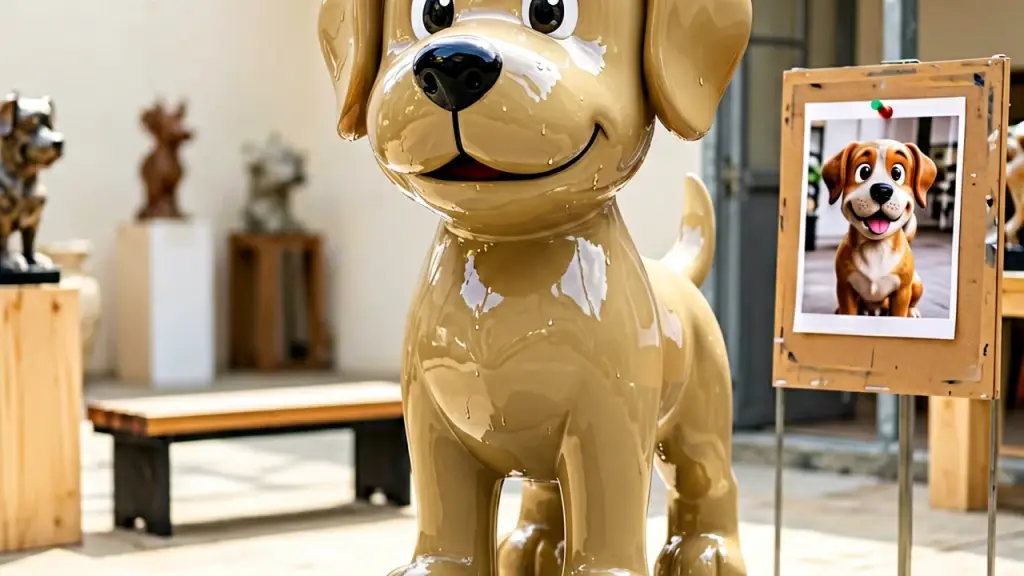
Almost every commission on this site begins with a single photograph — usually a phone snap taken years ago. The question we are asked before anything else is whether one image is really enough to build a statue from. It is, within limits we will state plainly before you pay anything. This guide walks through how a flat photograph becomes a life-size fibreglass cartoon statue in our studio, stage by stage, and what each stage asks of you.
Everything here assumes fibreglass (FRP) and a finished height of 1.5 m or more. That combination — a large cartoon figure that is faithful to its reference and still light enough to move, install and repaint — is the whole reason we work in FRP rather than bronze or stone.
What “photo to 3D model” means at our studio
Search for photo to 3D model and you will find two very different services. One is software: you upload an image and an algorithm extrudes a rough mesh, usually for a game or a 3D print, with the face and the surfaces left for someone else to fix. The other is the way a sculpture studio works from photographs — a modeller studies the image, rebuilds the subject as a three-dimensional form, and infers everything the camera could not record. We do the second.
The distinction is not pedantry. A scanned or extruded mesh knows only what the lens saw; it has no idea how the far ear sat, how the tail carried, or how deep the chest was. Those are the details that decide whether the finished statue reads as your dog or as a general-purpose dog. A human modeller working from a photograph makes those calls deliberately, and that judgement is the work you are commissioning.
Step 1 — The photo review (free, within 24 hours)
You send the photographs you have, by email or a cloud link. We read them for four things: the subject’s proportions, the surfaces (fur, fabric, gloss), the pose worth keeping, and the single most recognisable angle. Then we reply in writing, within 24 hours, with a clear answer: this is buildable, here is what we would infer, and here is what you may want to send to improve it.
What a single photograph gives us well
- The silhouette and the overall proportion — head size against body, length of leg, stance.
- Colour and marking, including the exact shade of a coat, a jersey or a collar.
- The characteristic that made you choose the image in the first place: the head tilt, the ears, the expression.
What it cannot give us on its own
- The true depth of anything. A photograph flattens a nose, a muzzle or a chest into a shape one pixel deep.
- The far side of the subject, unless the pose makes it predictable.
- Absolute scale. “Life-size” means nothing until something of known size appears beside the subject.
None of these is a deal-breaker, and a single strong photograph is a normal starting point. They are simply the decisions a modeller makes for you, in the open, rather than quietly guessing. Our companion guide on how many photos a sculpture actually needs covers what to send if you have more than one.
Step 2 — From photo to 3D model
Once the reference is settled, the subject is modelled in 3D from scratch. This is the stage that turns a two-dimensional image into something with a back, a weight and a readable pose.
Rebuilding the dimension the camera dropped
The modeller reads the front view and, where it exists, the profile, then reconstructs the volume between them: how far the muzzle projects, how the shoulders sit, how the body carries its weight on the legs. Where the photograph shows only one side, the form is mirrored and then adjusted, because almost nothing with a personality is symmetrical — one ear sits higher, the head turns slightly, the stance favours one leg.
Keeping the cartoon proportion
This is where a cartoon statue differs from a portrait bust, and where clients have the most influence. A cartoon sculpture deliberately enlarges the head, simplifies the extremities and exaggerates the one feature that carries the character. We discuss that proportion with you before modelling, because it is the decision that makes a piece charming rather than merely accurate. A statue that is one hundred per cent faithful to a photograph often reads as flat; the same statue with the head at roughly 1.4× life proportion reads instantly as the animal.
Step 3 — Your approval decides the piece
You receive a set of rendered views of the finished model from the angles that matter — front, three-quarter, profile — and this is the moment the piece is actually decided. Once you approve the model, the geometry is locked and the build begins. Up to this point changes are quick and free; after it, a change means reworking a full-size form. That is why we slow down here rather than at the end.
Step 4 — 3D model to full-size statue
The approved model is scaled up and cut as a full-size form, then finished by hand into the master shape. That master becomes a mould, and the mould is where the statue is actually born: layers of glass-fibre mat and resin are laid into it by hand, built up to the thickness the size demands, with a steel armature set inside anything tall enough to need one. FRP is chosen here for a practical reason — a 2 m fibreglass figure weighs a fraction of a comparable cast metal piece, which changes how it is delivered, installed and, if it is ever knocked, repaired. The full sequence — CAD build, moulding and hand lay-up — is set out in our guide to the fibreglass sculpture process and on our process page, and everything from 1.5 m upward sits in our life-size range.
Step 5 — Paint, gloss and the cartoon finish
Cartoon work lives or dies on the finish. The piece is primed, sanded and sealed, then painted in automotive-grade acrylic and finished in the gloss level the design calls for — a deep wet-look gloss for most characters, satin where a softer surface suits. Small details such as eyes, whiskers or stitching are painted by hand, and a UV-stable clear coat goes over everything bound for outdoors. If you are weighing this against another material, our materials page compares fibreglass, stainless steel and bronze band by band.
Step 6 — Crating, delivery and installation
The finished statue is packed in a custom crate, braced against the base rather than the surface, and shipped worldwide. Anything over roughly 2 m is usually built in two or three sections that bolt together on site around the armature; a ground anchor or plinth is supplied where the statue will stand outdoors. Installation is normally a morning’s work with two people. Larger commissions and full installation services are quoted case by case on the quote page.
How long it takes, and what it costs
A typical 1.5–2.5 m fibreglass cartoon statue runs eight to twelve weeks from approved model to crate, with the model stage itself taking one to three weeks depending on how quickly the reference is settled. Cost is driven by three things rather than by height alone: the finished size, the complexity of the pose and surface, and whether the piece is a one-off or one of a set. A single figure starts in the low thousands; a pair or a family group is quoted as one commission. We give a written figure before modelling begins, and it does not move unless you change the brief.
Before you settle on a height, it is worth reading what to expect from a life-size cartoon character statue — the size you choose changes the frame, the freight and the timeline.
Sending us your photograph
Send the original file rather than a screenshot, do not crop or filter it, and tell us the finished height you have in mind and where the statue will stand. If you have a preferred pose, or a detail that must be right, say so in the same message. That is enough for us to answer honestly about what is possible. If the subject is a dog, our guide to what to send for a custom dog statue from a photo narrows it down further. A worked example of what a finished commission looks like is in our case studies, and the pet range itself starts at cartoon pet statues.
Send one photograph and a height, and we will tell you within 24 hours whether we can build it and roughly what it will cost — free, and with no obligation to go ahead.
More from the Workshop
Ready to Start?
Send us photos and get a free, honest quote within 24 hours — no obligation.
Get a Free Quote