
Cartoon Bust — Retired Headmistress, Cut-Paper Treatment, Dublin
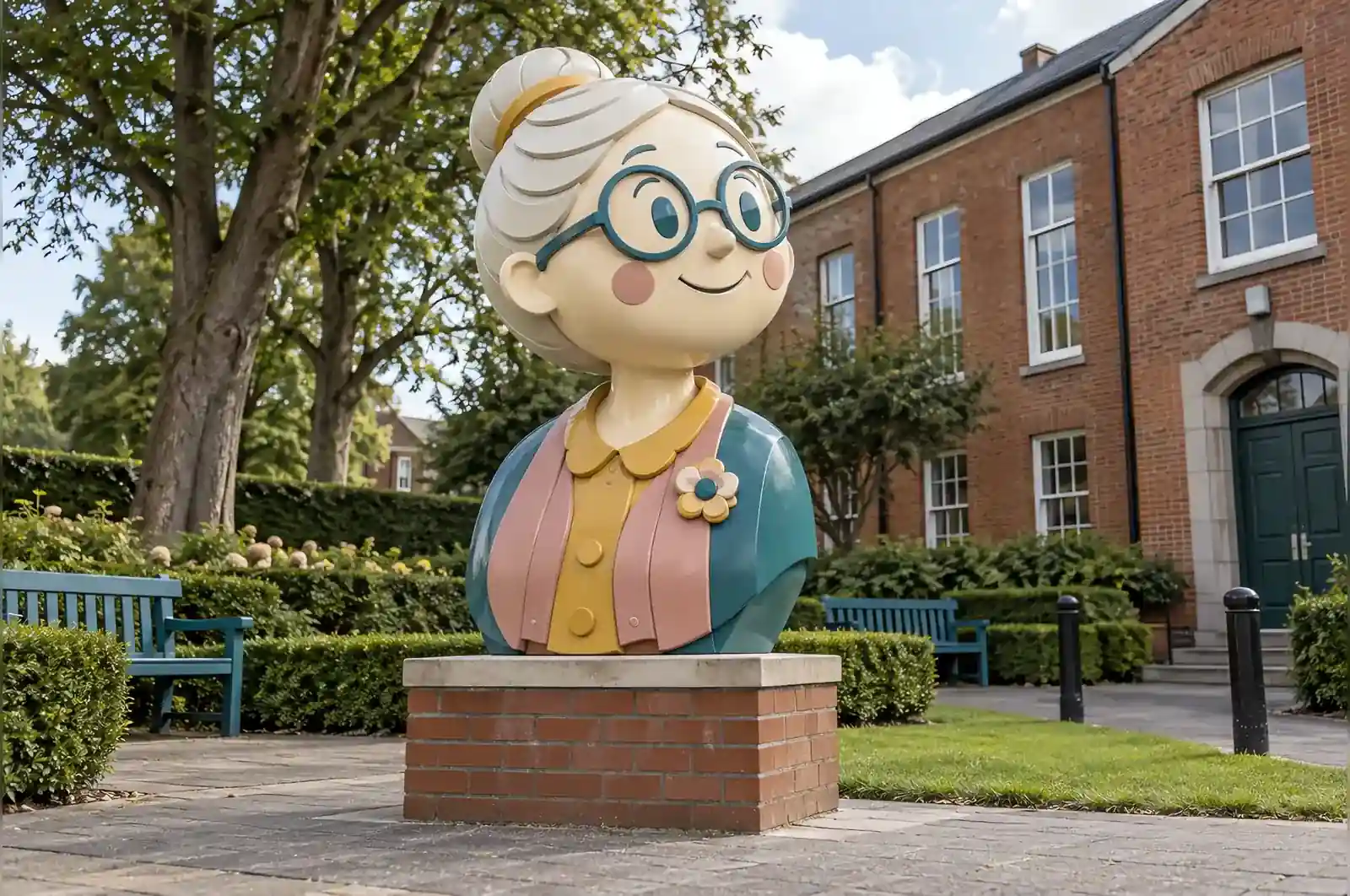


She taught at the same school for twenty-six years and ran it for eleven of them. The staff wanted a sculpture, the governors wanted nothing that would frighten the parents, and the art department had one suggestion which turned out to be right: make it out of paper.
The idea that survived
Not actual paper, obviously. The piece is fibreglass. But it is built as though each element of her had been cut from a sheet and stacked: a cream silhouette, then a dusty pink layer for the blouse, then mustard for the cardigan, then teal for the glasses and the brooch. Each layer sits about 12 mm proud of the one behind it, so the whole bust has a soft cast edge everywhere a layer ends.
Teachers work in layers. Lesson plans, marking, duty rotas, parents’ evenings, and underneath all of it a person who has been standing at the front of a room for twenty-six years. That is the piece.
Keeping it a person
Flat layers are a risk on a portrait, because a face made of flat planes stops being a face very quickly. We protected the likeness in three places and left everything else flat: the eyes are modelled in the round, the mouth is a single curved cut, and the line of the chin is the one soft edge on the whole sculpture.
Her glasses are two teal circles cut clean, with a small bridge. That was her request and it is the element that makes the piece unmistakable from across the garden.
Build
Fibreglass over a steel core, matte finish on the flat faces and a low satin on the cut edges, which reproduces the way real cut card catches light only along its edge. Five colours, and no blending anywhere.
In the school garden
It stands at the edge of the garden where she used to take her coffee, at a height of about 1.6 m so that it is level with a standing adult and above the children, which the art department insisted on. Children touch the cast edges constantly. That is holding up well, because those edges are laminate, not paint.
What could not be given up
Two things on this commission were fixed before we started, and the rest of the design had to work around them. The first was the placement. The piece stands at the edge of the garden where she used to take her coffee, which set the height at 1.6 m, level with a standing adult and above the children, because that is the height at which the staff see it and the children walk past it.
That height is not incidental. A layered bust depends on being looked at straight on, because a face built from stacked flat planes only reads when it is at eye level. If the piece had been scaled down towards child height, it would have read as a piece of play furniture rather than a portrait, and the layers would have been seen from above, where they collapse into a single shape rather than a face.
The second fixed point was the finish. The cut-paper idea only works because the flat faces are matte and the cut edges carry a low satin, so the piece catches light along its edges the way real card does, and the matte UV clear coat is what preserves that. If the whole surface had been gloss, the layers would have merged into one continuous reflection and the paper reading would have been lost.
How it holds up in a damp garden
Two details carry this piece through an Irish garden, where the weathering pressure is dampness far more than sun. The first is that every cut edge is laminate rather than paint. The layered bust presents a lip wherever a layer ends, because each layer sits about 12 mm proud of the one behind it, and a lip is exactly where a child’s hand lands. Laminate does not chip the way a painted edge does, so the touch points keep their line.
The second is the matte UV clear coat over the five colours. It is the barrier between the card-cream, dusty pink, mustard and teal and the weather. Because the surface is flat colour zones with no blending anywhere, any scuff sits on one plane and one colour, so a touch-up is a repaint of a single zone rather than a re-do of the whole bust.
The cast edges are washed by rain and handled daily. That is the honest test of a finish like this, and it is holding up because the edges are the structural laminate, not a painted surface.
What to settle before asking for a quote
Three questions decide most of a commission like this. The first is whether the piece is a portrait or a character. This is a portrait of a person who taught at the same school for twenty-six years, so the likeness had to survive the flat construction, and we protected the eyes, the mouth and the chin and left everything else flat. If a likeness is not needed, more of the surface can be layered.
The second is whether the audience will touch it. A bust in a school garden is handled every day, so the touch points had to be laminate. The same piece behind a rope in a lobby would not need that, and the finish could be lighter.
The third is height relative to the people who will stand beside it. This piece is 1.6 m so it is level with a standing adult and above the children. Settle that height before a size, because the placement decides it, and the placement decides how the layers read.
Twenty-six years of standing at the front of a room, and now I get to sit in the garden while everyone else does the work.
A primary school in Dublin, Ireland