Cartoon Bust — Founding Partner, Faux-Marble Treatment, Singapore
Firms like this one have busts. It is what they do, and the sculpture budget usually goes to a marble commission that takes two years and satisfies nobody under fifty.
What they actually wanted
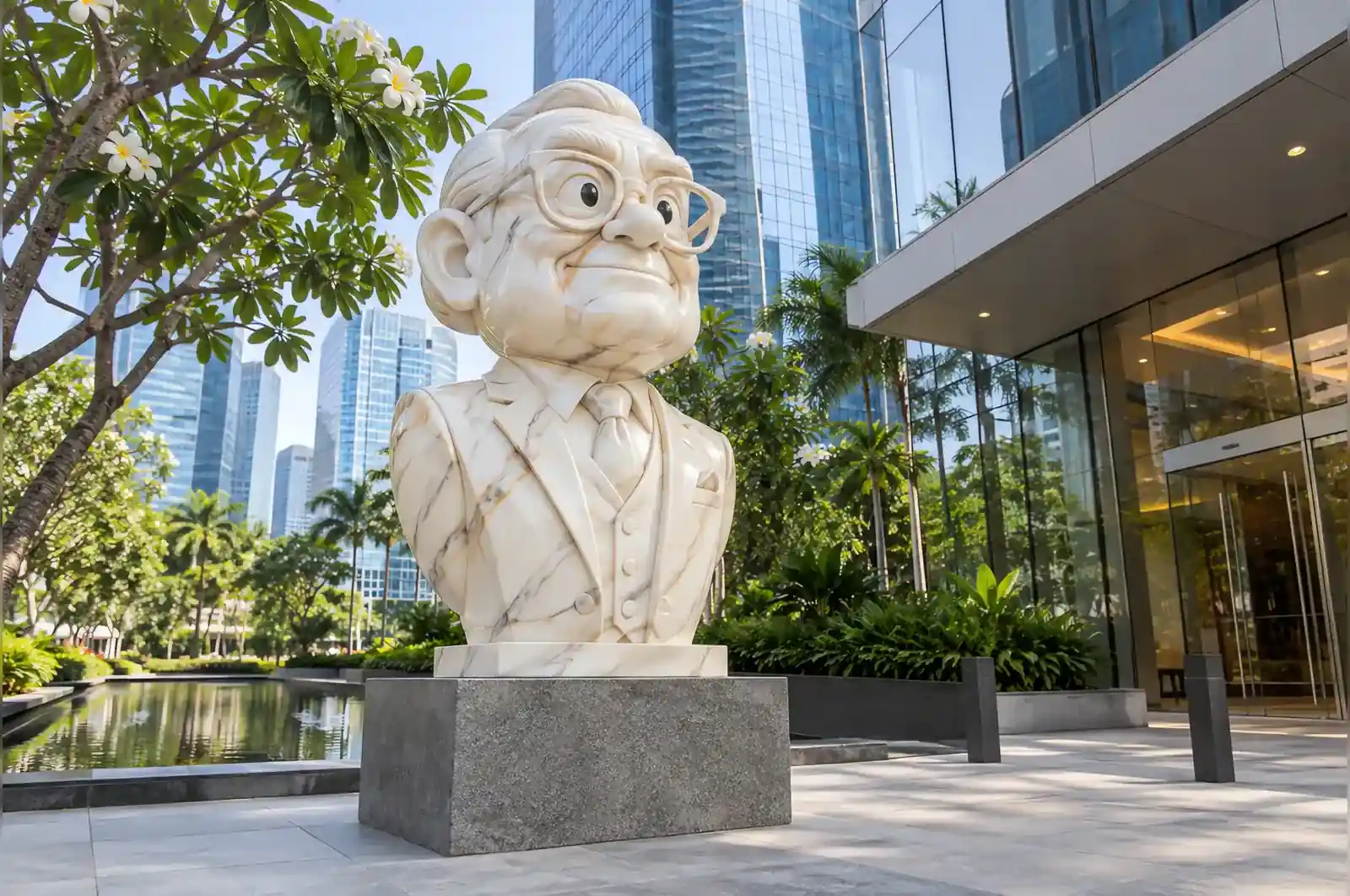
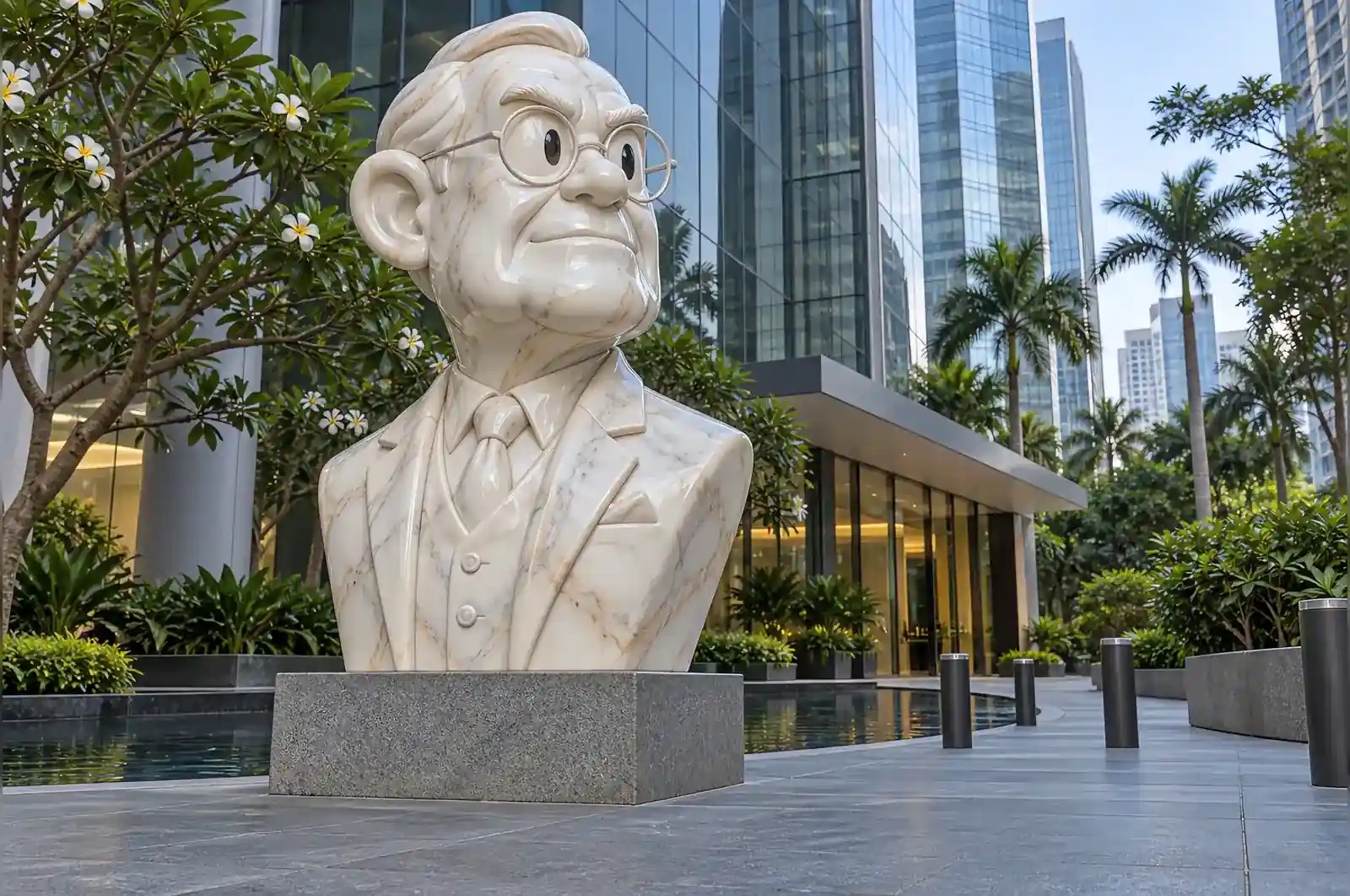
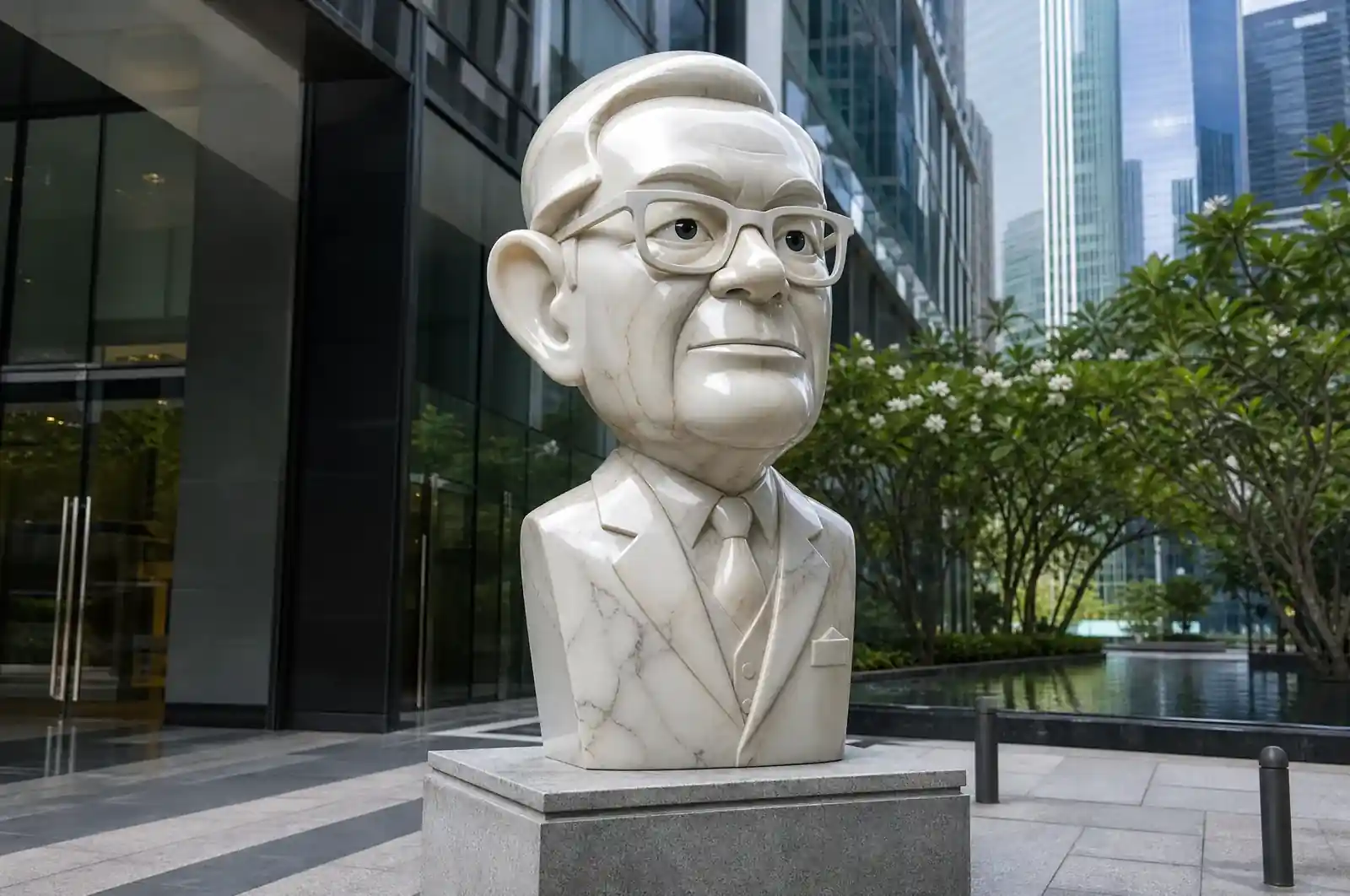
A bust of the founding partner, in the plaza outside the Singapore office, at about 1.9 m, that would read as a serious object from the road and as a clearly caricatured one from three metres. In their words: traditional from far away, human up close.
Faux marble, not marble
So it is painted to look carved. A creamy white ground with soft grey and warm umber veining, polished to a high gloss, with the vest, the tie knot and the collar cut as crisp shallow relief and the head modelled in exaggerated cartoon proportions — a large head, a strong jaw, a heavier brow than the man has, spectacles simplified into two thin ellipses.
The veining was the exacting part. It has to flow through the form rather than across it. Ours runs down the shoulders and gathers under the chin the way an actual block would, because we painted it from a scan of a real piece of Carrara and mapped the vein directions onto the geometry of the bust before laying any paint.
Why not real stone? Weight, cost and safety. A marble bust of this size is upwards of a tonne, needs a structural plinth and needs a crane every time it moves. This one is roughly 90 kg and two people can walk it on a trolley.
The one joke
There is exactly one element of caricature in the whole piece beyond the proportions: the spectacles are a fraction too wide, and their left arm sits slightly higher than the right, which is how he actually wears them. Every partner who has seen it has noticed this within a minute, and none of the clients ever will.
In the plaza
It stands on a low granite plinth at the corner of the plaza, under a canopy of frangipani, with the reflectivity of the gloss reading much stronger in Singapore’s light than it did in our workshop. In practice that means the veining almost disappears at noon and returns in full at six in the evening.
The two-distance read the plaza demanded
What this site actually fixed was the two-distance read. The plaza opens onto the street, so the piece is seen first from the road, where a 1.9 m bust is the difference between a statue and a garden ornament, and then from a few metres on the paving, where the caricature has to be unmistakable. The client’s phrase — traditional from far away, human up close — was not decoration; it was the requirement that drove the height.
If the height had been different, the rest of the design would have moved with it. At about 1.2 m the far read disappears: the exaggerated head and jaw dominate, and from the road it reads as a novelty figure rather than a bust. The finish was tied to the same constraint. The gloss is what carries the piece across the plaza, because it picks up the sky and the frangipani and tells you the object is smooth and carved; a matte paint would hold the veining all day but go flat and dead at a distance.
Had the piece been moved indoors, the whole tuning would change. In a lobby there is no noon wash-out, so the veining could be heavier and the gloss lower; the piece would be lit by fixed spots instead of the sun’s sweep, and the two-distance read would collapse into a single one. It was built for this corner of the plaza, and that is what the 14 weeks and the 90 kg were spent on.
Maintaining a painted vein under gloss
The maintenance question on this piece is the vein, not the surface. The veining is paint laid under a thick clear gloss coat, so the gloss is doing two jobs at once: it produces the polished read from the road, and it is the barrier that protects the painting beneath it. That arrangement is what the aftercare has to respect.
In Singapore’s humidity, with the frangipani overhead, the surfaces pick up a fine dust film and the occasional splash from rain, and the frangipani drops flowers. The cleaning regime is deliberately unambitious: fresh water and a soft cloth, no solvent, no abrasive pad. Any abrasive will cut through the clearcoat into the vein layer and leave a cloudy patch that cannot be touched up invisibly, because a spot repair on a high-gloss painted surface shows a colour and gloss mismatch from three metres — exactly the distance this piece is read at.
If the gloss ever dulls from UV, the correct response is not a local polish but a full re-clear in the workshop. At 90 kg on a trolley the piece can come back without a crane, which keeps that option cheap and realistic; a partial polish, by contrast, would be permanently visible. The short version is that the surface is maintained with water, and everything else is planned as a full refinish.
Settling your brief before the quote
Three things on a brief like this are worth settling before you ask for a quote, because each one changes the design rather than just the estimate.
What are the two viewing distances? This commission had to read at two distances, from the road and from three metres. If yours reads at only one, the caricature can go further and the relief can be simpler. If it needs to read at both, the proportions and the height are effectively locked in, and the design work is about balancing them.
What light does the site get, and when? In the open in Singapore the veining washes out at noon and returns at six in the evening, and the design was tuned to that cycle. Under a canopy, in a courtyard or indoors, the light is steadier and the veining and gloss need to be set for a different level.
How does the finished piece reach the site? This one is 1.9 m and 90 kg, walked on a trolley onto a low granite plinth, with no crane and no structural work. If yours is larger or heavier, access becomes a build and timeline item of its own, and it is better known before the quote than after.
Traditional from the road, human from three metres. That was the brief and they hit it precisely.
A law firm in Singapore