
Cartoon Half-Length Portrait — Hospital Founder, Portland
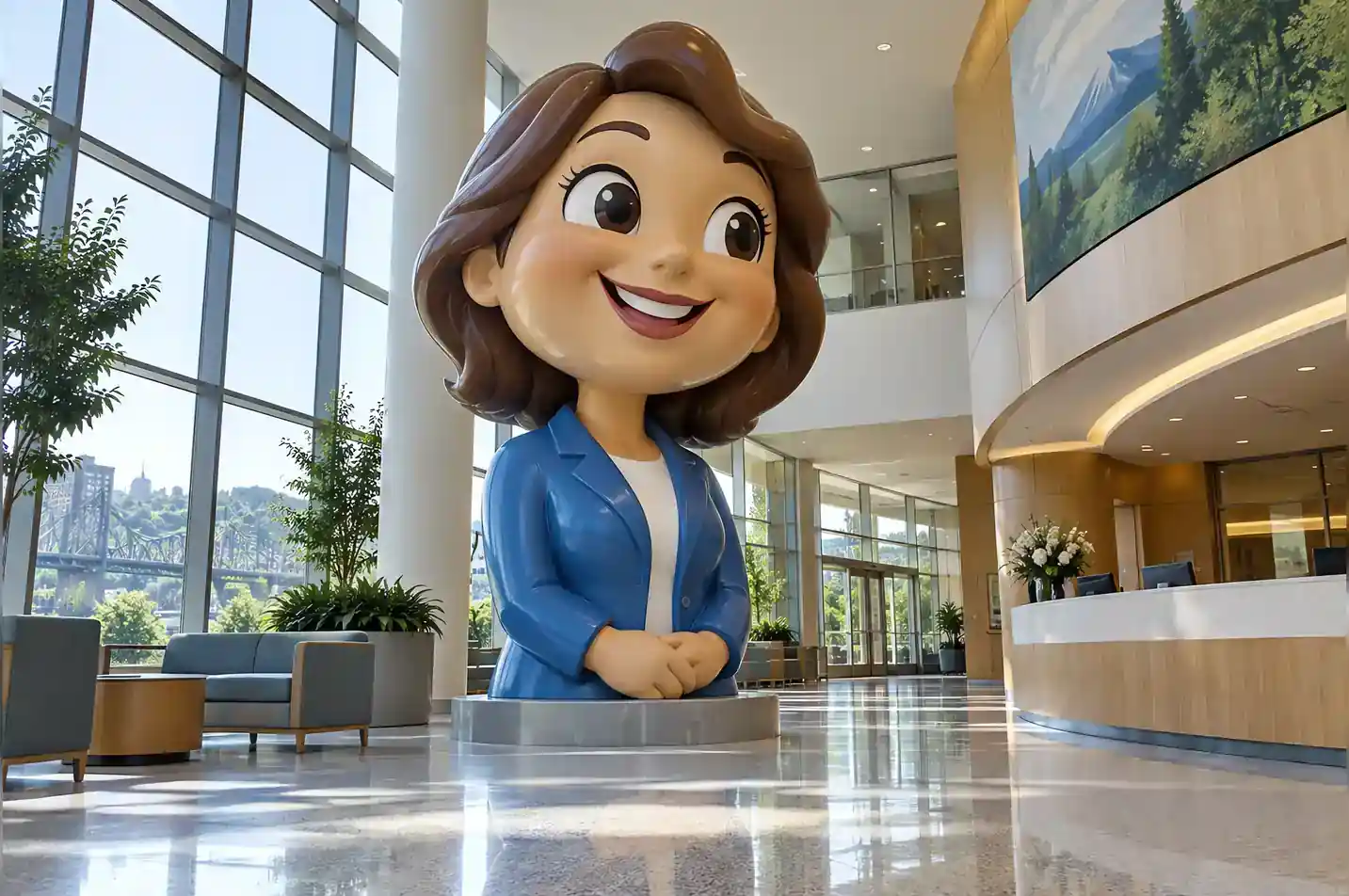
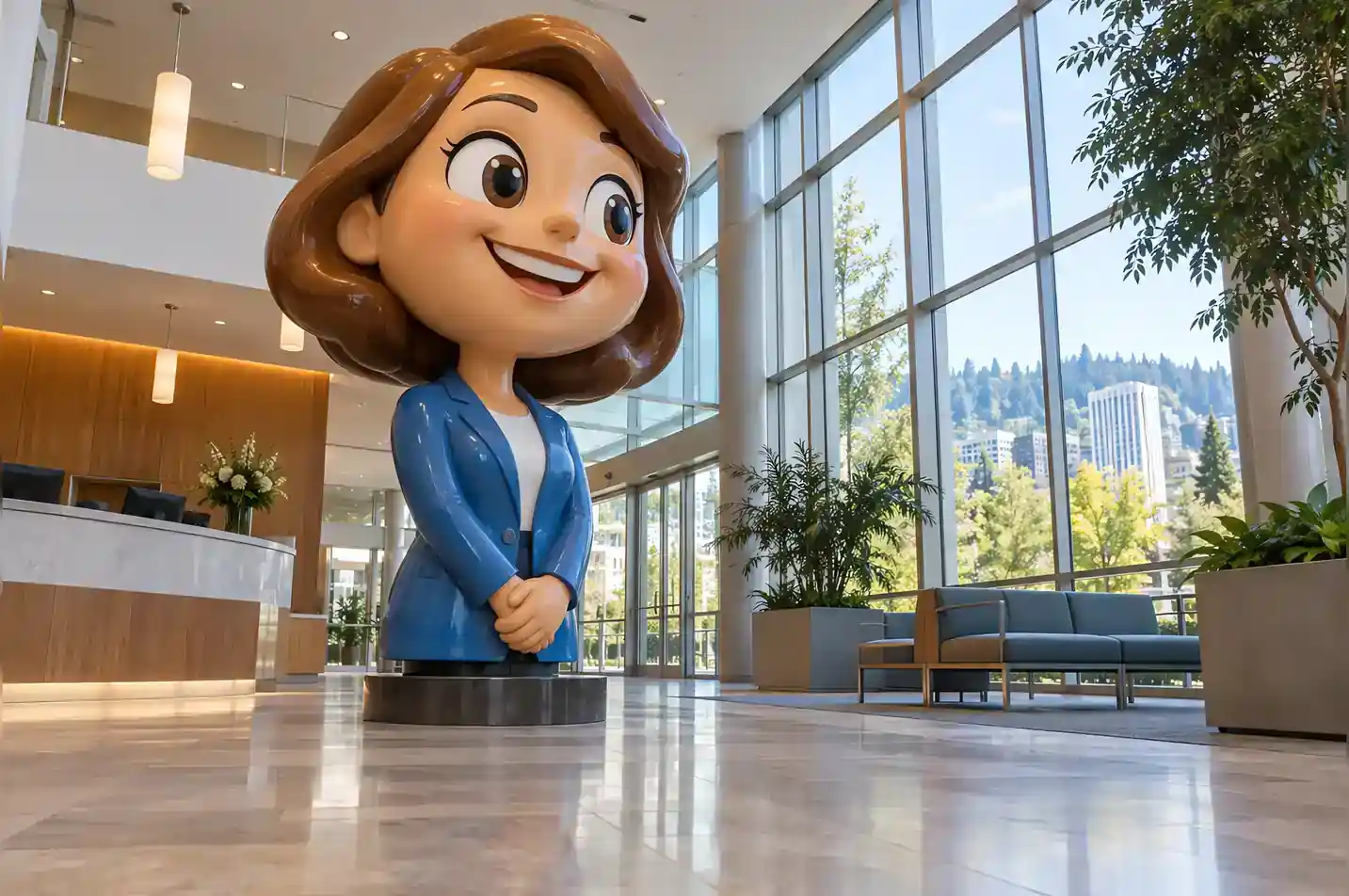

A hospital in Portland wanted to mark the woman who had founded it. A formal bronze bust had already been discussed and rejected: it did not sound like her, and the staff who had worked with her could not picture it.
What they asked for
A cartoon half-length portrait — oversized head, simplified features, still plainly her — with her hands sculpted at the base, because she talked with them. Roughly 1.8 m, for the lobby.
What was non-negotiable
The likeness was the whole brief. The staff who had worked with her had to be able to recognise her at a glance, which is what made this a portrait rather than a character figure. That decision drove everything downstream: the sculpting time, the hand-painted finish and the price.
The rejection of the bronze bust is the reason this is fibreglass rather than metal. A painted surface carries a likeness in a way a patina cannot, so once the brief was “her, recognisably”, the material was effectively settled before we quoted.
The two things that were genuinely settled early were the height and the placement. At 1.8 m the piece reads as a full presence in a lobby rather than a desk ornament, and the position just inside the main entrance was fixed because that is where visitors and staff pass her daily. Both were agreed before any clay was cut.
Had the likeness not been essential, the same commission could have been met with a more stylised figure — larger head, simpler face, no eye set to settle — which shortens the sculpting and lowers the cost considerably. Had the piece been destined for an outdoor plaza instead of a lobby, the finish would have changed, not the size: the UV clear coat would have had to be an automotive exterior grade, and in Portland’s damp climate it would still need periodic re-coating. Indoors, it is effectively sealed. Had the height dropped below roughly 1.2 m, it could have been cast as a one-piece shell with no steel armature and no on-site assembly. The 1.8 m scale is what made this a full commission with a structural core and a bolted-down installation.
Building it at full size
At 1.8 m the piece sits on a steel armature. The likeness is the whole job: we exaggerate proportion, not identity, so the eye set, the nose profile and the hairline stay faithful. The hands took as long as the face.
The oversized head is the heaviest part of the piece, so the armature runs up through the neck and into the skull to keep the mass over the base rather than cantilevered forward. The hands are sculpted at the base of the figure because that is where they sit naturally when she is resting her arms in front of her; in a half-length portrait they read as part of the pose rather than as an addition.
The finish
Hand-painted over a base coat, natural skin tones with a navy blazer, sealed under a UV clear coat. Fibreglass is the material for this: a painted face holds a likeness that a metal patina cannot, which is why realistic portraits in stainless steel cost far more and lose the likeness easily.
Installation
Assembled in the lobby and bolted to the floor, positioned just inside the main entrance. Indoor access was straightforward for a piece this size.
Looking after it in the lobby
Once indoors, the piece has a long, low-maintenance life. The multi-layer automotive paint is hard and wipe-cleanable, so the hospital’s cleaning team can keep it dust-free with a soft, damp, lint-free cloth and a pH-neutral cleaner. What it should not be given is abrasive or solvent cleaners: they dull the clear coat and leave swirl marks that are hard to lift without a full re-spray.
Inside, the UV clear coat is doing very little work. Sunlight reaches the lobby through glass, so the paint will not chalk or fade the way an outdoor sculpture does, and the natural skin tones stay stable for many years. The realistic finish is the reason for the clear coat, not the protection.
The practical maintenance is light: a quarterly wipe-down, and an annual check that the floor fixings are still tight and that the base has not been scuffed by carts or trolleys passing the entrance. Because the piece stands just inside the door, the base takes wet-foot traffic in the rainy season; it is gloss-sealed, so a wipe with a dry cloth lifts the marks without disturbing the paint. A scuff in a lobby of this kind is a touch-up, not a re-spray, and the paint system is matched so a repair blends.
What it cost
A realistic painted portrait at 1.5–2.0 m in fibreglass lands around $8,000–$15,000 once the face and hands are refined. This commission came in at $9,800 delivered, ten weeks from 3D approval.
Before you ask for a quote
If you are commissioning something similar, settle three things first. Is the likeness essential? If it is, budget for a portrait with a settled eye set and refined hands — that is where the time goes — because a character figure with a simplified face is cheaper and faster for the same size. Where will it stand, indoors or outdoors? Outdoors changes the finish specification and starts a maintenance cycle; indoors, as here, the finish is effectively permanent. And who signs off? This commission was approved by a board, so the design had to be agreed in full before any sculpting began. A single owner is faster to satisfy than a committee, and a committee may ask for a second round of refinements after the first reveal.
Answer those three and a quote is straightforward. Leave any of them open and the estimate moves while you decide.
Staff walked past the drawing for weeks before we built it. By the time it arrived there was no discussion about whether it looked like her.
The Board of St Alder Regional Hospital