Cartoon Bust — Company Founder, Pop-Art Treatment, Rotterdam
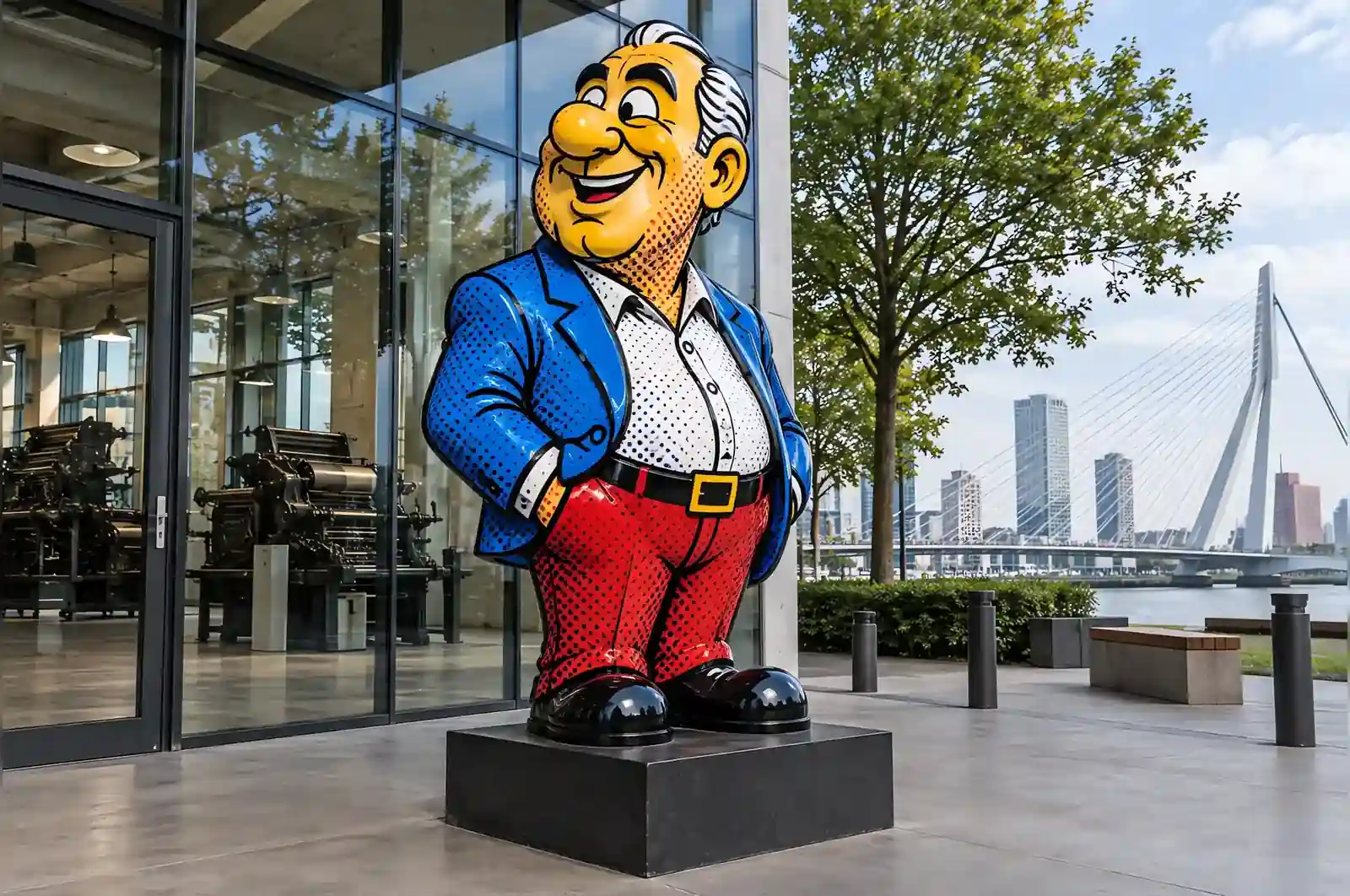
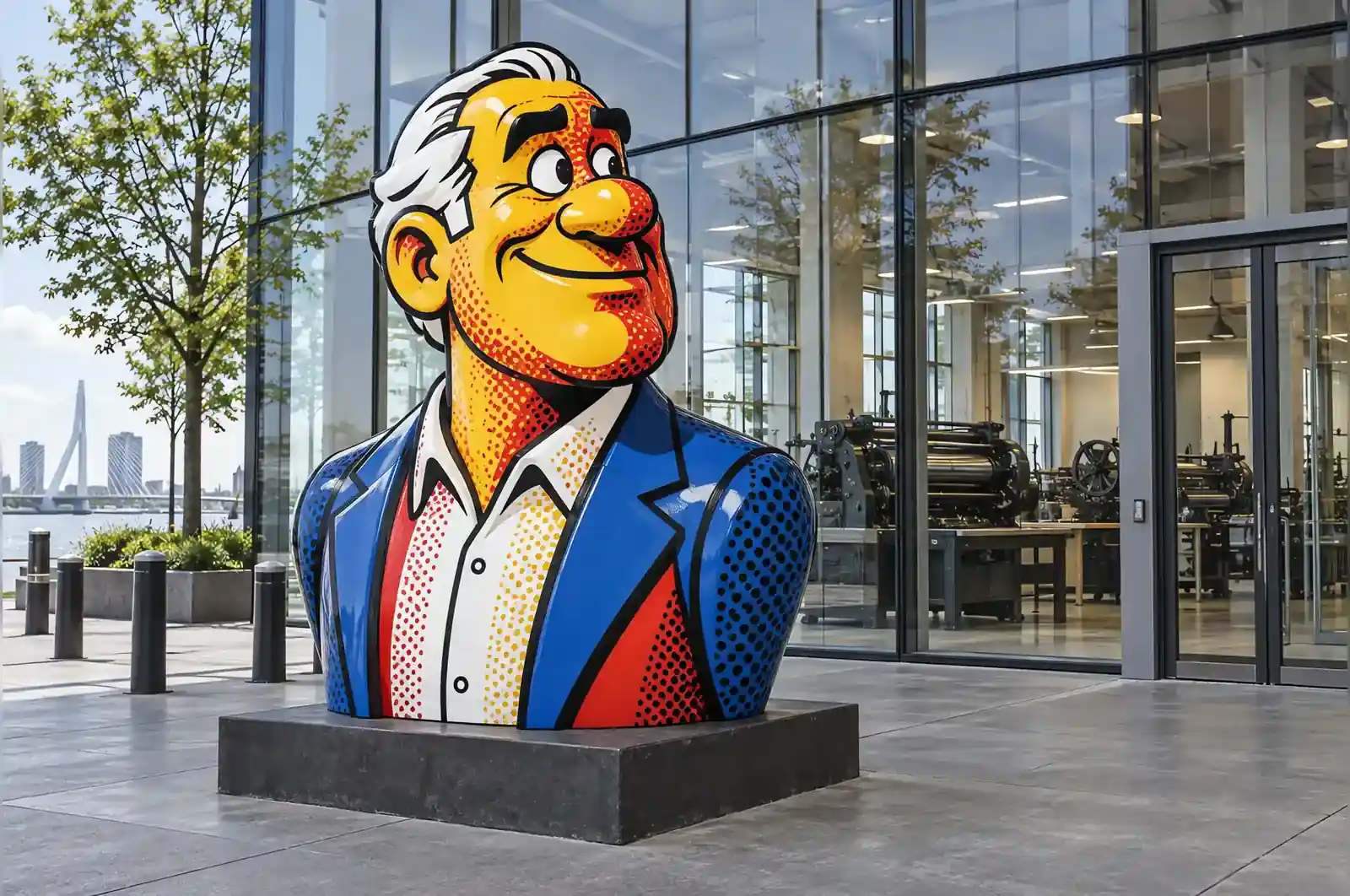
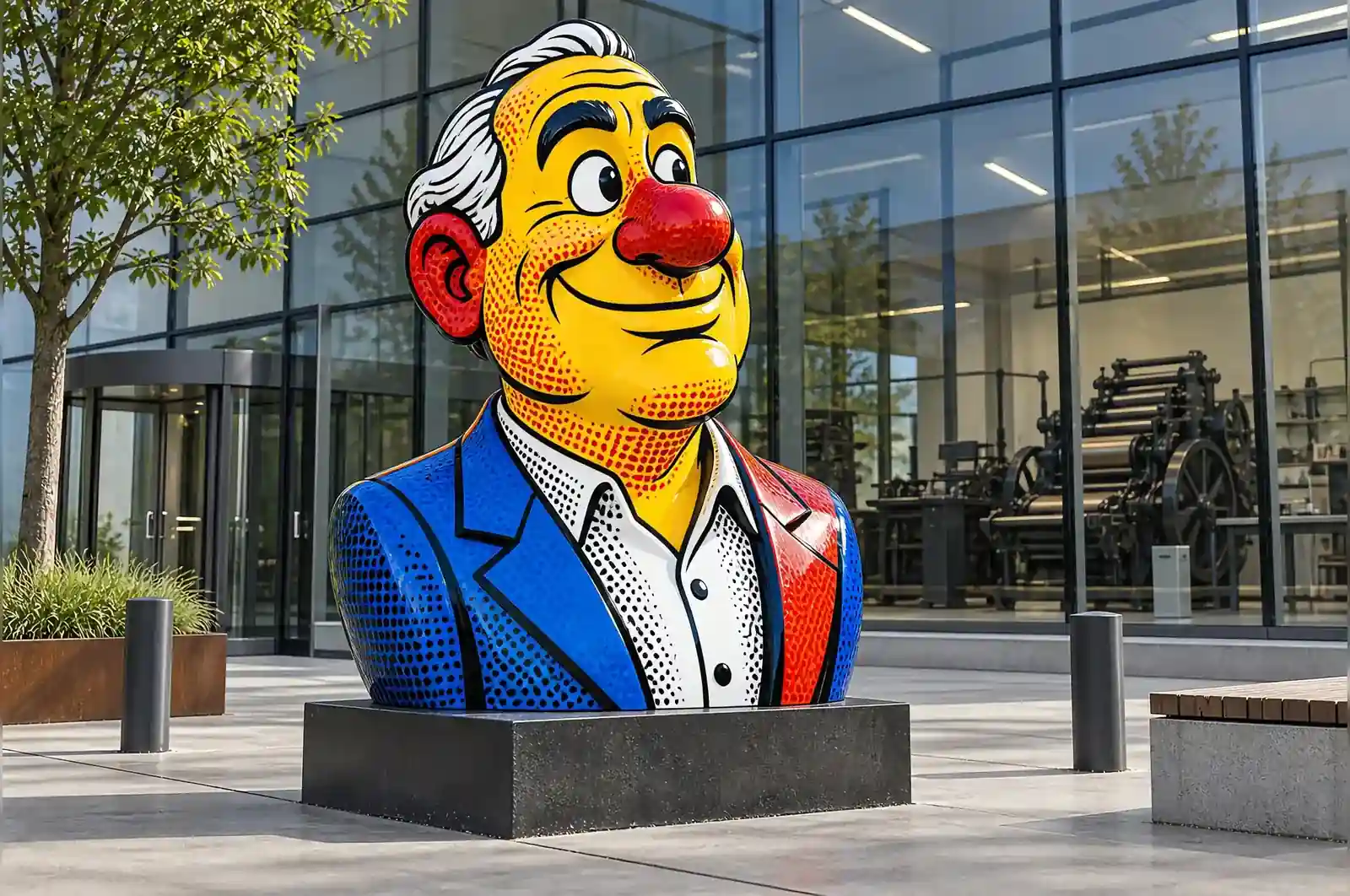
The founder retired after thirty-one years and the company wanted something other than a photograph, a clock or a bench. Their first instinct was bronze. Their second instinct, which they reached in the same meeting, was that bronze would be unbearable.
The brief
A half-length bust, about 1.7 m including the base, in the office lobby and on a plinth that could be moved to the plaza outside for events. Caricature rather than likeness — the nose and the eyebrows were named in the brief, which is how we knew the family had been consulted.
What the site demanded
The brief fixed two things at once: a bust that holds its own at 1.7 m in the office lobby, and the same piece carried out to the plaza on its plinth for events. Neither was optional, and the second is what made the first harder. A bust that lives on a movable plinth has to be stable without being bolted down, balanced at 1.7 m tall and 0.6 m wide, and finished so that a short spell of Dutch weather does not mark it.
If the plaza events had not been in the brief, the decisions would have been simpler. The piece could have been smaller, because indoors there is no crowd to read it across and no wind to rock it. The clear coat could have been dropped in favour of a plain matte, because a print finish that never leaves the lobby does not need protection from rain and UV. The plinth could have been fixed rather than movable. What the plaza bought, and what a lobby-only brief would not have justified, was the construction and the finish as built.
Choosing pop art
The man in question had run a printing business. That settled it. The bust is built in the language of a printed comic: flat primary colour across the jacket, a clean white shirt with two hard black lines for the collar, thick black contours around every form and a Ben-Day halftone dot screen for the shading on the face.
The halftone was the interesting problem. Printing artefacts are flat, and a bust is not. We kept the dot grid running at a constant angle across the whole piece rather than conforming it to the surface, exactly as it would if the sculpture had been photographed and printed. The shading is entirely a function of dot size — there is not one blended tone anywhere on the face.
Contours carry the likeness
With the modelling suppressed by the flat colour, the black lines had to do the work that shadow would normally do. The brow, the nostril, the line of the jaw and the break of the ear are all single black contours of around 8 mm, and their weight is deliberately uneven: heavier on the shadow side of the face, thinner where the light hits.
Build
Fibreglass over a steel core, gloss clear coat, on a low black plinth. The halftone is under the clear coat, so the flanks of the jacket, which people touch, will not wear through.
The clear coat and the Rotterdam climate
Rotterdam is coastal, and the plaza is open to rain, salt air and frost. That is why the halftone sits under a gloss UV-stable clear coat rather than on the surface. The coat is the part that has to carry the years, not the paint, and it is the same reason the flanks of the jacket can be handled without the dots wearing through. It is also the only surface a caretaker has to look after, and it needs the least.
On a piece that moves between lobby and plaza, the maintenance question is mostly the coat and the plinth. A wipe with a damp cloth and a mild detergent lifts the dust and the salt off the gloss without touching the halftone. Because the coat is UV-stable it does not need the regular re-spray a matte outdoor finish would; re-coating is a job measured in years, not seasons. The steel frame inside is sealed by the hand-laminated shell, so there is no exposed metal for the rain to find where it lands.
At the handover
The founder looked at it for a while and then said it looked like a screen-print of a man he used to be. The staff have since worked out that the contour of the left eyebrow is the exact angle he raises it at, which nobody has admitted to putting in the brief.
What to settle before you ask for a quote
Three questions from this commission are worth settling before a quote, because they change the build more than the modelling does.
The first is placement. A bust that stays indoors and a bust that moves out to a plaza are not the same object — the second needs a UV-stable clear coat, a balanced, movable plinth and a shell that shrugs off the weather. Decide where the piece will actually live and whether it will travel before you ask.
The second is finish. A caricature in flat colour and thick contours is a much more specific ask than a naturalistic portrait, and a halftone has to be planned at the modelling stage, not painted on later. If you want the print look, say so early; it constrains the sculpting.
The third is the likeness question. Here the family had been consulted and the nose and the eyebrows were named in the brief. A caricature has to land on the features the client cares about, and those have to be named up front — they are cheaper to ask for at the start than to adjust after the sculpt is approved.
It looks like a screen-print of the man I used to be, which is a considerably better compliment than it sounds.
A printing company in Rotterdam, Netherlands