Doodle — Crayon-Drawing Cartoon Dog, Schoolyard, Denmark
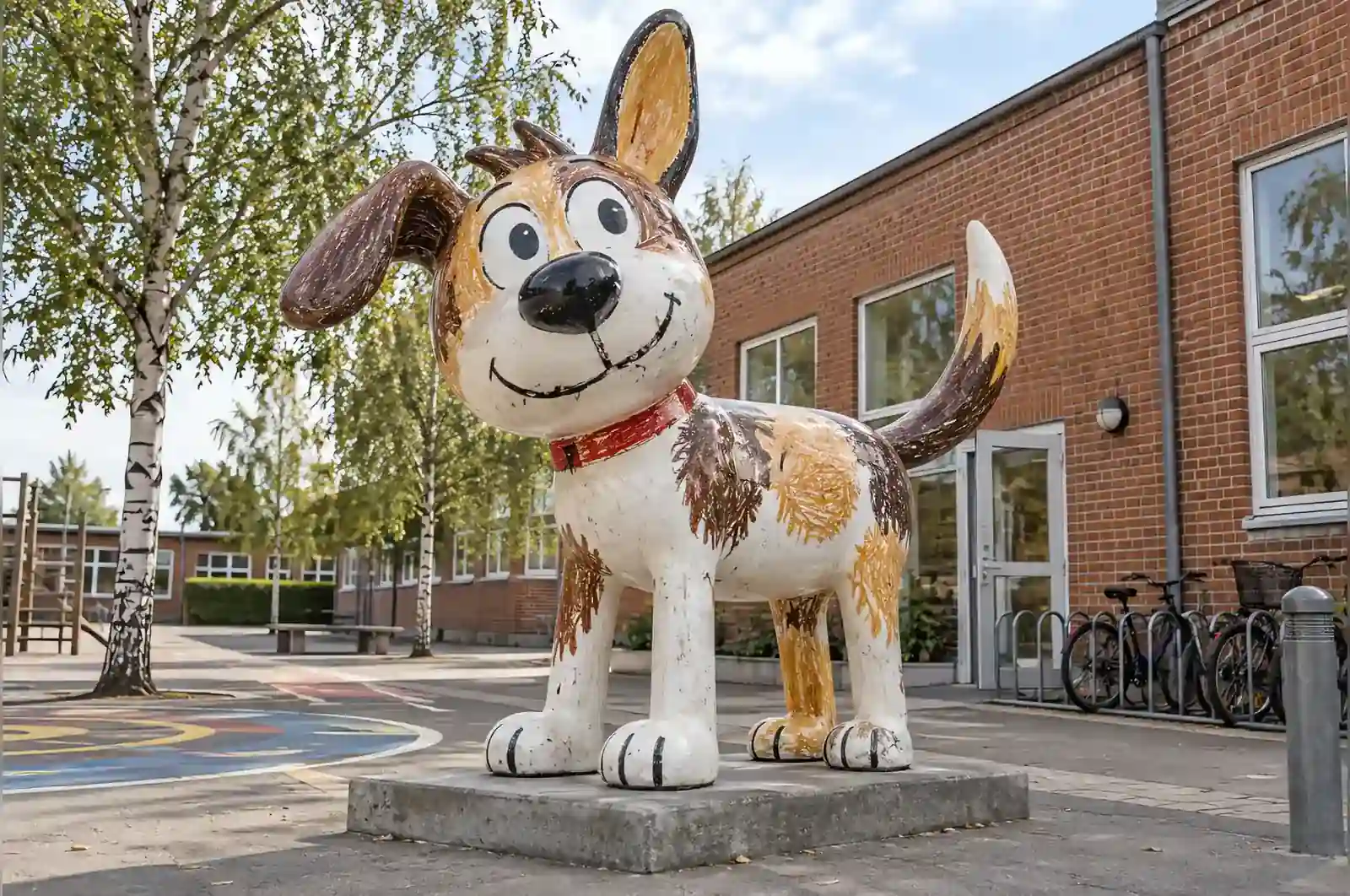
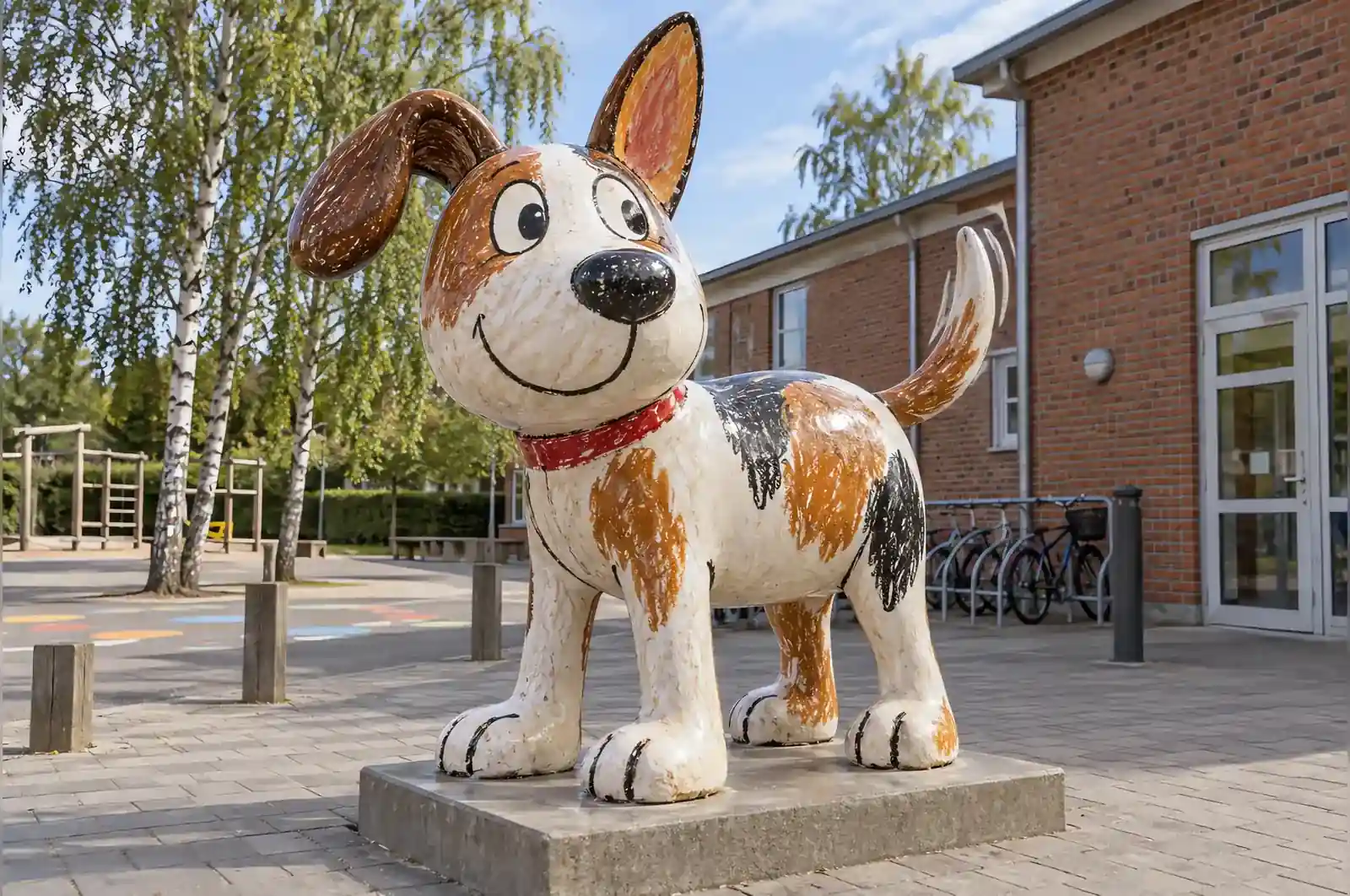
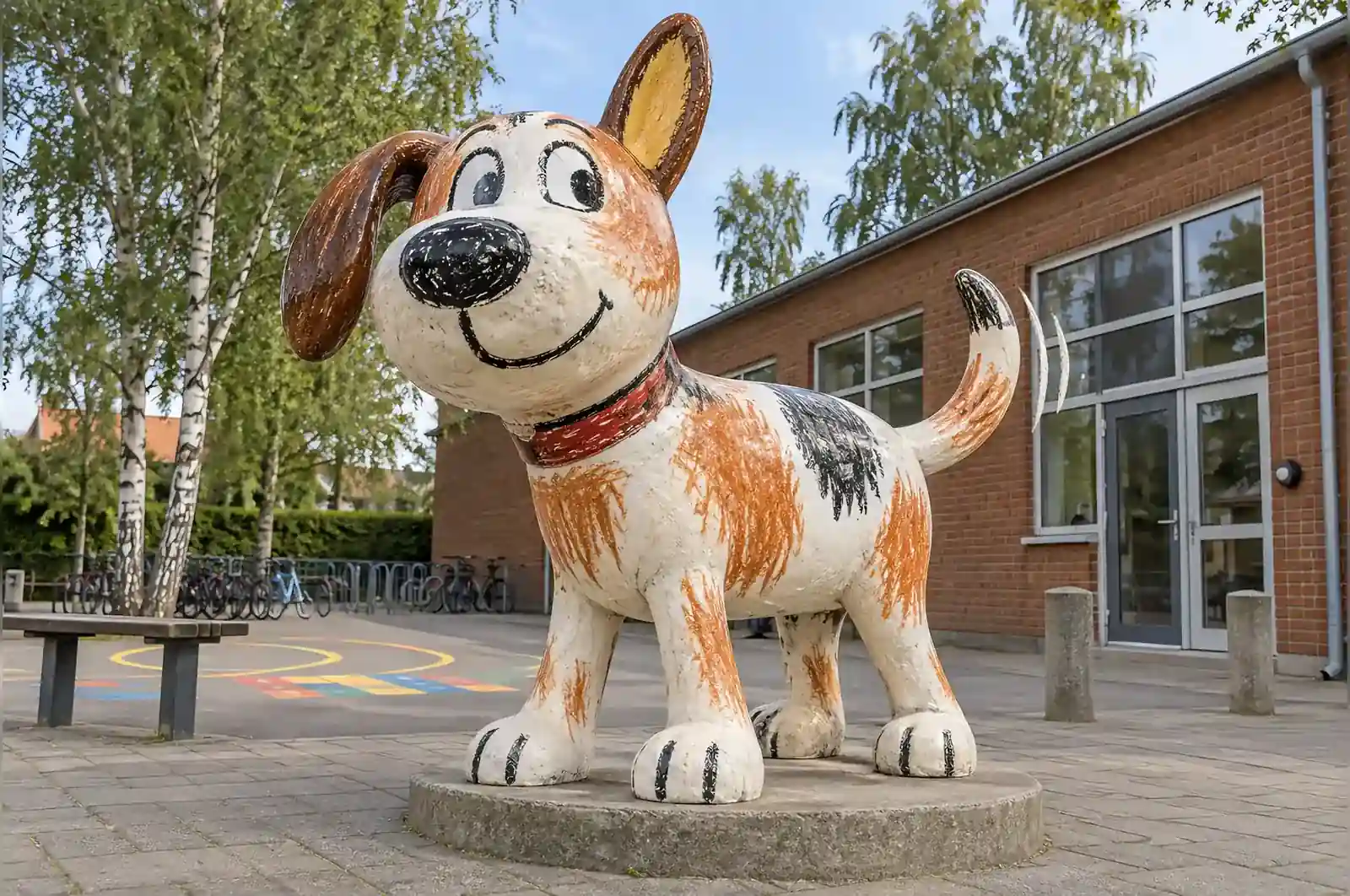
The design for this sculpture was already finished when we were called. It was a crayon drawing on A4 paper, made by a seven-year-old, of the school dog.
The decision we had to defend
The easy version of this job is to take the drawing as reference and build a clean, well-proportioned cartoon dog from it. We argued for the harder version: build the drawing itself, at 1.7 m, wobble and all. The school agreed, on the condition that it still be safe to climb, and that it still had to look like a dog from the other side of the yard.
The constraints the brief would not bend on
Two things were non-negotiable on this site, and both of them shaped the build more than the drawing did. The first was that the sculpture had to be safe to climb: it stands in a schoolyard, it is reached by children between roughly six and eleven, and the school would not accept a decorative object that could not be played on. That single requirement set the edge radii, the thickness of the tail and the steel core behind it, and the 300 mm apron of soft playground surfacing around the plinth. The second was that it had to read as a dog from the far side of the yard, not just from close up — which is why the silhouette, not the paint, carries the character.
Had either of those been relaxed, the piece would have been simpler to produce. If it had not needed to be climbable, the tail could have stayed at the thin width the drawing asked for and the edges could have been left sharper. If it had only needed to work from the front, the wobble could have been flattened into a texture on a clean form instead of being cut into the actual outline. It would have been a faster and cheaper mould, and it would have been a worse sculpture.
The size is the third fixed point. At 1.7 m the head sits above a child’s reach, so the wonky ear is the first thing a child sees rather than something at shin height, and the dog stays a landmark across the yard rather than a marker at the edge of it. Dropping the size below roughly 1.2 m would have turned it into a bollard; the drawing deserved more than that.
Turning a drawing into a form
We traced the original drawing into the 3D model as a construction guide rather than as a texture. The outline of the drawing became the actual silhouette of the sculpture — which is why one ear is noticeably bigger than the other, and why the left foreleg is thicker than the right. Those are not modelled errors. They are in the drawing.
The colour fill was the difficult part. A child’s crayon stops short of the outline in places and presses harder in others, leaving the paper visible through the wax. We reproduced that with a deliberately uneven paint lay-down over a warm-white ground, keeping the margin at the edge.
Build, edges and safety
Fibreglass over a steel core, satin clear coat so the wax texture reads without glare. Every edge was radiused to a minimum of 8 mm, the tail was thickened beyond what the drawing asked for, and the plinth was given a 300 mm apron of soft playground surfacing. It is climbed on constantly.
Maintaining the crayon finish outdoors
The finish is a hand-laminated FRP shell, gloss-painted and then sealed under a satin UV clear coat. Its real enemy is not the Danish weather — wet winters and freeze-thaw cycles sit well within what a UV-stable satin coat handles — but abrasion from climbing. Hands and shoes do more damage in a year than the climate does in five.
That is why the edges were radiused to 8 mm rather than left as paint lines: a hard edge is where a coat chips first, and once it chips the exposed fibreglass wicks water in. The thickened tail is the same decision — it is the point a child grabs to pull up, so it gets the most load and the most wear, and it was built accordingly.
Maintenance is straightforward. The shell is wiped down with a soft cloth and mild soap once or twice a year, and inspected each spring for the dulling or chipping that winter grit can leave. Because the colour is a warm-white ground with an uneven lay-down rather than a flat block, a local repair is blended in place rather than repainted as a patch, so a touch-up reads as part of the drawing instead of a correction to it. The satin coat can be refreshed in situ when the sheen dulls, without taking the piece down.
After a year
The wobbles have turned out to be the point. Children who would not look twice at a correct dog sculpture will stand and point at the wonky ear, because they have drawn that ear themselves. It has become a landmark for the school in a way a well-proportioned statue would not have been.
What this means for your own brief
Before asking for a quote on something similar, settle three questions. First, will the sculpture be climbed on? This decides the edge radii, the gauge of the steel core and whether the plinth needs soft surfacing — the single largest driver of cost and tooling. Second, is the drawing to be reproduced as the object, or merely the inspiration for it? Reproducing it means the wobble is cut into the silhouette itself, which is more tooling and a slower mould; using it as inspiration means a clean form with the drawing applied as a finish, which is faster and cheaper but loses the thing that made this piece work. Third, is it indoors or out? An outdoor commission in a wet climate needs the UV-stable satin clear coat and the radiused edges; an indoor one can carry a softer sheen and a lighter structure.
It is our own drawing. The children recognise the wobbly line before they recognise the dog, and then they cannot quite believe it is real.
A primary school in Copenhagen, Denmark