Momo — Kaiju-Toy Cartoon Cat, Designer Store, Los Angeles
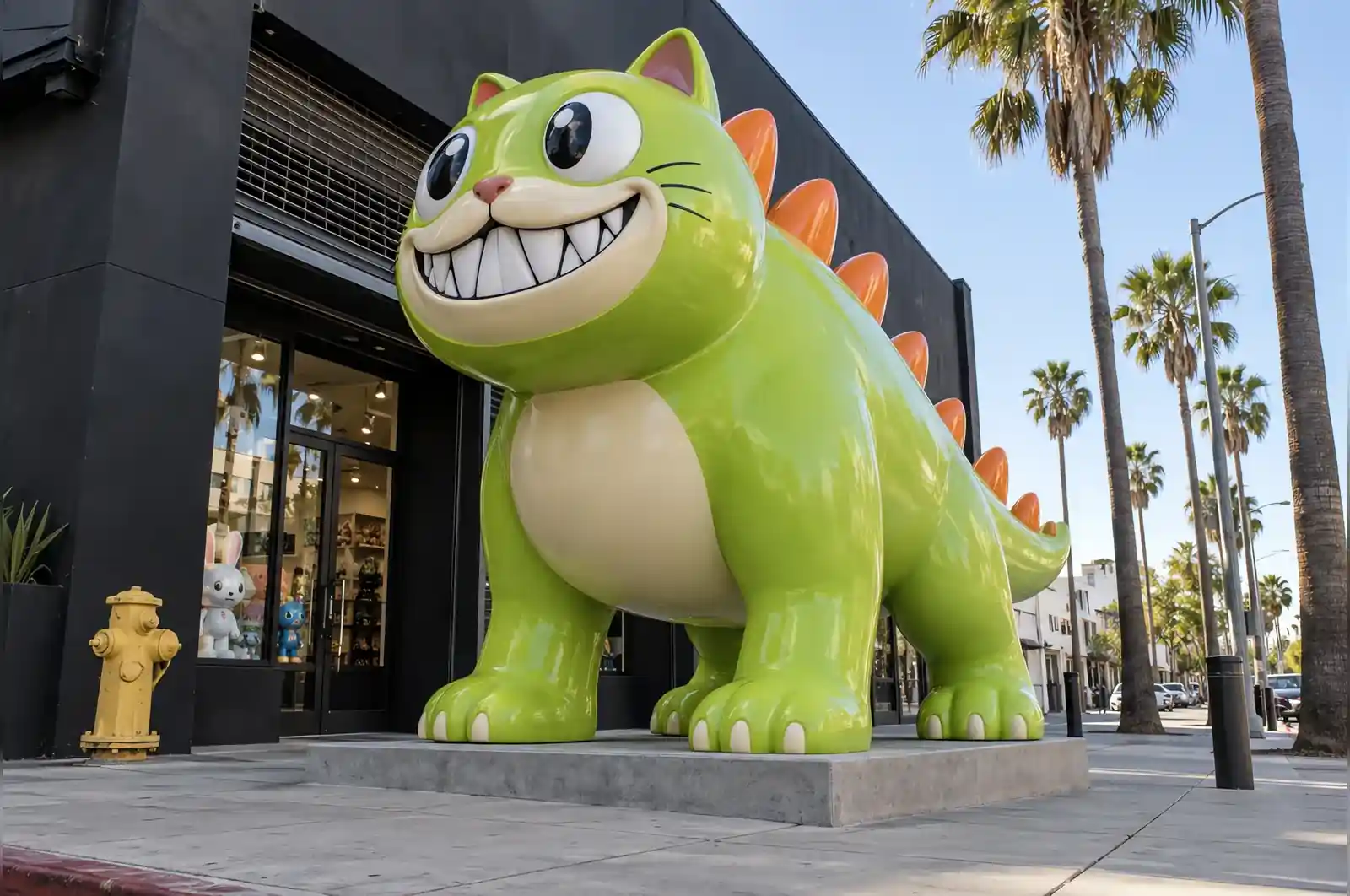
This store sells small plastic monsters to adults, and it has been doing so since before that was a respectable way to spend money. The owner wanted one large monster, outside, that would be the same joke told at a different volume.
The brief
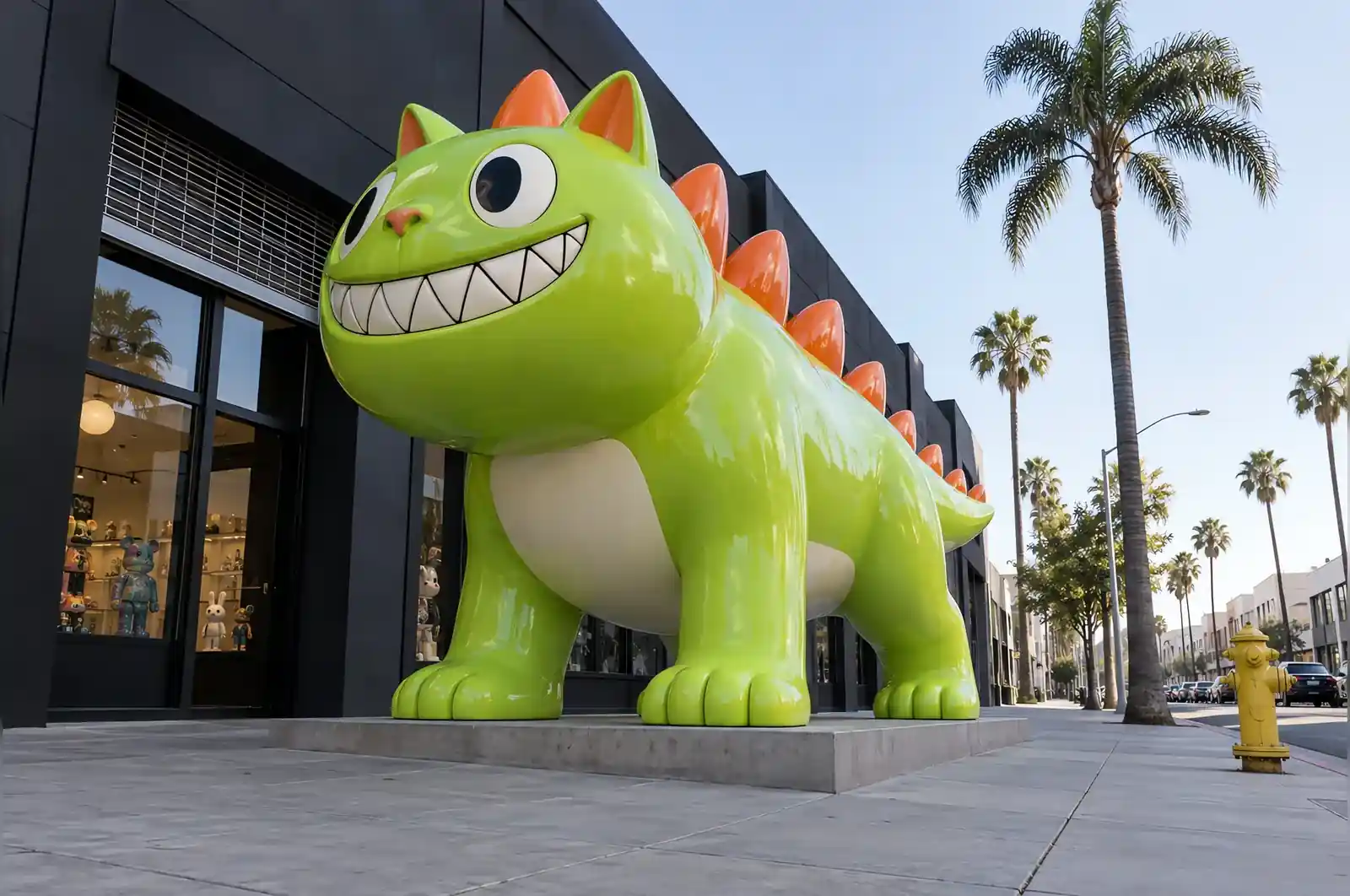
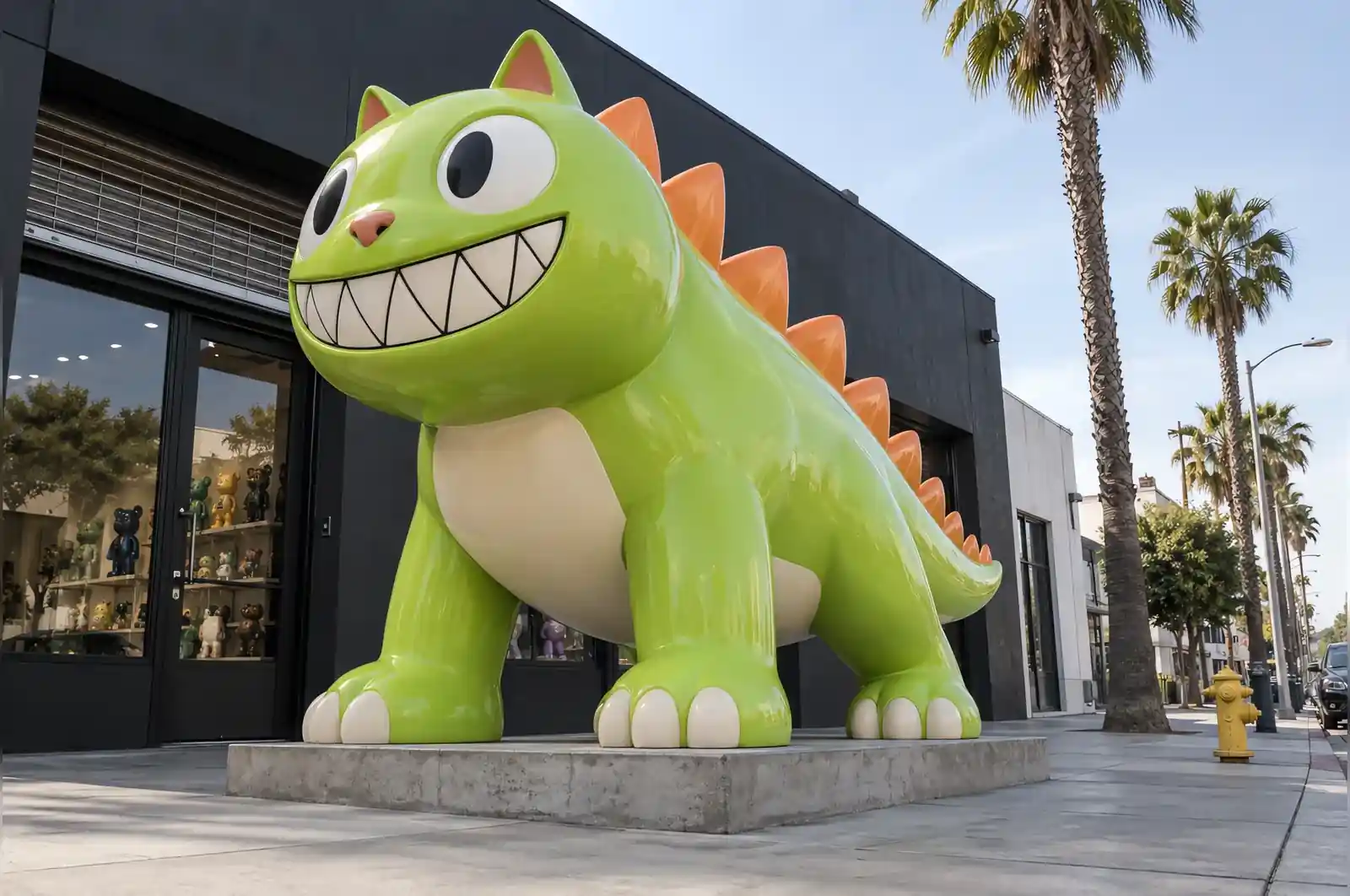
A cat, because he has one. But built using the design grammar of a Japanese monster toy: heavy planted stance, spiky dorsal plates, a mouth full of blunt triangular teeth and a grin that has no business on a cat.
Toy grammar at architectural scale
Designer monsters are built to be legible in a hand. Scale one up to 2.8 m without changing anything else and it becomes dull, because the eye can suddenly see all the detailing it could not see before. So the detailing was removed.
The plates along the spine number seven, all the same simple spiked profile, diminishing front to back at a fixed rate. The teeth are eleven shapes, each a blunt triangle with no variation. The eyes are two perfect circles with no pupils in them at all. There is no fur, no whiskers, no claw detail and no pattern anywhere. Everything the piece has to say it says with silhouette.
The annoying engineering
The stance was the hard part. A wide four-legged stance with a heavy body wants to sag in the middle, and fibreglass over a steel frame will sag if the frame is not carrying the load properly. The armature runs a spine rail the length of the body, with a diagonal brace down each leg, and the belly is a separate laminated panel bonded on afterwards so the underside stays flat.
Colour
Lime green body, orange plates, cream belly. These are the colours of the first toy the owner ever collected, and there was no discussion about them.
What the storefront fixed
Most of the decisions on a commission like this are negotiable. Three were not, and they all came from the placement rather than the design. The first was that the piece had to read from the pavement: at 2.8 m high and 1.4 m wide on a store frontage, a passer-by gets one glance from the street and maybe a second from the doorway, so the silhouette had to do the work before the colour was ever seen. The second was that it had to stand in front of the shop, not beside it, because it is the landmark that makes the address legible. The third was that it had to survive being looked at all day, every day, by people who are not there to buy anything.
Had any of those three not held, the piece would have been different. If it were an interior piece, it could have carried the fur, whiskers and claw detail that were deliberately stripped out here, because an indoor audience gets close enough to read fine detail. If it were set back into a plaza rather than on the frontage, the stance could have been relaxed into something more natural and less planted. And if the finish were not a glossy vinyl-like surface, it would not have caught the low ground-level lighting the way it does after dark, which is what makes the big green cat read as a toy at night rather than as a statue.
Keeping the gloss in a Los Angeles summer
The finish is the part that needs attention over time, and the climate in Los Angeles is a demanding one for it. The surface is a glossy, vinyl-like paint with a UV-stable clear coat on top, which is the reason the lime green and the orange plates will not chalk or wash out under the sun they get on a south-facing frontage. The clear coat is what the owner is protecting; the colour underneath is sealed by it, and once it is damaged the colour goes with it.
At 2.8 m, a maintenance coat is an in-place job. The clear coat can be re-applied with the piece standing on the sub-frame, without lifting it off the frontage, and the whole surface is reachable from a small scaffold or a platform lift. What needs routine attention is the gloss itself: on a high-gloss surface, bird droppings and tree sap should be cleaned off promptly, because they etch into the coat if they are left in the sun, and that is the one way this finish gets permanent marks. The steel sub-frame bolts under the concrete should be checked for tightness at the same time, since the piece is a fixed, bolted object and a loose fastening is a safety issue rather than a cosmetic one.
Before you ask for a quote
If you are commissioning something similar, settle these questions first, because each one changes the price and the lead time more than you would expect. The first is what the piece has to say from the distance it will actually be seen from. If that distance is the far side of a street, brief the silhouette and not the details; the details will be invisible and you will be paying for them anyway. The second is how close people are allowed to get. A piece at a store frontage is touched, photographed and leaned on, which argues for the gloss finish and the rounded forms used here, while a piece behind a barrier can carry much finer surface work. The third is where the sun will hit it at its worst hour of the day, because that decides whether you need a UV-stable clear coat and a light colour scheme, or whether a darker, satin finish will do.
Once those three are answered, the rest is a build question: the stance, the armature and the laminate schedule are what the thirteen weeks from 3D approval were spent on here, and none of them are things you can change halfway through without paying for it twice.
We sell toys for a living. Now we have one outside that is bigger than the store and nobody can buy it.
A designer toy store in Los Angeles, California