Tilly — Cartoon Cat for a Café Courtyard, Melbourne
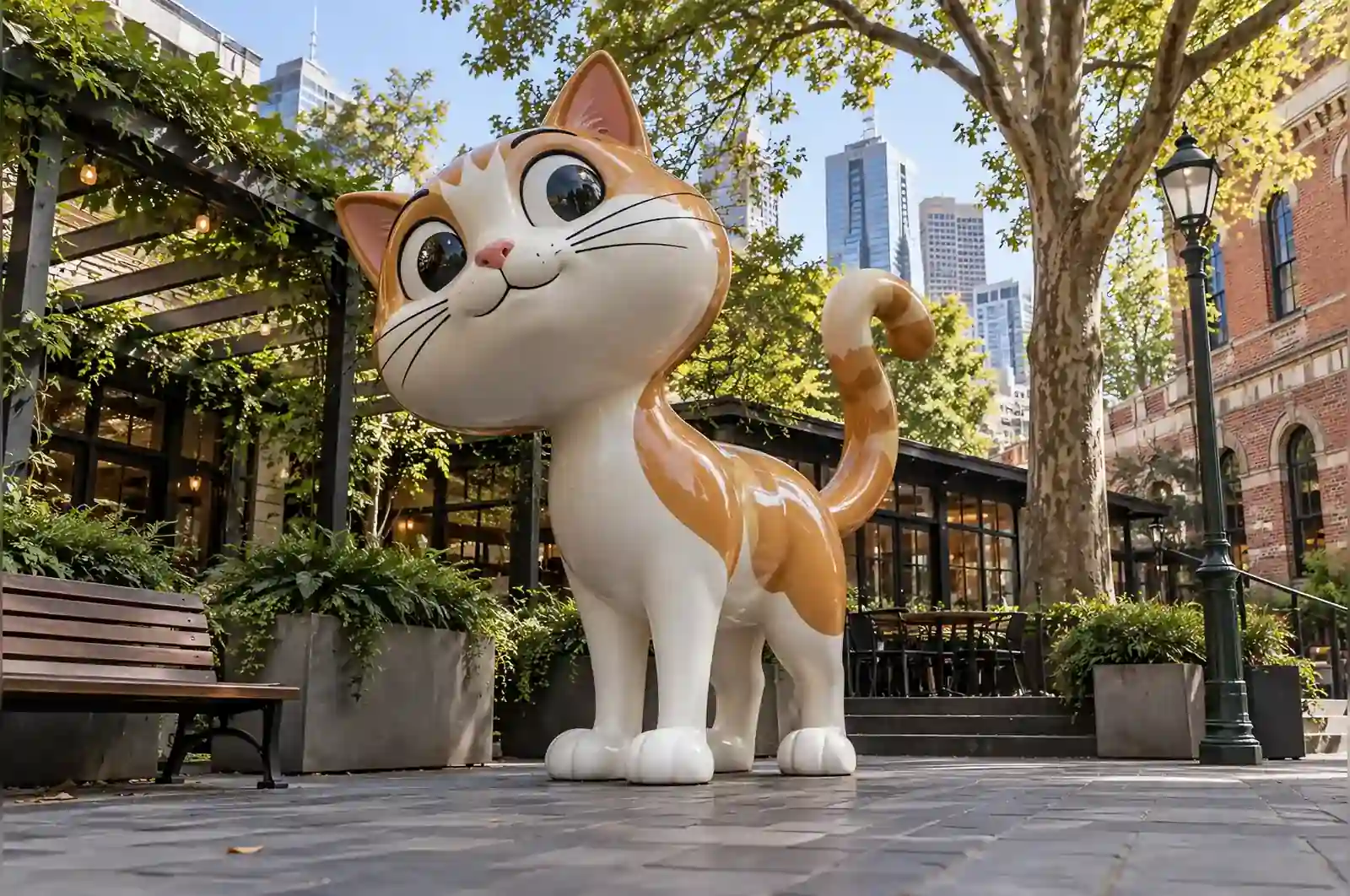
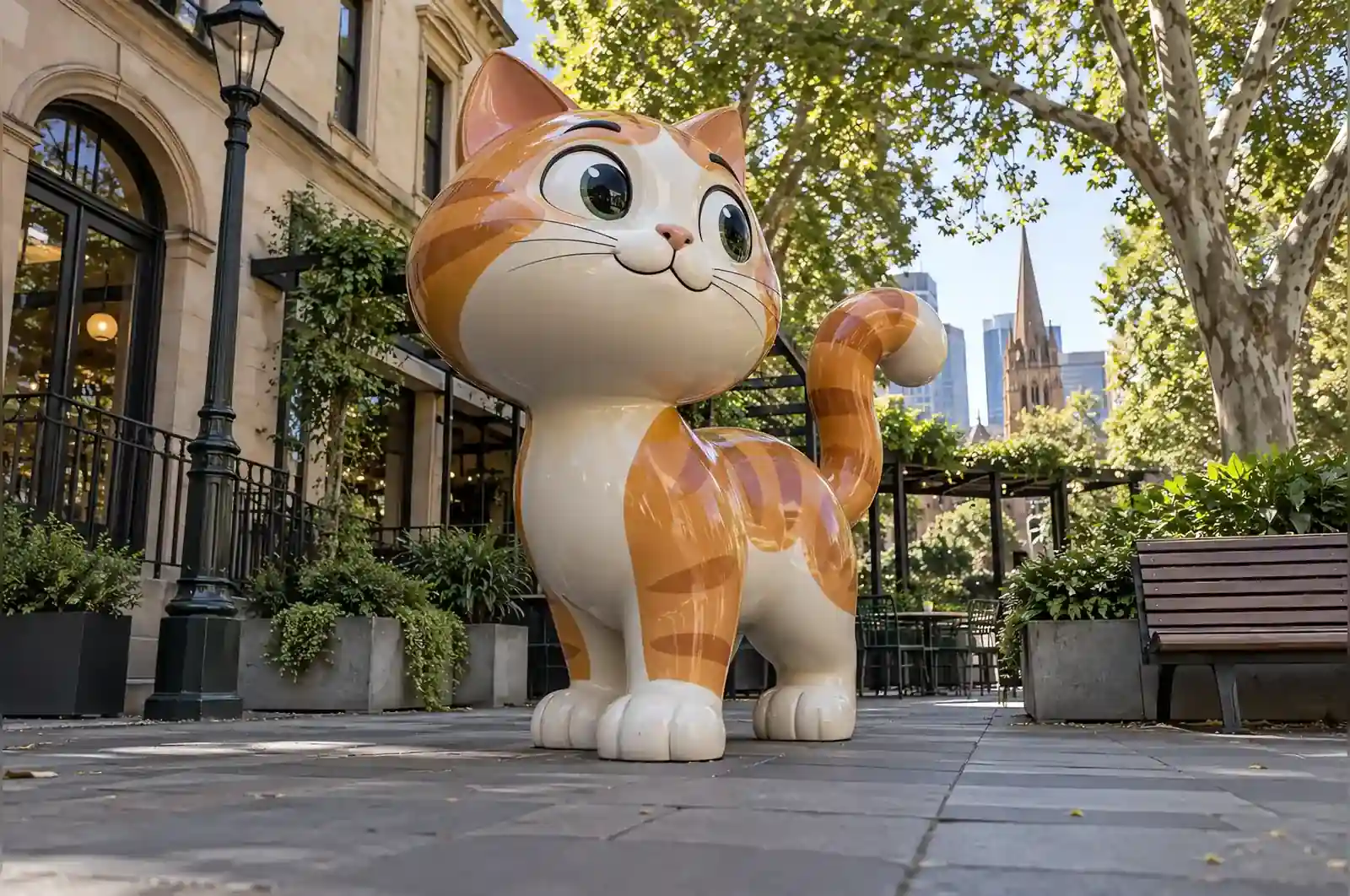
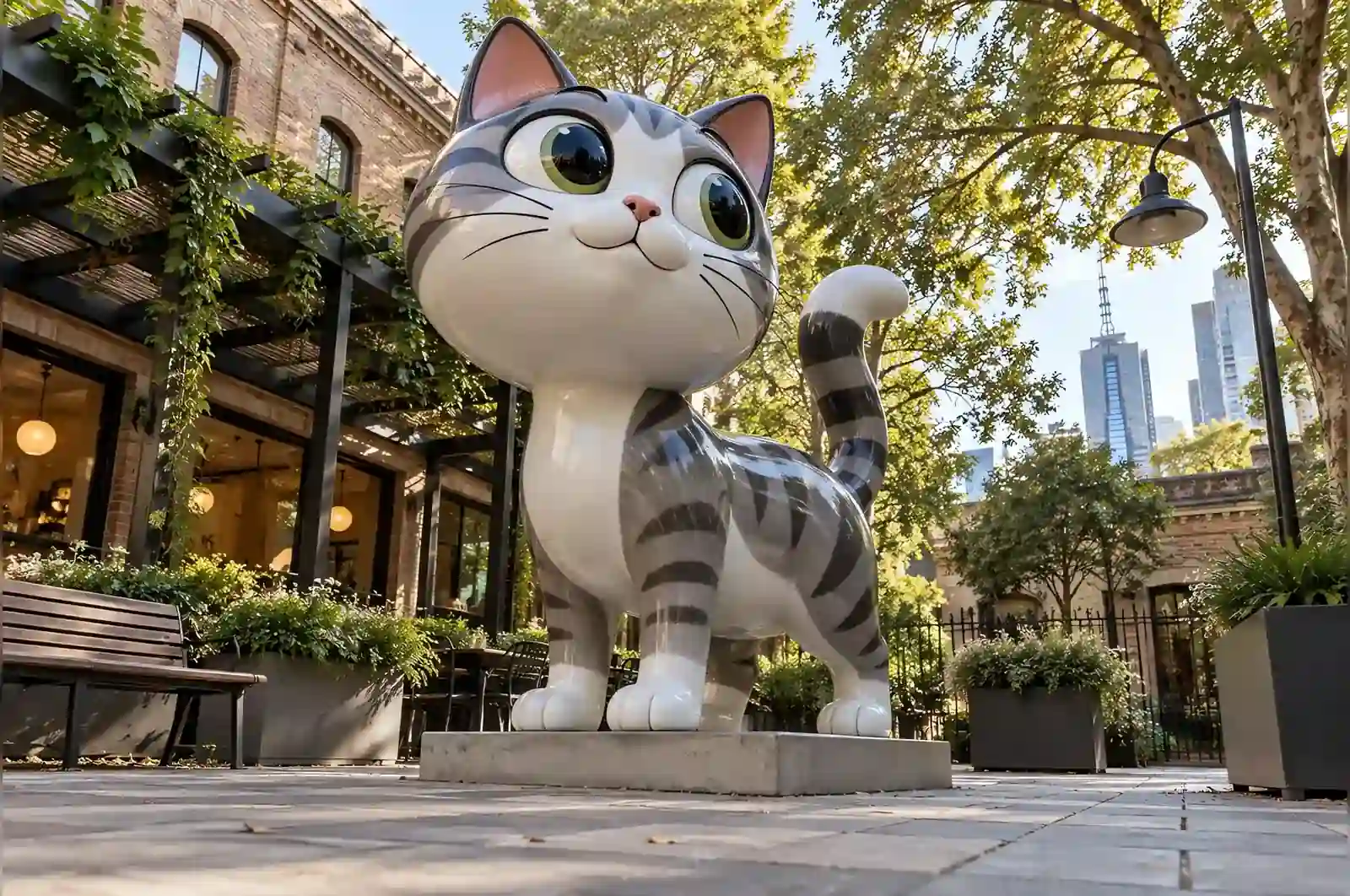
Tilly had spent nine years asleep under the same pergola at the back of a Melbourne café. When she died, the owner wanted her back in that spot — at a size the regulars would notice.
What they asked for
A cartoon version, roughly one and a half metres, sitting or curled. The brief was specific about tone: friendly and funny, not a memorial. They wanted people to smile at it.
Building it at full size
At 1.6 m the piece carries an internal steel frame, which is what lets it stand in a courtyard without footings. The head was exaggerated well beyond cat proportion and the body kept chunky, which is what stops a sculpture this size reading as a garden ornament.
The finish
Gloss-painted fibreglass: multi-layer automotive paint with the tabby bands hand-painted rather than airbrushed, so the pattern keeps a drawn quality up close. Sealed under a UV clear coat for 15–20 years outdoors.
What was non-negotiable for the courtyard
Two things were fixed before the design started, and both came from the site rather than the cat. The first was the spot. The owner did not want Tilly at the entrance or in a display window; she wanted her under the pergola, on the paving slab the original had slept beside. That ruled out any sculpture needing footings or a prepared foundation, and it is the reason the frame is steel and the base bolts flat to the slab rather than sinking in.
The second was presence. The courtyard is open to the street through a low wall, so a tabletop piece would have been lost. At 1.6 m the figure sits above table height and clears the wall line, which is what gives it the “there is a cat here” moment from the pavement.
Had either been different, the commission changes shape quickly. Indoors — say on a shelf in the café itself — it would have run 0.5–0.7 m on a light armature, no UV clear coat, and a meaningfully lower price. At the street edge, exposed to wind and passers-by, the anchoring would have been heavier and the finish would have needed a tougher top coat against knocks. And if the brief had been a memorial rather than a cartoon, the hand-painted tabby detail would have given way to a quieter, more naturalistic finish. None of those were what the owner wanted; the courtyard cat is the courtyard cat.
How it is looked after
In Melbourne the finish does most of the work. The city has long, dry summers and cool, wet winters, so the two things a piece like this actually faces are UV and rain, in that order. The UV clear coat is the protection against the first; the gloss automotive paint is what stops the second from soaking into the fibreglass. Because the tabby bands sit underneath that clear coat, they never need repainting — the pattern is sealed in, not painted on top.
Maintenance is therefore routine rather than specialist. The smooth gloss means the figure just gets hosed down with plain water and a soft cloth when the courtyard is washed, which removes the dust and leaf matter that collect on the back and shoulders under a pergola. Once a year, whoever runs the café checks the clear coat for chips — a graze from a chair leg or a delivery trolley is the likely culprit, not weather. A small touch-up of clear over the damaged spot closes it again, and the 15–20-year outdoor life is measured from that coat, not from the paint underneath.
Two things are deliberately not done. The figure is not polished with abrasive compounds, which would cut through the clear coat and expose the hand-painted bands, and it is not moved for cleaning. The bolted base is checked at the same annual inspection, and the piece stays in place.
Installation
Bolted to a paving slab under the pergola, on the exact spot the original used. Light enough that two people can move her if the courtyard is ever rearranged.
What to settle before you ask for a quote
If this brief sounds like yours, the answers to four questions decide most of the price and most of the look. They are worth settling before you write to us, because they are the ones that change the build rather than just the description. The brief itself — a cartoon cat in a café courtyard — is easy to state; the four decisions below are what turn that sentence into a fixed price and a finished piece.
First, indoor or outdoor. That single answer sets the clear coat, the anchoring and the size ceiling. Second, the exact spot — free-standing on an existing slab, or into a bed or a prepared footing. The first is what made the steel frame and the bolt-down base here; the second allows a heavier, more stable piece. Third, how big relative to what it shares the space with. The test that worked here was clearing the wall line so the figure reads from the pavement; a size chosen without that reference tends to come out either ornamental or too large to place.
Fourth, and least obvious, how the pattern needs to read up close. The hand-painted tabby bands here keep a drawn, slightly loose quality at arm’s length, and the owner wanted exactly that — it is what makes it a cartoon rather than a photoreal cat. If you want a crisp, even pattern instead, airbrushing changes the technique and the price. Bring us the spot, the scale, and a yes or no on cartoon versus naturalistic, and we can quote the rest against a commission like this one: $3,200 delivered, eight weeks from 3D approval.
What it cost
Surveyed fibreglass ranges for 1.5–2.0 m run $900–$5,900. This commission came in at $3,200 delivered, eight weeks from 3D approval.
She sits under the pergola where the real one used to sleep. Regulars photograph her more than they photograph the coffee.
A café owner in Melbourne