
Hanami — Flower-Pattern Cartoon Cat, Garden Piece, Kanazawa
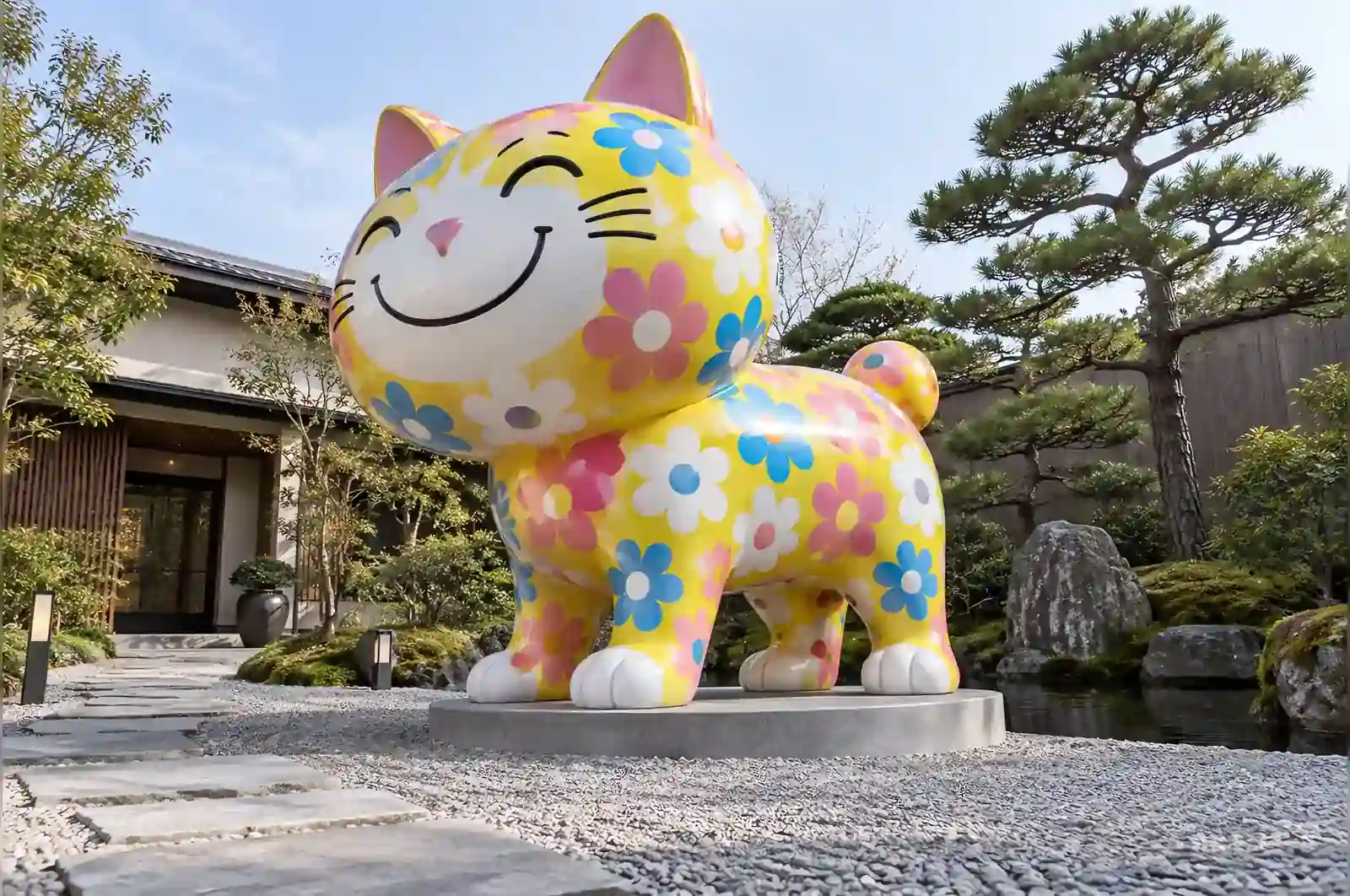
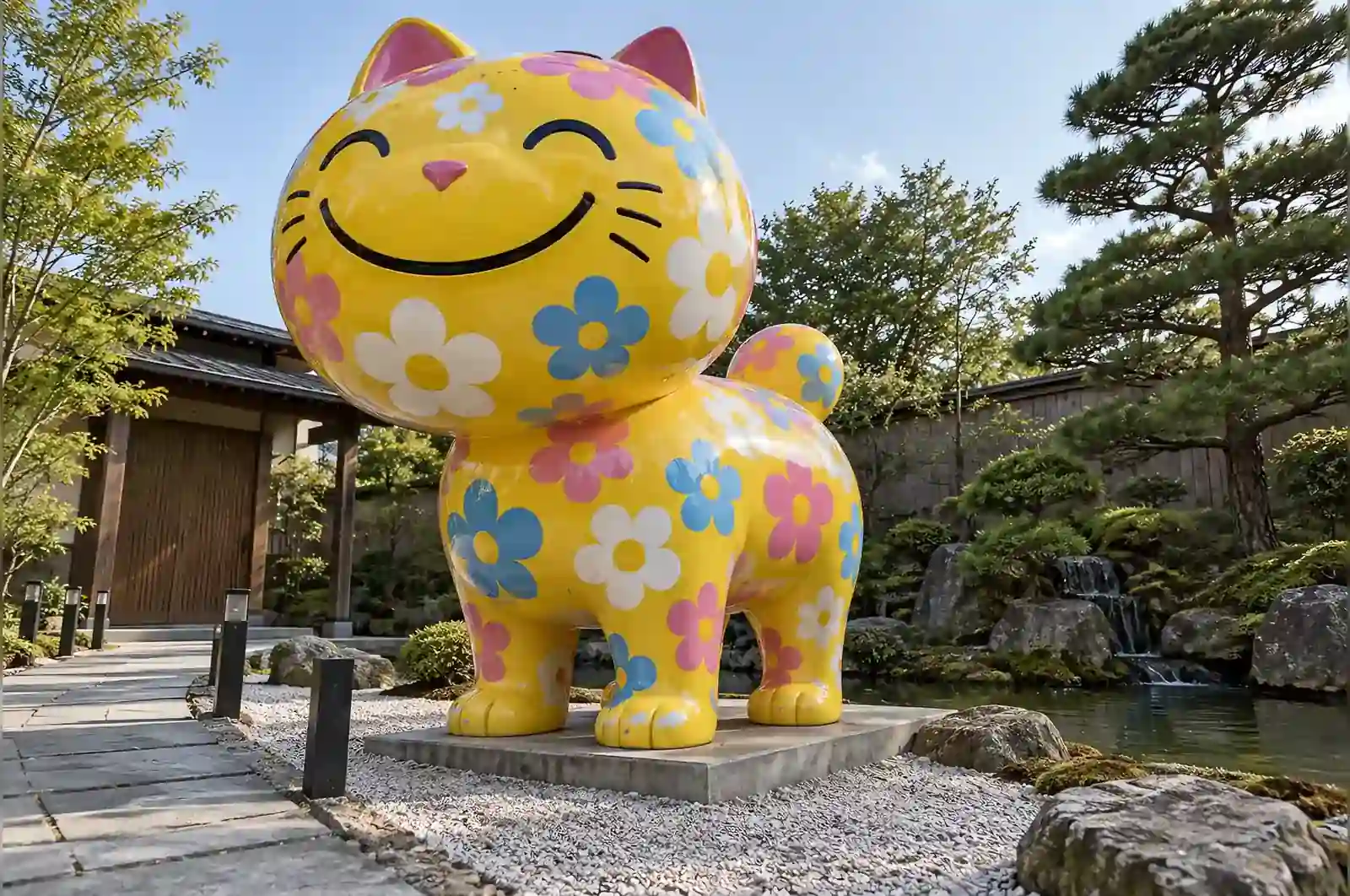
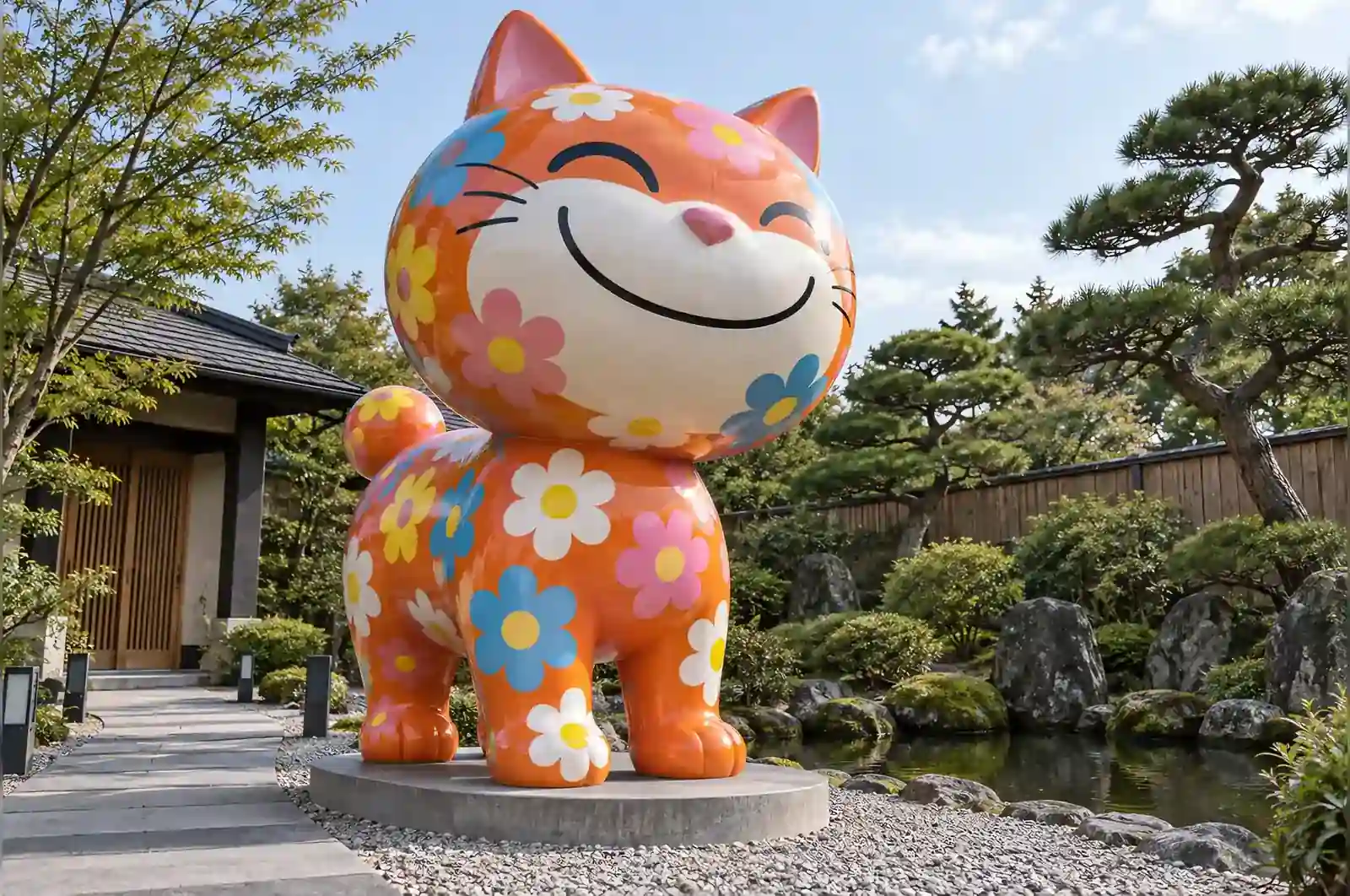
There is a particular kind of commission where the pattern matters more than the animal. This was one. The cat was almost a pretext.
The brief
A bobtail cat, standing, about 2 m, covered in flowers. The flower pattern came from a family textile — the client’s mother’s design, printed on fabric for most of a working life. The client wanted it on something that would not wear out.
Everything else was left to us. That is usually a warning sign. Here it was genuinely open, because the pattern was already the point.
Making a cat that can carry a pattern
A busy pattern needs a calm form, or the two fight each other. We reduced the cat to four large volumes — head, body, and two haunches — so that there would be broad surfaces for flowers to sit on. The muzzle, which would normally carry the character, was simplified to almost nothing. In exchange we allowed one big obvious smile, because a garden piece should acknowledge the viewer.
The colour of each daisy was pitched to the flowers visible through the garden window in April: white, soft pink, a yellow that is closer to pollen than to lemon, and a blue that is really a violet.
Build
Fibreglass over a steel core, gloss finish so that the piece catches the garden’s moving light and does not go flat under the overcast skies that Kanazawa gets for weeks at a time. The flowers were hand-laid over a bright ground and then clear-coated twice; roughly two hundred and fifty of them, in five sizes. We reserved the largest flowers for the flattest parts of the form.
In the garden
It stands where the path turns, so that it is seen against the pond and then against the pine. The client has said that visitors recognise the pattern before they recognise the cat, which she considers the correct order.
What the brief fixed
The non-negotiable was the pattern, not the animal. The textile design had to land on the finished piece at a scale where a viewer standing at the path turn could recognise it before they recognised the cat — the client’s stated measure of success. That one condition fixed two things before we modelled anything. The size, 2.1 m high, was chosen so the largest daisies would read across the garden’s viewing distance rather than collapse into texture up close. The finish, gloss with a UV clear coat, was fixed by the light: a flat surface goes dull under the weeks of overcast Kanazawa gets, while a gloss catches the moving light off the pond and stays legible.
What would have changed if any of that had not held. Drop the size and the pattern falls apart — at table scale two hundred and fifty daisies become a speckle, and the cat would have had to carry the whole commission on its expression. Change the finish to matte and the piece is only legible in direct sun, which is the minority of a Kanazawa year; the gloss is what keeps it alive under grey sky. Move it indoors, into a lobby, and the April colour reference loses its meaning — the palette was pitched to a window, not to artificial light — and the pattern would need re-pitching to a single source.
Keeping the pattern in a rainy climate
The finish is what has to outlast a Kanazawa year, and it is the reason the commission was gloss rather than anything softer. The UV clear coat over the bright ground does two jobs. It holds the whites and the soft pinks from drifting toward yellow under UV, and it sheds the rain the city brings for long stretches, so the surface dries instead of holding water against the paint. Maintenance is deliberately minimal. A soft cloth and plain water with a trace of detergent, no abrasives — anything scouring marks the clear coat and shows as a dull streak against the gloss, and once the gloss is scratched the pattern beneath is open to the weather it was sealed against. The two hundred and fifty daisies are painted into the surface, not applied on top, so a clean does not risk lifting one.
The one thing worth an annual check, at this size and placement, is the ground line. The piece stands where water collects after rain, and the fibreglass skin sheds it, but the steel core inside should stay dry, so the joint where the form meets the garden is the only seam that needs looking at.
What this means for your own brief
Settle three questions before asking for a quote, because they change the form, the finish and the schedule more than any material choice does. First, which is the point — the pattern or the animal? This commission worked because the client knew it was the pattern and let the form get out of the way. A detailed sculpt carrying a busy pattern is two competing focal points, and usually one of them loses.
Second, what are the viewing distance and the light? The daisies here were sized to read from the path turn, across the pond, and the gloss was chosen for an overcast climate. The same design on a sunlit courtyard would want a different finish and probably a different pattern scale. Third, who owns the design? This pattern came from a family textile — it belonged to the client, not to us, and we were working from a fabric they had lived with for decades. If you bring a pattern, know whether it is yours to use and what it means; if you do not have one, say so early, because sourcing or designing it is a stage of its own.
The flowers were my mother's pattern. Seeing it on something this big, in the garden, is a strange and lovely thing.
A private garden in Kanazawa, Japan