Humbug — Op-Art Cartoon Tabby, Gallery Courtyard, Berlin
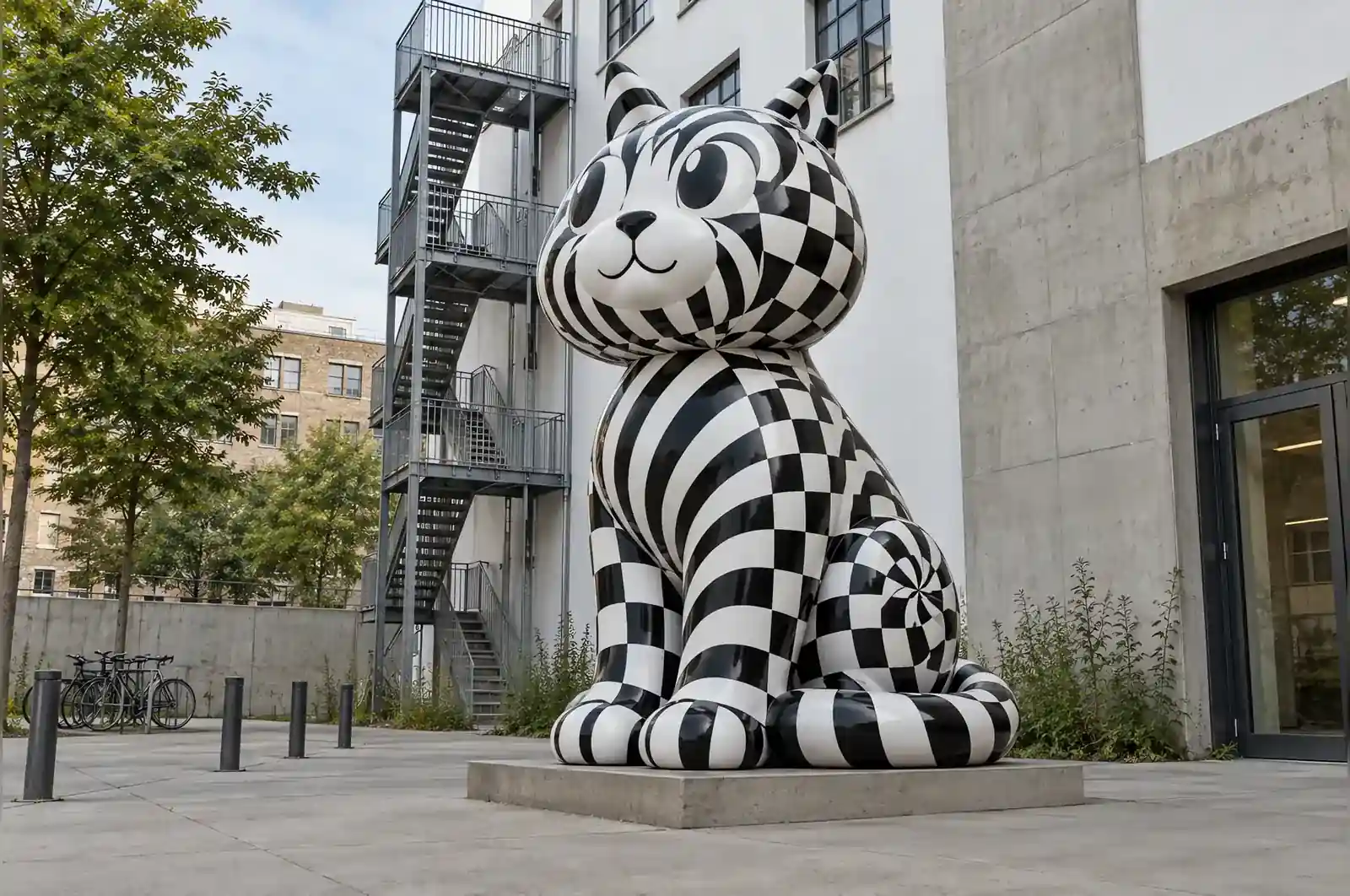
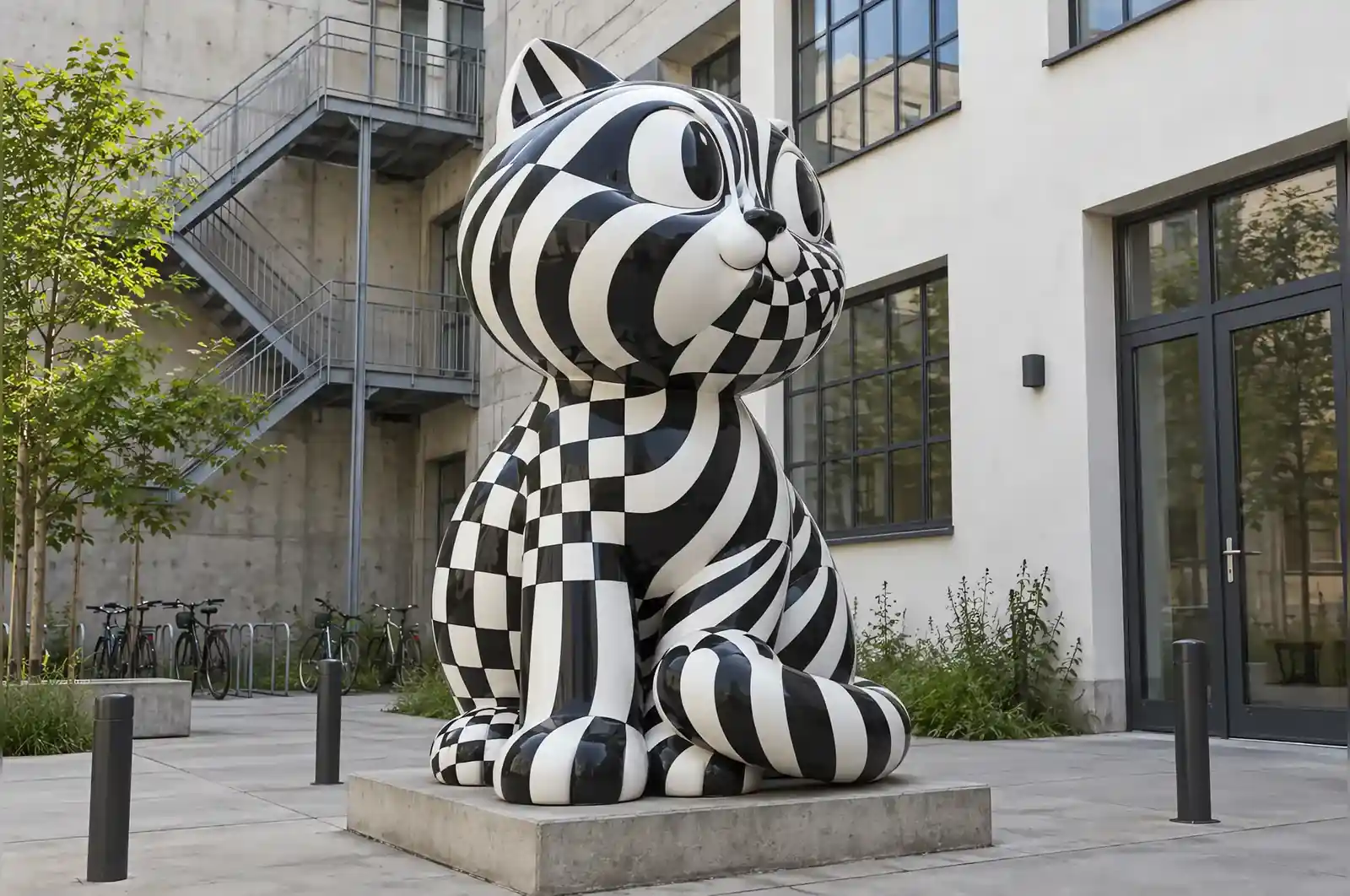
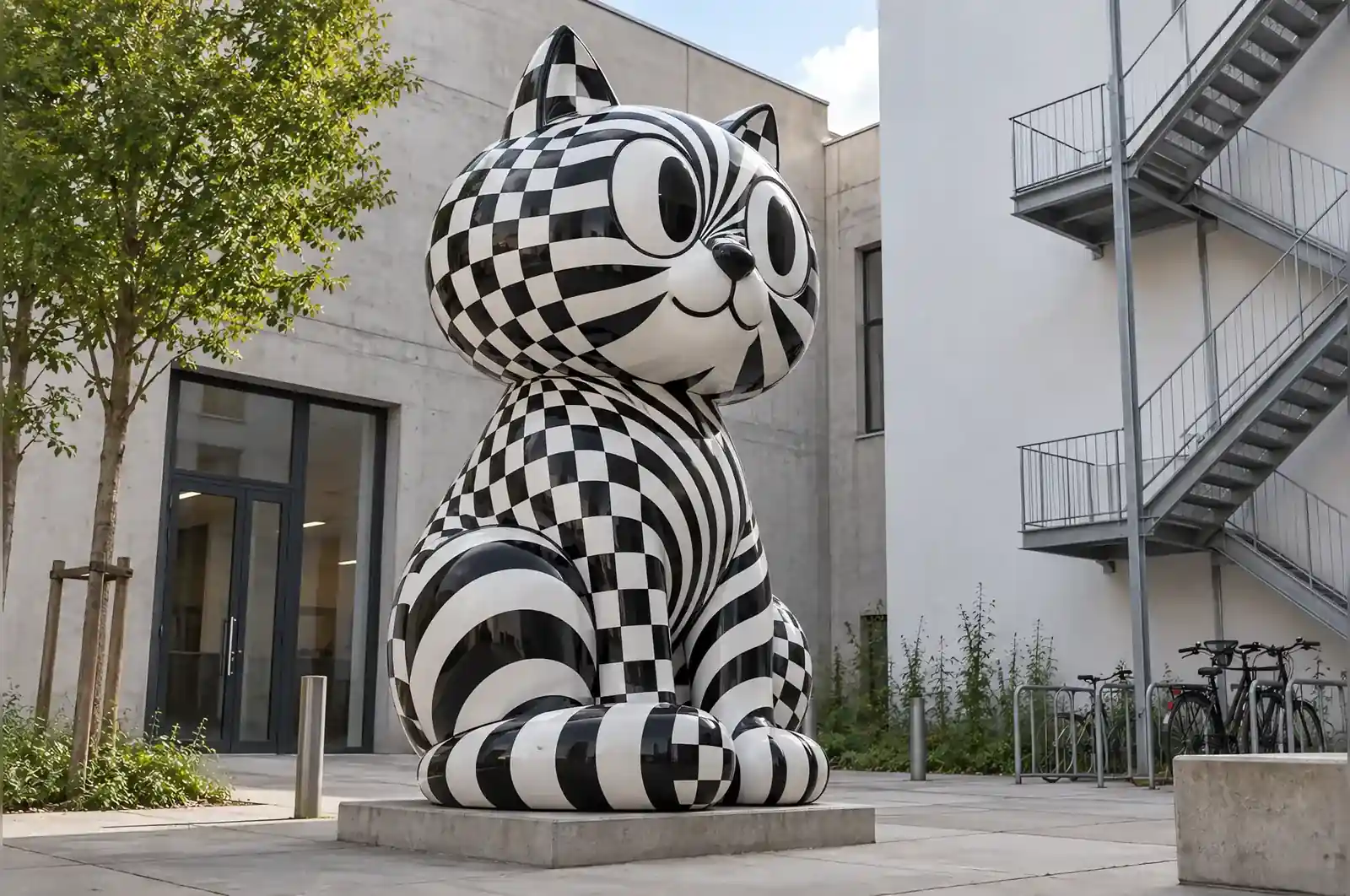
Two honest options existed for this piece. A tiger-striped tabby, which is what the reference photographs showed. Or a pattern that does something to your eye. The arts centre chose the second and we spent three weeks trying to talk them out of it, then built it and stopped arguing.
The problem with stripes on a curve
A straight pattern on a curved animal reads as wallpaper that has been stuck onto a shape. To make the pattern belong to the form, it has to warp with the surface. We mapped the stripes onto the 3D model so that they follow the actual topography of the cat, compressing where the form turns away and stretching where it opens up.
Then we pushed further than the model wanted. Along the spine and down the front of the chest, the stripes deliberately tighten past the natural rate, which is what produces the shimmer. That shimmer is the only reason a static object can hold a viewer’s attention from across a courtyard.
Where the pattern had to stop
Total coverage looked wrong, and also destroyed the character. We kept the eyes and the inside of the ears as solid flat areas, and let the stripes resume behind them. Two clean islands in a field of interference. It is the only legible bit on the whole piece and it does all the work of making the object an animal.
Build
Fibreglass over a steel frame, finished in a hard gloss. Op art depends on contrast, and a matte finish in Berlin’s grey light kills the contrast before the pattern has a chance. Every stripe edge was masked by hand; there are several hundred of them, and the masking took longer than the painting.
What stayed fixed
The placement was the one thing nobody argued about. The arts centre wanted the cat in the courtyard, and the courtyard is where it stands: 2.3 m high, 0.9 m wide across the front and 0.8 m deep, open to the sky. That fixes a great deal downstream. At that height the piece reads across the whole open space, which is what lets the shimmer work — the pattern has to be large enough to be seen from a distance before it can appear to move.
The finish follows the placement. Because it stands outside in Berlin’s grey light, the gloss UV clear coat is not decoration; it is what keeps the black-and-white contrast alive. Change either of those and the design starts over. Drop the size to under a metre and the stripes compress to the point where they read as texture rather than interference, and the effect is gone. Move the piece indoors and the brief changes entirely — a lobby does not need a UV coat, and the hand-masking could be looser because the light is controlled. The courtyard at 2.3 m with a gloss coat is what the whole piece is built around.
The clear coat and the Berlin winter
Outdoor gloss is a maintenance decision as much as a finish decision. The piece carries a gloss UV clear coat over hand-masked paint, and in Berlin that coat is doing real work. Winters bring rain and freeze-thaw cycles; summers bring UV. The coat is the layer that keeps the several hundred stripe edges from lifting and keeps the black from greying under that light. It is also the layer that can be renewed rather than rebuilt.
Clear coats are sacrificial: they wear before the paint does, and a piece like this is planned around re-coating, not repainting. Because the cat stands at eye level in a courtyard people walk through, it is reachable, which makes scuffs a realistic risk rather than a remote one — the coat is what absorbs them. At 2.3 m the whole surface is also easy to inspect. An annual look at the stripe edges and the coat is enough, and any touch-up is a masking-and-spray job rather than a structural one. The fibreglass over the steel frame is unaffected; the coat is the part you maintain.
One detail is worth knowing before you specify an outdoor op-art piece: the effect depends on the coat staying intact, not just on the paint. A single dull patch where a clear coat has worn or been scuffed is enough to break the shimmer at the point it covers, because the eye reads contrast before it reads pattern. So the coat is not cosmetic trim on a commission like this — it is part of the optical design, and it is specified and maintained as such.
Before you ask for a quote
Three questions settle most of a brief on something like this. The first is where it will stand — indoors or outdoors, in sun or in shade. That alone decides the finish: a gloss UV clear coat for an exposed courtyard, a softer or matte finish where the light is controlled. The second is how far away people will actually see it from. The op-art effect only works at the distance it was designed for; a pattern sized for a courtyard will not read across a street, and a pattern sized for a street looks busy up close. The third is how much of the surface the pattern may cover. Total coverage is tempting and it destroys the character — the eyes and the inside of the ears were kept clean on this piece for exactly that reason. Settle those three and the quote follows cleanly; leave them open and you will get a pattern that looks stuck on.
Half of our visitors walk straight past it and half stop dead. Both reactions are useful to us, and both were the point.
An arts centre in Berlin-Mitte