
Volt — UV Neon Cartoon Cat, Night Street, Osaka
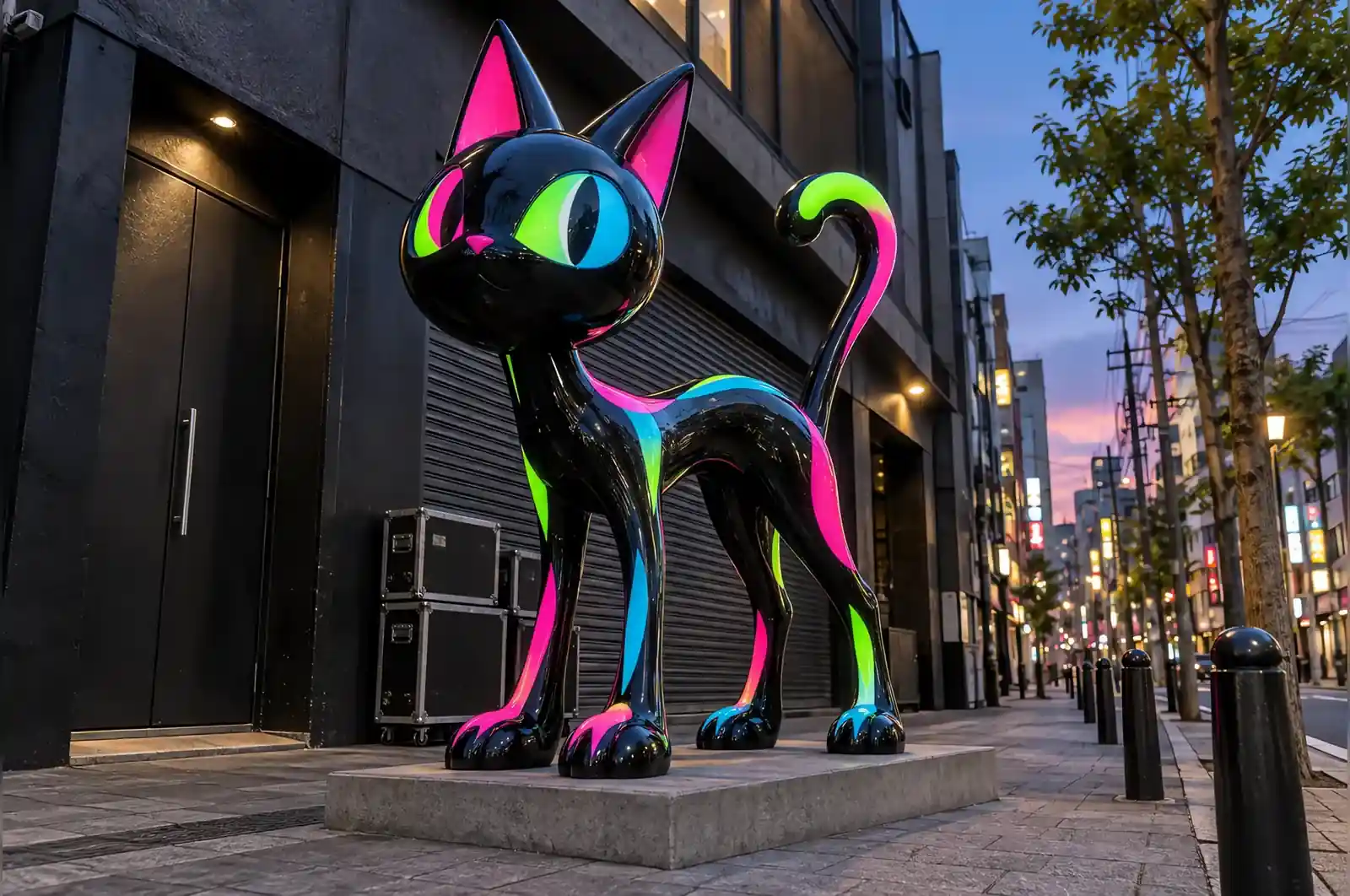
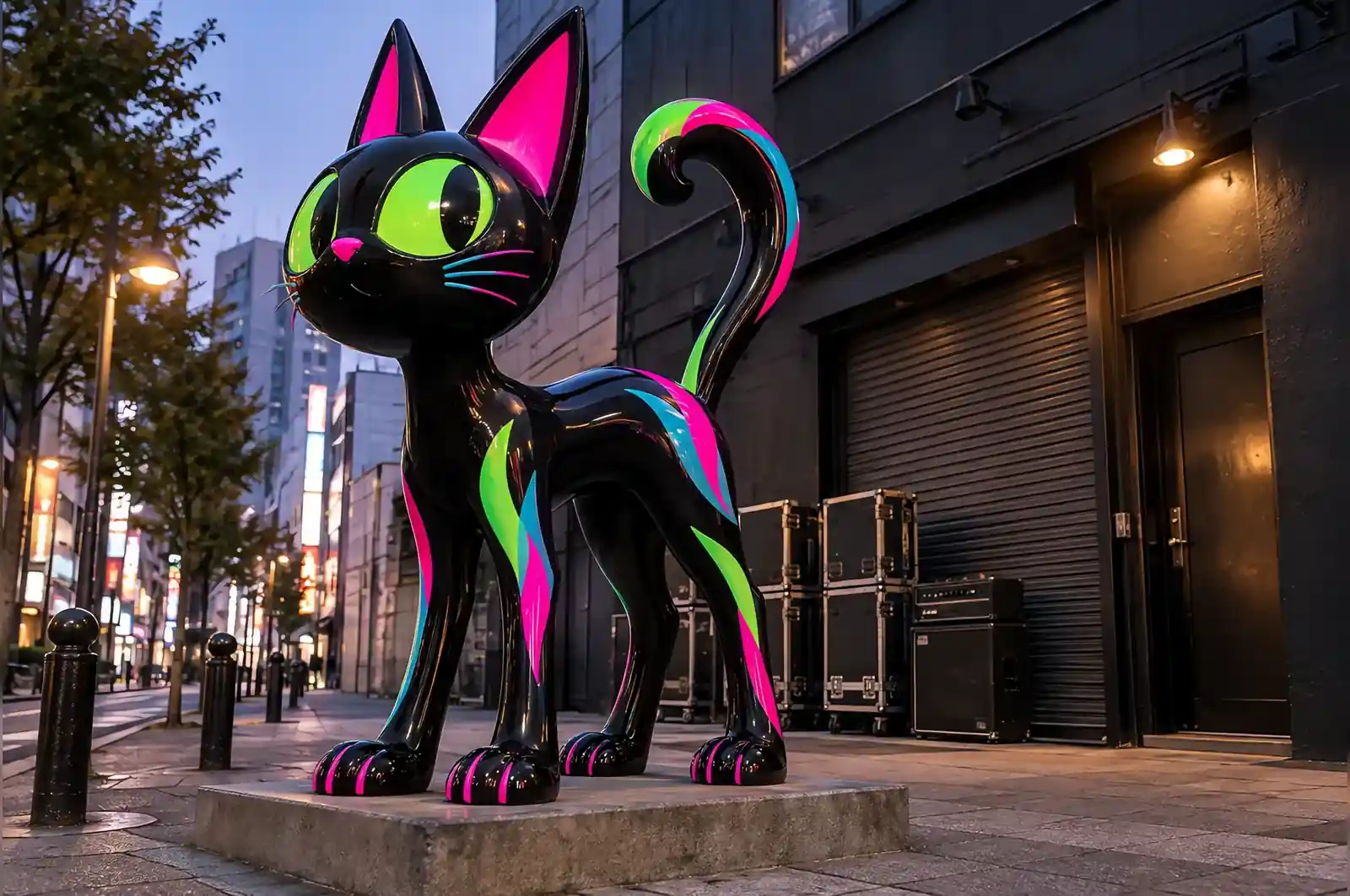
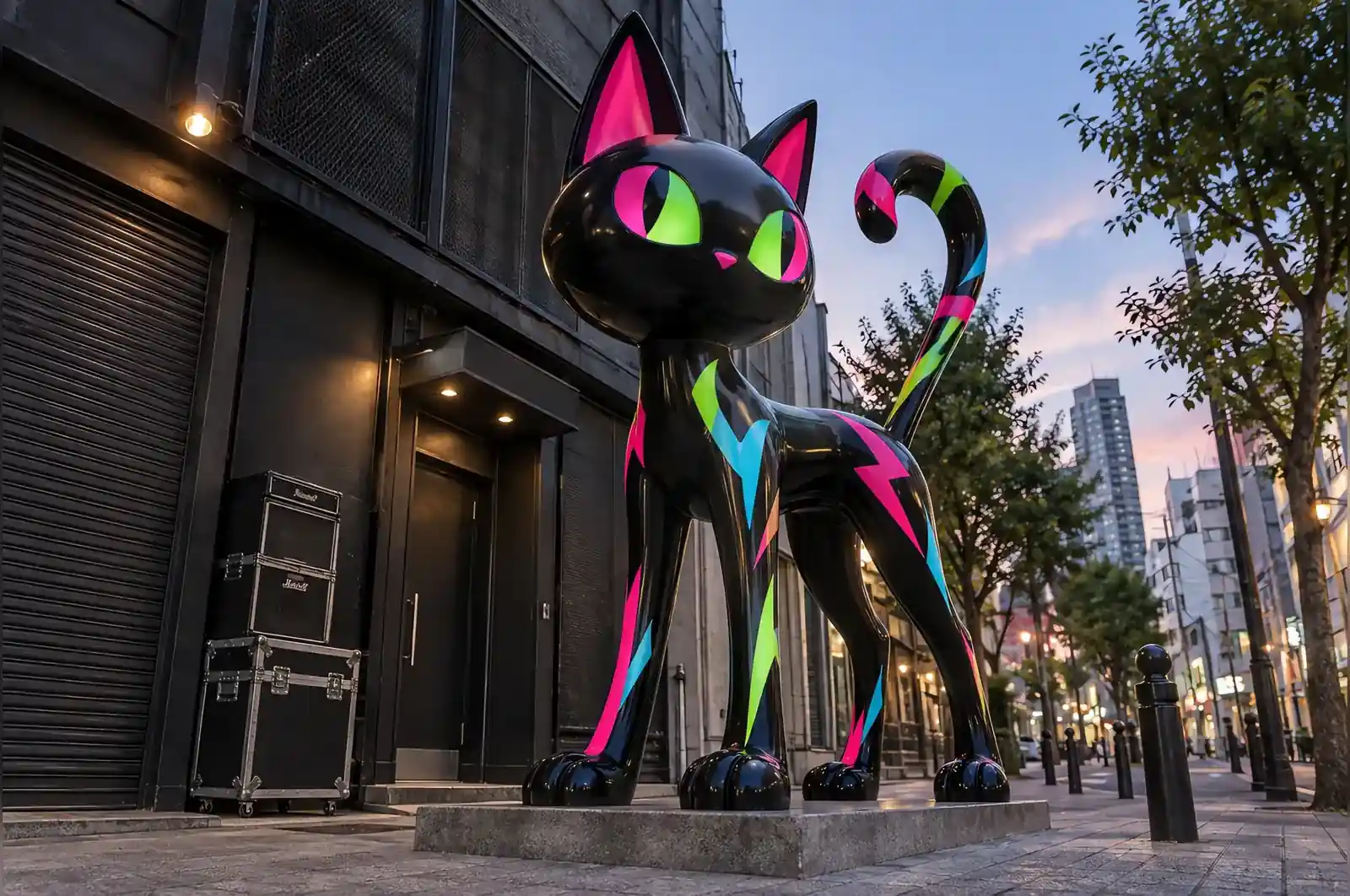
Most painted sculpture is designed for daylight and dies under artificial light. This one was designed the other way round: it is made to be at its best at nine at night, on a street of bars and small venues.
The brief
A cat for the pavement outside a venue, about 2 m, that would work as a landmark after dark on a street that already has a great deal of light on it. The owner had one stipulation: no sign, no name, no logo. The cat had to be the sign.
Designing for darkness
We built it on a black ground, which does two jobs. It is the natural colour of the animal, and in daylight it reads as an unassuming black cat — deliberately low-key. Then the fluorescent markings sit on top of that black: pink along the flanks, acid green on the chest and inner legs, cyan around the eyes and the ear interiors.
Fluorescent pigment does not glow on its own; it converts UV and throws it back as visible colour. So the placement matters more than the amount. We put pigment where the nearby street lighting and the venue’s own lighting strikes the piece most directly, which is the upper flanks and the head. Under-lit edges were left black on purpose.
Where the shape and the paint disagree
The pose was set to give the markings somewhere to live. A crouching cat would have compressed all the fluorescence into a low band. Standing tall, with the tail up, spreads the coloured areas vertically so the eye reads a whole animal rather than a bright lump.
Build
Fibreglass over a steel spine, gloss clear coat with a strong UV package — necessary anyway, since fluorescent pigment fades faster than ordinary pigment when exposed. The venue washes it by hand and reports that the paint has held its intensity for two seasons of outdoor life.
What the brief fixed, and what would have changed
The brief fixed three things at once. The cat had to be the landmark, so it had to read at a distance after dark; it had to be the sign, so there could be no sign; and it had to live on a street frontage that already carries a great deal of light. Those three constraints decided the design more than any aesthetic preference.
Drop the size and the commission fails differently. At 2.0 m the brightest markings sit high enough to be seen over a crowd and over the traffic on a busy pavement. A smaller cat would put the coloured areas below chest height, where bodies and bicycles hide them, and the landmark effect collapses into a low pool of colour at ankle level.
Change the finish and the whole idea is gone. Fluorescent pigment only shows where light strikes it, so an ordinary paint over the same black ground would simply be a black cat — low-key by day, invisible by night. The UV-reactive package is not decoration; it is the sign the owner refused to add.
Move it indoors and the premise inverts. Inside, the piece would depend entirely on the venue’s own lighting and would be brightest under the bar lights rather than out on the street, which is not what a landmark is for.
Keeping a black ground and fluorescent markings alive in Osaka
Osaka’s summers are hot, humid and wet, and the UV load on a street-frontage piece is high, so this finish is doing harder work than the same paint would in a milder city. The clear coat carries a strong UV package for exactly this reason.
The pigment is the fragile part. Fluorescent pigment fades faster than ordinary pigment when exposed, so the clear coat is not just gloss; it is the protection that keeps the colour at full strength. The venue washes the piece by hand, which is the right approach for this finish. A pressure washer would cut through the clear coat and expose the pigment beneath it, and the fading would accelerate from the moment that coat is breached.
The maintenance interval is set by the black ground as much as by the markings. On a dark surface, any scuff or loss of gloss is far more visible than it would be on a light finish, because the black shows marks and dull patches readily. The practical job is a periodic re-coat of the clear coat — the pigment depends on it, and a re-coat every few seasons is the single most effective way to hold the colour, rather than waiting for the coating to fail and repainting the whole piece.
On the street
In the morning it is a black cat that most people walk past. By nine in the evening it is the brightest object on that stretch of pavement, and it is now the meeting point everyone names when they are giving directions.
What this means for your own brief
Three questions settle most of the decision before a quote. First, what is the light actually doing at the placement? This piece was designed around light that already exists — street and venue lighting striking the upper flanks and the head. If your site is dark at night, fluorescent pigment has nothing to convert and the piece stays black, so you would need to add your own light or change the approach.
Second, is the piece a landmark or a decoration? A landmark needs height and a silhouette that reads at a distance, which is why this one stands tall with the tail up and why 2.0 m was not negotiable. If the brief only needs something attractive at close range, a smaller piece and a more subdued finish would cost less and do the job.
Third, who looks after it and how? A fluorescent finish over a black ground is a maintenance commitment: hand-washing, periodic clear-coat re-coating, and a dark surface that shows scuffs. If nobody on site will maintain it, a simpler finish is the better buy.
It is invisible in the day and then it is the brightest thing on the street at nine at night. Exactly what we wanted.
A music venue in Osaka