Lump — Clay-Look Cartoon Ragdoll, Animation Studio, Bristol
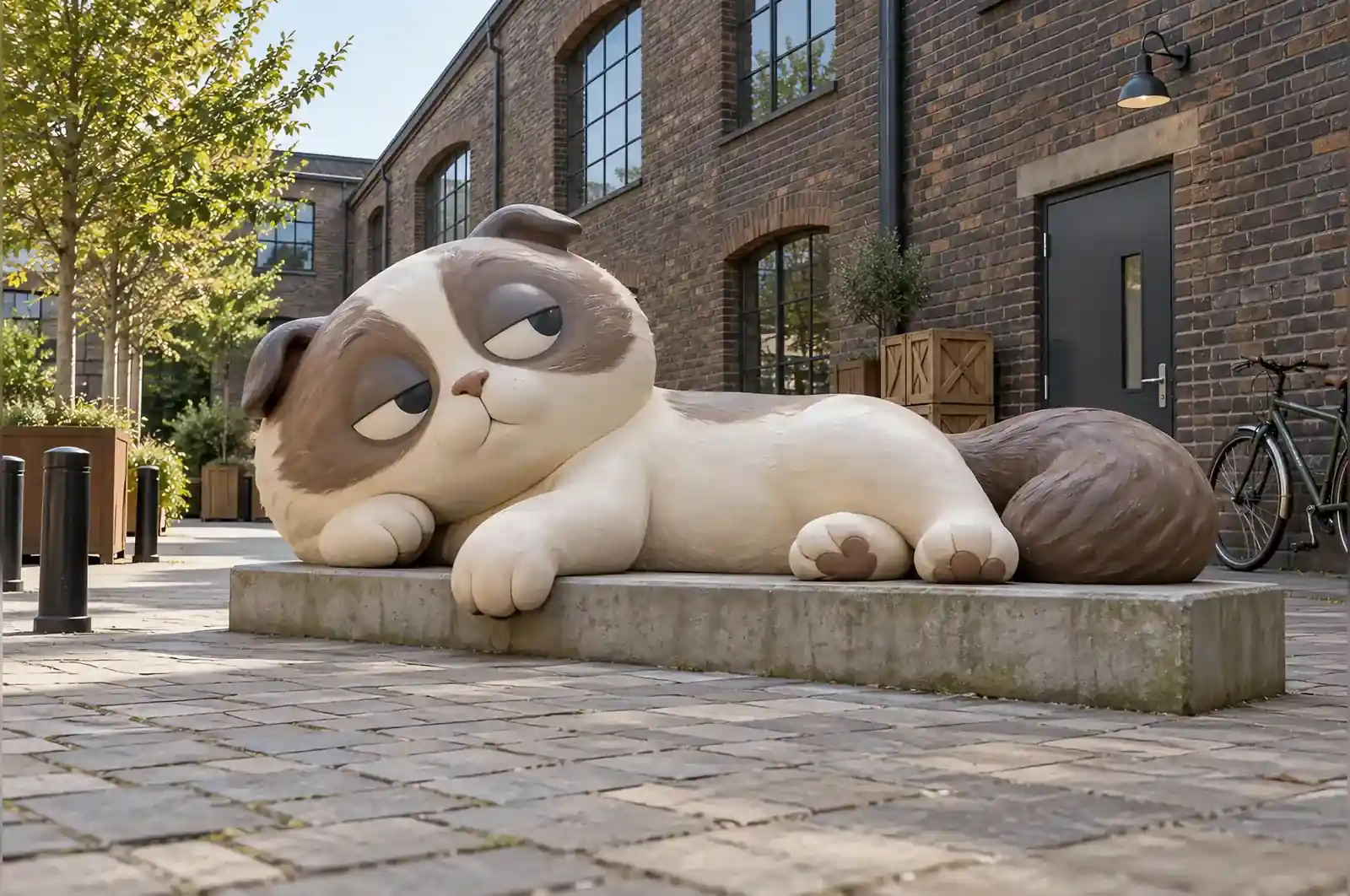
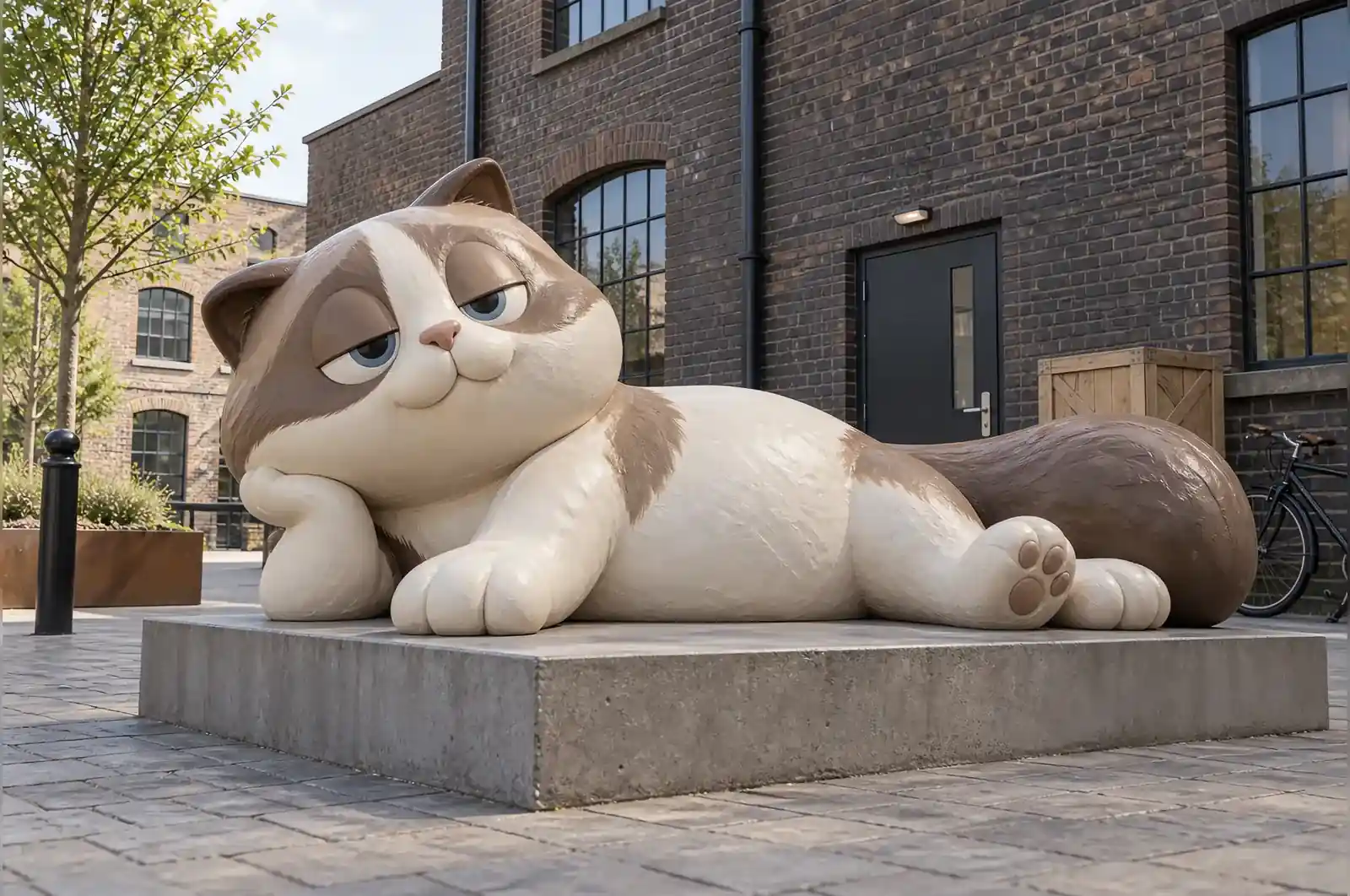
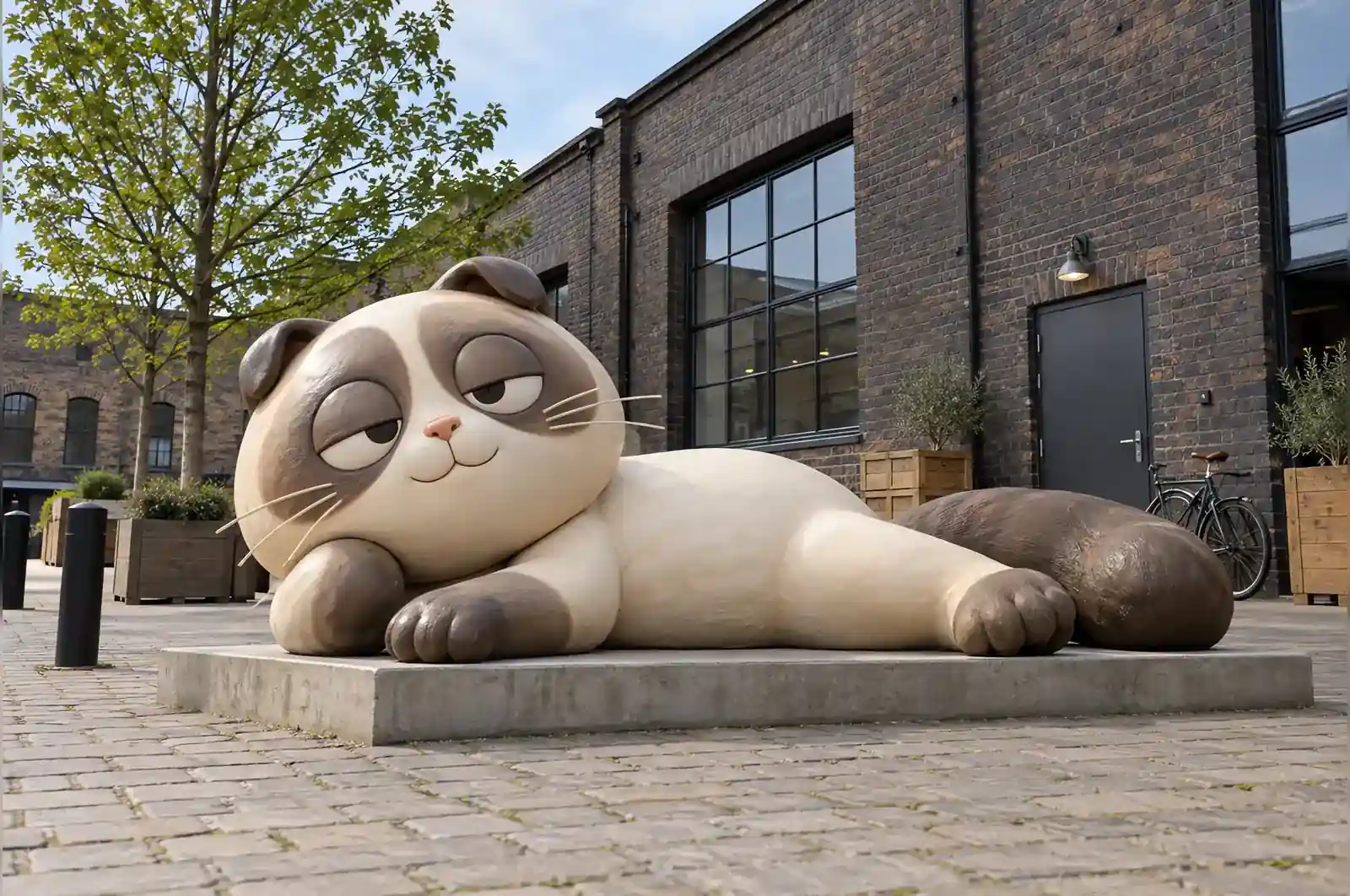
Asking a fibreglass shop to make something that looks like modelling clay is asking for trouble, so we were pleased when this one arrived. The client is an animation studio that still builds physical puppets for a living, and they were tired of digital sculpture in their own building.
The brief
A ragdoll cat, flopped on its side, about 1.7 m. The whole piece had to look as though it had been pressed out of clay by hand — including the marks. It also had to survive being outdoors in Bristol, which rules out clay by definition.
Reproducing a hand
We sculpted a small maquette in real clay first, at about 300 mm, and let the studio’s animators handle it until the surface had the right amount of accidental contact. Then we scanned it. The scan was not a shortcut — the clay maquette was the artwork, and the full-size piece is a casting of it.
Every fingerprint in the maquette survives in the mould, and therefore in the sculpture. At 1.7 m those marks are roughly five times life size, which sounds absurd and works completely, because at that scale a thumbprint reads as a landscape feature and gives the eye a reason to move across the surface.
We resisted the temptation to invent extra marks during finishing. What is on the piece is what happened while the maquette was being handled. An invented print is always too regular.
Making clay permanent
The finish is a dead-matte two-pack in six muted earth tones, brushed on rather than sprayed so that the colour sits slightly unevenly and pools a little in the deeper marks, which is exactly what clay does. It is fibreglass and paint; from three metres it is not.
What the courtyard decided
The outdoor placement was the one thing this brief could not give way on, and it decided everything that followed. A real clay surface, however beautiful the maquette, does not survive a British winter, so it was never a candidate. The clay had to be reproduced rather than used, and every later choice followed from that single fact.
The size was the second non-negotiable. At 1.7 m the fingerprint marks scale up to roughly five times life size and read as deliberate topography. If the commission had been for a smaller piece — below a metre, say — those same marks would be barely distinguishable, and the whole hand-pressed idea would collapse into an even, uniform surface, which is exactly what the client did not want. So the height stayed.
Had the piece been intended for indoors, two things would have changed. The construction could have been lighter: the internal steel frame is there because a 1.7 m freestanding form has to stand up to wind and to people leaning on it in an open courtyard, not because the sculpture needs it inside. And the finish could have been more forgiving. Outdoors it had to be a dead-matte, UV-stable two-pack that keeps its soft look and will not chalk or yellow in the sun.
At 1.7 m, outdoors
The piece is hand-laminated fibreglass over an internal steel frame. The frame is the load-bearing part: it stops the 1.7 m body from flexing when someone leans on it or when wind gets behind it, and it keeps the thin fibreglass skin from carrying forces it was not designed for. Lamination over a frame rather than a hollow cast is what lets the sculpture be handled the way the animators handle it.
In Bristol’s maritime climate the surface has two things to live with: rain and frost. Rain is the easier. The matte finish sheds water and the deeper marks drain, though a dead-matte surface does hold atmospheric grime more than a gloss would, so it shows streaking after heavy weather. Cleaning is a soft brush and a diluted neutral cleaner. No wax, no polish — adding sheen is the one thing that would break the illusion of clay.
Frost is the reason the surface is sealed rather than open. A matte, open-textured finish would let water into the marks; a freeze would then damage it. This one drains and is sealed, so the marks that give the piece its character are also what keep it safe through winter.
Before you ask for a quote
If you are commissioning something like this, three questions settle most of the result before price is even discussed.
First, is it genuinely outdoors, in a climate that freezes? That is the biggest single driver. If it is, the clay look has to be achieved in the finish rather than the material, and that is more work than it sounds. If it is indoors, you have far more freedom and the surface can sit closer to the real thing.
Second, how close will people get, and how big is the piece? The fingerprint trick works because the marks are scaled up. A small piece cannot carry it, so the surface treatment has to be finer; and a piece people will touch a lot wants a matte finish that hides handling rather than a gloss that shows every mark.
Third, do you want it to read as hand-made, or as sculpted? Hand-pressed clay reads through uneven tone and irregular surface; sculpted reads through deliberate, precise forms. Both are achievable, but the finish, the finishing process and the cost are different. Saying which one you mean at the start saves a round of revisions.
In the courtyard
It has become the studio’s handshake. Visiting directors are walked out to look at it before they are shown any work, and animators touch it on the way in for luck. Nobody is entirely sure when that started.
Every animator who walks past touches it to check whether it is really paint. Some of them still do not believe us.
An animation studio in Bristol, England