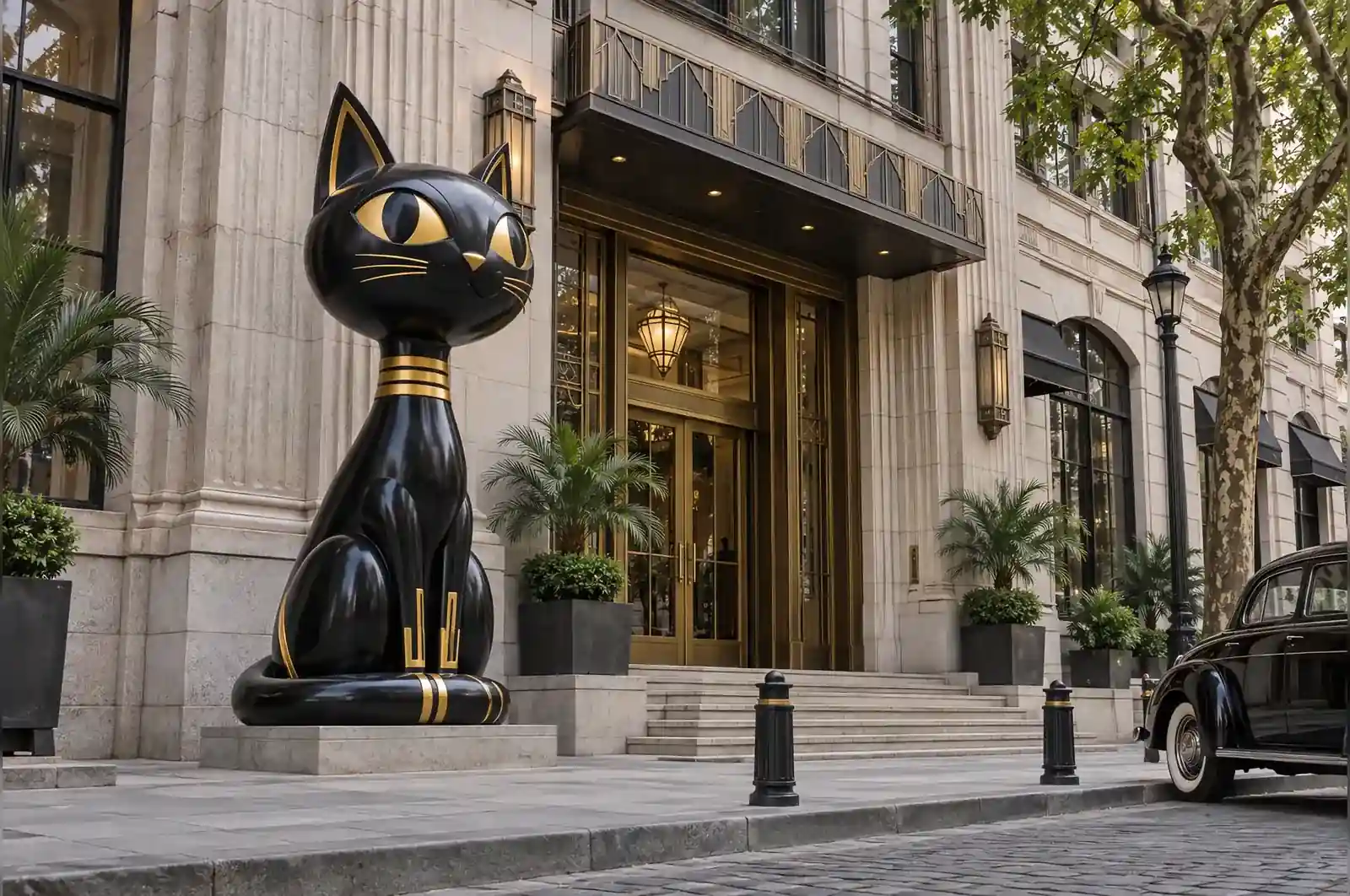
Vesper — Art-Deco Cartoon Cat, Hotel Entrance, Shanghai
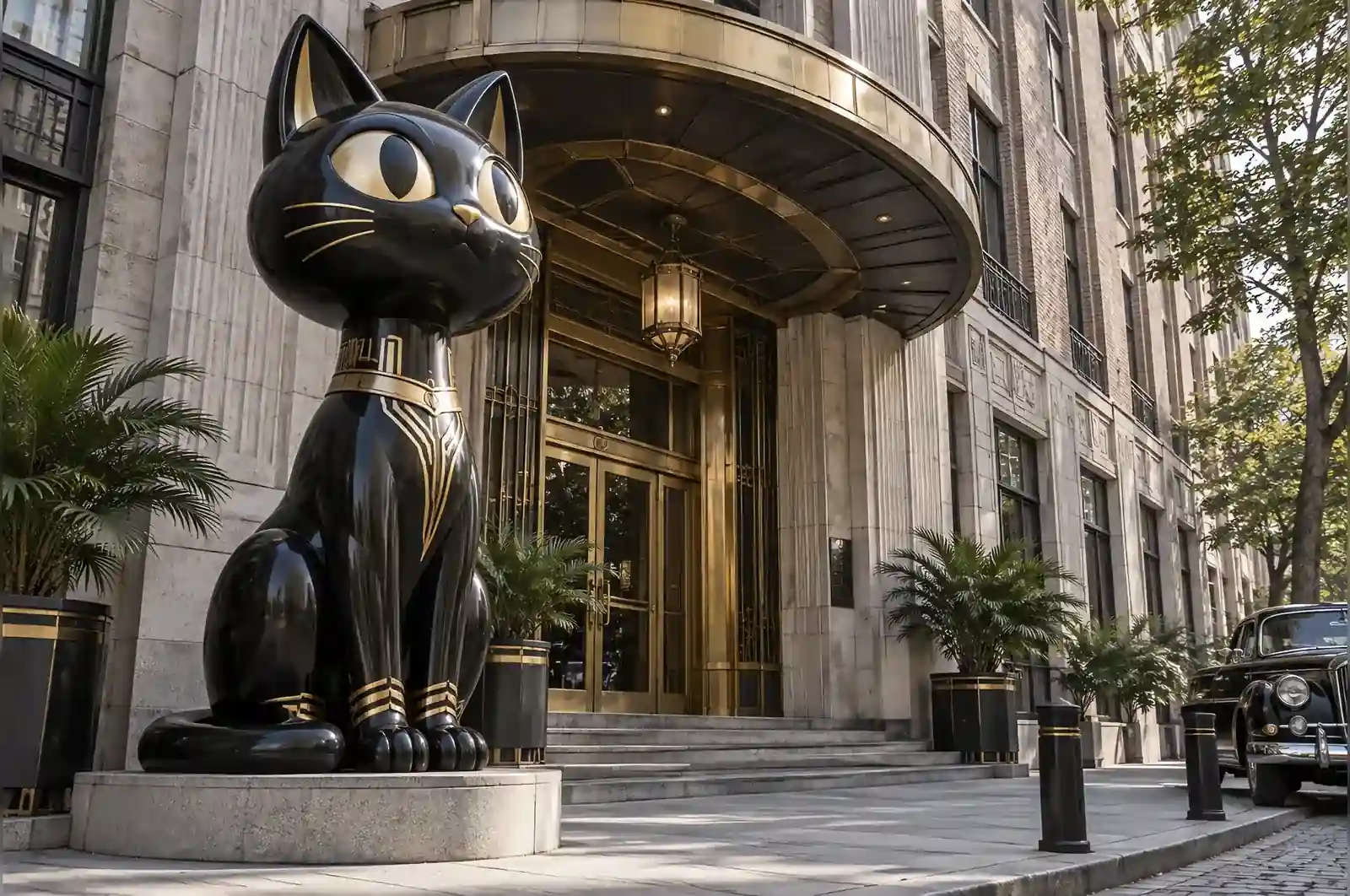
The building opened in 1934. The brief was one sentence long: the cat should look as though it had always been outside the door.
Reading the building
We spent two days in the lobby before drawing anything. The hotel’s vocabulary is stepped geometry: fluted pilasters, chevron inlay, a lift surround of concentric rectangles, brass everywhere. A piece built in that language sits next to the door as though it came with the stonework.
Making a cartoon that is also a period piece
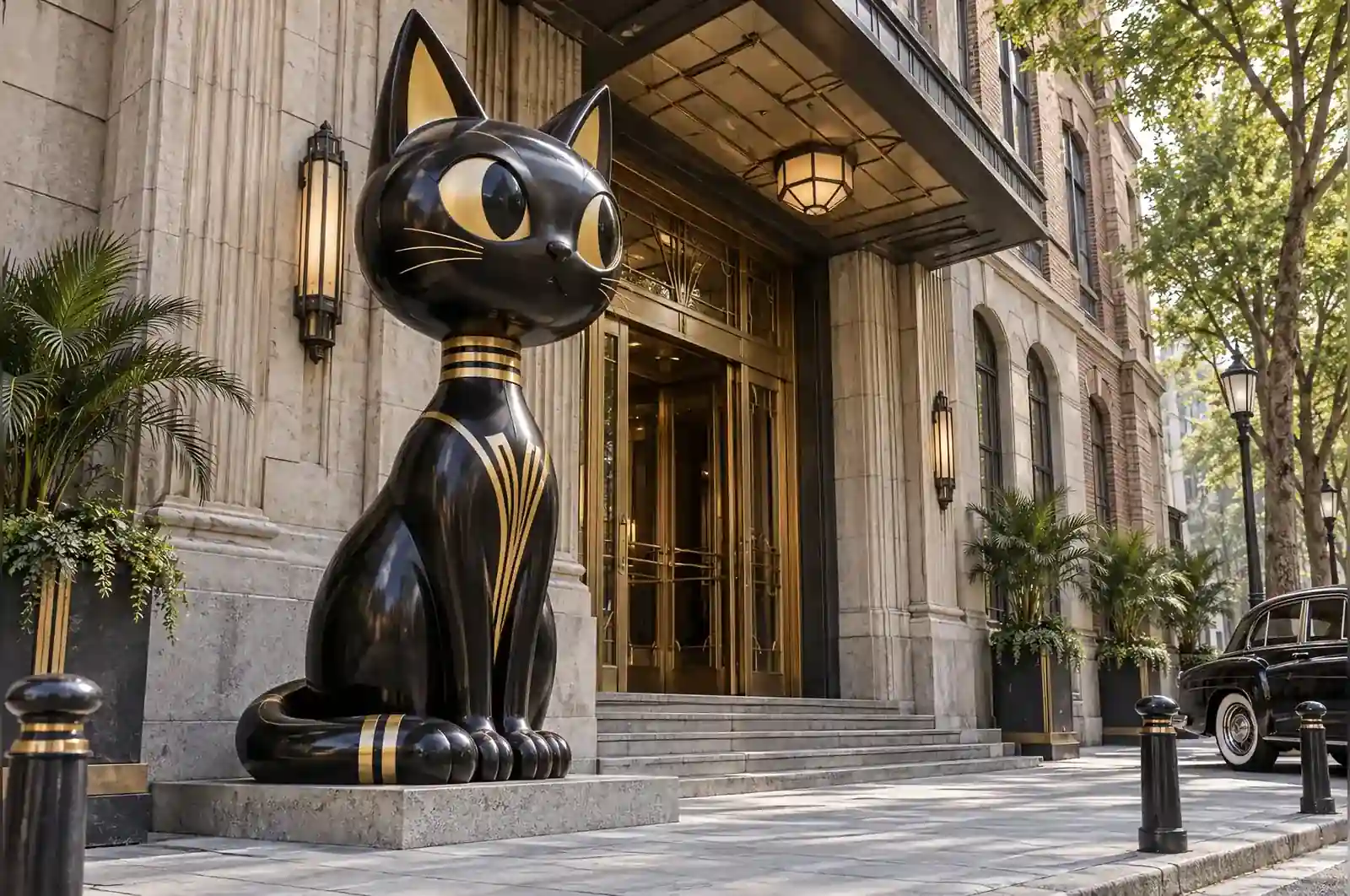
The cartoon survives because the proportions are still absurd — the head is far too large, the neck far too long, the body a smooth taper with no anatomy in it. The period comes entirely from the surface treatment.
The body was divided into stepped bands: four horizontal bands of equal width rising up the chest, each one lipped about 4 mm proud of the one below. The ears are built as small stacks of three flat planes rather than as curved cones. The tail, laid flat at the base, was given a chevron inlay in gold leaf.
The gold is real leaf, applied over a red bole, and it is confined to the ear edges, two bands on the chest and the tail inlay. Any more and the piece turns into a Chinese New Year decoration; any less and the deco reads as ordinary black furniture.
Black lacquer, outdoors
Straight black lacquer on a humid Shanghai street is a hard-wearing proposition to promise, so the finish is a filled two-pack system built up in nine coats with flow coats between, hand-flatted at the end. It reflects like lacquer and behaves like automotive paint.
What the entrance fixed
Three things were settled before we modelled anything: the size, the finish and the door. The cat had to be 2.4 m tall and no more than 0.8 m deep, because the entrance is a working one. Guests pass through it all day, luggage trolleys come up the path, and the doors swing outward. A round sculpture that projected past the plinth would have been in the way, so the 0.8 m depth is a hard maximum rather than a design choice.
The finish was not negotiable either. The lobby is brass and black lacquer, so a satin paint or a bare fibreglass gelcoat would have read as the wrong object however well it was modelled. We would not have taken the commission on any other surface.
Had the depth been tighter, the piece would have been a standing relief rather than a full round, and the stepped bands would have been shallower. Had the entrance been wider, the tail could have curved off the plinth instead of lying flat. Had the cat been indoors, the nine-coat system would have come down to six and the gold leaf could have been brighter without the weather to worry about.
Carrying the head
The cartoon proportions put the head far too large for the body, which means the centre of gravity sits high. The internal steel frame is ballasted at the base with a cast plate, and the plinth is bolted to the slab rather than standing on it, so the whole assembly moves as one unit instead of pivoting at the ankles. This is the most important detail on a 2.4 m piece with an oversized head: it is what keeps a top-heavy sculpture upright in wind, and it is why the piece cannot simply be set down on the ground.
The gold leaf needs watching outdoors as well. Because the leaf sits over a red bole on a humid Shanghai street, the edges of each band are sealed with a clear coat so moisture cannot get under the leaf and lift it. On this site the re-leafing check is annual; in a drier climate it would be every two years.
The stepped bands were cut as separate tooling inserts rather than blended into the body, which is why the 4 mm lips read as sharp lines instead of soft transitions. It costs more tooling to do it that way, and at 2.4 m it is the only way to keep the geometry crisp across the whole height.
The daily polish the concierge team does is a dry cloth only. A damp cloth is never used on the hand-flatted lacquer, because a wet wipe leaves a bloom that has to be flatted out again.
At the door
It is set on a low dark plinth to the left of the entrance, where it catches the brass light from the lobby after dark. The concierge team polishes it every morning along with the door furniture, and the hotel shop now sells a photograph of it, which nobody asked for and nobody objects to.
What to settle before you ask for a quote
The first question is depth. Do you have the 0.8 m of clear space at the position you have in mind, or does the piece need to be a standing relief? A full round at this size needs the depth in front of it; a relief needs only the wall behind it.
The second is the anchor point. A 2.4 m sculpture with an oversized head is top-heavy, and it has to be bolted to something — a slab, a plinth or a reinforced base — not set down. Tell us what the floor is at the position before you ask, not after.
The third is the surface. The black-lacquer deco finish costs more coats and more lead time than a satin painted finish, and it asks for more care in service. If the brief wants the deco look, build the finish, the lead time and the annual re-leafing check into the plan along with it.
Settle these three and the rest of the brief writes itself around them.
Guests assume it is original to the building. That is the highest thing you could say about it.
A heritage hotel in Shanghai