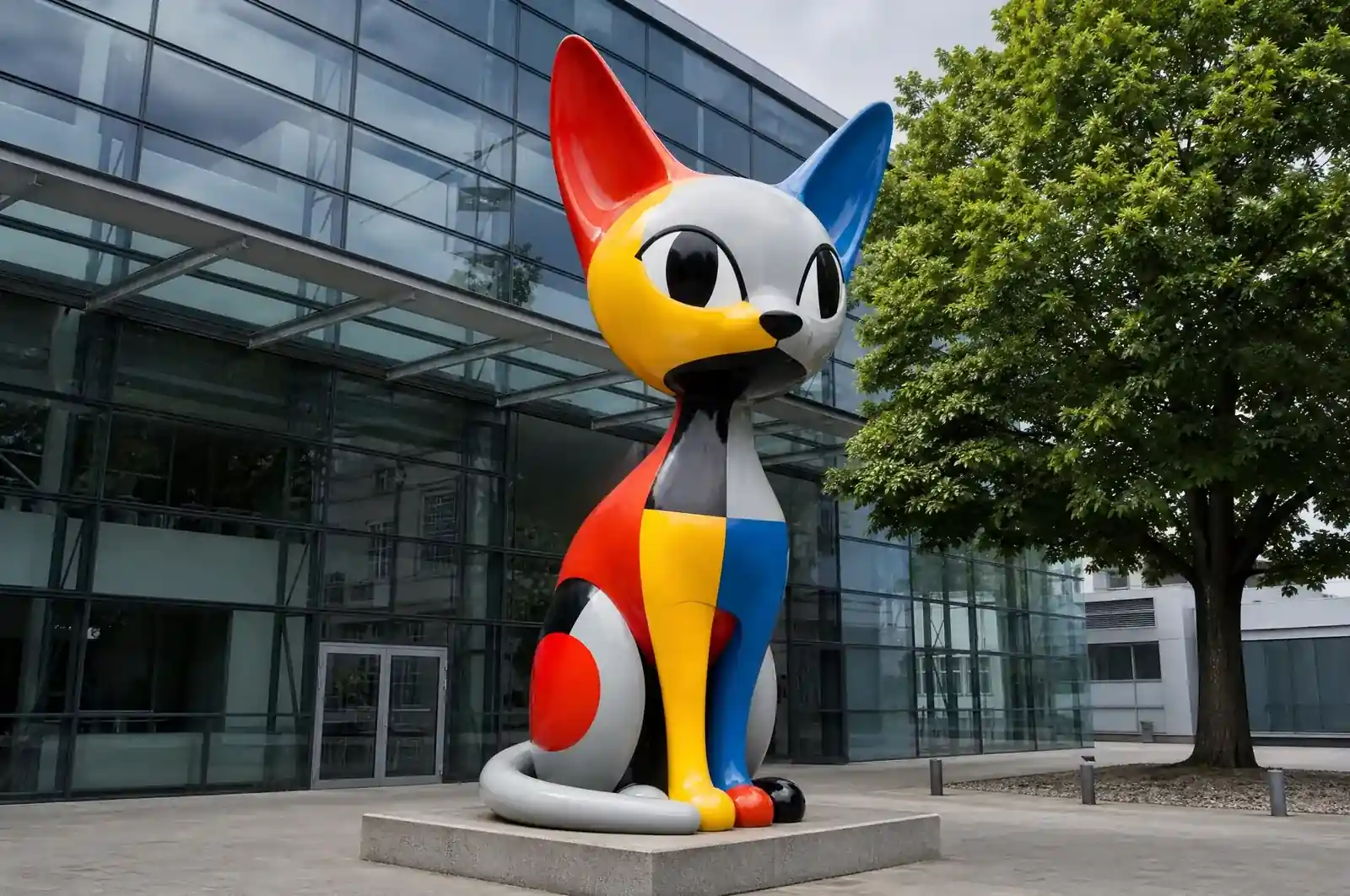
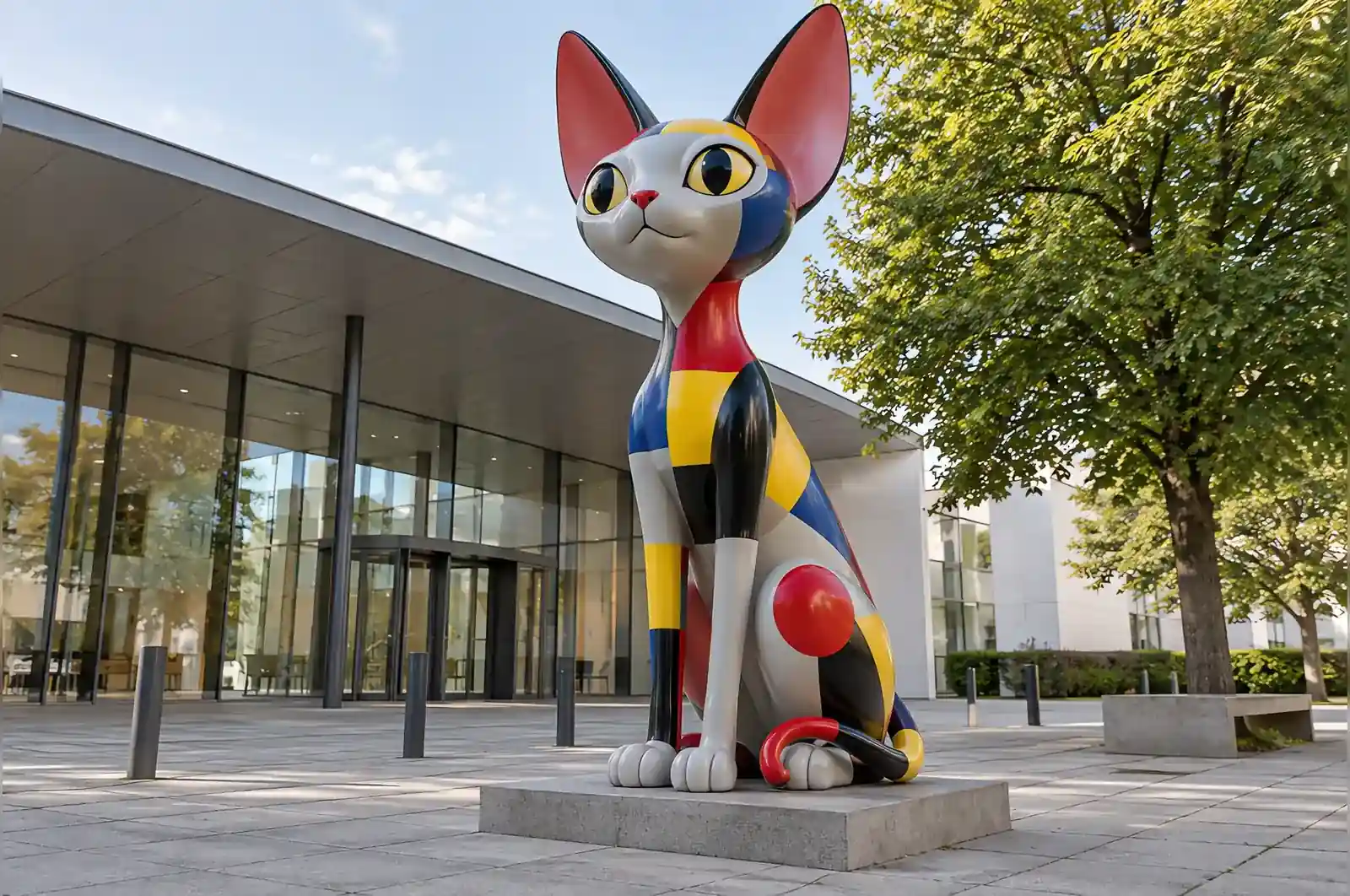
Zero — Bauhaus-Blocked Cartoon Sphynx, Museum Forecourt, Dessau

There is a certain kind of museum that will only accept a cartoon if the cartoon has an argument behind it. This commission came with the argument attached, and the argument was good.
The proposition
The museum wanted a piece for its forecourt that would stand as a colour study in the tradition of the building, while still being something a child would run towards. Their suggestion, which we kept: use an animal with no fur and no pattern of its own, so that the colour is entirely ours. A sphynx.
Dividing a cat into geometry
The rule was that the body would be divided by hard painted edges into circles, squares and triangles, in red, yellow, blue, black and grey, with no gradients and no soft transitions anywhere. Applying that rule to an animal means deciding where the joints are.
We let the school of the building make the decisions. The head is a blue circle. The chest is a yellow square rotated forty-five degrees. The hips are red. The ears are two triangles, one black and one grey, and the tail is a thin grey line that completes the composition. Every edge is a hard transition — the colour simply stops and another one starts.
The ears had to grow to carry their triangles. A sphynx ear is already large; ours is close to a third of the head height, which pushes the piece past naturalism and into the cartoon in one move.
Why satin and not gloss
Full gloss on strong primary colours produces a wet, almost confectionery look that would have worked against the geometry. The satin coat keeps the painted planes reading as flat colour under the museum’s north light, which is the condition the forecourt actually lives in.
In the forecourt
It stands off to the side of the main approach rather than on the axis, which was the museum’s decision and the correct one: you arrive, you notice it, and you walk over to it as a choice. Their education team now runs a colour workshop that starts in front of it.
What could not be traded away
The museum’s brief did not leave the colour rule open. The hard-edge division into red, yellow, blue, black and grey, with no gradient anywhere, was the argument the piece had to make, and it was fixed before the model was touched. That left two further decisions that had to be settled in the same breath, because the rule only holds at a particular scale and under a particular light.
At 2.6 m high, each painted plane is large enough to read as a single block from the far side of the forecourt, roughly fifteen metres away. Had the commission been dropped to around one and a half metres, the planes would have started to cancel one another and the composition would have read as pattern rather than geometry. The height is what makes the rule legible at this distance.
The finish worked the same way. The satin coat is not a taste choice; it is the condition under which hard edges survive north light. Move the piece indoors and the argument changes, because museum spotlights are directional and a satin surface takes them differently. The coat would have had to be renegotiated, not just the colour.
Carrying 2.6 m on a 0.7 m footprint
The form is a tall, slender column. The footprint is 0.7 m by 0.7 m and the piece stands 2.6 m high, so the skin is close to four times as tall as it is wide. That ratio decides the structure before it decides the surface.
The load path runs through an internal steel frame, which is what keeps a two-and-a-half-metre cat upright in an exposed forecourt. The FRP is hand-laminated over that frame; the fibreglass is not doing the holding, it is carrying the surface and the colour.
Because the colour is applied as discrete planes divided by hard edges, a chip or a scuff is repaired inside a single block, and the hard edge is the line that hides the repair. That is an advantage over a continuous airbrushed coat, where any local repair shows as a soft patch. The satin UV clear coat carries the protection in the Dessau climate — rain, frost and strong daylight — and it is also the surface most at risk from abrasive cleaning. Wash it down rather than scrub it, and check the clear coat when the hard edges begin to show wear.
The three questions to settle first
Three questions settle most of the risk on a piece like this, and they are worth answering before you ask for a quote.
The first is whether the site has a rule. Here the rule — the hard-edged colour blocking — was the entire point, and it came from the building. If your brief carries an argument, fix the argument first; it decides the geometry, and the geometry decides the mould work. With no rule, the piece drifts.
The second is distance and light. This piece was finished for a north-lit forecourt viewed from around fifteen metres. A sculpture for a dark atrium or a south-facing plaza is a different problem, and the coat and the plane sizes would change with it. State the viewing distance and the light condition in the brief.
The third is the installation. A 2.6 m piece on a 0.7 m base needs a real anchor, wind-load consideration and access for a lift at the far end of the job. Settle the base and the access before the quote, not after the frame is made.
It is a joke that the building would have approved of. The geometry is serious, the cat is not, and we needed both.
A design museum in Dessau, Germany