
Recon — Camouflage Cartoon Service Dog Memorial, Christchurch
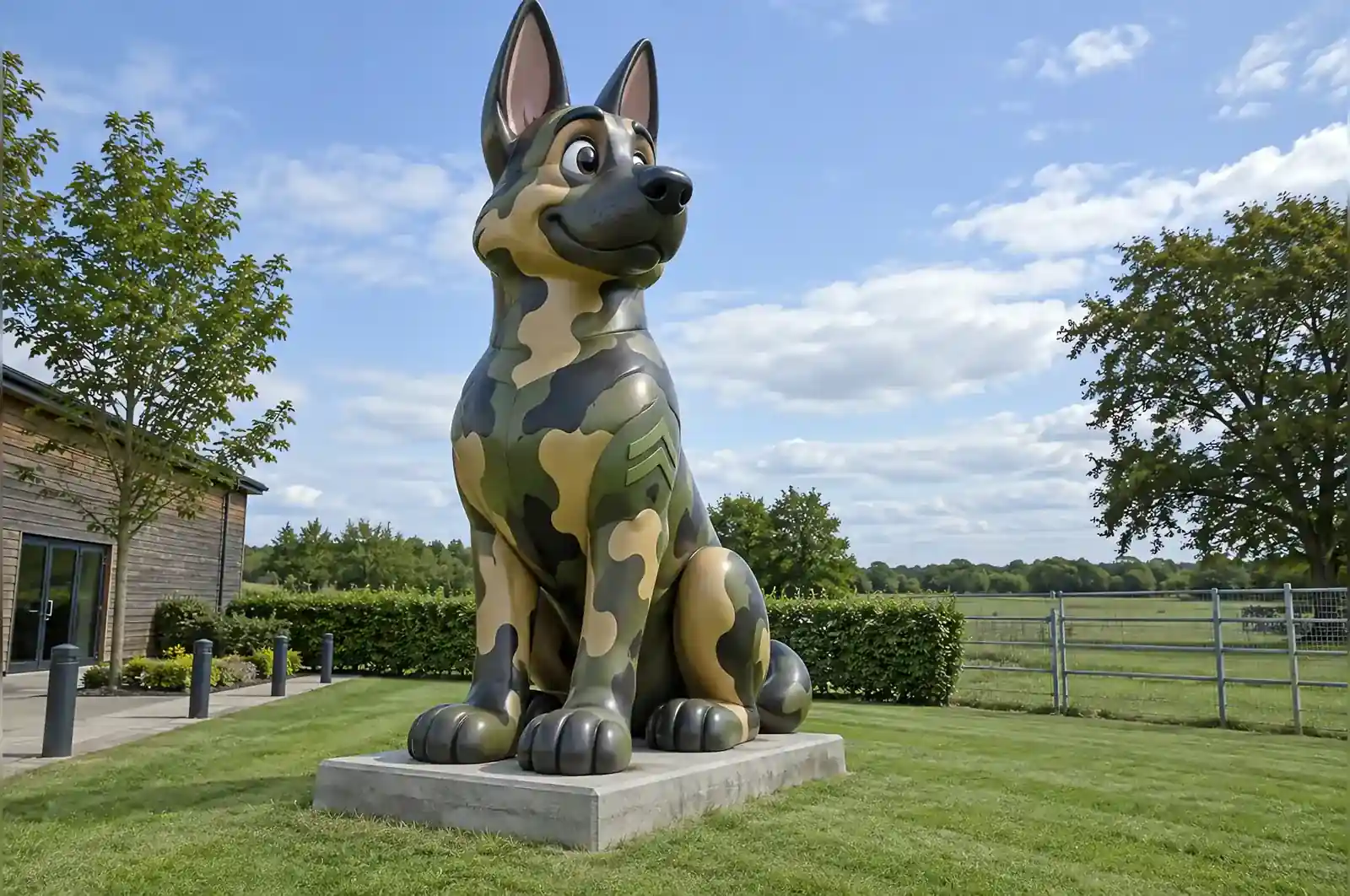
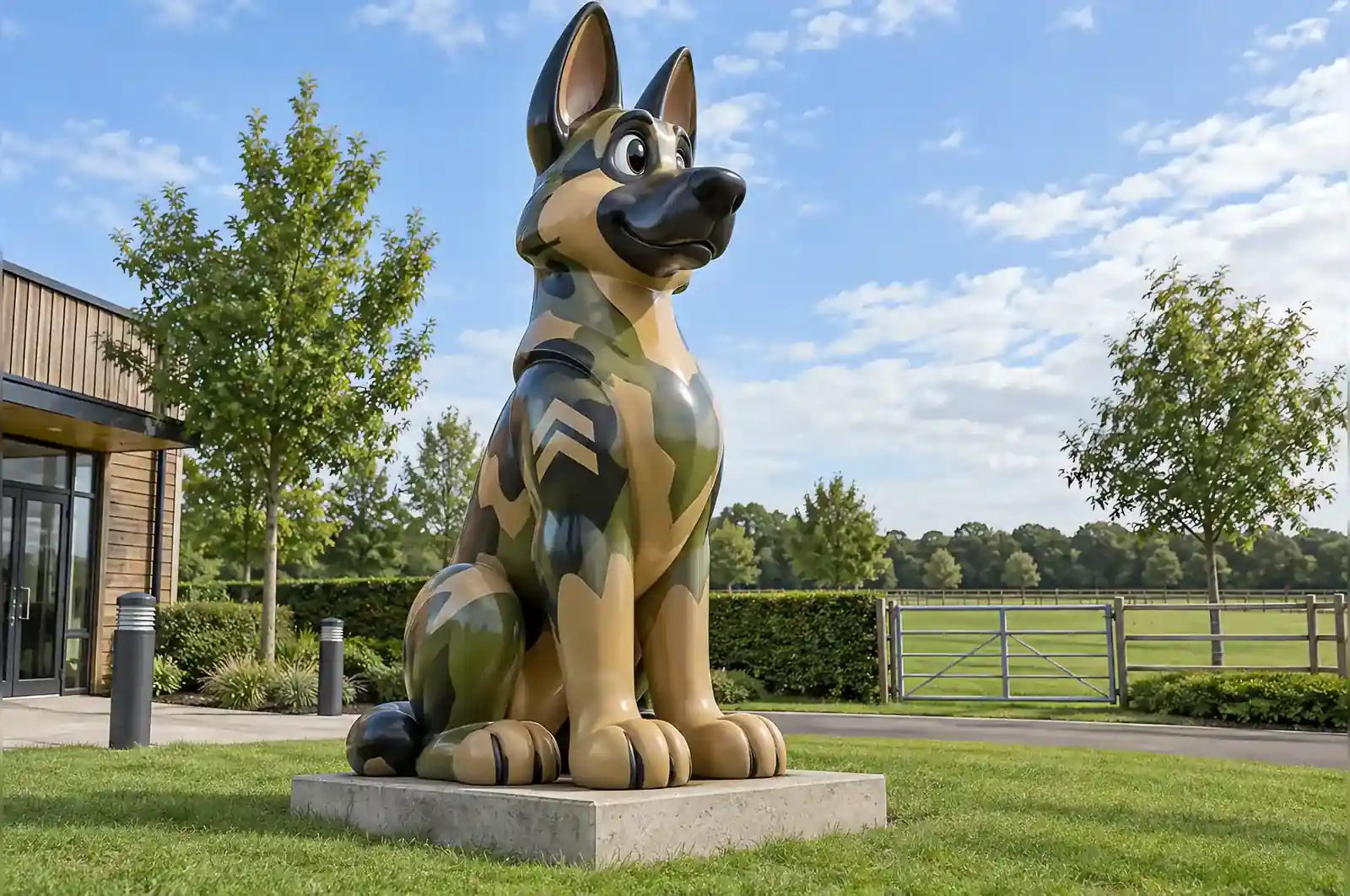
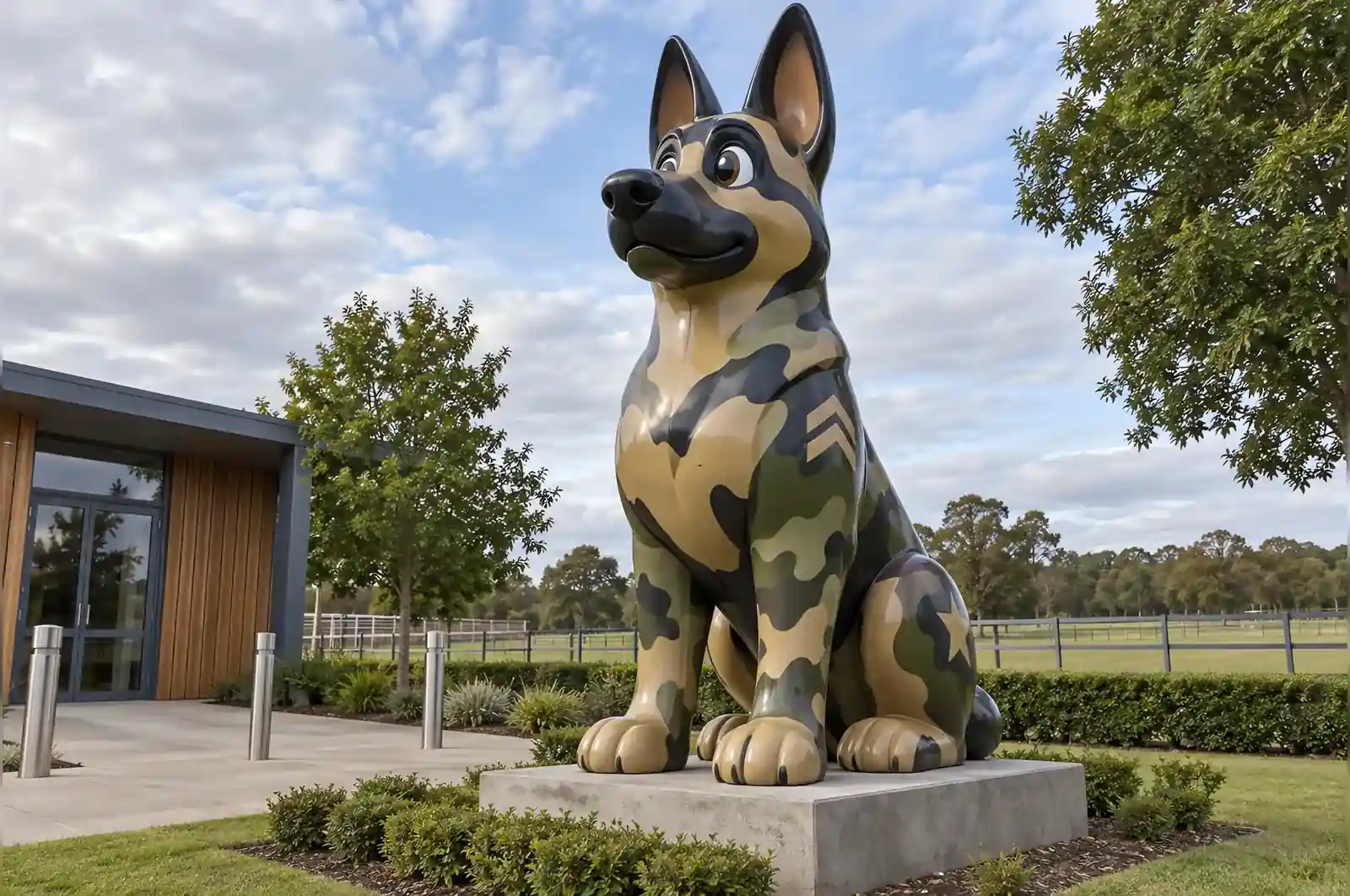
Memorials for working animals are difficult to get right. Done literally they become sad, and a sad sculpture in a training yard is a daily weight on the people who work there. The centre had already decided against bronze before they called us.
nn
What they asked for
n
A german shepherd, sitting, 2.6 m, in camouflage paint. Two reasons for the camo, and they were both good. It belongs to the world of working dogs rather than the world of garden ornament. And it lets a plainly emotive object be something you notice first as a pattern and understand second as a memorial.
nn
The posture
n
We tried standing. Standing read as a statue of an idea. Sitting, with the head level and the ears fully upright, read as a dog waiting for its next instruction, which is what a working dog actually is. The chest depth and the straightness of the front legs were set from photographs of three different animals; there are no identifiable features from any one of them.
n
The head is oversized by about a third relative to a real shepherd, and the muzzle is shortened. That is what allows it to stay a cartoon at 2.6 m instead of tipping into a portrait.
nn
The camouflage
n
We kept the pattern clean and stylised rather than photoreal military. Four colours — olive, sand, deep green, charcoal — in large soft shapes, plus a few hard stencil-like marks that do not spell anything. The satin topcoat keeps it legible in the flat Canterbury light, where a gloss finish would have turned the pattern into glare.
nn
Why not bronze, and what that changes
Bronze memorials for animals are usually darkened, patinated and set on a plinth, and every one of those choices adds distance between the object and the person looking at it. This centre wanted the opposite: a figure that handlers would touch without thinking about it. Fibreglass painted in a satin finish invites that; bronze at the same size reads as an object with a rule around it, and the maintenance regime (wax annually, accept the patina) is somebody’s job. The material decision here was made before design, and it decided the posture, the finish and the placement as well.
The wear that is not damage
Handlers rub the top of the head on the way past, and after two years that is a polished patch with the paint burnished through in the middle. The centre has asked for it to be left. That is the correct call and it is worth designing for from the start: the head carries the thickest gel-coat layer on the piece, so the burnishing has something to work through before it reaches laminate, and the satin topcoat is touchable rather than fragile. A memorial that shows where people put their hands is doing its job. What we would not do is re-spray the head to make it look new, because the patch is the only part of the piece that is not us.
Camouflage that has to survive Christchurch light
Canterbury light is flat, bright and very even, which is unforgiving to a four-colour pattern: gloss turns the lighter values into glare and the pattern collapses into a grey shape. The satin topcoat was chosen for that specifically, and the four colours were pulled apart in value rather than in hue, so the pattern still reads as a pattern when the sun is behind cloud. The stencil marks were kept abstract — no lettering, no insignia, nothing that could be read as a unit marking — because the moment a pattern contains a word the piece becomes a sign and the memorial becomes an interpretation.
Commissioning a working-animal memorial
Ask what the people who work with the animals will do with the piece, not what visitors will think of it. Handlers touch, lean and walk past; visitors read. If the two answers conflict, build for the handlers and let the visitors read the panel. Then decide where the figure stands relative to the daily route — this one is at the edge of the exercise yard, not at the gate, which is the difference between a piece that is part of the working day and a piece that is a sign at the entrance. And agree the wear policy before installation, because a memorial that is regularly restored to look new loses the thing that makes it a memorial.
One number is worth agreeing in writing at the same meeting: the interval at which the piece may be repainted. Every repaint closes the burnished patch on the head and starts the wear again, so a centre that repaints every three years is choosing to reset the memorial, and one that repaints when the laminate is exposed is choosing to keep it. Neither is wrong. What is wrong is discovering the difference after the first invoice, which is why it goes into the handover file beside the cleaning sheet.
Handlers, in our experience of memorials in working yards, notice a re-sprayed head within a week and mention it for years.
At the centre
n
It stands at the edge of the exercise yard rather than at the gate, so it is part of the day rather than an entrance feature. The handlers rub its head on the way past. That wear is already showing and nobody there wants it cleaned off.
nn
It is a cartoon, so nobody finds it maudlin, and it is a shepherd, so everybody who trained here knows exactly who it is for.
A K9 training centre in Christchurch, New Zealand