
Fiberglass Sculpture Process: From 3D Model to Full-Size Statue
2026-09-18
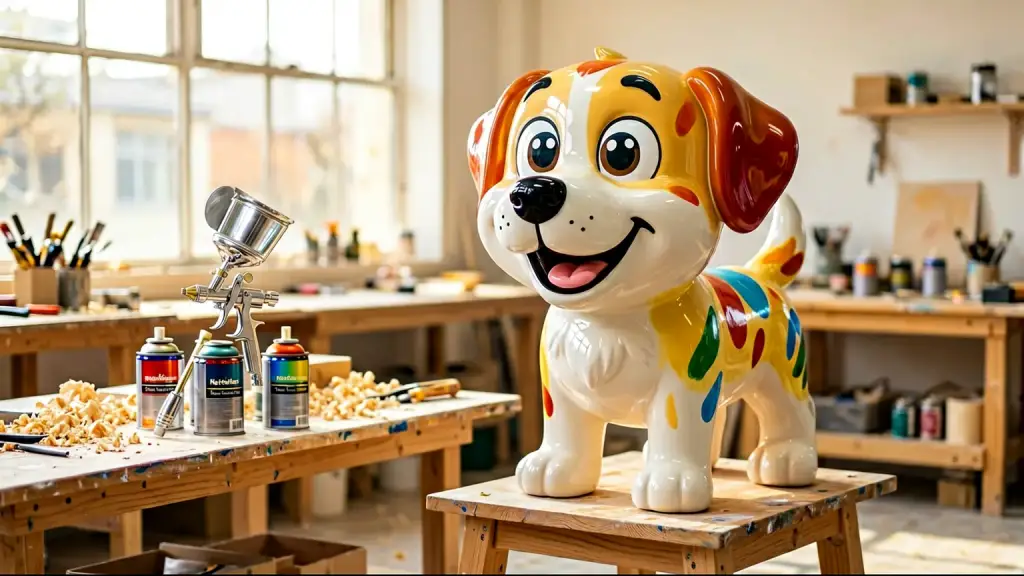
Every commission starts the same way: a handful of photographs, a size, and the same question — what actually happens between the picture I send and the crate that arrives? For a large cartoon piece the answer is seven stages, and a 1.5–2.0 m fiberglass sculpture runs six to nine weeks end to end. This is what each stage involves, and where the time and the money really go.
We publish the whole sequence on our Our Process page, so nothing here is a reveal. What a summary cannot show is the hand-work inside each step — the part that decides whether a cartoon sculpture reads as the character you had in mind or as a generic ornament. That is what this guide is for.
The fiberglass sculpture process in order
| Stage | What happens | Typical time |
|---|---|---|
| 1. Photos & brief | You send two or three clear angles plus size and setting; we reply with an honest read and a fixed quote. | 24 hours |
| 2. Quote & sign-off | Size, material grade, internal frame, freight and warranty confirmed in writing. | 1–3 days |
| 3. 3D model | The form is built in three dimensions and you approve renders from every angle. | 1–2 weeks |
| 4. Full-size build | The approved model is scaled up and sculpted over an internal steel frame. | 1–3 weeks |
| 5. Mould | The full-size form becomes a multi-part mould that holds every painted detail. | 1–2 weeks |
| 6. Layup & finishing | Glass-fiber layers are laminated into the mould, then filled, sanded and primed. | 1–2 weeks |
| 7. Paint & delivery | Automotive paint, hand-painted detail, UV clear coat, crate and freight. | 1–2 weeks |
Above 2 m the build is sectioned, the frame is drawn by a structural engineer, and everything stretches by roughly 20–40%. We only take on fiberglass cartoon sculpture from 1.5 m up, because below that a cartoon’s exaggerated proportions have nowhere to live — the head, hands and feet that make the character recognisable collapse into a blob.
Stage 1–2: photographs in, fixed price out
Two or three photographs are usually enough: a front view, a profile, and a three-quarter angle. Old photos and phone video are fine — we are reading shapes, not chasing resolution. What we cannot work from is a single smiling snapshot with the head turned away, which is why we ask first rather than guess later.
The quote that follows is fixed, not an estimate. It names the material grade, the wall thickness, the internal steel frame, freight, who pays duty and the length of the warranty. If you want to know which references actually support a large piece, our guide to how many photos you need to commission a sculpture goes through it properly.
Stage 3: the 3D model — where the likeness is won
The approved photographs are turned into a three-dimensional digital model, and you get renders from every angle before a single physical piece is cut. This is the one stage where revision is genuinely cheap, so it is the stage to be fussy about. Two rounds are included.
Exaggerate proportion, not identity
Cartoon work is a translation, not a caricature of the person it is meant to represent. We enlarge the head, thicken the limbs and simplify the silhouette — the language of a cartoon — but the features that make the subject themselves, the set of the eyes, the shape of the muzzle, a favourite marking, stay faithful. Get that balance wrong and you have an insult rather than a portrait. Get it right and a fiberglass cartoon sculpture reads as affectionate even at three metres tall.
Nothing goes into production without your sign-off, and if a model cannot be made to work we will tell you at this point rather than after the layup.
Stage 4: the full-size build
The approved model is scaled up and sculpted at full size over an internal steel frame. Every piece above 1.5 m carries one, and above 2 m the frame is engineered and documented. This is the stage where the schedule is won or lost: a frame that flexes means a mould that distorts, and a mould that distorts cannot be rescued by paint.
The frame is also the line item a cheap quote quietly leaves out. On a large piece it is typically 10–20% of the total cost, and it is the difference between a statue that holds its shape through a decade of weather and one that slowly droops.
Stage 5: the mould
The full-size form becomes a multi-part mould. For a complex cartoon character that can be eight or ten separate pieces, split along the lines where the surface turns away, so no mould seam lands on a face or a painted marking. This is where the process pays for itself: because fiberglass is laminated into a mould rather than carved, the same mould can produce ten identical pieces at a fraction of the per-unit cost of building each one by hand.
Stage 6: fiberglass layup — how a fiberglass statue is actually made
With the mould ready, the statue itself is built in layers. This is the part people picture when they ask how to make fiberglass statues, and it is more deliberate than it looks.
Layer by layer
- Gel coat first. A pigmented resin skin goes into the mould before anything structural. It becomes the outer surface of the finished piece, so it carries the sharpness of every line the pattern held.
- Chopped-strand and mat layers. Glass-fiber is built up in alternating layers over the cured gel coat, saturated with resin and rolled out by hand to drive out air. Trapped air is the single most common cause of a weak panel or a blister three years later.
- Woven cloth at stress points. Woven roving goes where a cartoon’s shape concentrates load — ankles, wrists, the base of a tail, anywhere a limb meets the body.
- Bonding to the frame. The shell is bonded to the internal steel frame, which carries the weight the fiberglass alone should never be asked to take.
- Release, trim, fill, sand, prime. The piece comes out of the mould, edges are trimmed, seams are filled, and the whole surface is sanded and primed. This is 30–40% of the hand-work and the stage clients always underestimate, because nobody sees a sanded panel — they only see the paint that could not hide a bad one.
Stage 7: paint, detail and clear coat
Finishing is multi-layer automotive paint: base colour, hand-painted detail for markings, eyes, a collar, a logo or a nameplate, then a UV clear coat sealed over the top. That clear coat is what decides how long the colour survives outdoors, so it is specified on every job — it is the reason a fiberglass sculpture holds 15–20 years in a garden rather than four.
The paint stage is also where cartoon work diverges from fine art. A painted cartoon face wants flat, confident colour and a clean edge, and the panel beneath has to be perfect before a single drop goes on. We cover the material trade-offs in plain numbers on our Materials page.
What the process means for you
- Time. A 1.5–2.0 m fiberglass cartoon sculpture is a six to nine week build, plus sea freight of four to eight weeks depending on destination. If you have a fixed date, say so at the start — it is far easier to plan around a deadline than to recover one.
- Where to be decisive. Pose, colour and detail changes are cheap at stage 3 and expensive afterwards. Everything on our cartoon sculpture timeline hangs off that one rule.
- Scale. We build from 1.5 m up. If you are weighing up a small desk piece against a garden-scale one, the life-size cartoon sculptures page covers what changes as a piece grows.
- Material. Fiberglass is what we make, and it is the only route that reproduces an exact colour — a specific coat, a set of markings, a painted face. Where a bare-metal look is essential we will say so honestly, even though we do not fabricate it.
That is the whole process: two or three photographs, a model you approve, a full-size build over an engineered frame, a mould, a hand-laid shell, and a paint job finished under clear coat. Seven stages, and no stage you cannot see coming. If you have photographs ready, the first one is free — send them over and we will tell you what is possible.
More from the Workshop
Ready to Start?
Send us photos and get a free, honest quote within 24 hours — no obligation.
Get a Free Quote