Buster — Life-Size Cartoon Golden Retriever, Bend, Oregon
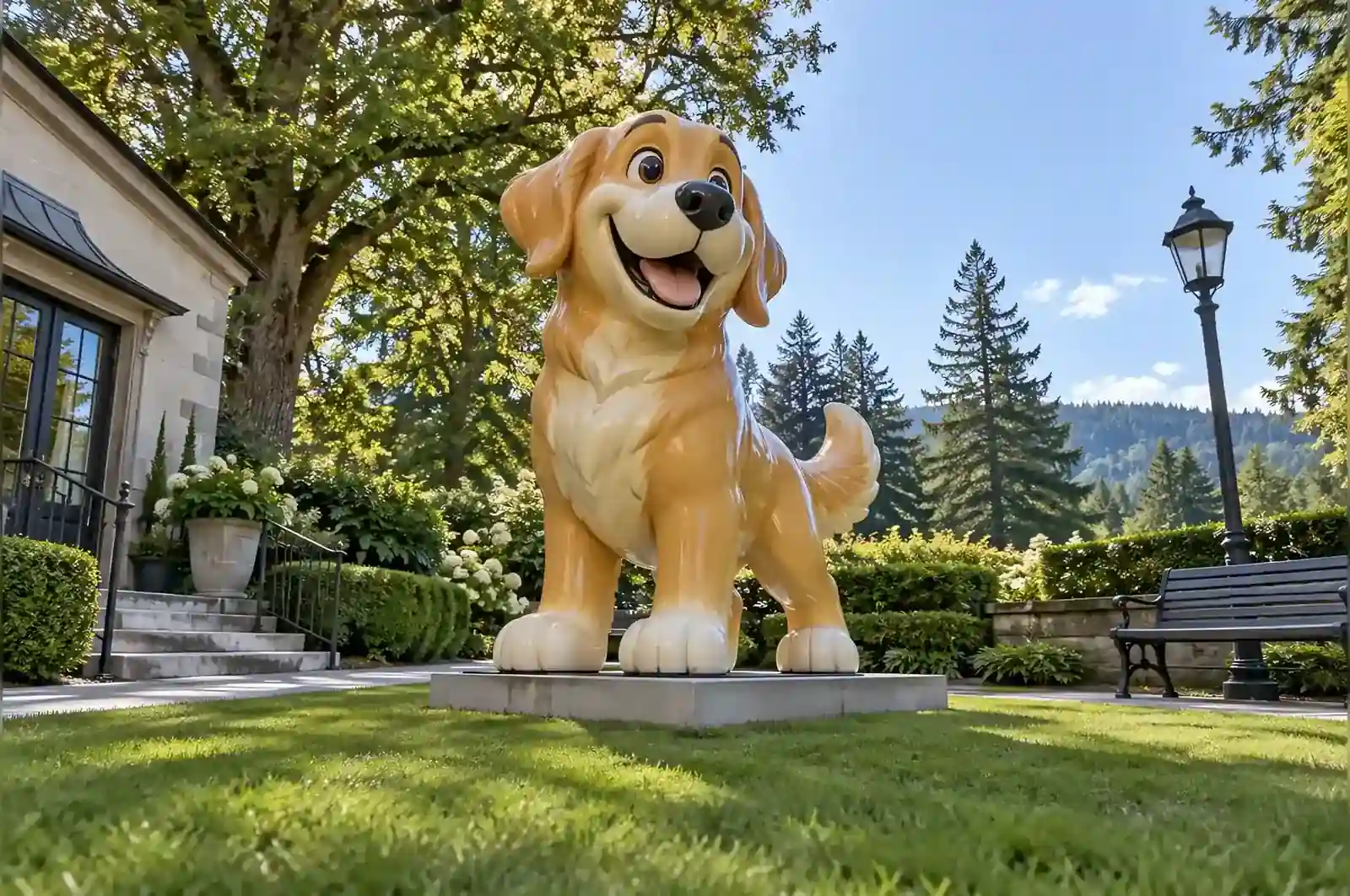
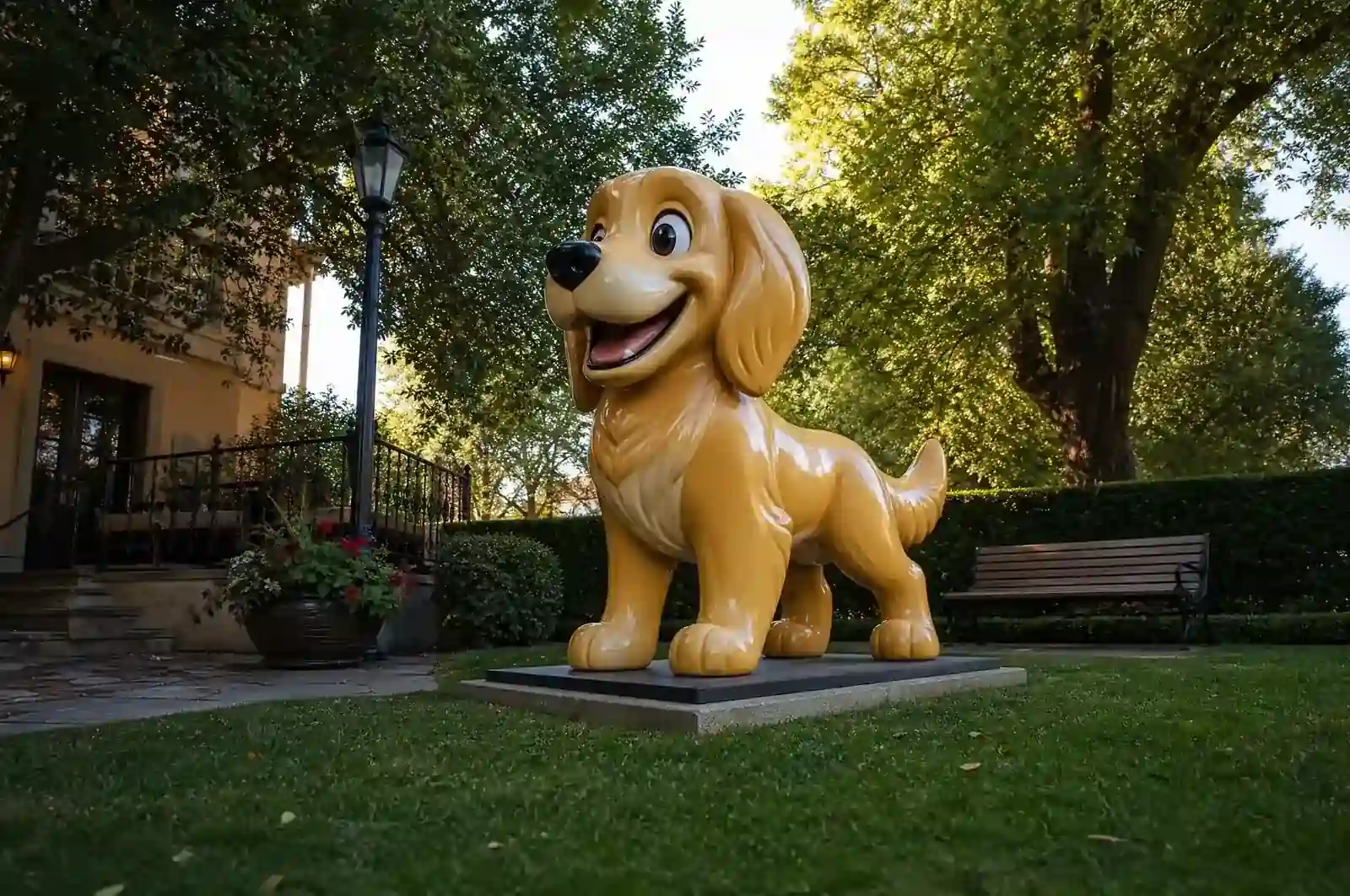
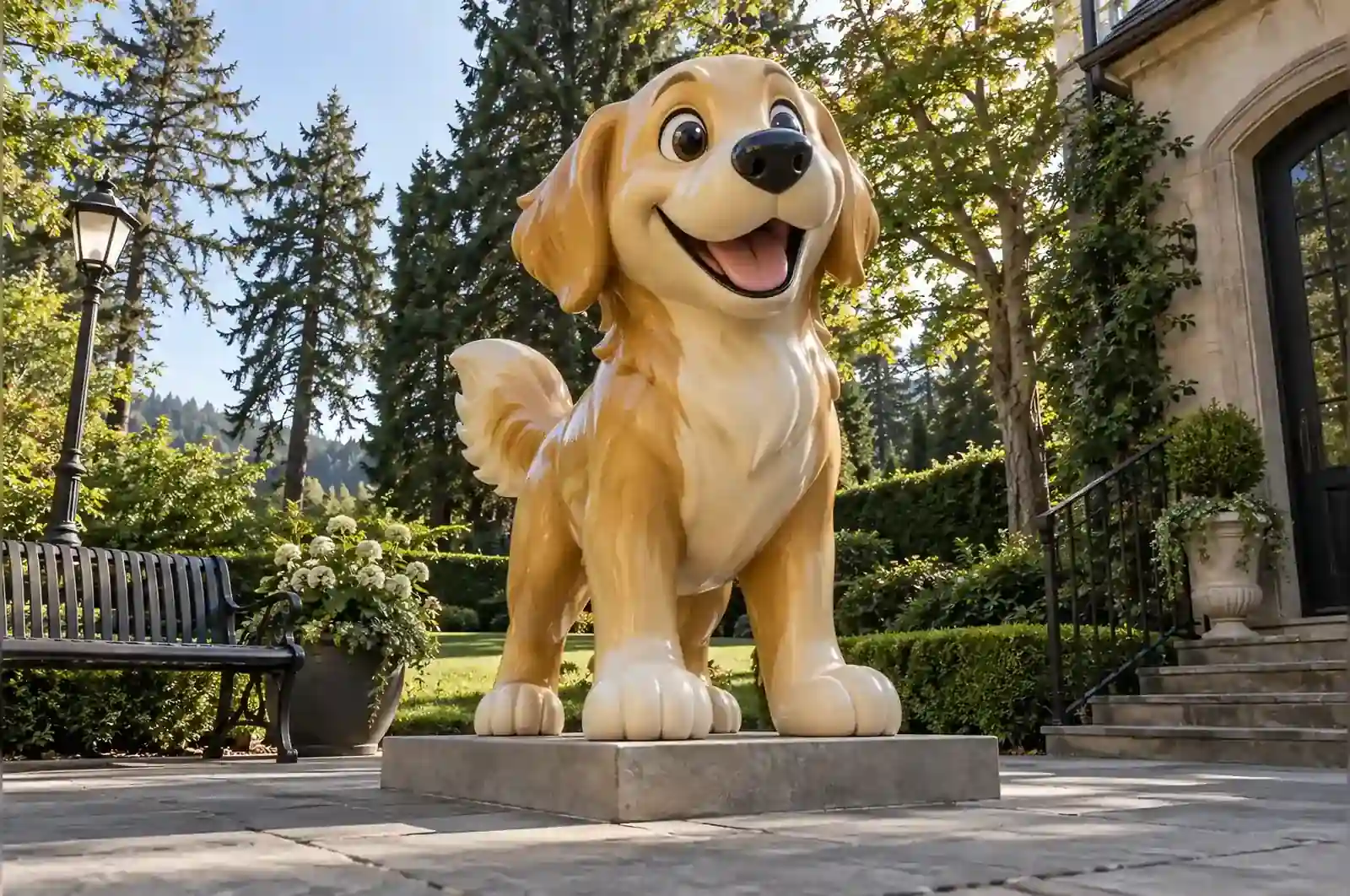
Buster had claimed the same patch of grass at the back of a garden in Bend, Oregon for thirteen years. The family did not want him in a box on a shelf. They wanted him where he was, and they wanted him big enough to greet people at the gate.
What they asked for
Not a memorial in the solemn sense — a cartoon portrait of a dog who sat. The brief was explicit about tone: friendly, rounded, clearly a cartoon, but unmistakably Buster. They sent phone snapshots from his last two years and about forty seconds of video, and asked for a life-size seated piece that could stay outdoors year-round in central Oregon.
What the placement fixed
The non-negotiable on this commission was not the dog. It was where the dog had to live. Buster was going back onto the same patch of grass, outdoors, all year, in central Oregon — a high-desert climate with intense summer sun, very dry air and ground that freezes and thaws through winter. That single fact set the size, the material and the finish before the first sketch was drawn.
The size was fixed by the gate. He had to greet people at the entrance, and the family wanted him at full scale, so 1.6 m it was. Anything above 1.5 m gets an internal steel frame, and that frame is what lets him stand on a lawn with no foundation at all — and what accounts for roughly a tenth to a fifth of the cost. Had the brief allowed something smaller, a shelf or table piece, the frame would have gone and the budget with it.
The finish was fixed by the outdoors. Gloss, multi-layer automotive paint sealed under a UV clear coat is a weather decision, not a style one. If he had been destined for a sheltered interior, a matte or satin finish would have been a live option and the clear coat would have been doing far less work.
Building it at full size
We built him at 1.6 m tall over an internal steel frame, which every piece above 1.5 m needs. The frame is what lets a sculpture this size stand on a lawn without a foundation, and it is typically 10–20% of the cost. The cartoon proportions came from pushing the head and paws while keeping the tilt of his head exactly as it appears in the video.
The finish
Gloss-painted fibreglass: layered glass-fibre in a mould, then multi-layer automotive paint with the cream chest and the white muzzle hand-painted, sealed under a UV clear coat. That clear coat is what gives a fibreglass piece 15–20 years outdoors before it needs refreshing.
Installation
He stands on a low concrete plinth on the lawn, bolted through the base. No groundworks, no crane. The whole piece weighs a fraction of the bronze equivalent, which is the practical reason fibreglass is the value choice at this size.
Aftercare in a Bend garden
The thing a piece like this actually needs is not repainting — it is attention to the joint between the sculpture and the ground. Buster is bolted through his base onto a low concrete plinth, and in Bend the soil under that plinth freezes and thaws several times a winter, nudging the ground by millimetres each cycle. That is why the base is bolted rather than grouted: the bolts can be re-tensioned, and a seasonal check of the plinth is the single most useful maintenance task on a sculpture of this size.
The second job is the clear coat, not the paint beneath it. A gloss finish at 1.6 m in full sun takes the heaviest UV load on its horizontal surfaces — the top of the head and the back. Washing those surfaces a couple of times a year keeps the UV clear coat doing its work, and it is the clear coat, not the colour under it, that delivers the 15–20 year outdoor life. When it finally dulls, it is refreshed with a re-coat, not a repaint.
For this family the practical rhythm is modest: a wash in spring, a check of the bolts, and a look at the clear coat every few years.
What it cost
A 1.5–2.0 m fibreglass sculpture surveyed overseas lands between $900 and $5,900. This commission came in at $3,850 delivered, nine weeks from 3D approval, including the engineering on the frame and the crating.
What to settle before you ask for a quote
Three questions decide most of the cost on a commission like this, and all three can be answered before a quote is requested.
First, size. Is this a piece that stands on the ground at life scale, or does it sit on a shelf or indoor plinth? Above roughly 1.5 m an internal steel frame becomes part of the build, and it is a real line item.
Second, placement. Will it live outdoors in the weather, or under cover? Outdoor placement in a strong-UV and freeze-thaw climate decides the finish and the clear coat, and it changes what the piece has to survive.
Third, likeness. Is this a character that has to read as one specific animal — as Buster had to be unmistakably Buster — or a general cartoon? A portrait brief means modelling from photographs and video, and that modelling time is the largest single variable in the schedule.
Size and placement set the envelope before likeness enters the picture; the delivered price for this commission is the one in the section above.
We were nervous about a cartoon version of Buster, but they kept the tilt of his head exactly. It has been out in Oregon rain for two winters and the paint still looks wet.
The Alvarez family, Bend, Oregon