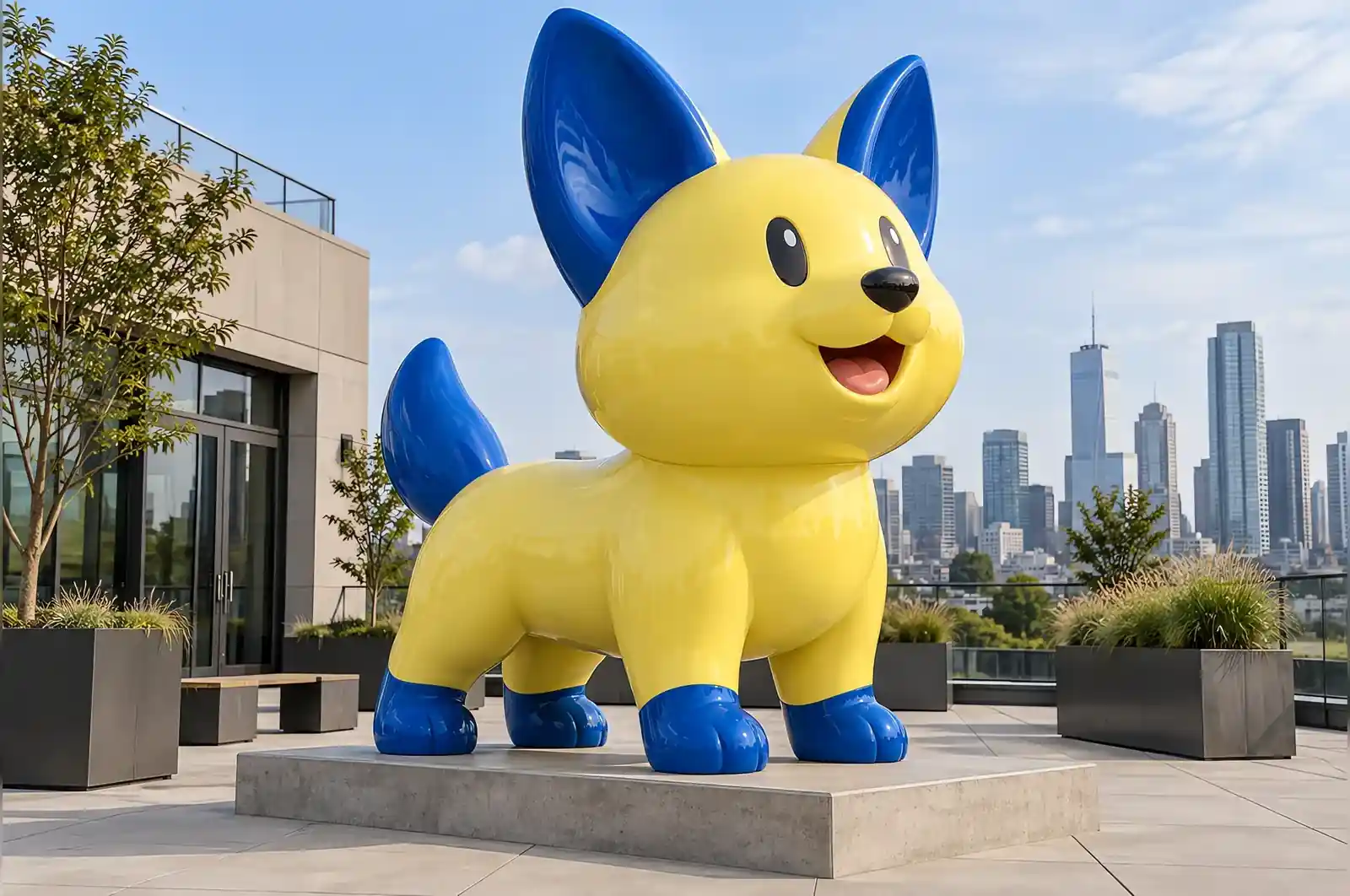
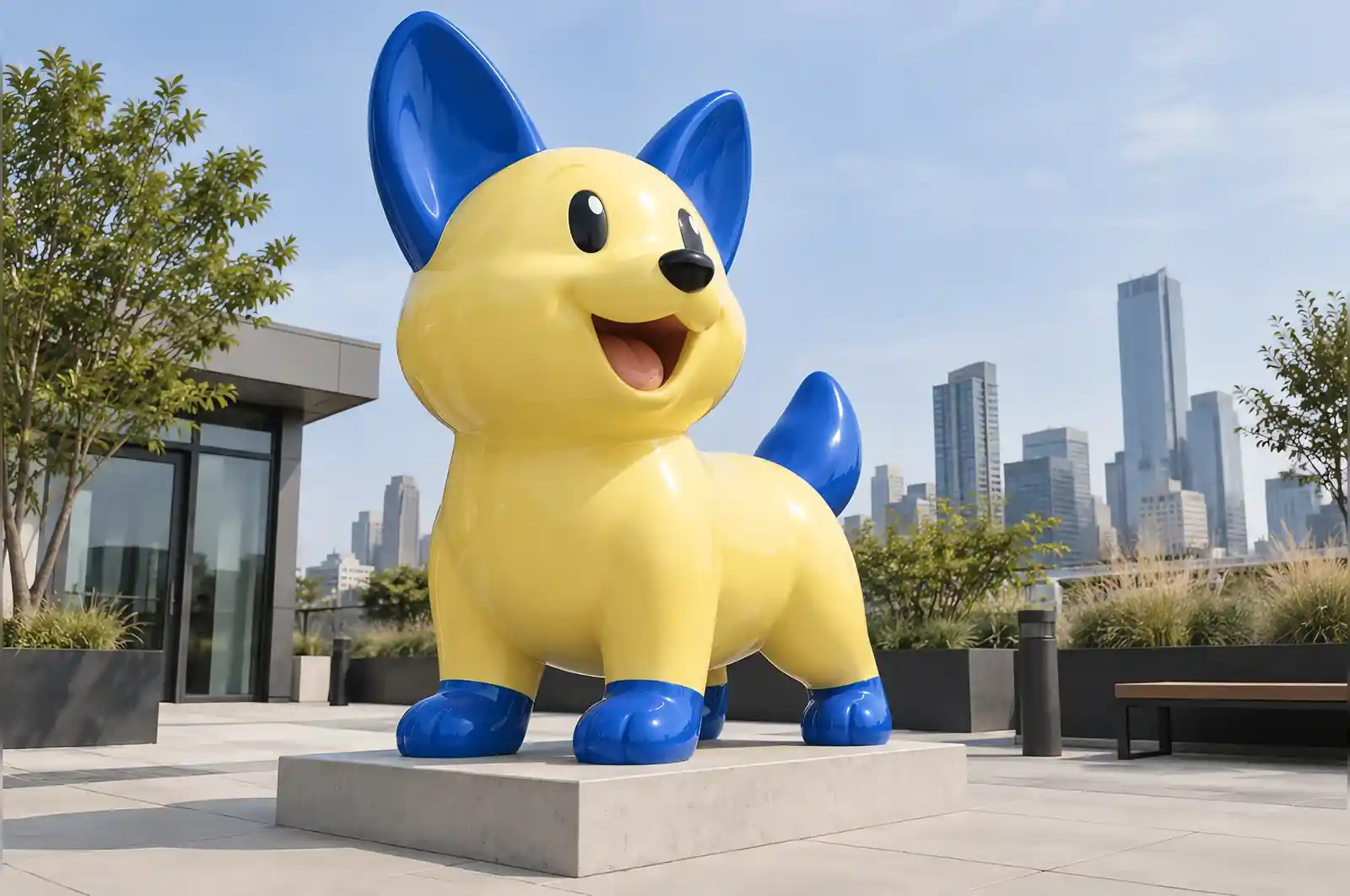
Pixel — Art-Toy Cartoon Corgi, Rooftop Terrace, Austin
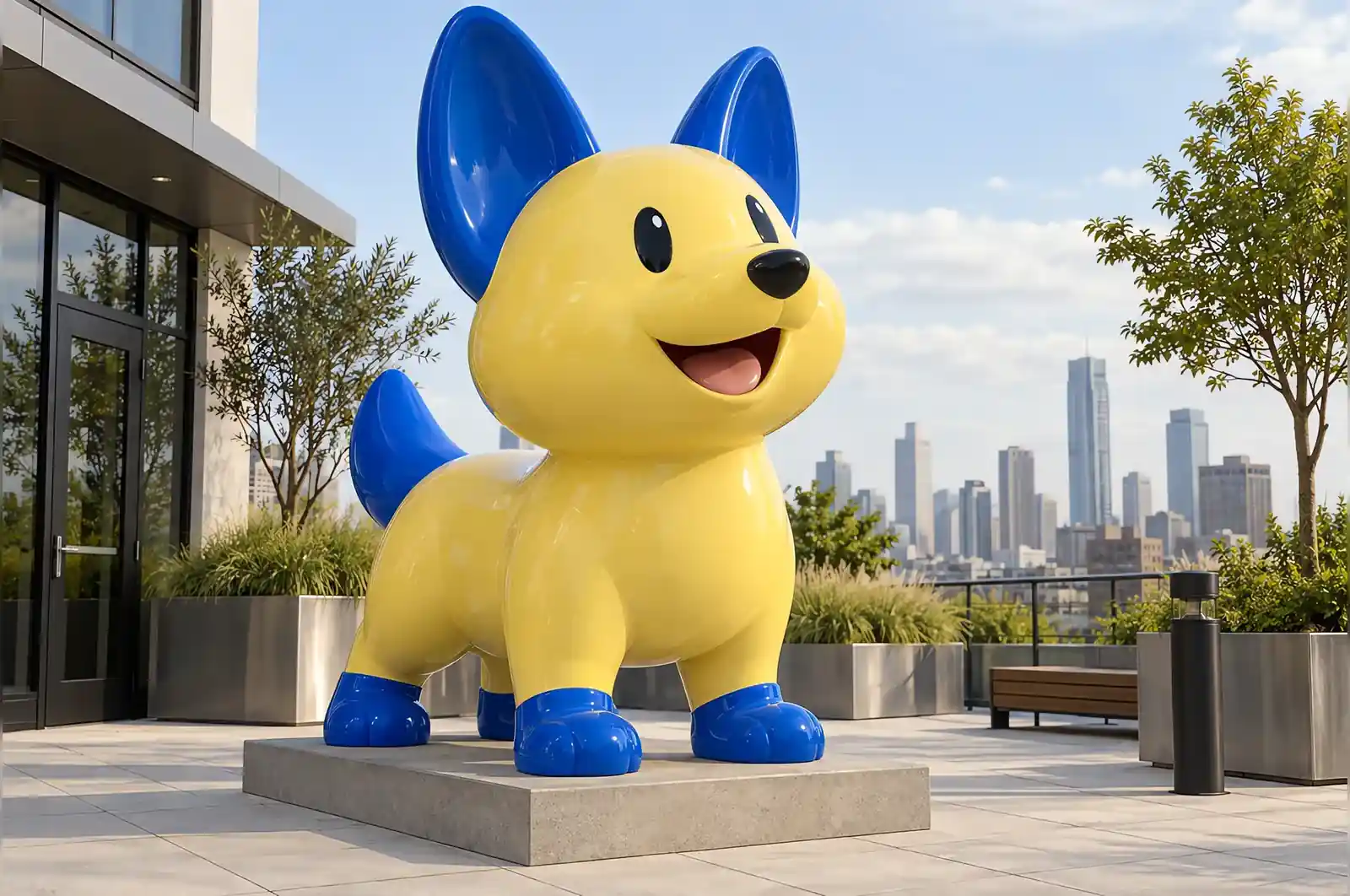
The brief arrived as a photograph of a dog and a colour swatch. The dog was a corgi called Pixel. The swatch was the butter yellow the company had used on its first business card in 2014.
What we were asked for
A sculpture for the roof terrace of their office, roughly the height of a person, that would read both from four floors up and from the pavement below. Not a memorial and not a portrait of a real animal — a character. The one hard rule was that it had to look like it had been made on purpose, and not like a giant pet ornament.
Designing it as a toy, not as a dog
So we stopped designing a corgi and started designing a toy. The head grew until it was almost half the height of the body. The legs shortened. The body became one plump volume with no anatomy left in it at all. Once the silhouette worked as a toy, we put the corgi back in — the upright ears, the low-slung shape — and it survived the reduction. That is the test we run on every character before we build it.
The 3D file went through six rounds because of a single problem: seen from the pavement, the ears read as two separate objects floating above the head. We thickened each ear at the base and tilted them back four degrees, which joined them into one continuous silhouette.
Build and finish
Laminated in fibreglass over a steel armature, then finished to a single ultra-gloss coat — the sort of surface you find on a designer toy, not on a garden ornament. Butter yellow over the body, cobalt blue on the ears, paws and tail. The gloss was the risky part: every hollow and every bump in the form shows in it, so the sanding took longer than the painting did.
On the roof
It is bolted through the paving into the structural slab, with a crane lug on the underside so it lifts off when the building needs to work on its roof membrane. The studio has since started using the colour as a brand accent, which we are taking as the highest compliment available.
The brief’s two hard requirements
Two things in the commission were not open to negotiation, and both of them drove the build.
The first was the height. At 1.8 m H × 1.3 m W × 0.6 m D the piece has to read from the pavement below the terrace and from the floors above it, and the dimensions were set by the roof rather than by the dog. That wide, low, stocky envelope is the silhouette that holds up against a rooftop sky. If the height had been cut to well under a metre and a half, the sculpture would have stopped reading as a deliberate object from the street and started reading as roof clutter — the brief’s single hard rule, that it look made on purpose, would have been the first thing to go.
The second was the gloss. A designer toy is a high-gloss object; a garden ornament is not. If the finish had been dropped to matte or satin, the piece would have read as exactly the giant pet ornament the client did not want, no matter how well the silhouette was drawn. The gloss also decided the build order: because every hollow and bump shows in an ultra-gloss coat, the filling and sanding had to be finished before the paint went on, not patched afterwards.
Looking after the surface on a Texas rooftop
An ultra-gloss butter-yellow surface sitting on an exposed rooftop in central Texas is asking for trouble, so the paint is topped with a UV-stable clear coat. That clear coat is what stands up to the sun; without it the yellow would drift from butter toward a washed cream over a few summers. It is also the reason the piece can be kept clean without dulling the read — soft cloth and water are enough, and abrasive cleaners are not, because they scratch the coat and turn the high-gloss surface back into a satin one.
Two things are worth checking on a schedule. The first is the fixings: the piece is bolted through the paving into the structural slab, and a fixing that has worked loose on an exposed rooftop is a real problem rather than a cosmetic one, especially in the storm season. The second is the crane lug on the underside, which is what lets the building lift the sculpture off when the roof membrane needs work. That lug has to stay clear of the paint so the rigging can be attached without scratching the gloss the rest of the piece depends on.
What to decide before you request a quote
Before asking for a quote on a piece like this, settle three questions.
First, where is it seen from and at what distance? This piece is read from the pavement and from the floors above, so it was designed as a silhouette first and a dog second. A sculpture seen only at close range can carry far more detail and a far softer form, and the two are not interchangeable: a form built for a rooftop reads as crude at arm’s length, and a detailed interior piece vanishes from below.
Second, is it a character or a likeness? Pixel is a character — the proportions were pushed until the anatomy was gone, then the corgi traits were put back in. A true portrait of a real dog keeps its anatomy and reads very differently, and the brief’s one hard rule, that it look made on purpose rather than like a giant pet ornament, is the rule for either.
Third, where will it live and what will the weather do to it? An indoor piece does not need a UV-stable clear coat or a bolted base. An exposed rooftop piece needs both, plus the access arrangements that let the building work around it. The finish and the fixing follow from that answer, not from the subject.
We asked for a mascot, not a memorial. It sits on the roof like it has always lived there, and the yellow is the exact yellow of our first business card.
A software studio in Austin, Texas