Mochi — Kawaii Cartoon Shiba Inu, Boutique Entrance, Tokyo
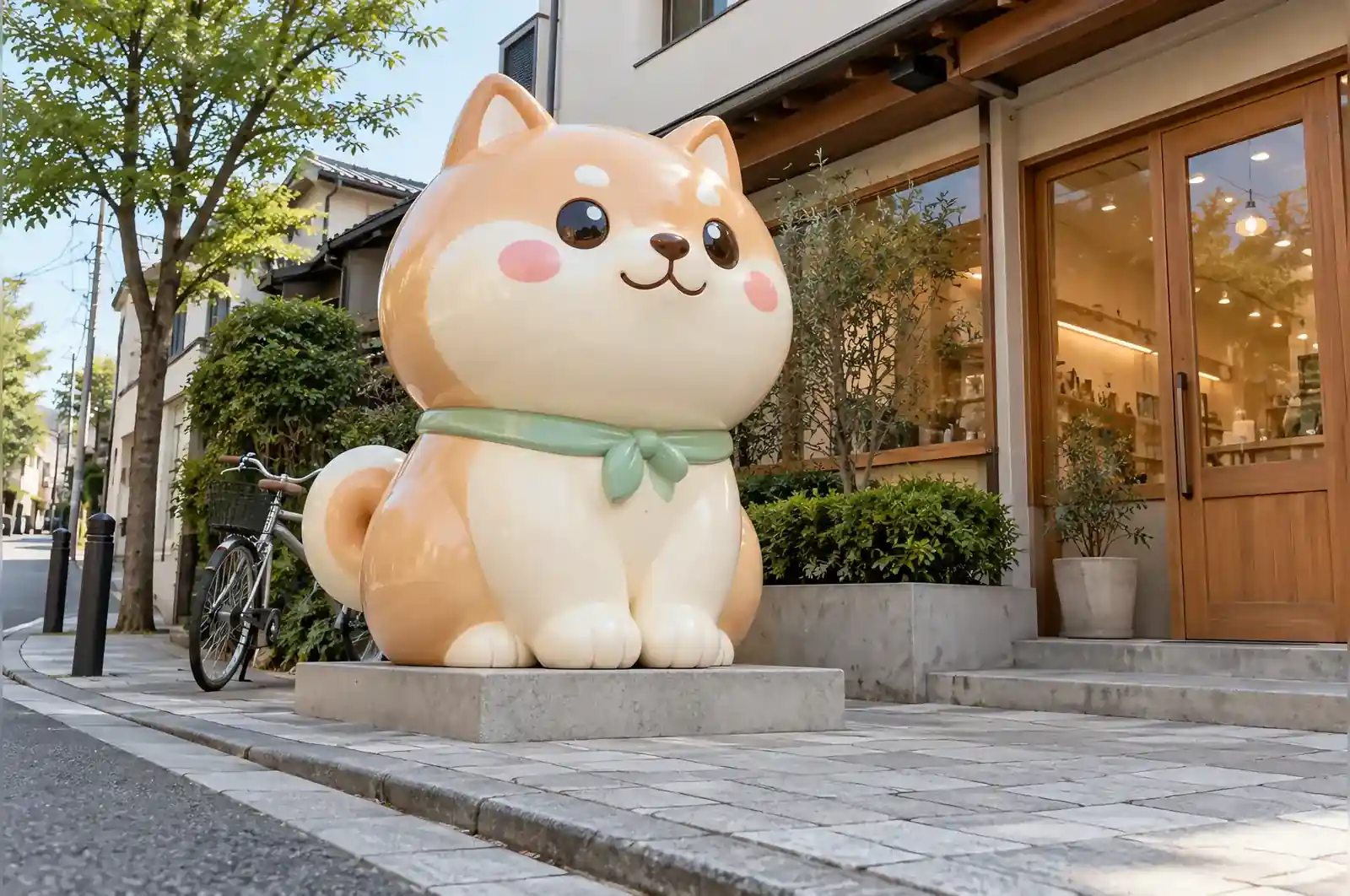
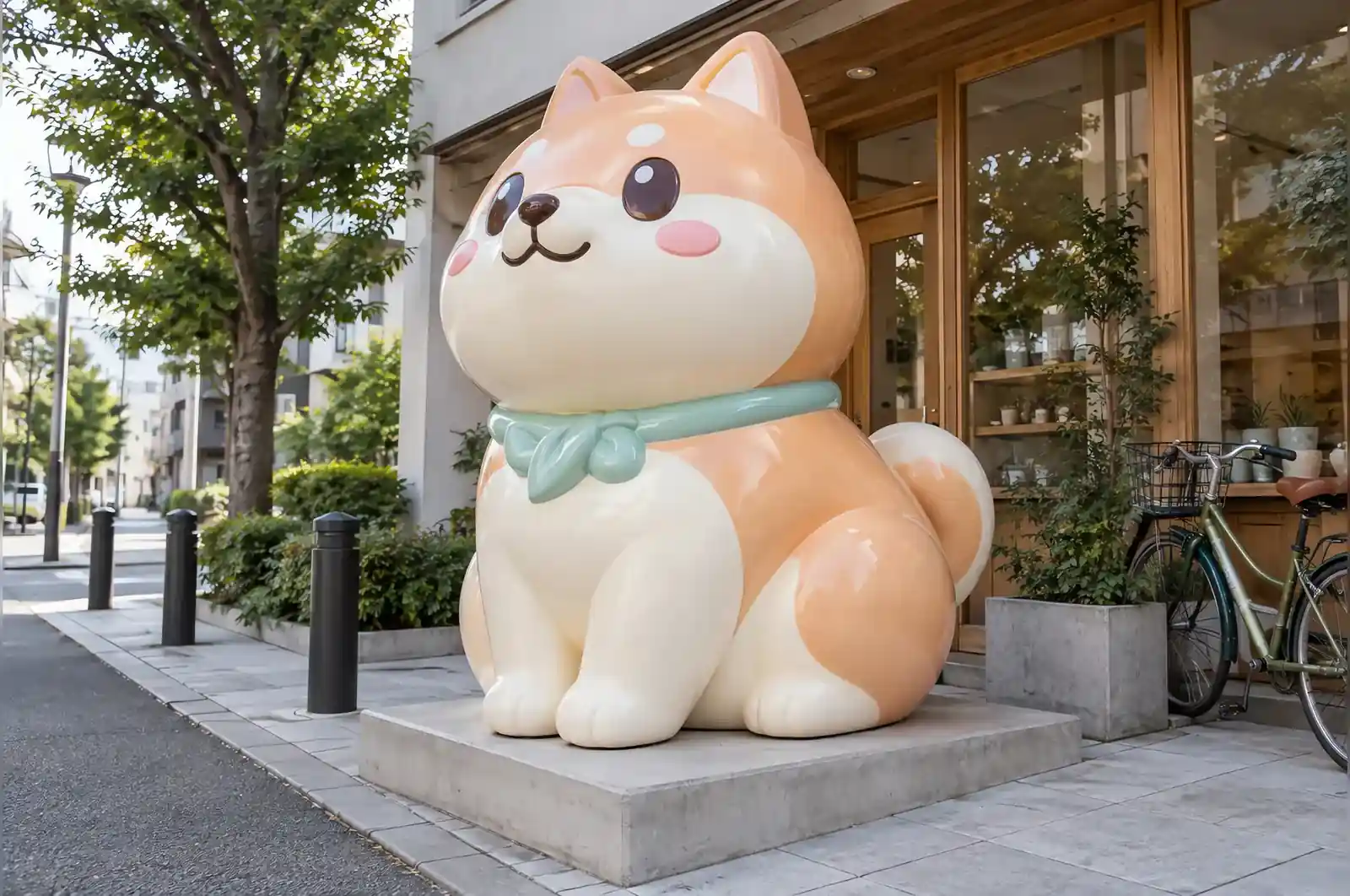

Daikanyama is full of shops that try to look like galleries. This one sells clothes for small children, and the owner wanted the opposite: something a four-year-old would run at from across the street.
The brief
A dog, plump, seated, roughly 1.6 m so that it is taller than the children it is for but shorter than an adult. It had to survive being touched, climbed on and photographed several hundred times a day, and it had to be washable, because a pavement sculpture in central Tokyo is not clean for very long.
Why it had to be 1.6 m and stay outside
Three decisions on this commission were effectively fixed before we started, and each one shaped the build. The height had to be about 1.6 m — taller than the four-year-olds it is aimed at but shorter than their parents, so a child can stand beside it and a photograph still frames both. If it had been a metre shorter it would have read as a toy to be carried rather than a landmark to run at, and the proportions we settled on (head 44% of body height, eye line at 62%) only work at this scale. The placement was the second fixed decision: it lives on the pavement outside the shop, which is why it is laminated over an internal steel frame instead of cast as a light hollow shell, and why the clear coat is UV-stabilised. A figure made for a window display or an interior lobby would carry none of that. Third, it had to be washable. If the brief had allowed an indoor placement we would have used a softer, more forgiving satin and dropped the hosing-down requirement entirely — but a pavement sculpture in central Tokyo is cleaned with water, and the finish had to be able to take it every day.
Building the cuteness on purpose
Cuteness is a set of measurements, not an accident. We raised the eye line to 62% of total height and widened the gap between the eyes. The head ended up 44% of the whole body height. The legs became so short that the body almost rests on the ground, which is what makes the figure look as though it is settling in rather than standing guard.
The client asked for pink and we argued for it, then lost, then agreed. Blush peach over the body with mint on the ears and chest. The two blush ovals on the cheeks were added in the last review and are the only element on the whole piece that is pure decoration. They are also the element children reach for first.
Finishing for a pavement
Satin rather than gloss, because gloss in a shopfront reads as plastic and shows every fingerprint. Two-pack automotive paint over the fibreglass, then a UV clear coat, which in practice means the piece can be hosed down and still look new. The shop has had it for a full summer now and the colour has not moved.
A top-heavy head and a satin that will not scratch
The head is 44% of the total height and the legs are so short that the body almost rests on the ground, which makes this a top-heavy figure with a small contact patch. That is the reason for the internal steel frame rather than a plain fibreglass skin: the frame is welded to a base plate that sits inside the lowest part of the body, so the weight of the sculpture — and the weight of a child leaning on it — is carried down through the base instead of through the shell. The two-pack paint is what makes the daily washing possible. On its own it is hard and water-resistant, but the UV clear coat is the layer that actually takes the wear, which is why the satin sheen survives hosing and fingerprints. It should be cleaned with water and a mild detergent only. An abrasive pad or a solvent will cut through the clear coat and leave a dull patch, and once that is gone the satin has to be re-cleared. After a full Tokyo summer outdoors the colour has not moved, and that is exactly what the top coat is there to prevent.
What it does for the shop
We built it as a sign, and it works as a sign. The owner reports that parents photograph their children next to it and then come in. Nothing about the sculpture says the name of the shop, which was deliberate — a character people choose to photograph is worth more to a shopfront than a logo they ignore.
Three questions to settle before you ask for a quote
Most of the cost decisions on a piece like this are settled before anyone starts modelling, and they are worth putting in writing first. Is it going to be touched, climbed on and photographed all day, or is it display only? A display-only figure does not need the internal frame, the base plate or the abrasion-resistant clear coat, and it can be built lighter and cheaper. Where is it going to live — pavement, or indoors? An indoor piece can use a softer satin and a lighter structure; a pavement piece needs the washable UV-stabilised finish and the fixing that stops it being pushed over. And what is the scale relationship you actually want? The proportions here — head at 44%, eye line at 62%, the body settled on the ground — are tuned to a 1.6 m figure that a child runs at. If the brief is for a 2.5 m landmark or a 0.8 m desk piece, the same numbers produce a very different animal, and the modelling should start from the scale, not the species.
Children stop and hug it before their parents can read the sign. That is more effective than any signage we have ever paid for.
A children's clothing boutique in Daikanyama, Tokyo