
Pearl — Polka-Dot Cartoon Poodle, Art Island Garden, Naoshima


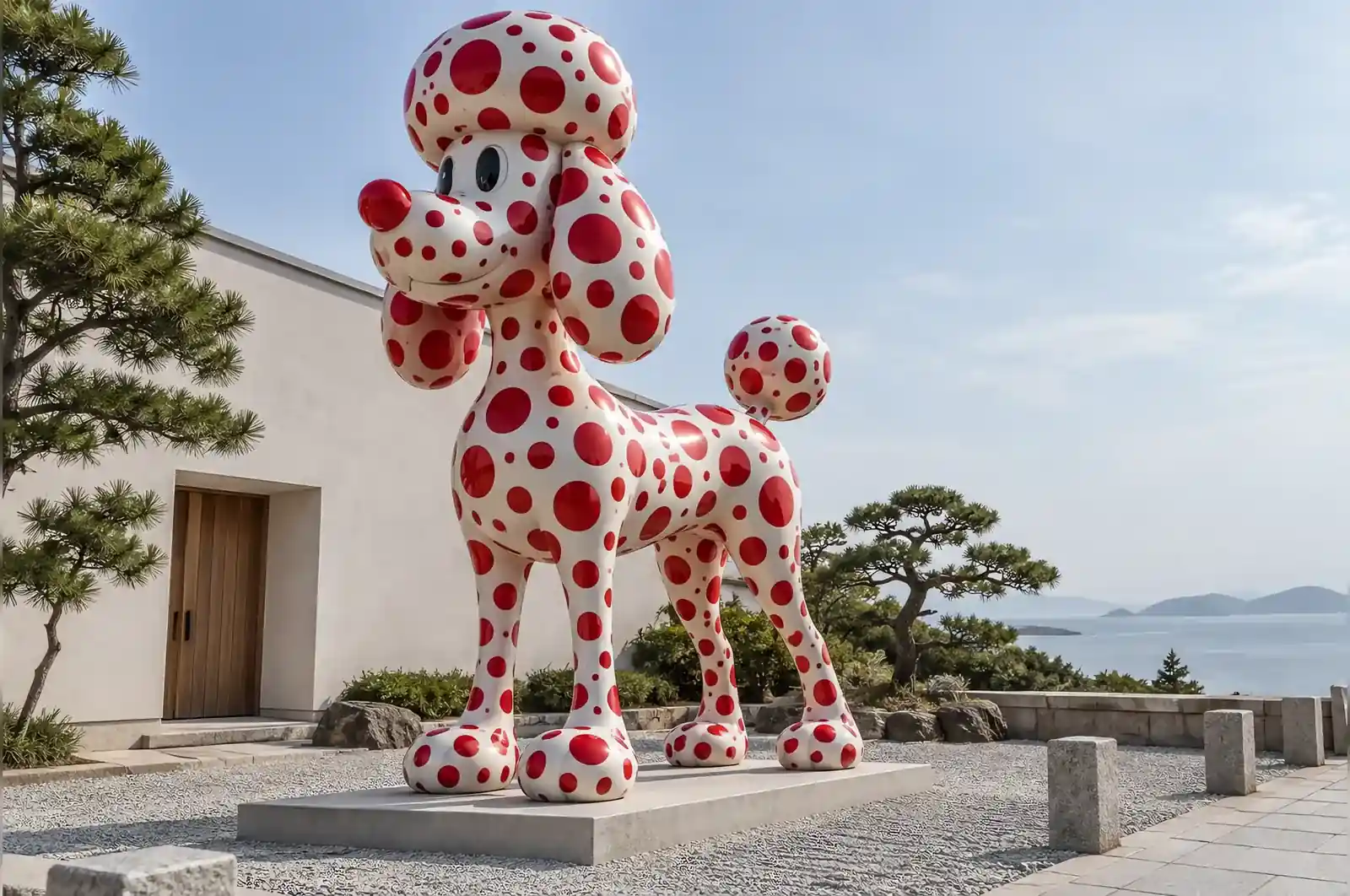
This one is a game played with distance. The client walked the path to her house several times a day and wanted something that changed as she approached it.
The brief
A poodle, about 2 m, in a single-hue polka-dot pattern — deep crimson dots on a chalk-white ground. From the far end of the garden it had to read as a piece of pattern, almost an object from the collection. From two metres away it had to read unmistakably as a cartoon dog.
Why the pattern had to be painted, not wrapped
A dot pattern applied as a flat graphic dies the moment it meets a curve. To survive the form, every dot had to be projected onto the 3D model, then painted across the seams after lamination so the pattern continues without a break through the legs, the topknot and the ears. We used five dot sizes. The largest sit on the broad planes of the body where curvature is gentle; the smallest cluster around the muzzle and the ankles, where a large dot would have shredded the silhouette.
The topknot is the exact point where the two readings swap. At distance it is a dense knot of dots; up close it is a pompom, and it is the only place on the piece where the dots are allowed to touch each other.
What could not be compromised
The brief had one fixed point: the pattern had to hold both readings. Pattern from the far end of the garden, cartoon dog from two metres. That single requirement is what set the size, the finish and the paint plan, in that order.
The 2 m height is not a stylistic choice. At 2 m the broad planes of the body are wide enough to carry the largest dot size without the dots shredding the silhouette, and the piece still reads as a dog from a human two metres away. Drop the height to something table-scale and the distance reading collapses into a speckled shape that could be anything; the garden corner no longer has an object in it.
The gloss UV clear coat belongs to the same decision. A matte finish would have absorbed the island light and blurred the dots as soon as the viewing distance grew; the gloss keeps the white ground reflecting whatever the sky is doing and holds the dot pattern legible across the whole length of the path. If the dual reading had not been non-negotiable, the simplest change would have been to move the piece indoors. Indoors, with controlled light and a fixed viewing distance, the size could have come down, the dot count could have been lighter, and the clear coat could have been satin rather than gloss. The pattern, not the dog, is what this commission was actually buying.
Build
Hand-laminated in fibreglass over a steel spine, sanded back through three grades. The white ground went on first, then roughly four hundred dots by hand over nine days, then two gloss clear coats. The pattern is under the clear coat, not over it, so a scratch does not remove a dot.
Aftercare in the coastal air
Naoshima is a coastal island, which means salt in the air and hard UV on anything that lives outdoors. For a gloss-painted fibreglass piece the practical consequence is that the clear coat is the weather barrier, not the paint. The white ground and the crimson dots sit beneath it, so the maintenance question is a clear-coat question rather than a repainting question: if the coat dulls or chalks in the sun, the dots are unaffected because they are sealed underneath.
The construction supports that. The shell is hand-laminated over an internal steel frame, and that frame is fully encapsulated by the laminate, so there is no exposed steel to rust and streak the white ground. The low granite kerb matters as well: the piece stands above the soil and the gravel rather than in it, so rainwater drains away instead of pooling around the base, and the shell never sits in standing water where a seam could wick moisture. In practice the routine is a fresh-water wash and a soft cloth, the same care a gloss car body gets, and the clear coat is the only part that would ever need attention.
In the garden
It is set on a low granite kerb at the corner where the gravel path turns, so the client meets it head-on every morning and side-on every evening. The white ground picks up whatever the sky is doing, which on that island changes hourly.
What to settle before you ask for a quote
Three questions decide most of a patterned commission like this one, and they are worth settling before a quote is requested.
First, which reading has to win. If the piece must read as pattern at distance and as the subject up close, that sets the dot geometry, the dot count and the paint plan, and it is the single largest driver of lead time on a piece like this. If only one reading matters, the brief is much simpler.
Second, is it going outdoors, and in what climate. UV and salt air decide whether the finish is gloss or satin and how the clear coat is specified; an indoor piece and an outdoor piece on the same subject are not the same build.
Third, is the size set by the site or by the subject. A piece that has to hold a garden corner and announce itself from a distance needs the 2 m class of build with the internal frame to go with it; a piece that will be read at arm’s length does not. Size also sets the lifting and setting plan, so it is the first number to fix, not the last.
It reads as a pattern from the house and as a dog from the path. Those two readings happen at different distances, and that is exactly the trick we asked for.
A private art collection on Naoshima, Japan