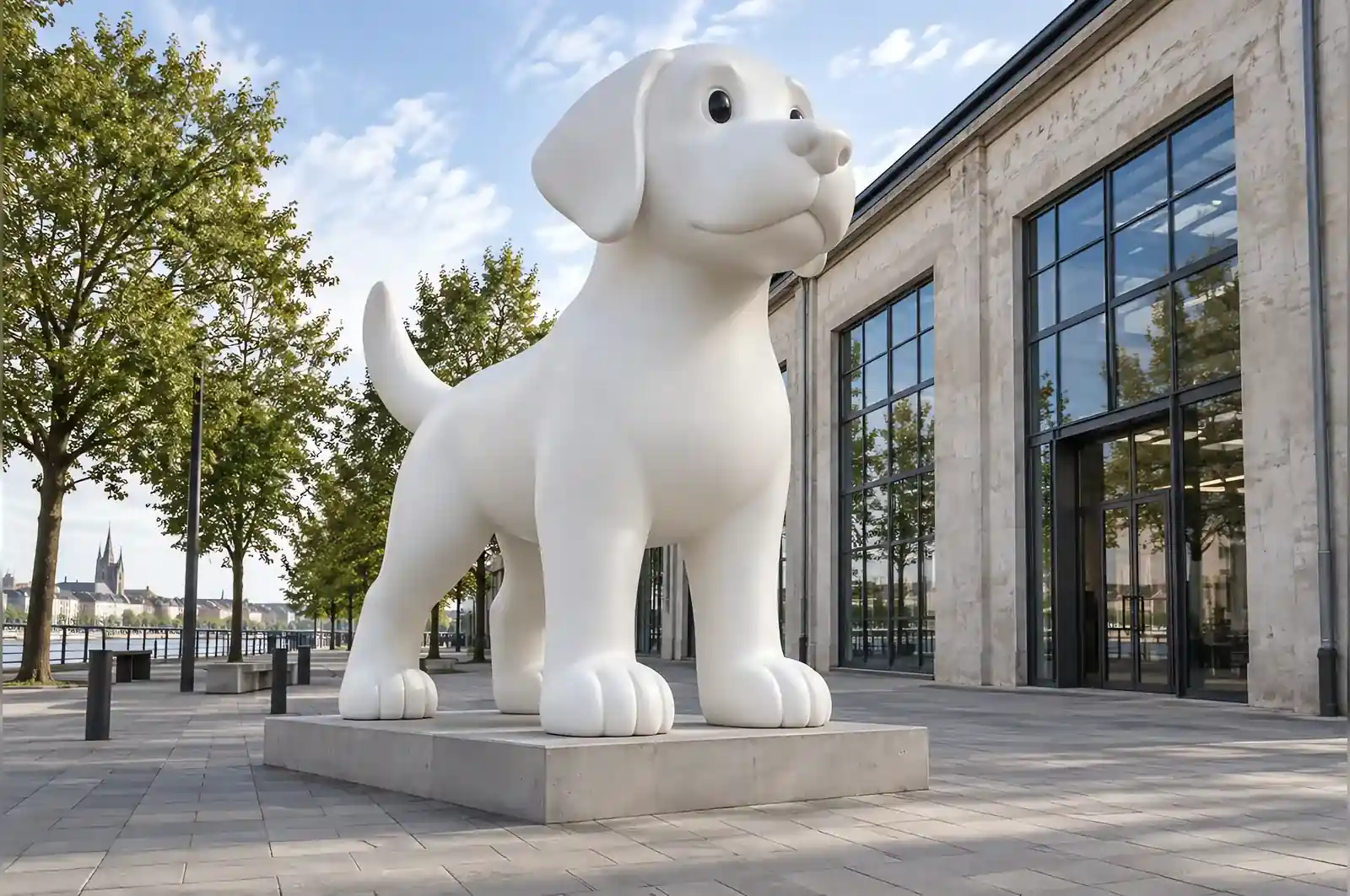
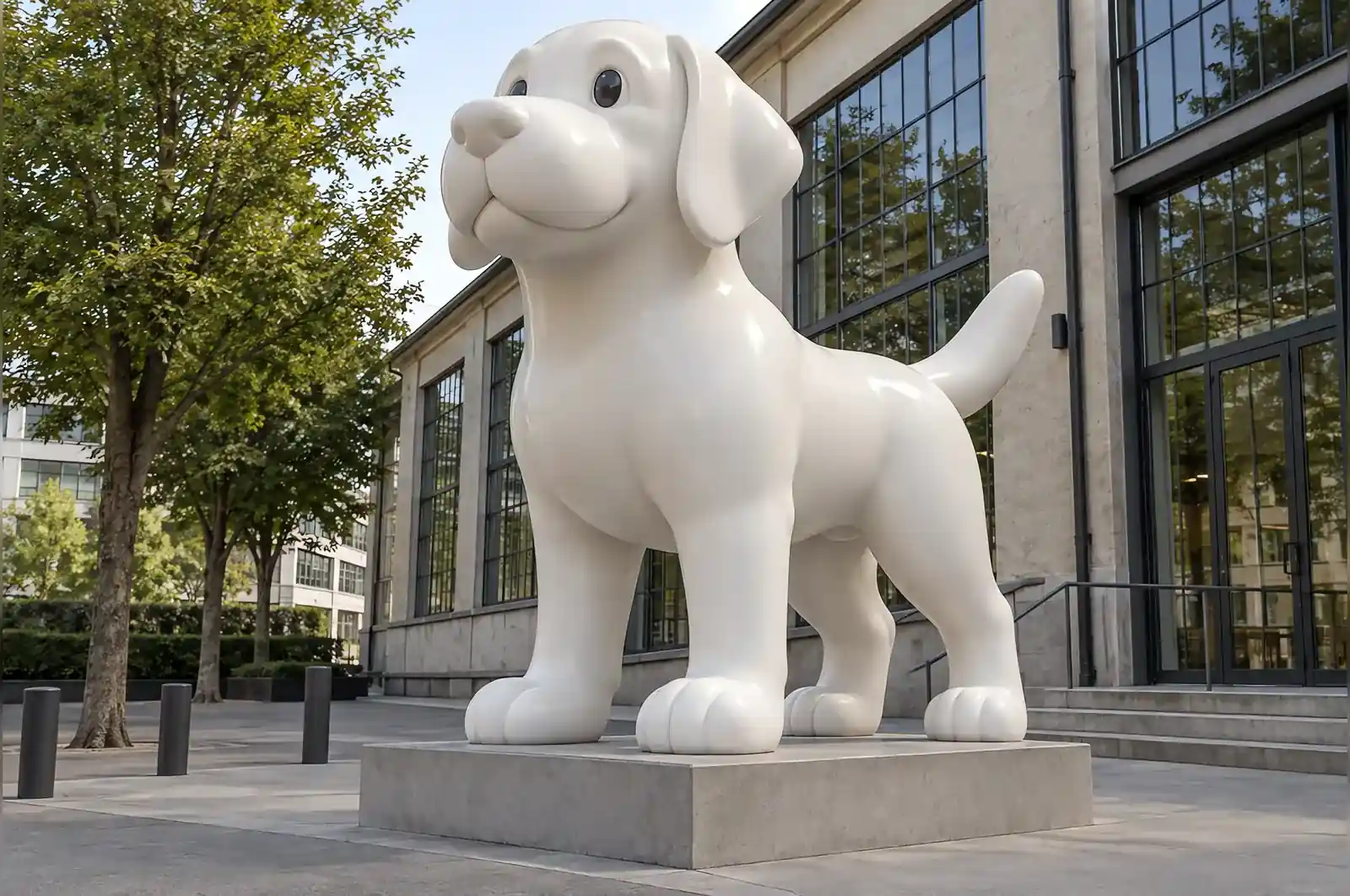
Onyx — Chalk-White Cartoon Labrador, Gallery Forecourt, Basel
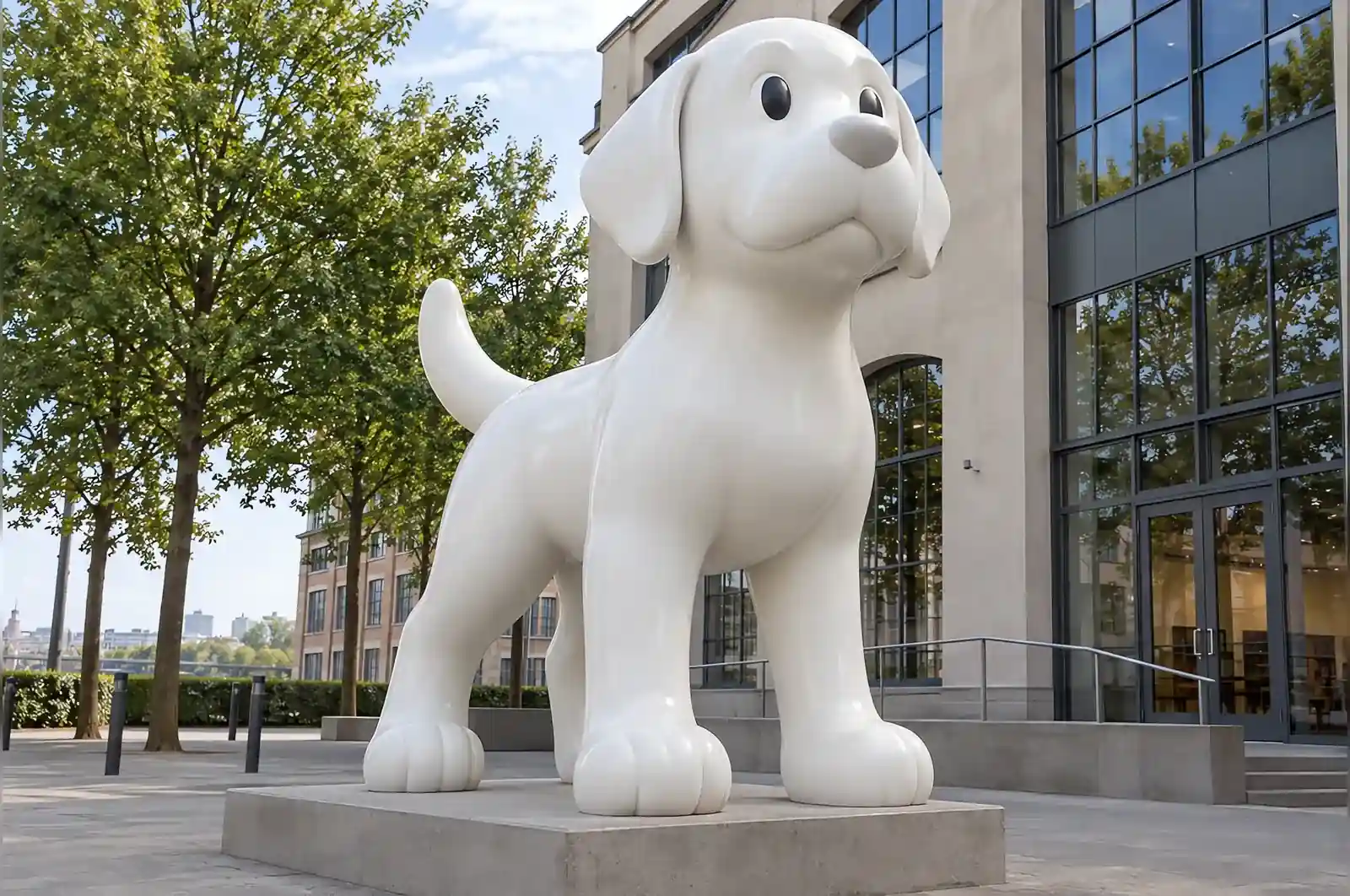
Most of what we are asked for is colourful, and most of the time colour is doing the work. This commission was the opposite. The foundation had a forecourt, a sculpture budget and one condition: no colour at all.
The argument behind the brief
Their reasoning was blunt and, we thought, correct. A cartoon in strong colour can hide a weak silhouette. Strip the colour out and a viewer sees only the shape. If the shape is still a character, the design is honest.
So they asked for a labrador — a familiar, blocky, forgiving dog — in a single flat chalk-white matte, and about 2.4 m, so the form could be walked around.
Designing without colour
We shortened the muzzle and widened the skull until the head silhouette recognised itself from fifty metres. The chest became one broad rounded plane and the legs became cylinders with no articulation in them at all. The tail, which was the last element to work, is raised about twenty degrees. At a neutral angle the whole animal looks as though it is waiting for a command it does not want to hear.
Two rounds of the 3D were thrown out entirely because the body read as a generic herding breed. Labrador comes down to two things in silhouette: skull width and the depth of the chest behind the front legs. Everything else is negotiable.
Matte, and the reason it is hard
A matte white finish is the least forgiving surface in the trade. There is no gloss to scatter the light, so every ripple in the laminate is visible in exactly the place a viewer stands. The shell was blocked by hand through four grades, primed, blocked again, then finished in a dead-flat museum white with a UV clear coat that stays flat. There is no pattern anywhere on the piece.
What happens in daylight
The forecourt faces north-east. In the morning the white picks up the cool light off the glass and reads almost grey; by late afternoon it goes warm. The foundation reports that visitors spend longer walking around it than around the bronze inside, which is the outcome they were hoping for.
What was non-negotiable, and what would have changed
The no-colour condition was the anchor, and everything else was traded against it. The matte is what makes the shape do the work; without it the commission is a white ornament rather than a sculpture. But the matte only earns its keep at a size that can be walked around. At 2.4 m the silhouette reads at fifty metres and a viewer can circle the piece and watch the head resolve. Drop it to plinth scale and the same honest shape reads as a lawn ornament, because a small white dog does not command a forecourt.
Had the foundation not insisted on matte, the build would have been simpler to keep clean: a gloss white scatters the light and hides the laminate ripples, but it would have picked up the glass facade and read as a mirror rather than a dog. The finish was the brief, not an incidental choice.
Had the piece gone indoors instead, the risk profile changes entirely. There is no UV and no freeze-thaw, and matte is far more forgiving in a climate-controlled space — the museum-grade clear coat, the hand-blocking through four grades and the dead-flat paint would all have been simpler, and the steel frame lighter, because it would not have to carry a Swiss winter’s wind load on an open forecourt. The foundation wanted the dog in the weather, not behind glass.
Building and looking after a matte outdoor white
The form is a hollow shell, not a solid block. The internal steel frame carries the 2.4 m of height and the wind load on the forecourt; the hand-laminated FRP is there to carry the shape, not the weight. A matte surface cannot be maintained the way a gloss one can. The moment you compound or polish a dead-flat finish it takes a sheen, and the no-gloss argument is gone, so the aftercare is deliberately boring: a neutral pH detergent, a soft cloth, no power washer, and no wax — wax is gloss in a jar.
The clear coat is what earns its keep here. Matte whites yellow faster than gloss whites because there is no gloss layer to block the UV, so the UV clear coat is the filter, and it is this coat that gets re-applied on a maintenance cycle rather than the paint being touched. Basel sits in a freeze-thaw climate; the shell is sealed so no water can get inside and expand on a winter night, and the base drains rather than pooling against the feet.
What this means for your own brief
Three questions settle most of the decision before a quote is asked. First: is the silhouette the point, or is the colour the point? If colour is doing the work, you can run a gloss finish and a pattern and the build gets simpler. If the silhouette is the point, you are committing to a matte, a size that can be walked around, and a subject with an outline that recognises itself.
Second: is it going outside, and in what light? An outdoor matte in a UV climate needs the clear coat and the maintenance cycle that goes with it; an indoor matte is more forgiving and less of it matters. Third: how much of the breed do you need? Labrador comes down to skull width and chest depth in silhouette, but if your owners want to recognise their own dog, the details have to be right and the 3D work gets longer.
We wanted a cartoon with nothing to hide behind. Take away colour and you find out whether the form actually works. Ours does.
A private foundation in Basel, Switzerland