Candy-Stripe Cartoon Child — Sweet Shop Sculpture, Copenhagen

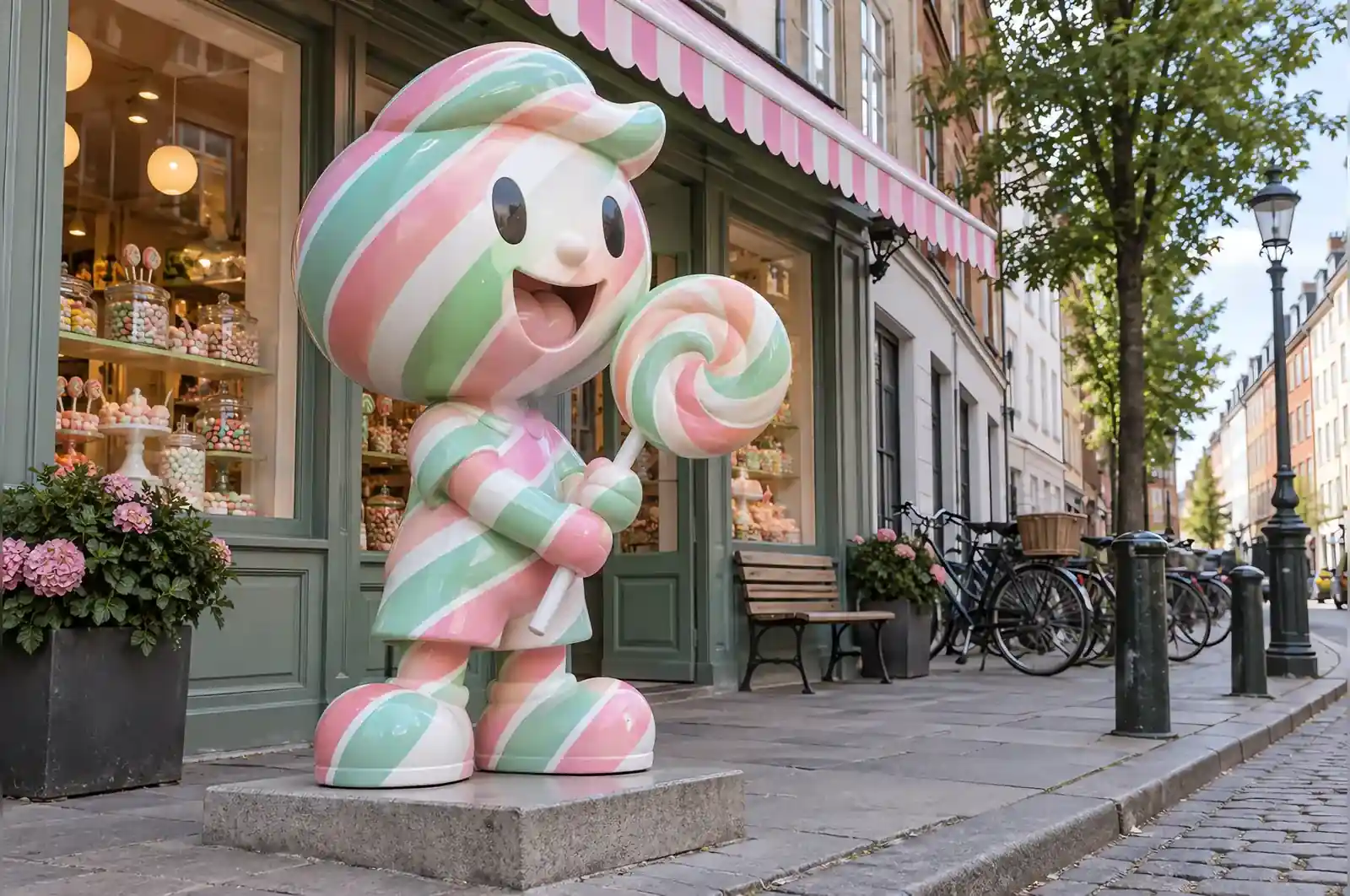

The commission was for the front of a sweet shop, and the first question a job like that has to answer is whether the figure is standing on the pavement or floating above it. A sculpture that children can walk up to and touch gets used; one that is lifted out of reach gets looked at once.
Holding something
This child holds a lollipop, 520 mm across, gripped in both hands at chest height. It gives the pose a reason to exist, which is the hardest thing to get out of a standing figure, and it gives children something at their own eye level to look at. The stick is a stainless rod inside a painted sleeve; it is not carrying any load, but it is anchored at both ends so that nothing can be levered off.
The stripes
Candy stripes are a trap, because a stripe that runs over an arm and then continues straight across the chest stops reading as a wrap. On this piece the bands were laid out on the finished form along the actual geometry, so each stripe bends, compresses and widens exactly as a wound ribbon would. There are eleven bands, 90 mm wide, each edged with a 6 mm white line that was masked separately.
Whose height
1.6 m, which is roughly the height of the seven-year-olds who are the shop’s main customers. The head is deliberately 24% of the total height, which is far too large for a real child and is what makes the piece read as a cartoon rather than as a statue of somebody.
On the pavement
It stands to the side of the door rather than in front of it, close enough to the window to appear in every photograph taken of the shopfront, and far enough from the kerb that nobody has to step into the road to walk past it.
Children try to work out where the stripes start on the back. They do not wrap the way anybody expects.
A confectionery shop in Copenhagen, Denmark