
Chalk-White Cartoon Child — Children’s Hospital Garden, Rotterdam

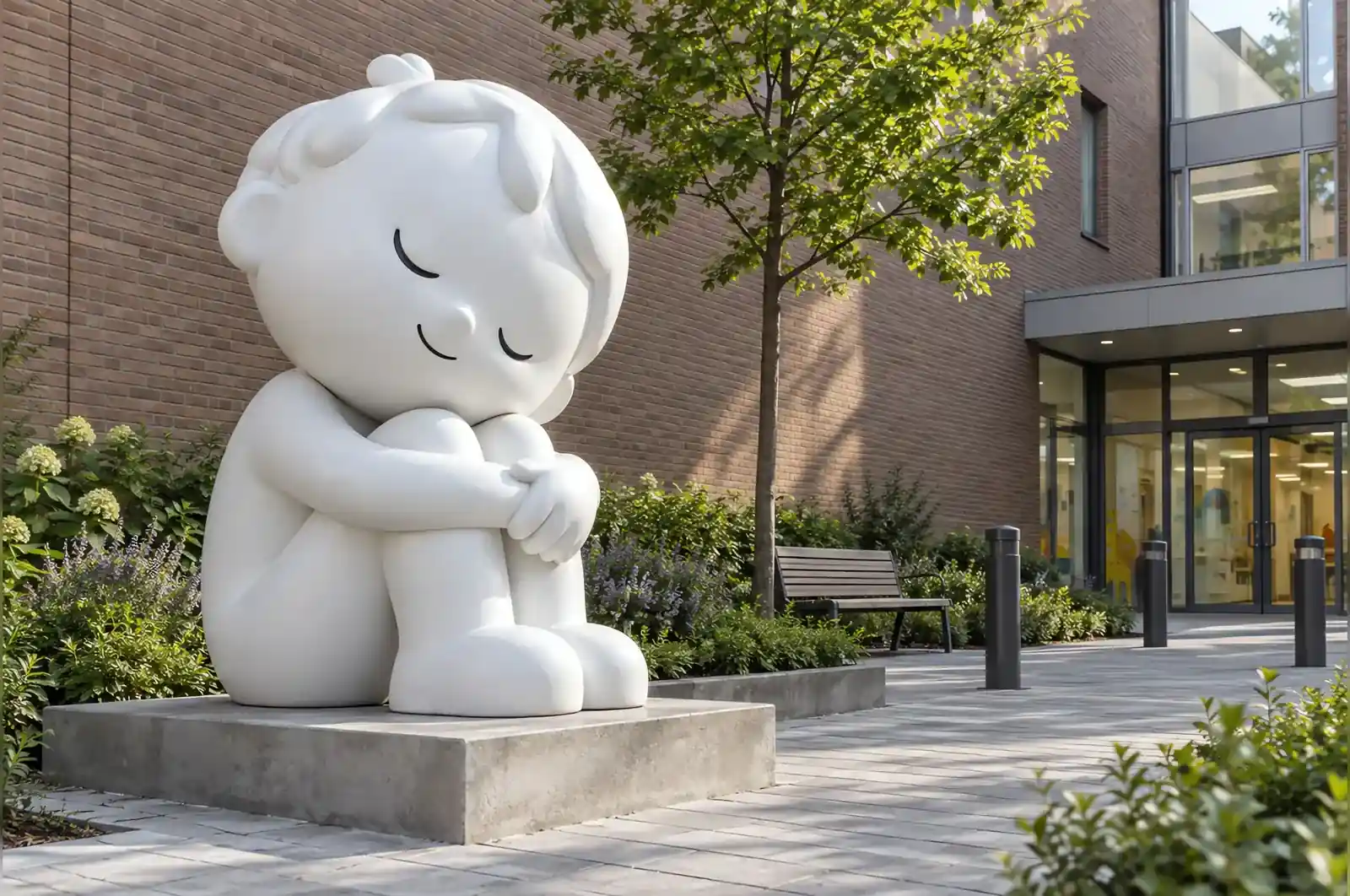

A children’s hospital asked for a figure, and then asked for it in a single flat colour. The second request is the interesting one, and they were right about it.
Why there is no pattern
The garden is used by children who are in the building for weeks, and by their families. Anything bright and busy in a place like that becomes something a child has to have an opinion about every time they walk past it. A single matte white figure does not ask anything of anybody. There is no accent colour, no second tone and no decoration of any kind, and the piece is legible entirely through form: soft rounded planes, hard shadow underneath, and the light moving across it during the day.
The pose, which is the whole piece
Seated on a low block with the knees drawn up and both arms wrapped around them, head resting sideways on the knees, eyes closed. It is the pose of a child waiting, or resting, or simply being somewhere for a long time, and it was chosen over three standing alternatives because it is the only one that does not imply an activity. A standing figure waving is a greeting, and a greeting is the wrong thing to be met with on the fourth week.
Matte, and the problem with matte
Flat white matte outdoors is unforgiving: every sanding mark, every seam and every fingerprint shows, and there is no pattern to hide behind. The shell was flatted in four passes from 240 to 800 grit and then finished with a matte clear coat that keeps the surface dead flat rather than slightly satin, which is what a sealer will do by default if it is not specified.
The finish was the fixed point
Every other decision on this commission stayed open until it was made. The size was not fixed when the brief arrived, the block the figure sits on was not fixed, and the pose was chosen from four options. The one thing that was never negotiable was the finish: a single flat chalk-white matte colour with no pattern anywhere, so the figure reads through form and light alone. It did not arrive as a preference. It arrived as the point of the commission.
Because the finish was fixed, the other decisions were made to serve it. A gloss finish would have hidden the surface-preparation work in reflection and would have let a smaller figure carry the same read; at 1.7 m a matte surface needs the figure to be the whole event, so the size was kept at the top of the seated range rather than reduced. The same finish indoors would have been far less demanding, since there is no rain, no frost and no bird traffic inside — but this piece was always going to live outside at the end of the main path, so the surface specification was built for weather rather than for the workshop.
Cleaning a matte white figure in a maritime climate
Rotterdam is a damp, cool, maritime climate: rain for much of the year, frost in some winters, and a garden with soil and planting close by. A matte white surface is the most demanding finish there is in that setting, because matte has no gloss to reflect dirt away and no pattern to break it up — every mark reads as a mark.
The piece is hand-laminated over an internal steel frame, so the shell is rigid and can be cleaned at full reach without flexing. The UV clear coat is the sacrificial layer: it is what takes the weather and what gets renewed when the surface eventually needs it, rather than the pigment beneath. The practical routine is a soft cloth and plain water, wiped downwards so that any streaks follow the form instead of crossing it, a mild detergent for bird traffic, and no abrasive at any point. At 1.7 m seated height the whole surface is reachable from the ground, which matters because the matte finish will always need a wipe, and there is no way to do that from a ladder.
In the garden
It sits at the end of the main path at 1.7 m, at seated height for an adult and slightly above the height of the children who use the garden. The block it sits on is part of the sculpture and is where people put things down. The client’s own note about what happened next is in the panel above.
Three questions to settle before you ask for a quote
First, is matte white genuinely the finish, or is it a direction you are still open on? It changes everything downstream. The surface-preparation schedule runs from 240 to 800 grit in four passes, and the clear coat has to be specified dead flat rather than left to a sealer’s default. That is the difference between a figure that reads through form and a figure that reads through a sheen.
Second, where exactly will it sit — the precise spot, its orientation to the light, and who can reach it? That decides the surface specification, because an exposed position at the end of a path and a sheltered corner are different jobs, and the difference shows up in how the finish is maintained.
Third, does the figure have to imply an activity, or is stillness the point? A seated child with knees drawn up and arms wrapped around them is a deliberate choice that says nothing and therefore says everything. If a waving or running pose is wanted instead, both the figure and its placement change, and the reason the pose was chosen here — that a greeting is the wrong thing to be met with on the fourth week — disappears.
Nobody has asked what it is supposed to represent. They sit next to it, which is the only thing we were asked to achieve.
A children’s hospital in Rotterdam, Netherlands