
Cartoon Bust — Orchestra Conductor, Iridescent Finish, Vienna
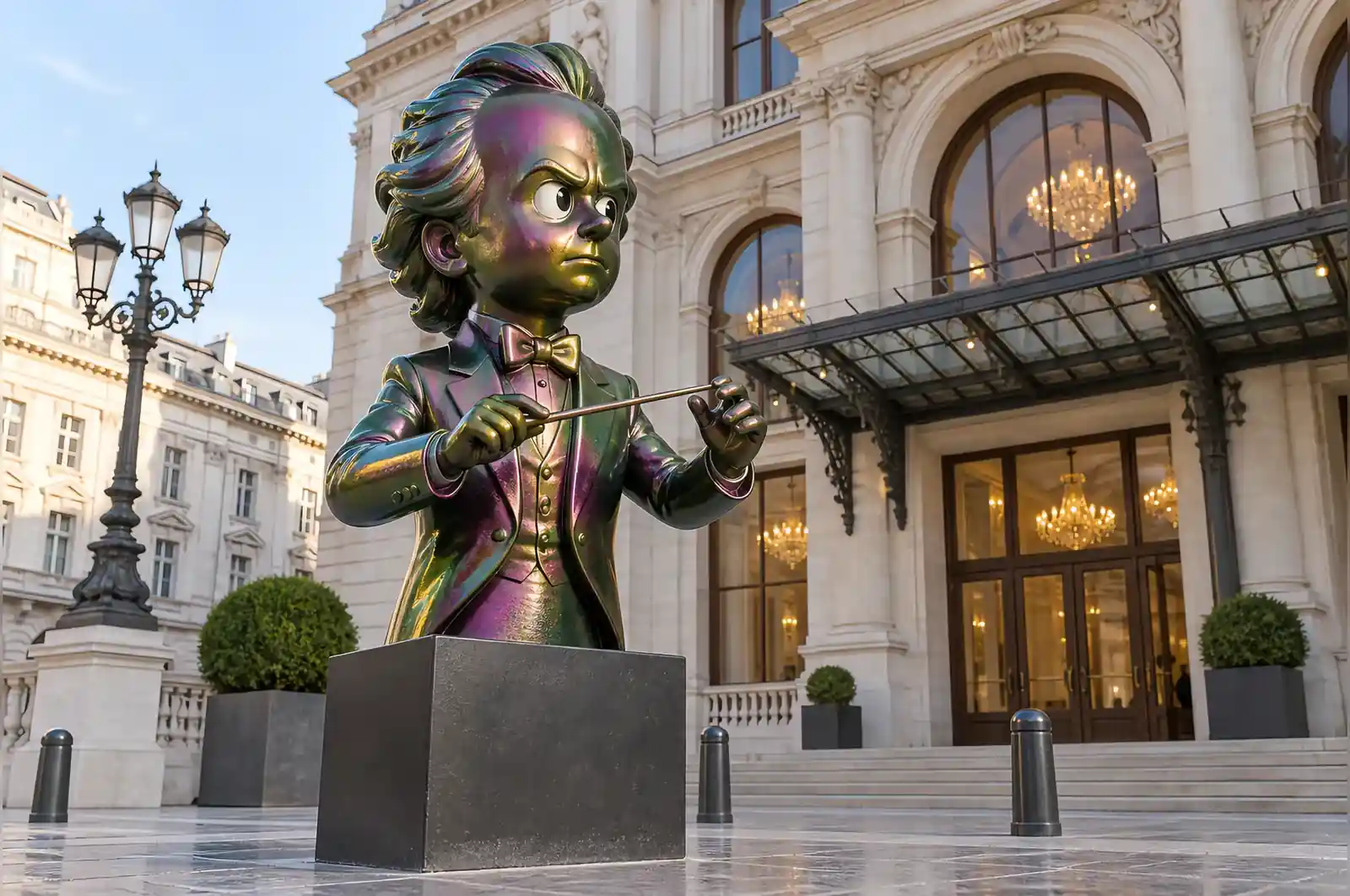
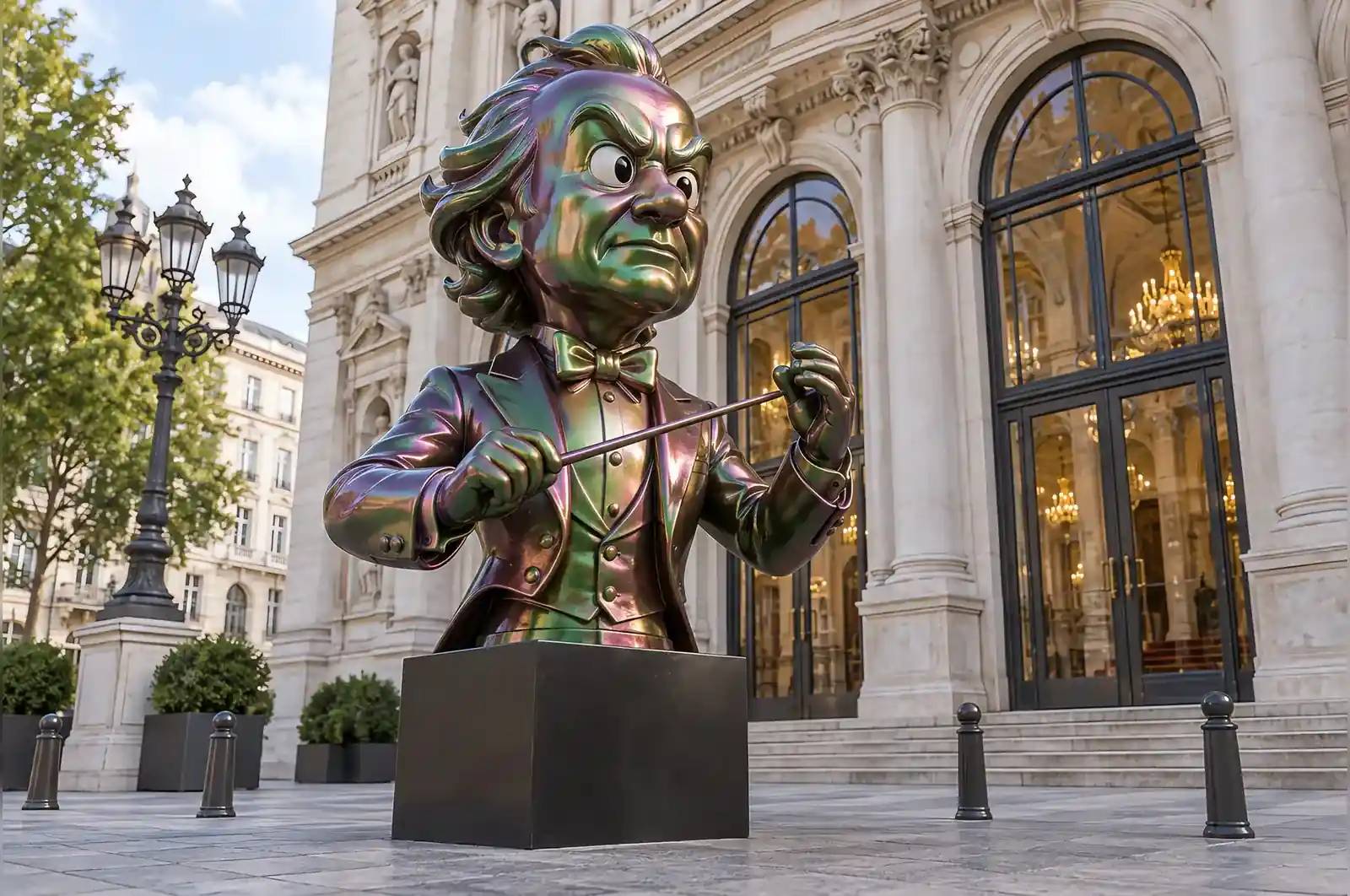
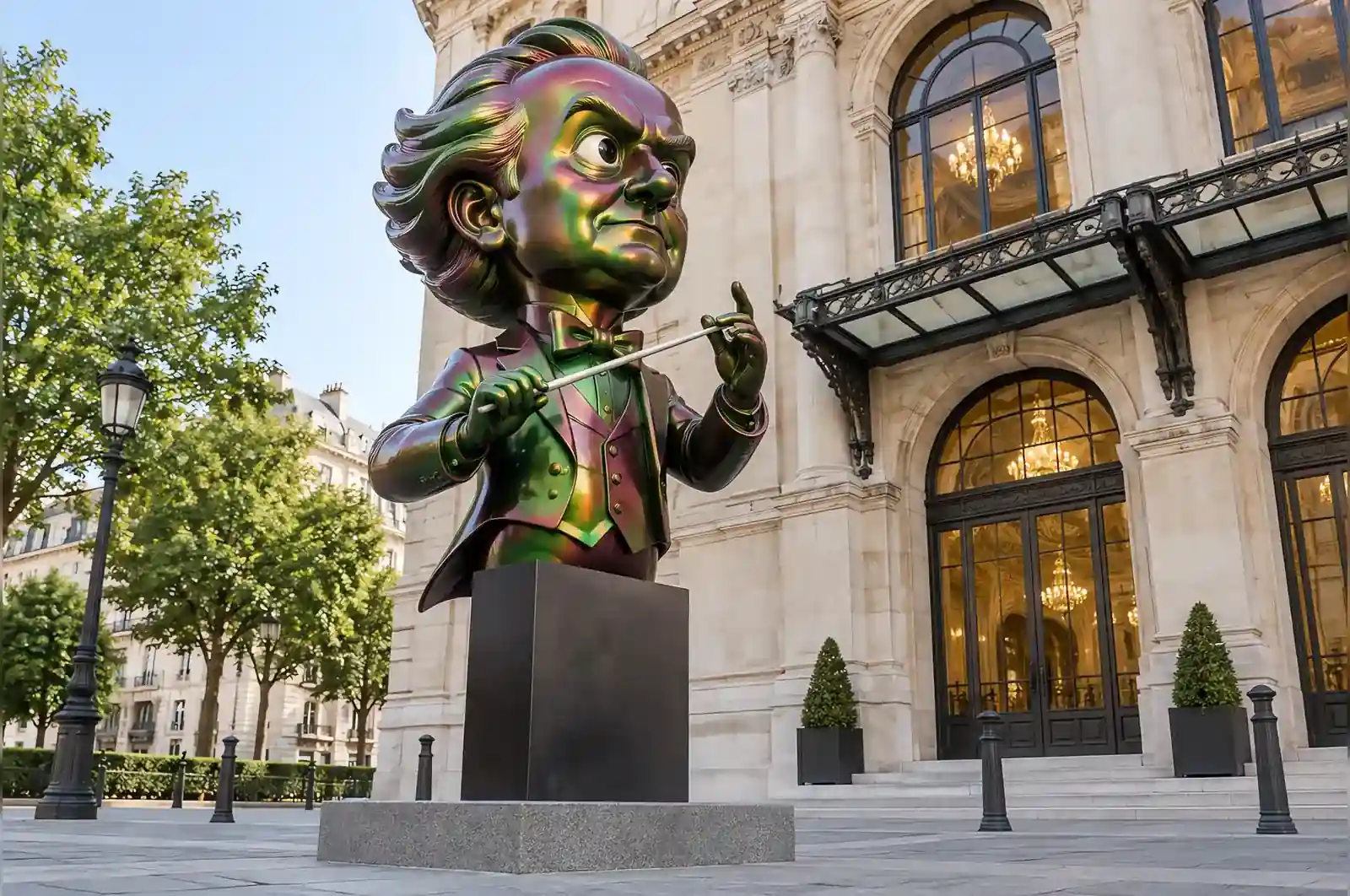
He conducted the same orchestra for twenty-two seasons. The house wanted the bust in the foyer, which is a space with a great deal of glass and a great deal of chandelier, and they were worried about one thing: that a sculpture in there would look like luggage.
The proposal
An iridescent finish. Colour-shifting paint over a dark base, so that the piece has no fixed colour at all and instead takes its colour from wherever the viewer happens to be standing. In a foyer with chandeliers and moving people, that means the bust is never the same twice.
Why the finish was non-negotiable
The colour-shift finish was the one thing in the brief that could not be traded. It is what answers the house’s original worry: a dark, static object in a bright, busy room reads as luggage, but a surface with no fixed colour never sits still visually, so it belongs in a space full of glass and chandeliers. Size and placement were the variables, not the finish. If the finish had been dropped, the bust would have needed a different strategy altogether — either much smaller on a wall bracket, or finished in the single deep green or gold that dominates the flip at its strongest angle, so it read as one deliberate object rather than a shape that refuses to hold a colour. At 1.8 m high and 0.7 m wide, the bust on its black steel plinth is sized to the room rather than to the subject, and it stands to the side of the main doors so that the head sits roughly at eye level against the light from the glass.
The placement was just as fixed as the finish. The house wanted the bust in the foyer and not elsewhere, so the working question was whether the finish could be made to survive that particular space. Had the light in the foyer been flat or purely artificial, the flip would have read as a single dull tone and the whole idea would have failed; the glass is what gives the piece its two readings. In that sense the commission was never about the likeness alone — it was about making a likeness that could hold its own in a room designed to be looked through and reflected in.
Designing for a moving surface
Colour-shift pigment works on curvature, so the geometry has to be chosen for it. Flat panels read dead; tight curves read as stripes of colour. We kept the bust deliberately rounded — a large softened head, a smoothly bulging shoulder line, corners radiused away — and used the baton, held horizontally across the chest, as the one hard straight element. It reads as a black line until the viewer moves, at which point a gold flare runs along its length.
The face is the constraint. Colour-shift on a face is a distraction, so the head is finished in a near-solid dark base coat with the flip pigment held back to the outer edges of the skull and the jaw. The likeness lives in a calm dark area in the middle of a shifting object.
Build and finish
Fibreglass over a steel core, blocked to a much finer tolerance than usual because a colour-shift coat shows every defect twice. Six coats of base, the interference layer, then two clear coats. The whole surface is under the clear, so the baton can be handled without damage.
The clear coat and the foyer routine
The two gloss UV clear coats are the part of this piece that does the daily work. In a working concert hall foyer the bust is walked past, touched and dusted several times a week, and the clear is what stops that traffic reaching the interference layer underneath. The venue is indoors, so the finish does not face frost or driving rain; what it faces instead is daylight through the glass and the routine cleaning of a public building. That makes the clear coat the maintenance surface. A soft wipe and the occasional light polish keeps the gloss, and if the topcoat ever dulls it can be refreshed without repainting the colour-shift layer, because the whole surface sits under the clear. The internal steel frame keeps the shell rigid so the fibreglass does not flex under its own weight, which matters at 0.5 m deep on a 1.8 m tall piece.
In the foyer
It stands to the side of the main doors, at 1.8 m, on a black steel plinth. The house reports that audiences arriving for the evening concert see it as green and leaving see it as magenta, because the light coming through the glass changes. Nobody planned that and it is the best thing about the piece.
What this means for your own brief
If you are considering a similar piece, settle three questions before you ask for a quote. First, what light will it be seen in: colour-shift pigment is read against the light rather than against the object, so the answer decides whether the flip reads or reads dead. Second, where will it stand and at what height: a 1.8 m bust on a plinth works because the head sits around eye level against the light from the glass, and the same piece at floor level in a low room would read very differently. Third, will it be touched or cleaned: a piece in a public foyer needs the full gloss clear and the maintenance that goes with it, while a piece behind a barrier can be built to a lighter specification. These answers do not change the likeness; they change the geometry, the number of coats and the lead time, which in this case was 14 weeks from 3D approval.
It is green when the audience arrives and magenta when they leave. I have spent my life working in changing light, so this seems fair.
A concert hall in Vienna, Austria