
Cartoon Bust — Long-Serving Groundsman, Sunset Gradient, Liverpool
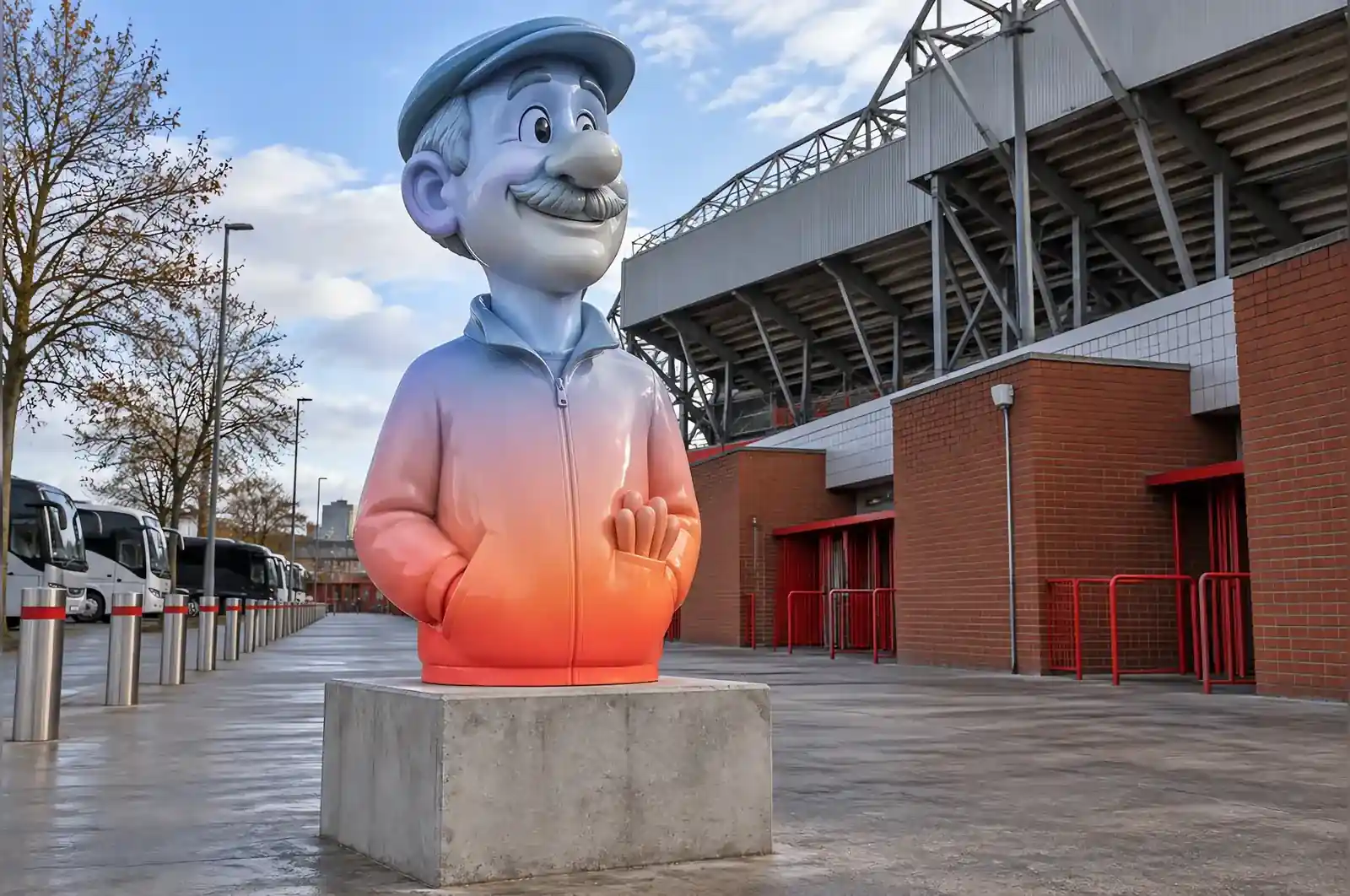
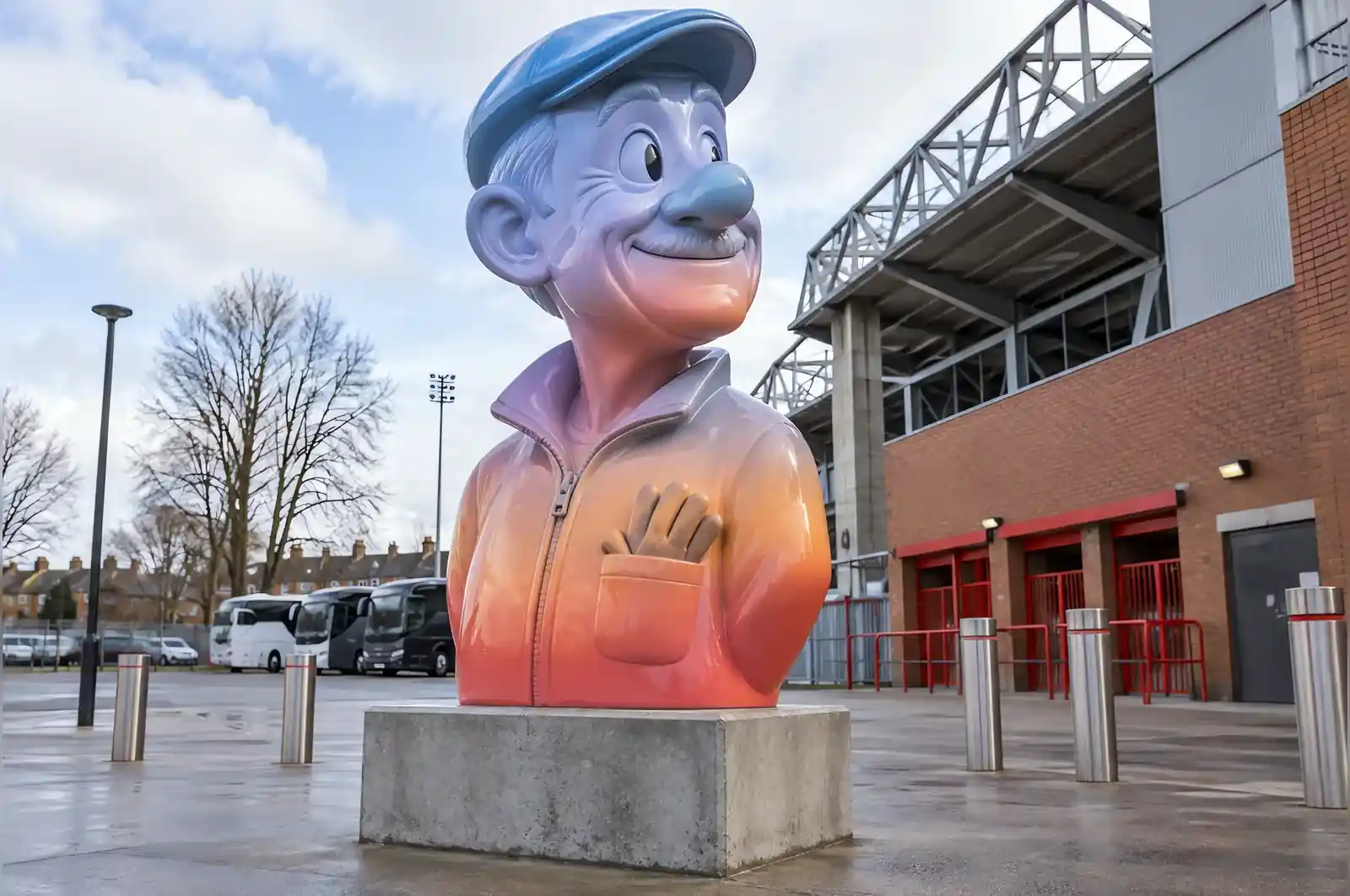
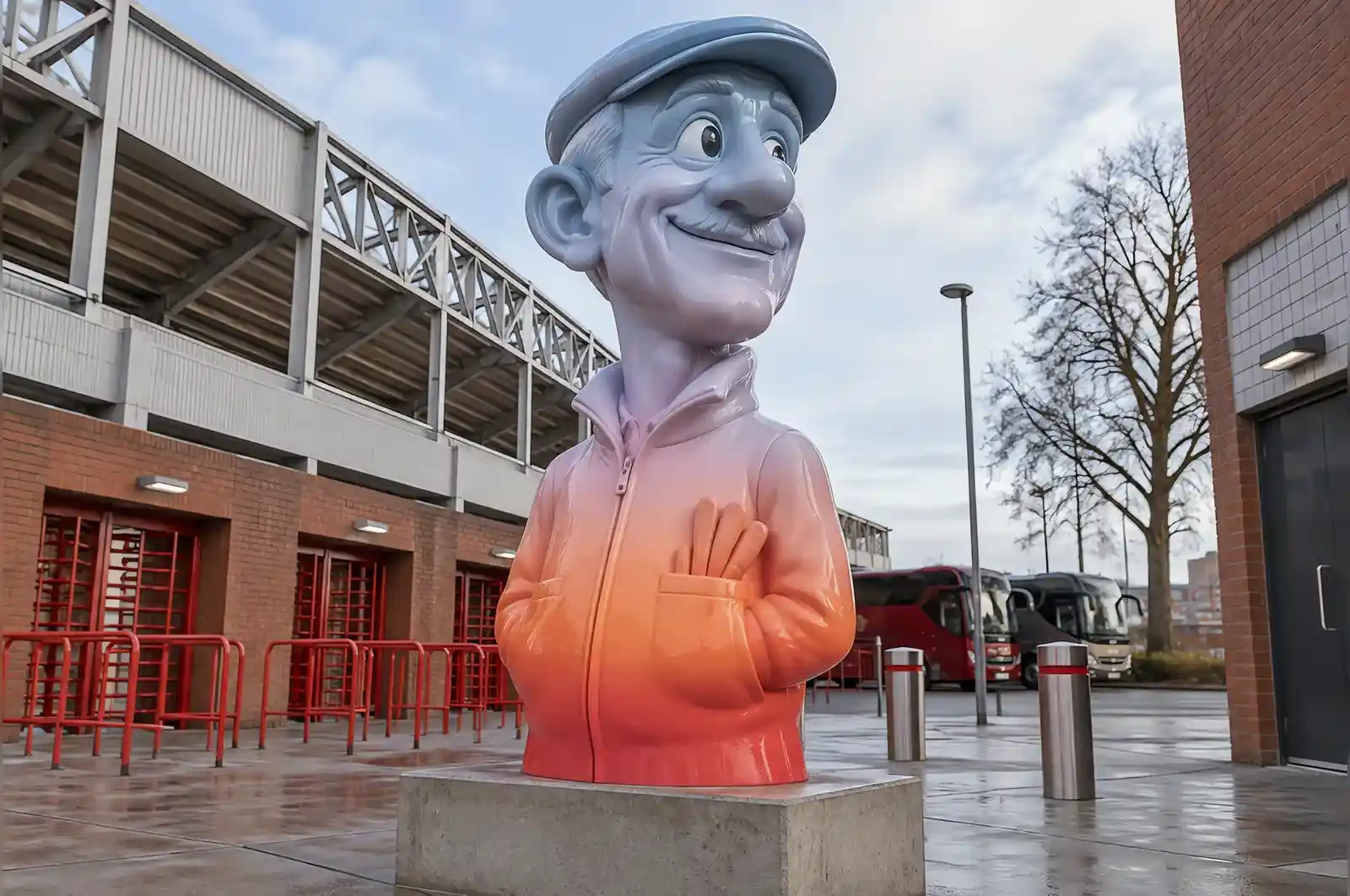
Fifty-one years, one club, one pitch. He started cutting it at sixteen and he was still walking it at sixty-seven. When he retired, the club asked what he would like and he said a decent set of shears and a quiet life. The supporters’ trust built this instead.
The brief from the trust
They wanted it outside, on the concourse, where supporters arrive, at about 2 m, and they wanted it to be cartoon enough that nobody would mistake it for a formal memorial. On the colour they were unusually specific: a sunset, because every match he ever worked finished at one.
A gradient as the whole design
Most of the pieces we make are organised by edges — blocks of colour, a pattern, a line. This one has no edges at all. The entire surface is a single continuous airbrushed gradient running from deep coral at the base, up through apricot and pale lilac, to a cool blue-grey at the crown of the head.
That means every element has to be legible without any colour change to help it. The lapels of the coat, the collar, the peak of the cap and the line of the jaw are all read purely from form and from the way the gradient bends across them. The cap is the key: it is the only hard silhouette on the piece, and where the gradient crosses its peak it produces a horizontal band of colour that looks painted and is purely an accident of geometry.
What could not be changed
Three things were fixed before we touched a drawing. It had to stand on the concourse, outside, where supporters arrive, because that is where the trust wanted the piece and that was not negotiable. It had to be about 2 m — tall enough to be seen over a crowd, short enough that a supporter could reach the cap. And it had to carry the sunset gradient with no edges, because that was the whole content of the brief.
Had any one of those changed, the piece would have been a different thing. Dropping the height to about 1.2 m would have made the head a single, easier pull and cut the number of airbrush bands needed, but it would have sat below eye level on a concourse and read as a bench ornament rather than a figure. Moving it indoors would have let us use a gloss coat, since the satin finish exists only because this stands outside — but it would have lost the arrival moment, which was the point of the commission. And simplifying the finish to three flat bands of colour would have removed the cap’s accidental horizontal band, and with it the only hard silhouette on the piece.
Airbrushing a two-metre surface
A gradient this large cannot be sprayed in one pass or the transitions go patchy. It was laid in nine bands with the colours mixed wet and blended with a wide soft airbrush working upwards, then sealed under a satin clear coat. Satin, not gloss: gloss on a smooth gradient produces a mirror line down the middle of the piece that fights the colour.
The frame and the satin coat
At 2 m high, 0.8 m wide and 0.5 m deep the piece is hollow FRP, but it is not a shell that stands on its own. It is hand-laminated over an internal steel frame that runs from the base of the coat to the crown of the head, and it is that frame which carries the load; the laminate is there to give the surface its shape. Because the gradient has no edges there is no panel line behind which to hide a join, so the surface was laid on as continuously as possible and the frame was welded and sealed inside before the shell was closed.
The satin UV clear coat is the only thing standing between that airbrushed gradient and Liverpool weather. It is what keeps the rain off the surface and the UV from fading the coral to a pale pink within a couple of seasons, and it is a maintenance item rather than a one-time finish. It will need a refresh in a few years, and the cap, which supporters touch, will wear first. The trust has asked us not to repair that wear — they consider it part of the piece.
On the concourse
It stands beside the turnstile he used to come through at half past six in the morning, at 2 m, on a plain concrete plinth with no plaque. Supporters touch the cap, which is the highest point and the easiest thing to reach. That wear is already visible and the trust has asked us not to repair it.
What this means for your own brief
If you are commissioning something similar, three questions settle most of the cost and the lead time before any quote is written.
First, where does it stand? Outdoor placement is what made the satin coat necessary and it sets the structural rules — a 2 m figure outside needs the internal steel frame and a sealed, weatherproof surface, and neither is optional. Indoors, both can be relaxed.
Second, does the design have edges? A piece organised by blocks of colour and a pattern is faster to produce than a continuous gradient, because bands can be masked and sprayed separately. A gradient like this one has to be laid in wet bands with a wide airbrush, and that is the single largest labour item on the piece. If your design can accept an edge, the price falls.
Third, how tall is it? At 2 m the figure can be read over a crowd and still reached by hand. Much smaller and it becomes a table piece; much larger and the surface area — and with it the gradient work — rises with the square of the height.
Fifty-one years on one pitch and I never once watched a sunset from the stand. I am not complaining about this arrangement.
A supporters' trust in Liverpool, England