Mecha Robot Cartoon Figure — Sculpture, Robotics Plaza, Nagoya
Engineering companies commission very little art and, when they do, they tend to commission something about their own history. This one asked for the opposite: something that would look like the future their visitors expect to see.
The brief
A robot, about 2.4 m, at the head of the visitor route through the plaza. Cartoon, not industrial. The design team’s only firm instruction was that the robot must not look like any product the company makes.
Chibi construction
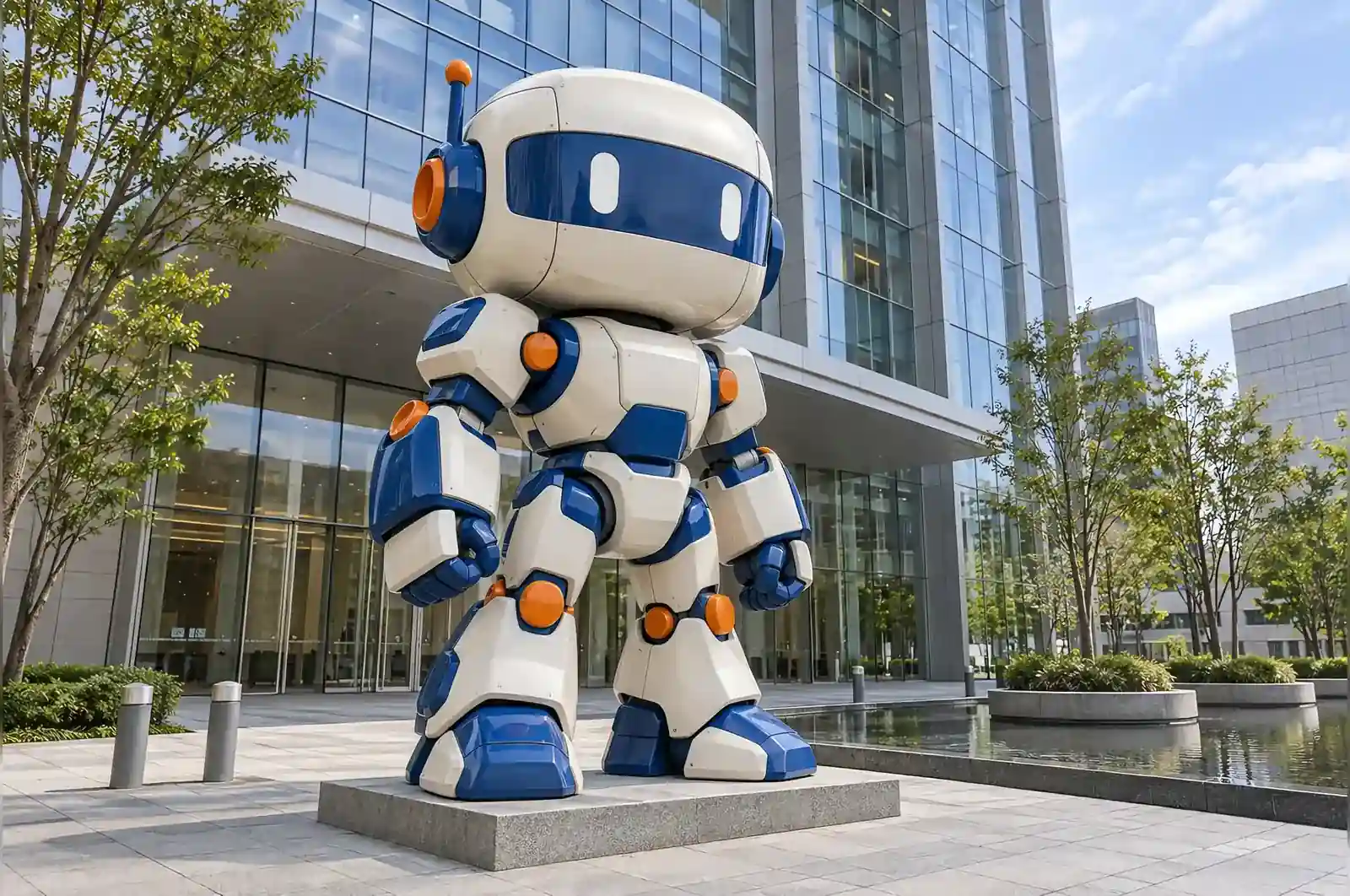
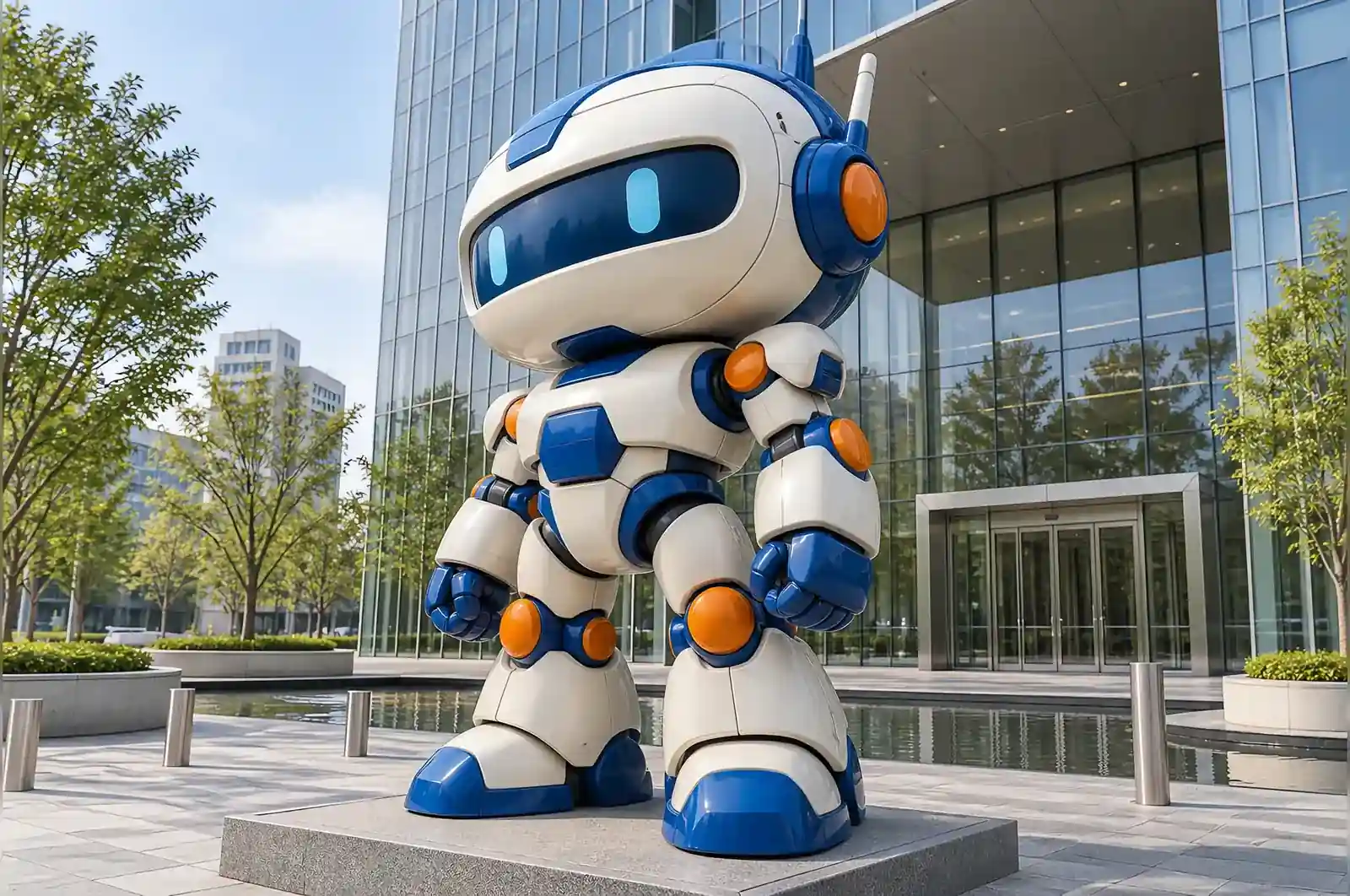
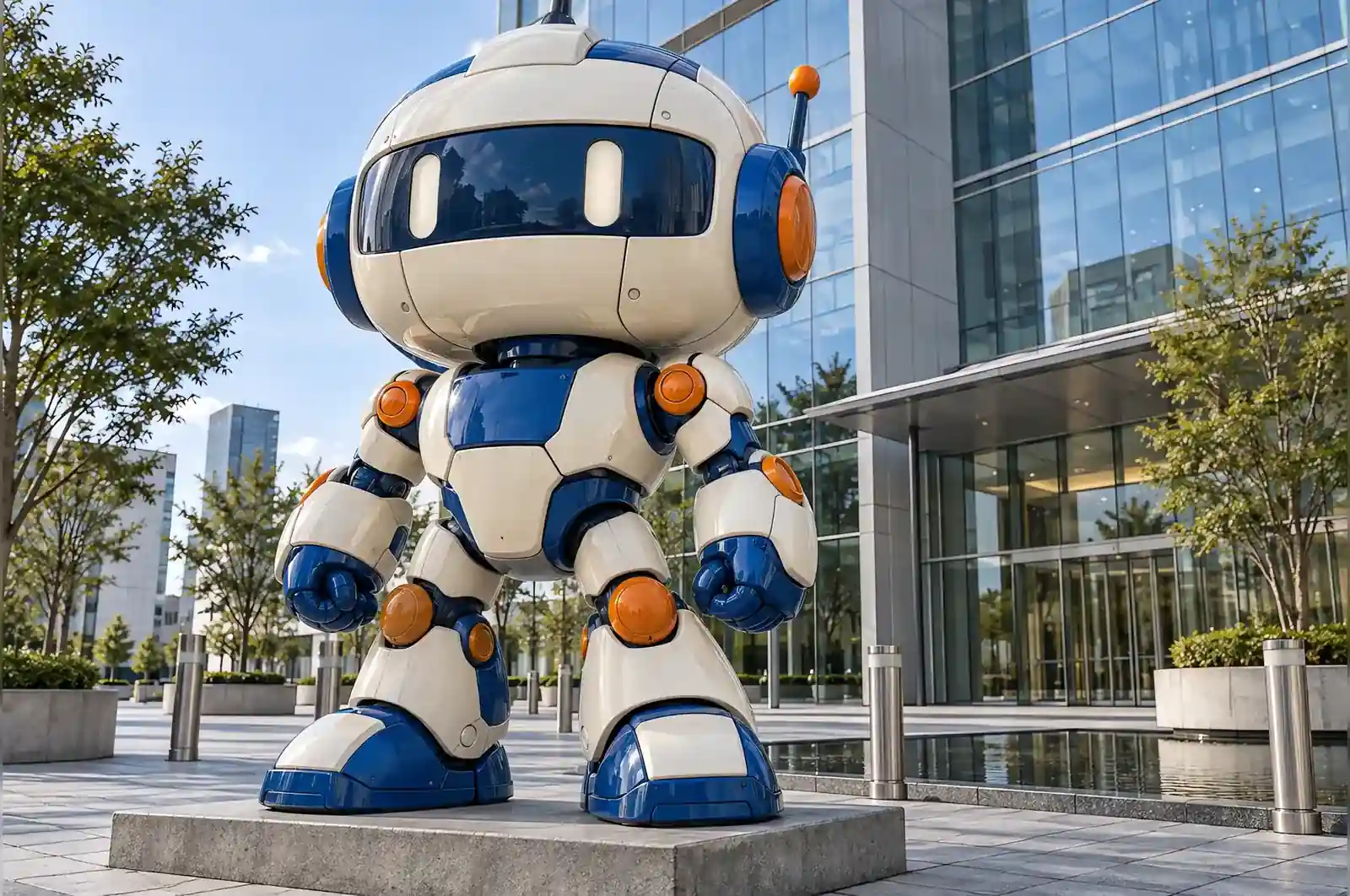
The proportions are deliberately wrong for a real machine: the head is about 30% of the total height and the legs are short and heavy. That combination is what makes a machine read as a character rather than as equipment, and it is the same construction we use on animals.
The detail vocabulary is where it earns its name. The body is divided into eighteen painted plates by recessed panel lines about 5 mm wide, all of them following the geometry of the underlying form rather than being drawn on. Bolted joints are modelled as real raised collars with four bolt heads each at the shoulders, elbows and knees. There is one antenna, rectangular, on the left side of the head, angled back at fifteen degrees.
The visor is a single wide horizontal band across the whole face, dark and reflective, with no eyes in it. It is the only element that makes the figure feel like it is looking at you.
Panel lines that are actually straight
Long straight lines on a curved shell are the hardest thing we make. Every panel line on this piece was scribed into the surface with a routed guide rather than masked and painted, so the line is a physical groove and the light defines it. Painting them on would have been faster and would have failed at three metres.
What could not be negotiated
The instruction that the robot must not look like any product the company makes was the fixed point of the whole commission. It is the reason the figure reads as a character rather than as a demonstrator: the chibi proportions, the off-white and cobalt plates and the orange joint caps are all drawn from the cartoon register, none of them from the company’s own machines. Everything else was negotiable once that held.
If the size had been dropped from 2.4 m, the figure would have stopped being the first thing a visitor sees. At head height it competes with the crowd being photographed in front of it; at 2.4 m it sits above them and holds the start of the route on its own, without a plinth. If the finish had been matte rather than gloss, the panel lines would still have been there but the light would not have carried them across the plaza. The gloss coat is what makes the recessed grooves visible from the road through the glass frontage.
The decision that would have changed the most was placement. At the head of the visitor route the robot is a welcome. Moved indoors to a lobby or a showroom it would have had to shrink, and at lobby scale the chibi proportions would read as a toy rather than a landmark. Outdoors, at 2.4 m and on the plaza, the same geometry reads as a landmark.
Building a figure that leans on visitors
The proportions make this a top-heavy piece. The head is about 30% of the 2.4 m height, so the mass sits high over a footprint of 1.4 m by 0.9 m, and the public do two things to it that they do not do to a machine: they stand next to it and they lean on it. The internal steel frame is sized for that, and the figure is anchored to its base rather than standing loose, so a visitor leaning into a shoulder or an elbow meets the ground, not a wobble.
Nagoya’s climate is the second constraint. Summers are hot and humid and the typhoon season brings heavy rain, so the laminate is sealed and the gloss coat is the water barrier. The panel lines are physical grooves rather than painted lines, which matters here: a groove does not flake or peel the way a masked stripe can, and the recess collects less dirt than a raised seam. The wide visor is the one part that is not painted off-white or cobalt, and it is washed rather than polished, because a reflective band that shows streaks reads as a broken face.
What to settle before you ask for a quote
The first question is what the figure must not look like. This client’s only firm instruction was negative — nothing like the machines the company builds — and it is the instruction that produced the whole look. If your site has a “must not resemble X”, say it in the brief; it is cheaper to state it up front than to discover it in the third set of drawings.
The second is where it will be seen from and how far away. This one is read from the road through a glass frontage and then at close range by the people photographed beside it, which is why the panel lines are scribed grooves rather than paint. A figure seen only at two metres can carry a painted line; a figure seen at thirty metres cannot.
The third is the non-negotiable size. At 2.4 m with a 1.4 m by 0.9 m footprint this piece stands without a plinth and reads as a landmark; if the height had to drop, the chibi proportions would have to change with it. Settle the height before the proportions, because the two are coupled.
Our engineers keep pointing out which parts are real and which are invented. There are more invented parts than they expected, and they enjoy that.
A robotics company in Nagoya, Japan