
Chalkboard Cartoon Teacher — Life-Size Sculpture, School Forecourt, Cape Town
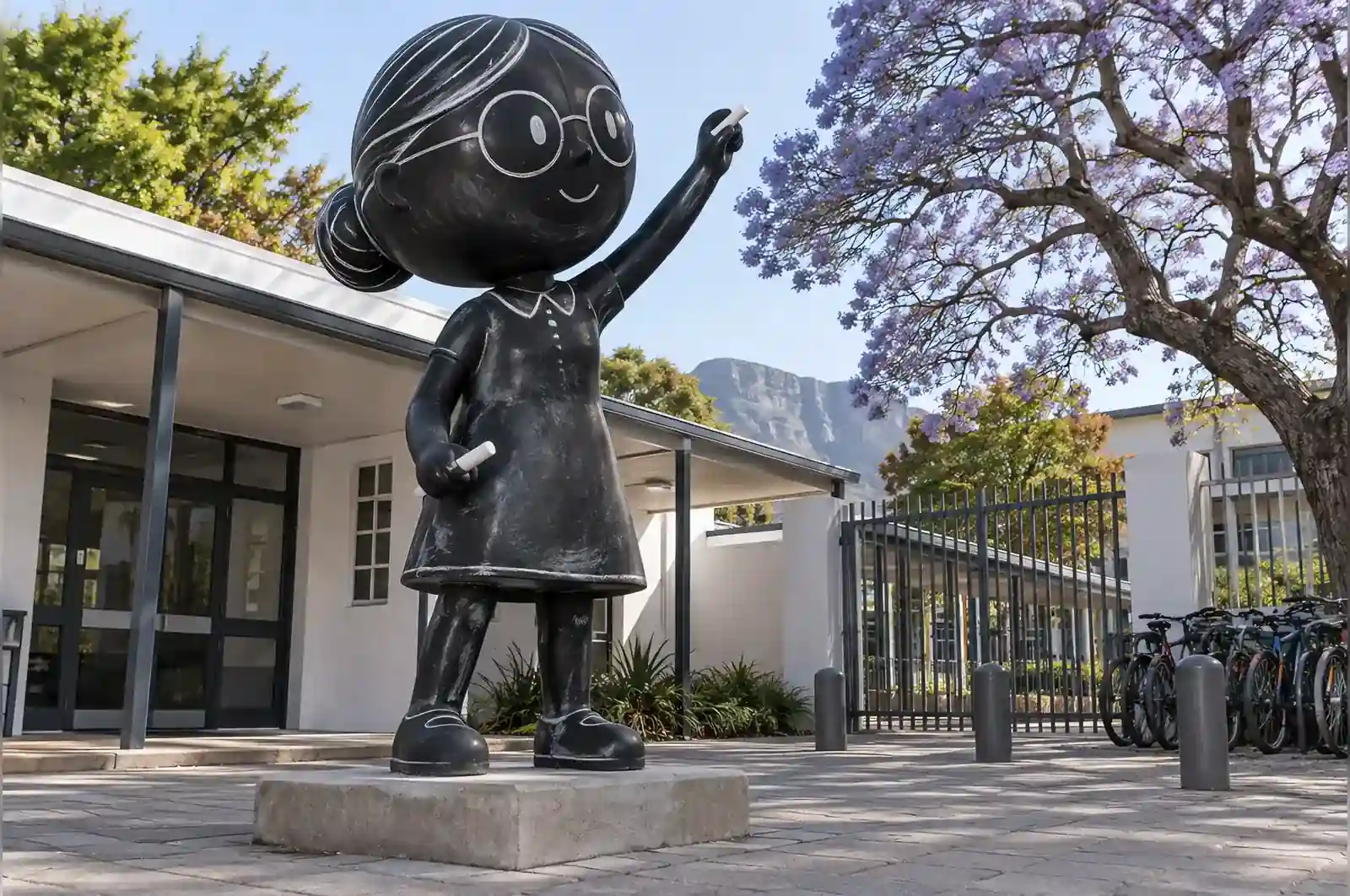
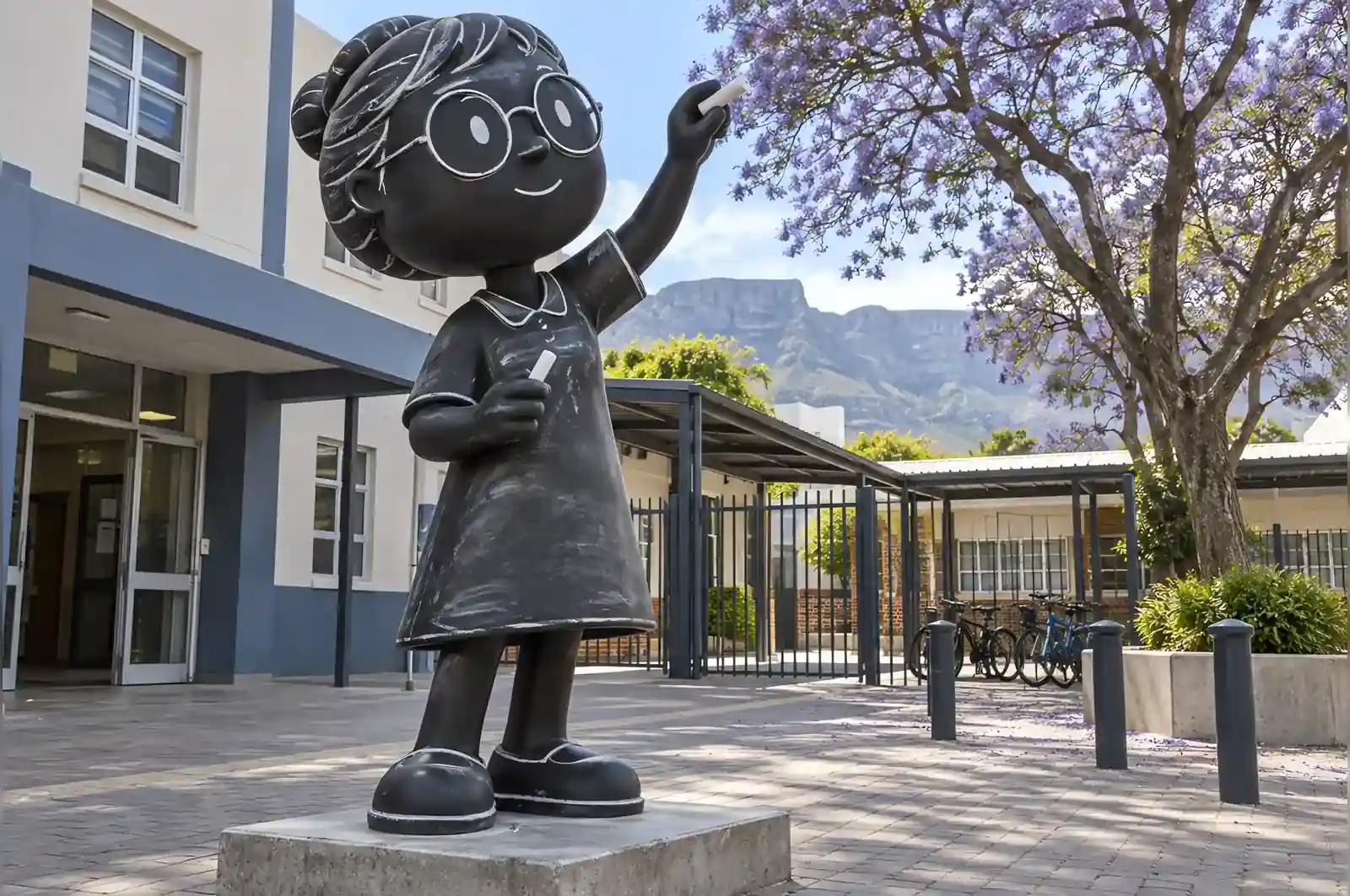

Thirty-one years teaching mathematics in the same building. When she retired, the staff wanted something and could not agree on what, until a former pupil suggested the board.
The proposition
That the sculpture be the blackboard, and that she be drawn on it. Not a figure holding a board — the figure itself as a board, with the chalk linework describing her form.
Drawing with chalk on a curve
The ground is a dead-matte near-black, which is the most demanding surface in the trade: it shows every imperfection and it absorbs light, so the modelling of the form has to come entirely from the white lines.
Everything on the piece is drawn in chalk-white: the outline of the face, the spectacles, the line of the jaw, the folds of the dress, the fingers, the raised arm. The lines vary in weight the way a real hand moves, heavier where the arm would press and thinner at the ends of strokes. There are three deliberate errors in them, all taken from her actual handwriting, including a stray mark at the corner of the mouth where the chalk slipped.
The smudges were the last thing we did and the most difficult. A blackboard that has been used and partially wiped has a specific look: grey clouds of chalk dust in the areas where a sleeve has crossed it. We reproduced eleven of them with a dry brush over the finished matte, following the arc a right hand would sweep.
Why matte
Gloss would have turned the piece into a decorated black object. A dead-matte blackboard with matte chalk lines is a piece about erasure and re-writing, and she has confirmed that this is what she wanted without ever using those words.
At the school gate
It stands inside the forecourt at 2.1 m, facing the gate, so that pupils meet it coming in rather than going out. The school has instructed the caretaking staff not to clean the smudges, and has already had to repaint the plinth once because children keep writing on that too.
What had to stay fixed
The size was the one number we were not willing to move. At 2.1 m the figure stands just above eye level for the oldest pupils and well above the youngest, so that coming through the gate means looking up at a teacher who has taught in that building for thirty-one years. Drop it to 1.5 m and the piece becomes a decoration you walk past rather than a person you meet; at 2.1 m it is a presence, and at 0.9 m wide it is still narrow enough to sit in the forecourt without blocking the line of movement through the gate. The placement follows from that. Because it faces the gate and sits inside the forecourt, pupils encounter it on the way in, when the day is ahead of them, not on the way out. If the finish had been the thing to move instead — a gloss coat over the same chalk lines — the concept would have collapsed into a decorated black object, which is exactly why the matte was non-negotiable. Indoors it would read differently again: in a foyer with fixed lighting the chalk dust would have to be lit deliberately and the smudges re-created each term. Out here the sun does the lighting work, and the school has simply asked the caretakers not to wipe.
Building and keeping the matte in a school forecourt
The frame is what carries the height. A 2.1 m figure with a 0.5 m depth is not a shell you can stand on a plinth and hope — there is an internal welded steel frame, and the hand-laminated FRP is laid over it in skins, so the piece is rigid without being heavy enough to strain the forecourt. The matte is the surface that needs the most looking-after, because a dead-matte near-black ground shows every mark it has ever received and there is no gloss to wipe a scuff out of. In Cape Town that matters twice over: the UV load on an open forecourt is strong enough to dull a clear coat over a few years, and the winter rain carries salt air in off the Atlantic. We specified a matte UV-stable clear coat as the sacrificial layer. The practical rule the school follows is simple — the smudges are not to be cleaned, because cleaning is what destroys a chalk drawing, and the plinth has already been repainted once because children keep writing on it. When the coat finally dulls, it is re-sprayed, not polished, and that re-spray is a one-day job on site rather than a return to the workshop.
What to settle before you ask for a quote
Three questions decide most of the cost on a commission like this, and they are worth settling before you ask for a number. First, where is it going and what is it facing? An outdoor piece in direct sun needs a UV-stable clear coat and a surface that can be cleaned or deliberately not cleaned; an indoor piece does not, and that single choice changes the finish specification. Second, is it a figure or a board? This sculpture is the board, with the figure drawn on it — the linework is the modelling. If you want a figure holding a board instead, the geometry changes completely, because then the form has to carry itself rather than be carried by a flat face. Third, who is going to touch it? A school forecourt full of children will test a matte surface hard, and that answer decides whether the finish is dead-matte and sacrificial or a harder, glossier, wipeable surface. Settle those three and the quote is a formality.
She wiped that board for thirty years. Somebody has finally put a mark back on it, and every child who walks in reads it.
A secondary school in Cape Town, South Africa