
Mosaic Cartoon Flamenco Dancer — Life-Size Sculpture, Seville
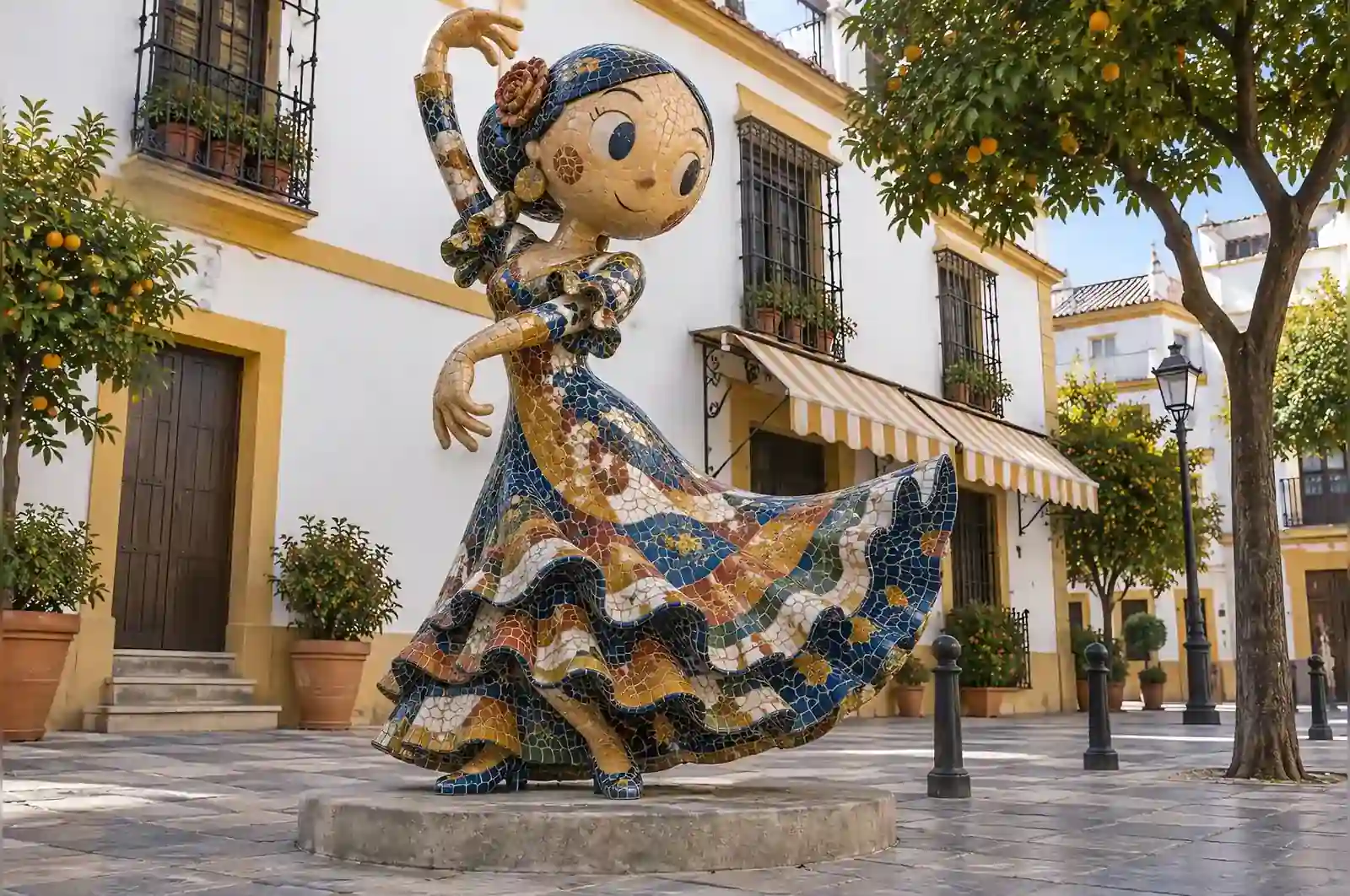
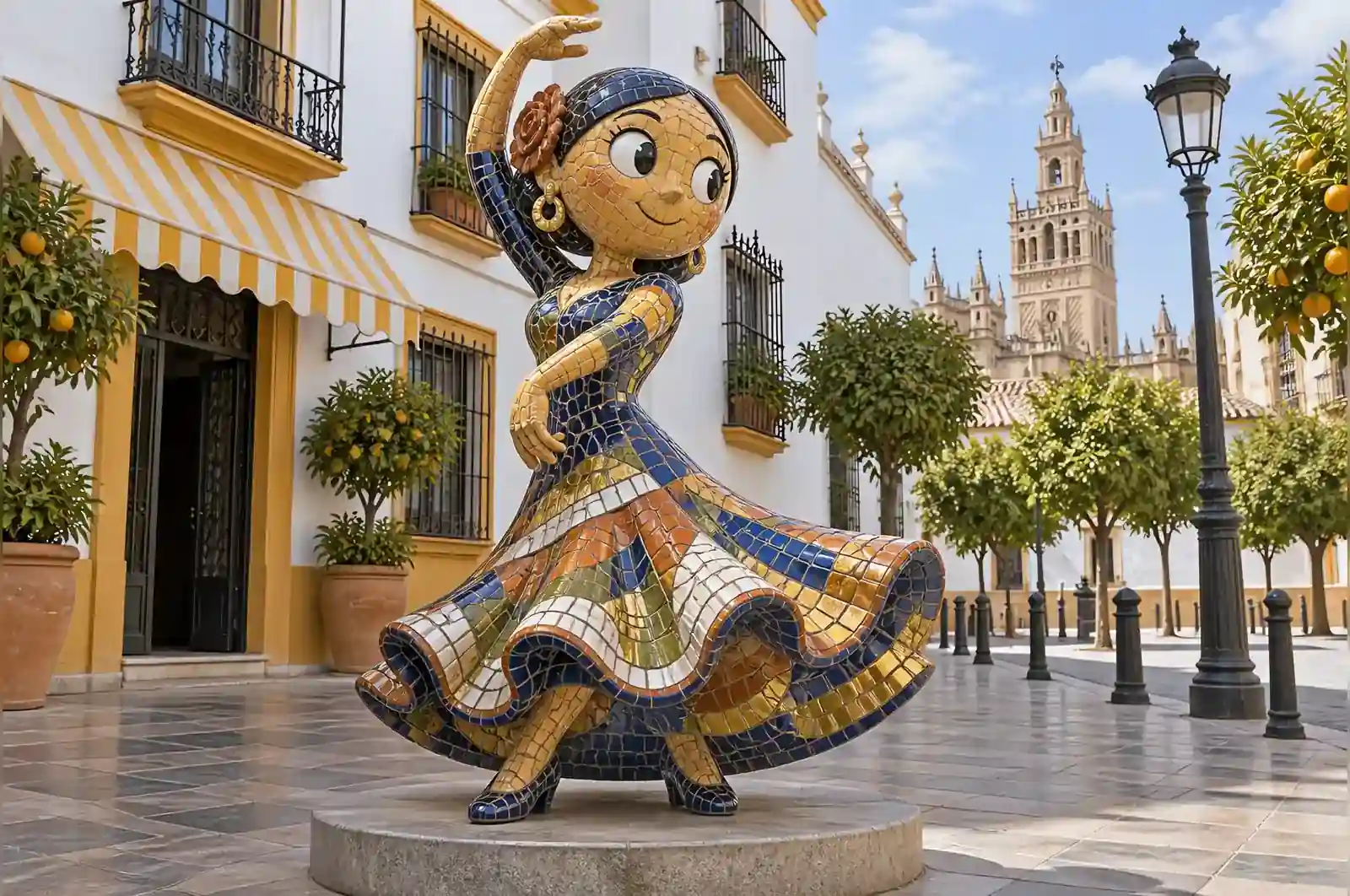
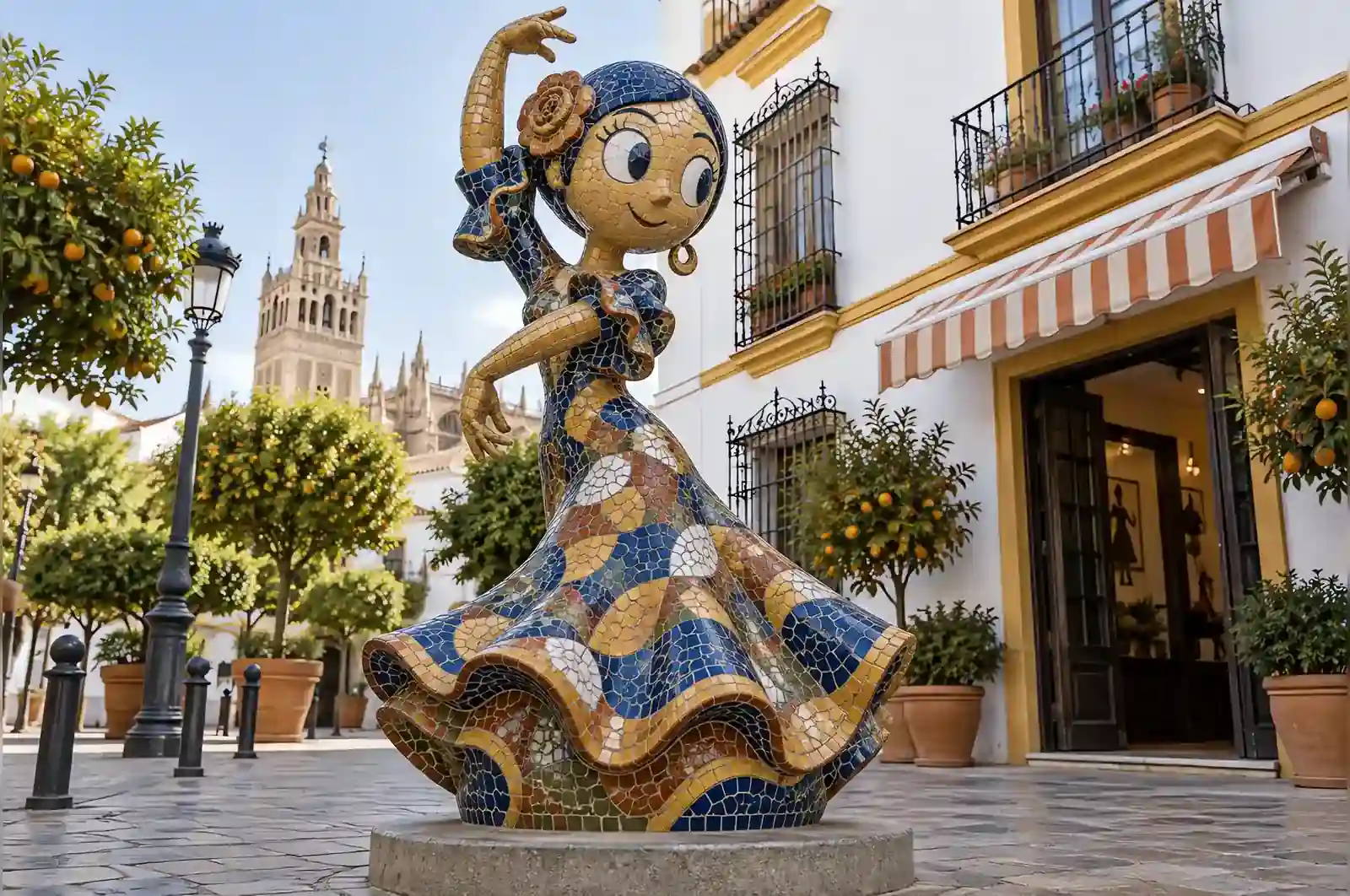
The school teaches flamenco to about ninety students a week. Their courtyard is tiled, their walls are tiled, and the commission began as a joke about a dancer made of tiles that turned out to be the right idea.
Why mosaic, and why it is not a shortcut
A mosaic is not a picture made of small pieces. It is a surface assembled from pieces that are all different, and the character of the finished thing comes entirely from that inconsistency. Nothing lines up, no two tesserae are the same shape, and there is a slight recessed line of grout between every pair.
The flared skirt is what makes the piece possible. A dancer mid-turn has an enormous continuous surface in the skirt, which is the ideal ground for mosaic: one large area of broken colour, roughly 2,400 pieces in our case, arranged in loose concentric bands that follow the rotation of the turn.
The tesserae
Roughly 5,600 pieces across the whole figure, cut by hand into quadrilaterals between about 25 and 45 mm at this scale, and laid with a consistent 4 mm gap. Each one is deliberately rotated a few degrees off the local grid, which is what stops a mosaic looking like a printed pattern. The palette is six colours plus a small number of gold pieces reserved for her earrings and the edge of the shawl.
The face carries almost no mosaic at all: the eyes are two solid tesserae each and the mouth is one, because a feature built from many pieces stops being readable as a feature at any real viewing distance.
Build and weathering
Fibreglass over a steel core, with the tesserae modelled into the surface rather than applied, so nothing can lift. The grout lines are recessed about 2 mm. The whole piece is finished in a gloss clear coat, which in Seville matters: the summer light on a matte mosaic flattens all six colours into one another.
What the site fixed
The brief had three things that were never open for discussion, and each one shaped the build in a different way.
The placement was the first. A free-standing figure on an open plaza beside a school entrance is seen in the round from the street, which ruled out any shallow relief-style treatment and set the depth at 0.6 m. That depth is what gives a 2 m figure enough footprint to stand without a plinth or anchor plate showing on the approach; the flare of the skirt widens that footprint still further at the base.
The finish was the second. The plaza takes full summer sun, and the client had seen what a matte mosaic does in that light, all six colours flattening into one another. So the gloss UV clear coat was written into the spec before a single tessera was cut, not added later as an afterthought.
The scale was the third. At 2 m the piece is tall enough to read as a landmark from the street but low enough that the detail at the face and the hem stays legible to a student standing right beside it. Shrink it and the mosaic stops working, because the tesserae would have to drop below the size at which hand-cut quadrilaterals are economical to produce.
In the plaza
It stands at 2 m on the plaza beside the school entrance, angled so that it is seen against the whitewashed wall from the street. Students touch the hem of the skirt on the way in for luck, which has polished that band of tesserae visibly lighter than the rest.
Looking after it in the plaza
Most of the maintenance is designed out rather than scheduled. The tesserae are modelled into the fibreglass surface rather than stuck on, so there is no adhesive line to fail and nothing that can lift in the heat. The grout is recessed about 2 mm, which means rainwater runs across the face and drains out of the joint instead of pooling in it; a flush joint on a vertical surface in this climate would hold water and slowly soften the grout.
The steel core is fully enclosed in the laminate, so there is no exposed metal at the base or the arms to rust. The gloss clear coat is the only surface that really weathers, and its job is sacrificial: it takes the UV and the dust so the pigment underneath does not.
What the school does have to manage is the hem. Students touch it on the way in for luck, and that repeated contact has polished the coat rather than the colour, which is protected underneath, on that one band. It is a wear pattern the client accepted at the outset; the alternative is a low barrier, which a dance school at an entrance is never going to choose.
What to settle before you ask for a quote
If you are considering something similar, three questions settle most of the cost before a quote is ever requested.
First, how close will people get to it? A piece seen from across a plaza can carry larger tesserae and looser grout, because nobody will read the individual joints. One that is meant to be stood beside, like this dancer at the school entrance, needs the tighter 25–45 mm scale and the controlled face described above. That distinction moves the cutting time and the piece count more than almost anything else.
Second, is it indoors or out? The gloss UV clear coat is not decorative here, it is what keeps six colours separate under Seville summer light. If the same figure were going into a lobby, the finish could be matte and the spec would be simpler.
Third, is it free-standing or set against something? A free-standing figure needs the depth and the internal steel frame to stand on its own footprint; the same figure against a wall can be shallower and lighter, with the back left unfinished.
Students count the pieces during their warm-up. Somebody once claimed to have counted all of them and we have never been able to prove them wrong.
A dance school in Seville, Spain