
Tie-Dye Cartoon Festival Figure — Life-Size Sculpture, Somerset
Fifty years of the same festival in the same fields, and the art on site had never outlasted the weekend. The organisers wanted one permanent object, and they had a clear idea of what it should be wearing.
The brief
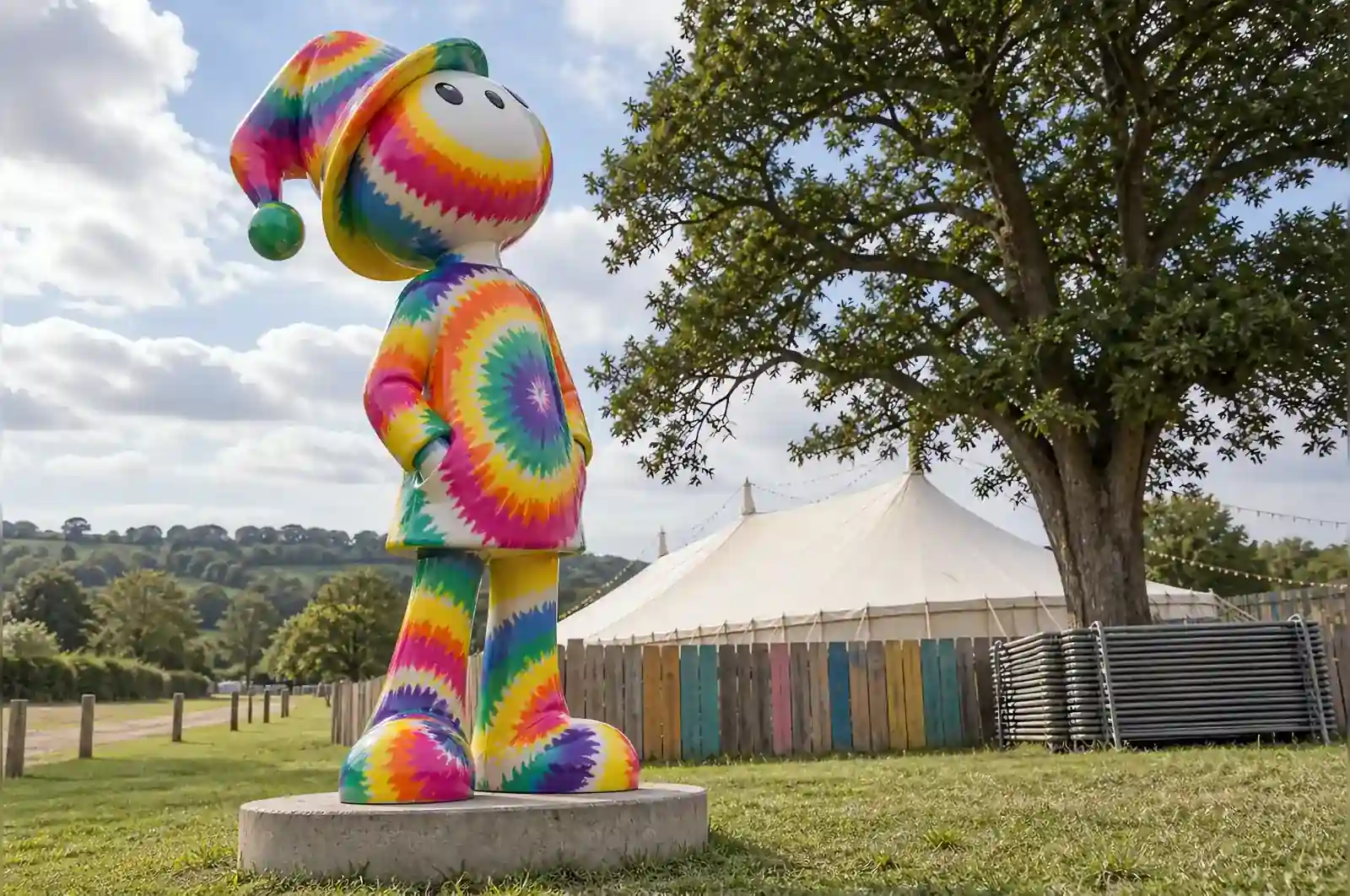
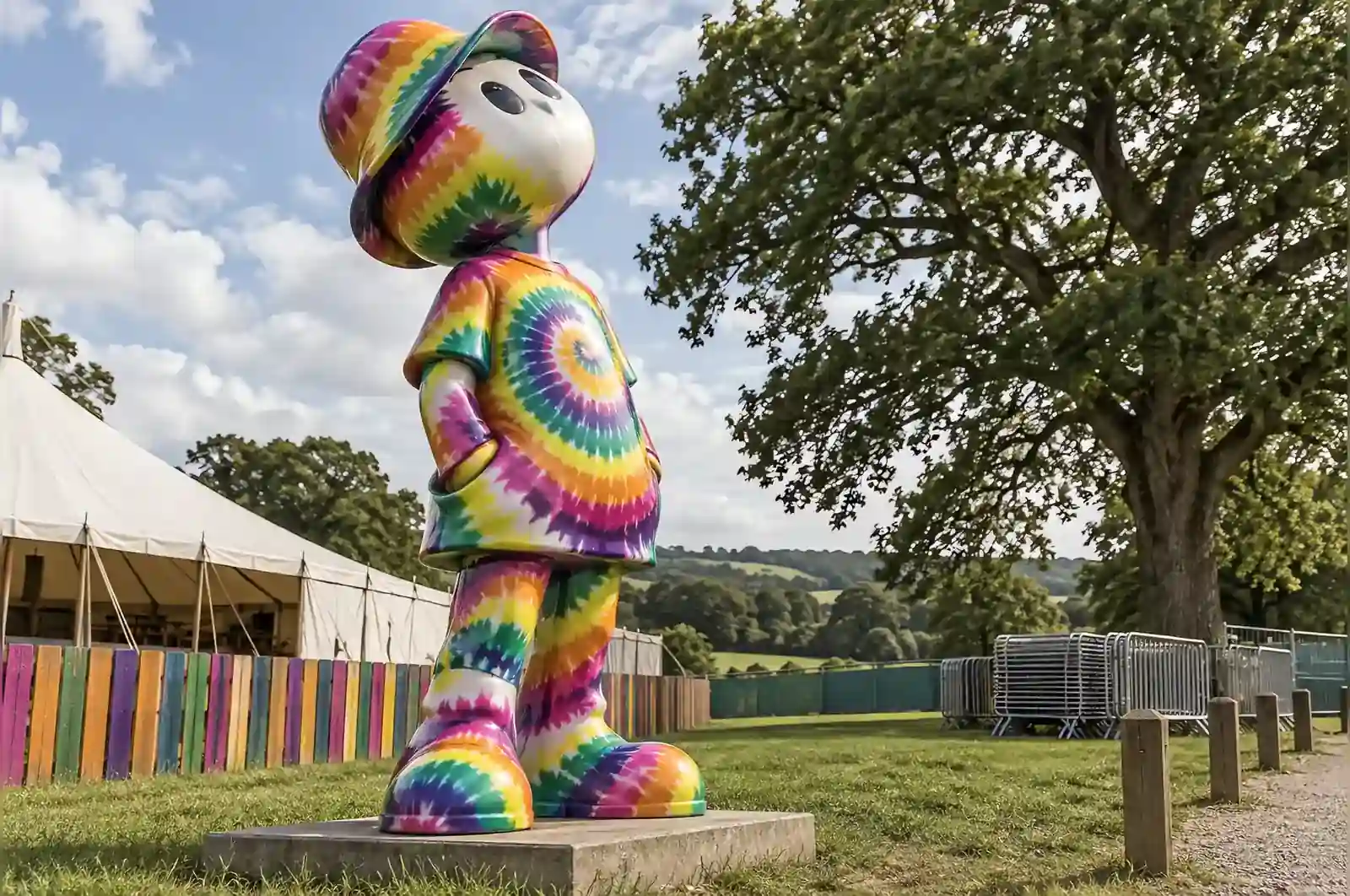
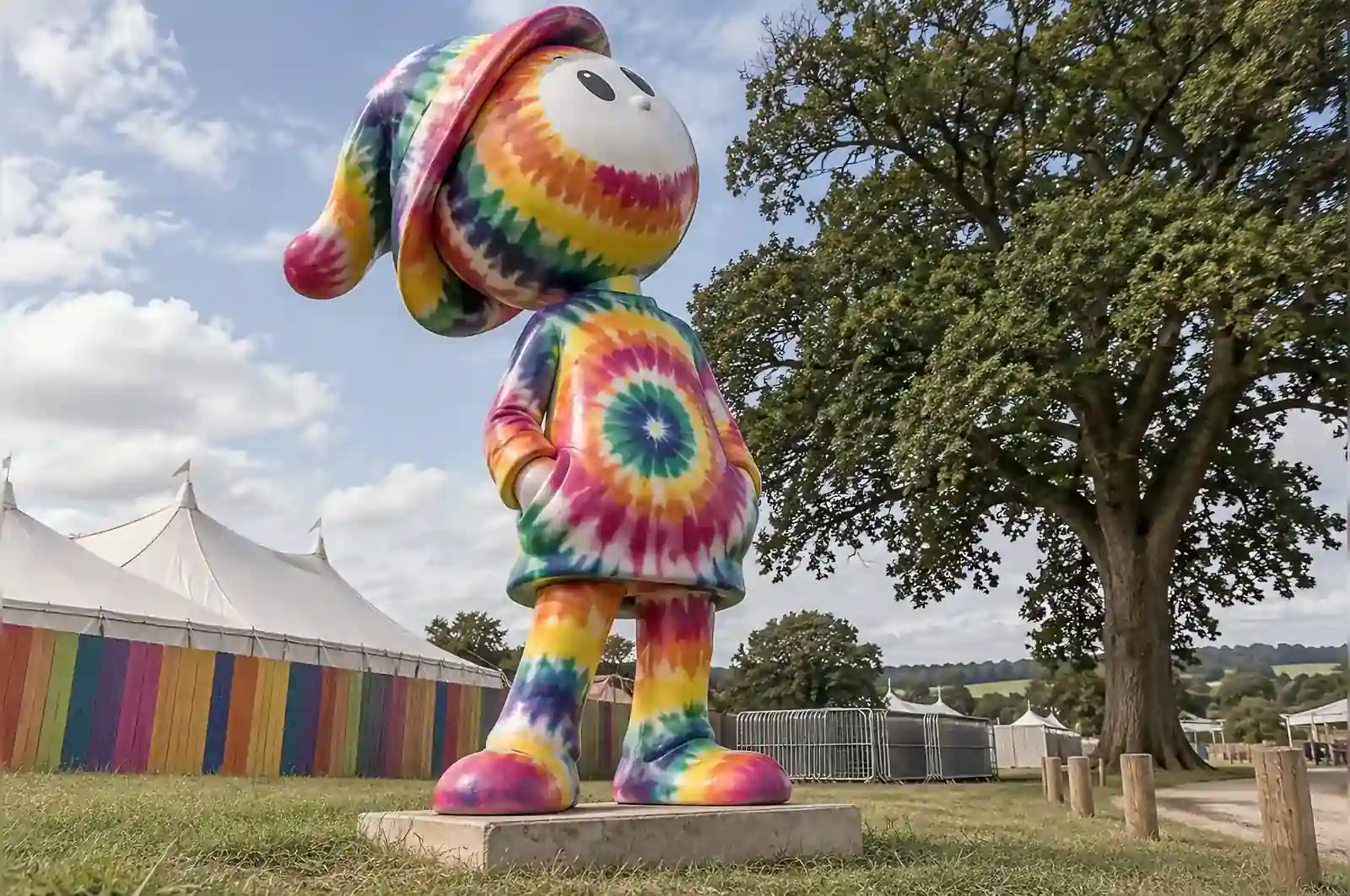
A figure at the edge of the main field, about 2.2 m, standing in the way people stand at a festival after three days: hands in pockets, head back, looking at nothing. Cartoon proportions. And the shirt had to be the loudest tie-dye anyone has ever seen.
Making dye behave
Real tie-dye has a specific structure that a printed pattern does not. There are concentric rings, but they never make clean circles, because fabric resists dye unevenly. At the boundary between two colours there is a zone where the two have bled into each other, and at the edges of each ring the colour is raw and irregular.
Ours is painted in the sequence a dye vat would produce: white ground, then the lightest ring, then each subsequent ring laid over the one inside it with a wet edge so the two bleed. Five colours and eleven rings across the tunic, plus two on each sleeve and three around the hat. There is no hard edge anywhere in the pattern.
The one concession to legibility is the face. Tie-dye over a face would have destroyed the character, so the neck and head are left in an off-white with only two rings, low and behind the ears, as though the dye ran down.
Weathering
It stands outdoors for six weeks a year and is under cover for the rest, which the festival arranged itself. The gloss clear coat means the whole piece can be hosed down with the barrier fencing at the end of the season.
In the field
It stands on a grass bank at the edge of the main field at 2.2 m, facing the stage rather than the crowd. The organisers report that more photographs are taken of it than of the painted sign that has stood on that bank since 1979, and that nobody has said a word about it being replaced.
What the site fixed
Three things were settled before we started, and none of them was negotiable. The height, the finish and the placement each shaped the build differently.
At 2.2 m, the figure reads at the distance a person crosses the main field. Large enough to be the landmark the organisers wanted, small enough to keep the cartoon proportions they had approved. Dropping it to 1.4 m would have turned it into a detail in the landscape rather than a destination; going above 2.6 m would have pushed it into a different weight class and a different internal steel frame.
The finish was the riskiest item. A tie-dye with five colours and eleven rings has to be laid in one order, wet over wet, and it cannot be corrected once the colour is down. If the festival had accepted a printed wrap instead, the rings would have been clean and uniform, and the whole reason for the piece — the look of dye meeting resistant fabric — would have been lost.
The third fixed item was the placement. It had to stand outdoors on the grass bank at the edge of the main field, facing the stage. Move it indoors and it loses the seasonal life and the six-week public run that made it worth building.
The frame and the shell
At 2.2 m high and only 0.6 m deep, the figure is tall and shallow — a profile, not a block. The internal steel frame carries the load, and the FRP shell is hand-laminated over it, so the strength comes from the geometry of the shell as much as from the steel. The two long legs and the thin torso take the bending load in wind, and they are laminated thicker than the arms and the head.
Because it stands on a grass bank rather than a concrete pad, the base is widened and ballasted so the figure does not rock in the wind that a field site in Somerset can take. The feet and lower legs are the heaviest part of the shell, which keeps the centre of gravity low.
The finish is what needs the most care at this size. A gloss UV clear coat over a painted figure in an exposed field takes the UV load through the summer, and it is the reason the whole piece can be hosed down at the end of the season rather than repainted. A scuff on a lower leg from a festival gate can be touched in locally, because the rings are laid in one sequence and a touch-in only has to match the ring it sits in, not the whole shirt.
Before you ask for a quote
Three questions to settle first, on a similar commission.
At what distance will it be read? A 2.2 m figure with eleven rings reads across a field. The same pattern on a 1 m figure collapses into a single blur of colour, because the ring width has to scale with the viewing distance or the finish is wasted.
Is it outdoors full-time or seasonal? This piece stands outdoors for six weeks a year and under cover for the rest, which is why the gloss clear coat is the last line of defence and why it can be hosed down rather than repainted. A figure in the weather twelve months of the year wants a different coat strategy and a different maintenance plan.
Can the pattern be laid in one sequence? A tie-dye is painted wet over wet, in one order, and it cannot be repaired section by section. If a ring colour needs to change after approval, the whole shirt has to be repainted, not one ring. Settle the palette before the 3D approval, because after that the pattern is locked.
Fifty years of this festival and the thing people photograph most is a sculpture of a person wearing the worst shirt we have ever seen on purpose.
A festival site in Somerset, England