
Cartoon Three-Quarter Portrait — Orchestra Conductor, Ghent
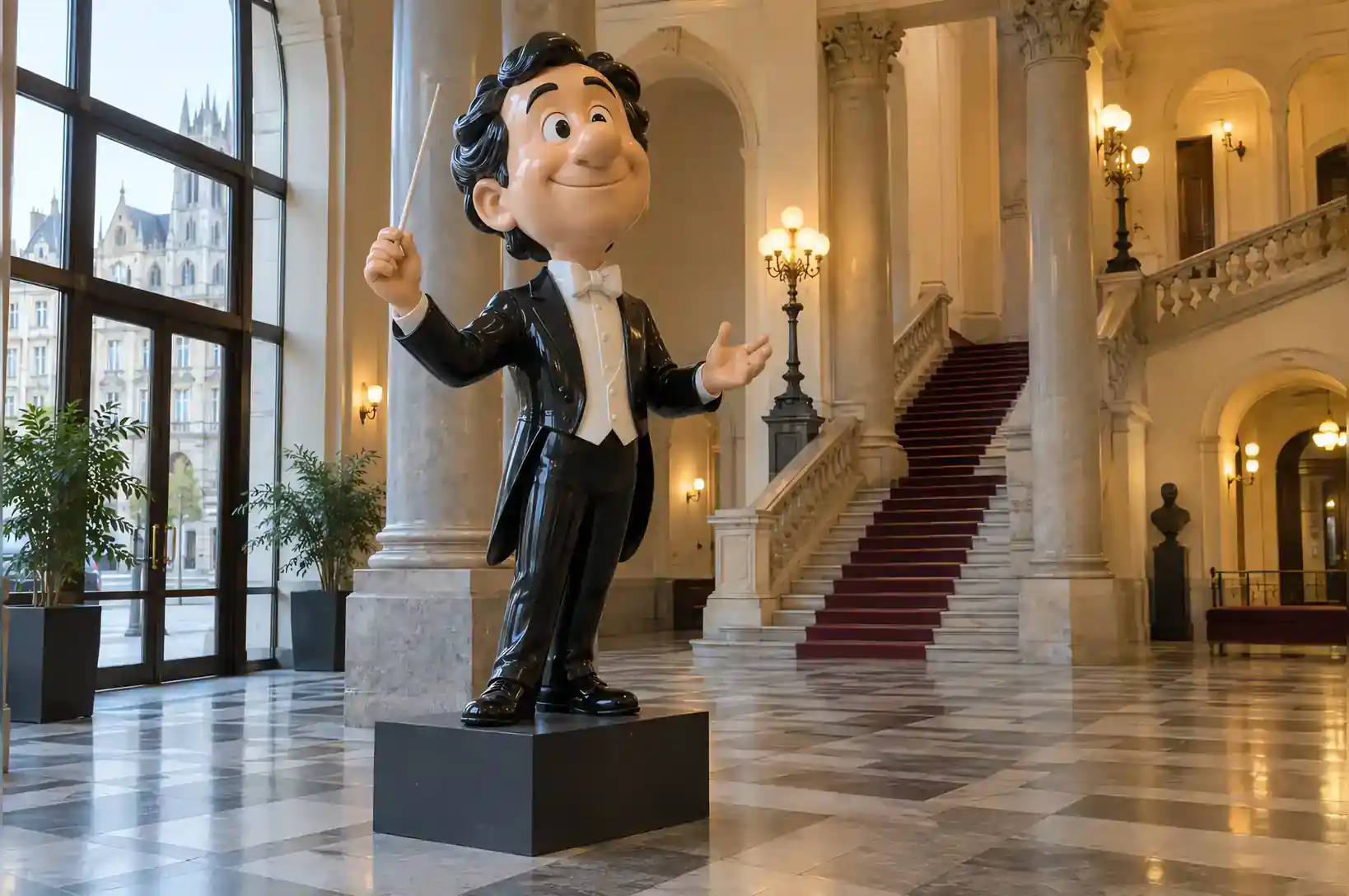
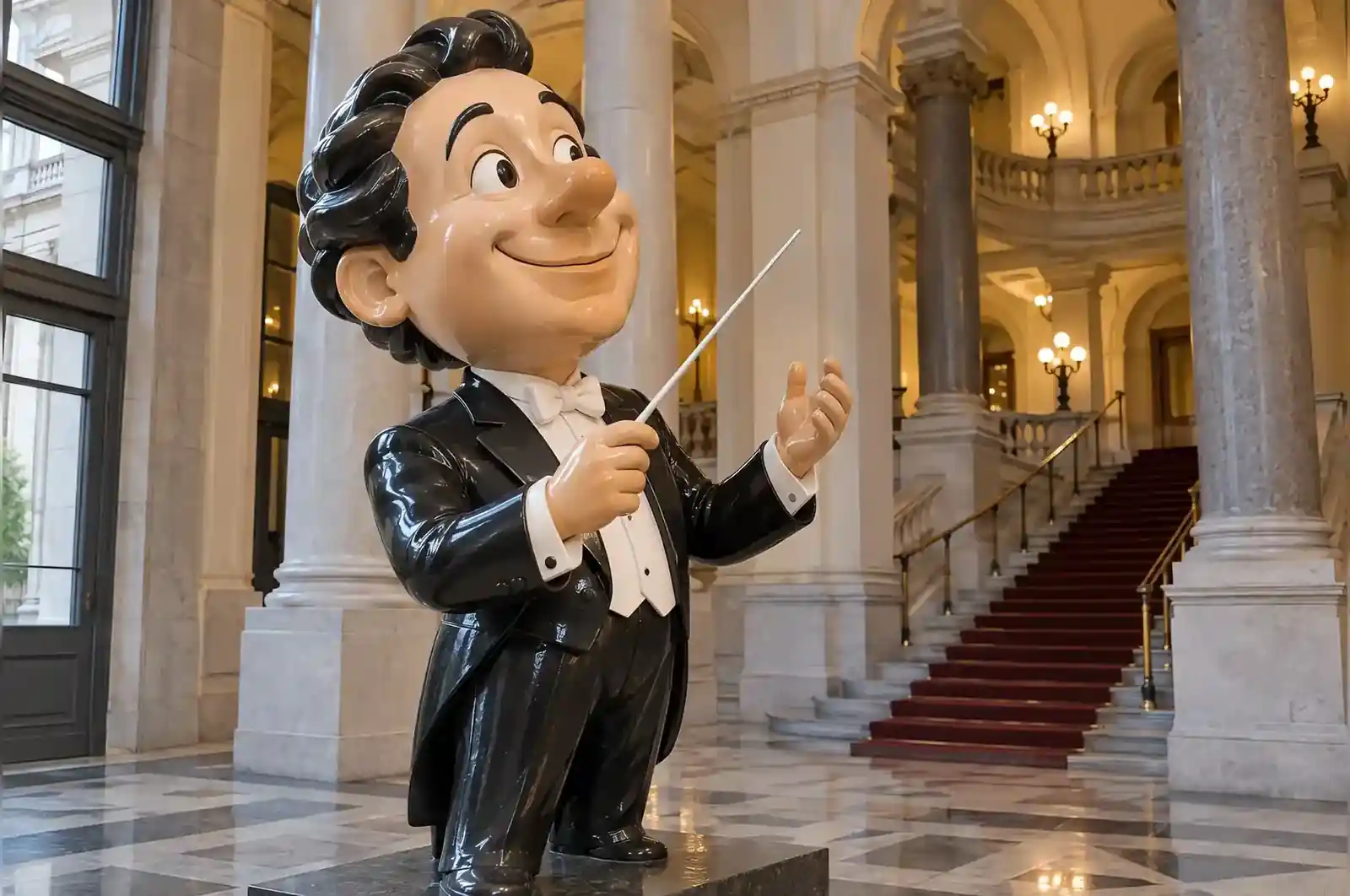
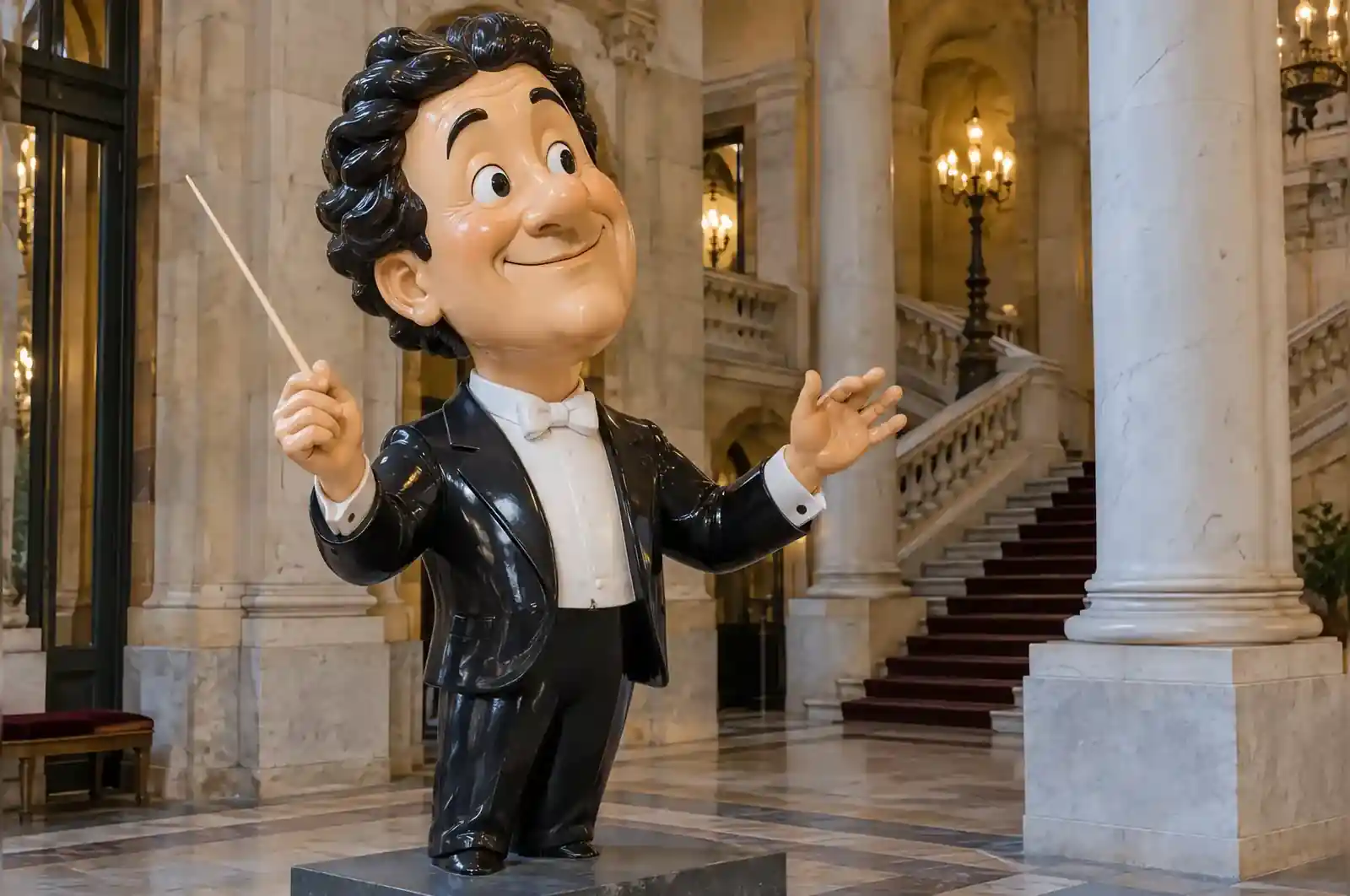
An orchestra in Ghent wanted to mark a conductor’s retirement. The obvious choice was a bronze bust. The committee’s concern was that he would have found it ridiculous.
What they asked for
A cartoon three-quarter portrait, cut below the knee, roughly 2.1 m, for the concert hall foyer. The baton hand had to be right — that was the one non-negotiable detail, and the committee sent two photographs of it specifically.
The baton hand
The baton hand was the one detail the committee would not negotiate, and it is the detail that decided the pose. They sent two photographs of it, taken from the podium at different distances, and the brief specified that the hand had to read correctly at full scale — the fingers, the thumb and the baton held the way he used it when cueing the strings. Everything else in the commission had room to move; that did not.
What would have changed if it had not been fixed is worth understanding, because it is what the price hangs on. With the hand fixed, the whole figure had to be posed around it: the arm raised to roughly shoulder height, the elbow bent, the torso turned a little to counter-balance the gesture. That is why the figure stands slightly off-balance rather than to attention, and it is that imbalance — not the likeness — that keeps a figure this size in a foyer from reading as a monument. If the hand had been allowed to be approximate, baton lowered or held against the chest, the pose could have been a simple standing figure. That would have made the modelling simpler, the armature lighter and the painting faster. It would also have been a statue of a conductor, not a portrait of a man mid-rehearsal.
Two other things would have moved with it. If the placement had been outdoors rather than in a foyer, the painted finish would have had to change — gloss-painted fibreglass holds a recognisable face but needs the shelter a foyer gives it, and out in the weather the committee would have been looking at a more robust but noticeably flatter finish. If the size had been dropped to a bust, the gesture would have gone entirely: a bust carries a head and shoulders, not a raised baton arm, and the thing worth keeping here was the man mid-rehearsal rather than the likeness alone.
Building it at full size
Built at 2.1 m over a steel armature, in a dinner jacket rather than concert dress, because that is how he rehearsed. The figure is slightly off-balance, caught mid-gesture rather than standing to attention, which is what keeps it from looking like a monument.
The finish
Gloss-painted fibreglass, hand-painted detail on the face and hands, UV clear coat. Painted fibreglass was the only route that could hold a recognisable face at this size.
Installation
Brought into the foyer in two sections and assembled on a low stone plinth at the foot of the staircase. The hall stayed open throughout.
The joint and the finish in a foyer
The piece went into the hall in two sections, and the joint between them is the part of the build that decides whether the figure reads as one form. The split was placed where the two sections could be carried through the doors and up to the foot of the staircase, and once the sections were seated on the plinth the seam was filled, faired and repainted so that the gloss runs unbroken across it. A large painted piece is therefore always assembled and finished on site rather than delivered finished: the seam has to be blended where the piece actually stands, under the lighting it will live under, and the hall stayed open while it was done.
Aftercare for a gloss-painted figure in an indoor foyer is different from the same piece outdoors. There is no rain and no direct sun, so the UV clear coat is there to slow the yellowing that stage and gallery spotlights cause in white and pale tones over the years, not to take weathering. What the finish actually needs is dust control: a gloss surface shows dust and fingerprints within days in a public building with steady footfall. The right way to clean it is a dry microfibre cloth, never an abrasive and never a solvent, both of which cut the clear coat and leave a dull patch that can only be repaired by a localised recoat and polish.
Decide these before you ask for a quote
Three things were settled before this commission went to a quote, and they are the three a buyer should settle on something similar. The first is the one detail that cannot be approximate. Here it was the baton hand, and it drove the pose, the armature and the painting. Settle the one detail you will not compromise on first, because it is the thing the price hangs on.
The second is access. A 2.1 m figure does not arrive in one piece if the route into the building will not take it. Know the door widths, the turning space and the lift before you ask for a price, because they decide whether the piece ships whole or in sections and whether the room has to close for the assembly.
The third is how much likeness has to read at distance. At 2.1 m in a foyer a painted figure is seen from across the room, not up close, and only painted fibreglass holds a recognisable face at that distance. Decide whether you need a likeness that reads across a foyer or a close-up portrait, because the second roughly doubles the painting time.
What it cost
A refined painted portrait at this scale sits in the $8,000–$15,000 band. This one came in at $12,400 delivered, eleven weeks from 3D approval.
The baton hand is the whole piece. They got the angle of it from two photographs and it is unmistakably him.
The Ghent Philharmonic Society