Pip — Abstract Brand Mascot, Copenhagen
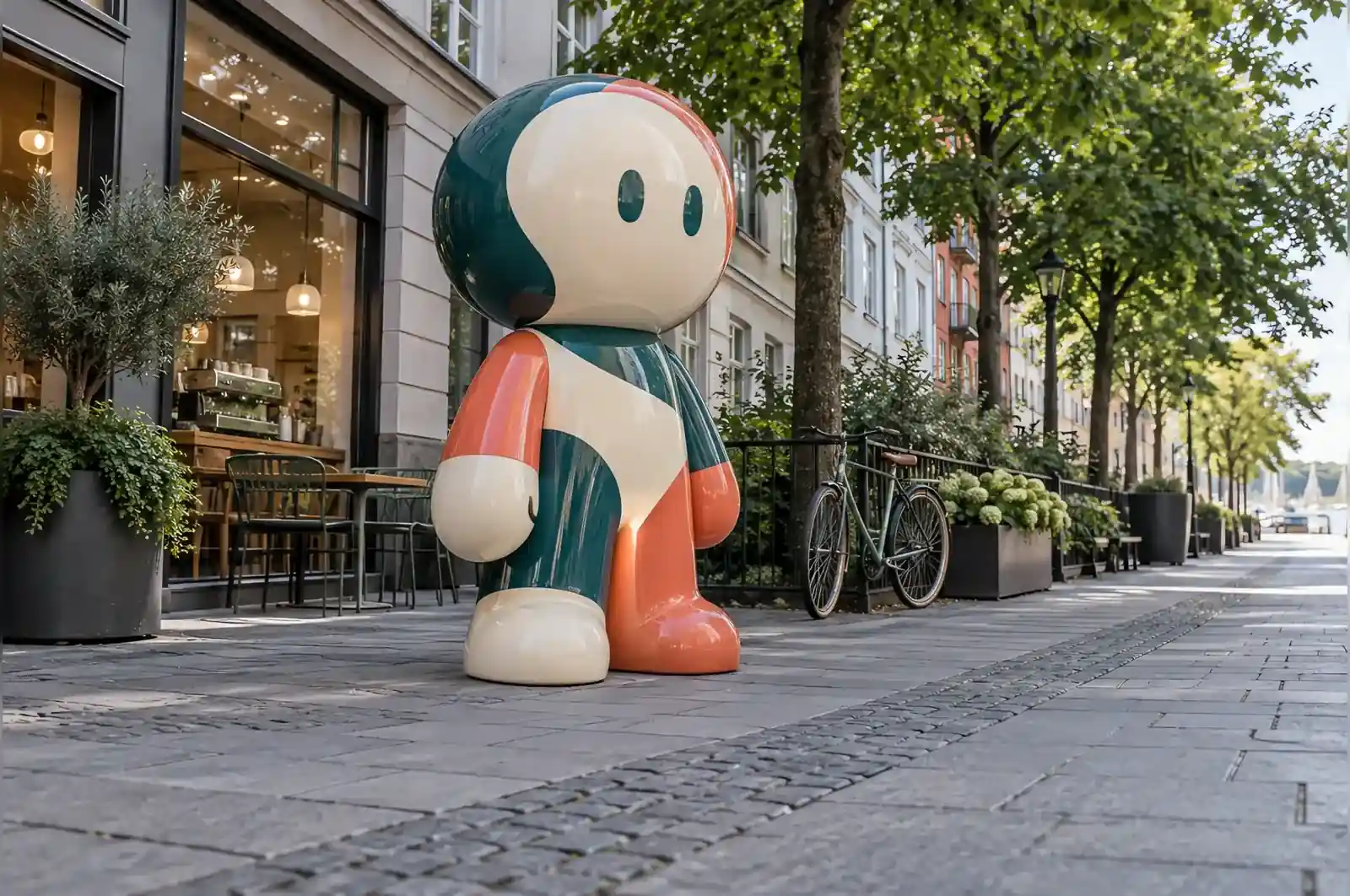
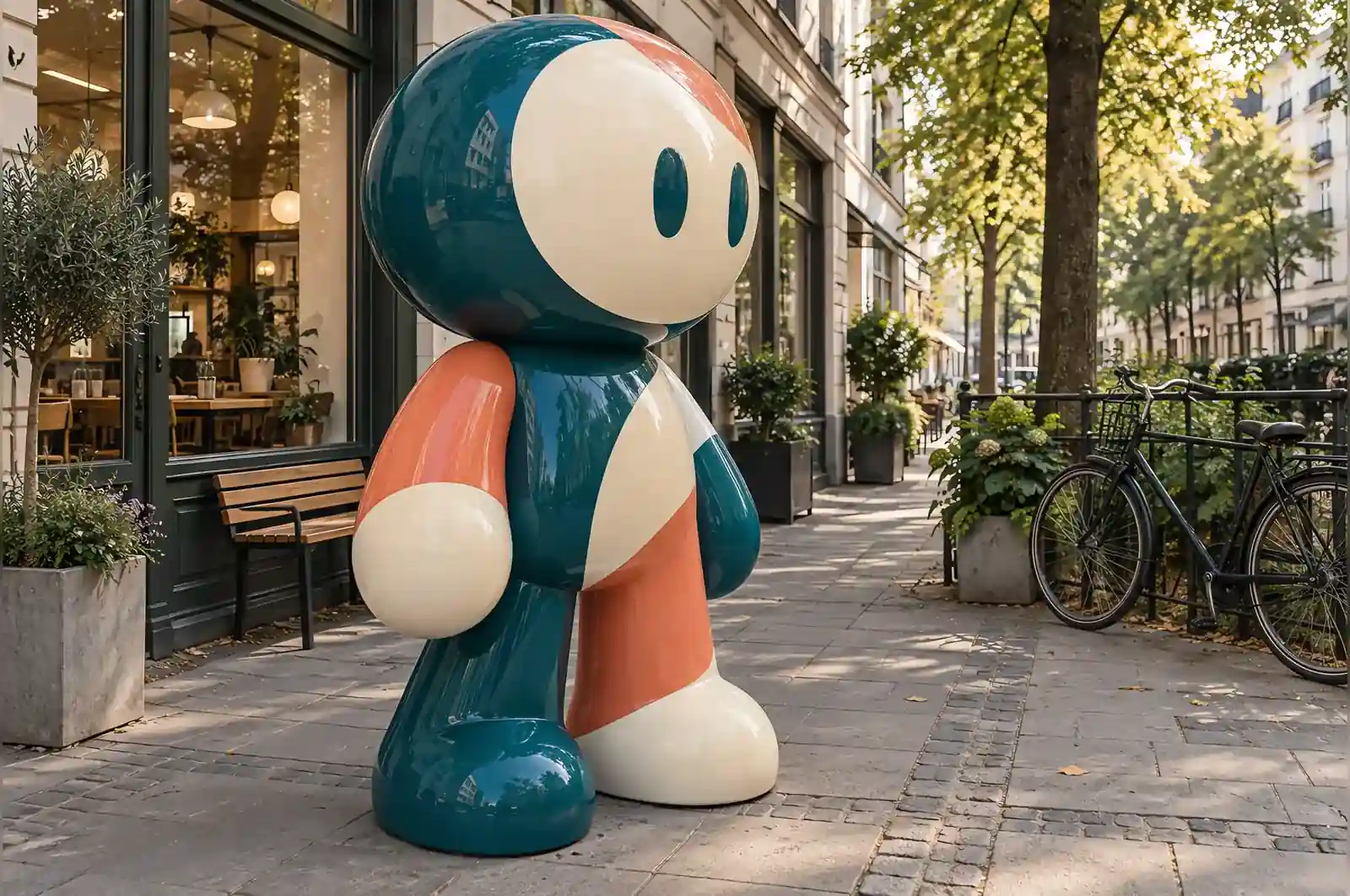

The chain had a logo and a colour palette, and nothing else. What they wanted was a character people would photograph — something that could stand outside each shop without being a person and without being a sign.
What they asked for
An abstract character at roughly 1.8 m, built from the brand’s own colours, with no face to speak of. The brief was explicit that it should not look like a mascot costume or a cartoon animal: a shape, a silhouette, a personality carried by proportion alone.
Designing something with no face
Without a face, everything rests on proportion and posture — the size of the head against the body, the angle of the shoulders, how the weight sits. We resolved all of it in 3D first and the client approved from renders, because at this level of simplification a small change to the head size changes the whole character.
What was non-negotiable
The non-negotiable part of the brief was the absence of a face. Everything else followed from it. Because the character could not use expression, the proportions had to carry the whole read, which is why the head-to-body ratio and the shoulder angle were settled in 3D before anything was cut. A face would have changed the process more than any other single decision: it would have let the shape be more conventional, shortened the approval loop, and moved the risk from the silhouette to the expression.
If the size had been dropped, the design would not simply have been scaled. At 1.8 m the figure reads from the pavement and sits below the shop fascia, with the head above the average sightline. Below about 1.2 m that presence goes, and the no-face proportions would have had to be exaggerated further to keep the silhouette legible from the pavement. Above 2.4 m it stops being a shopfront object: the internal frame and the base plate get heavier, the two-person move becomes a crane lift, and both the price and the lead time rise.
If the finish had been different, the brief would have failed at the colour stage. A patinated metal finish cannot be matched to a specific brand code, and neither can a textured stone; only the automotive paint reproduces the palette exactly. If the character had been moved indoors, the base plate and the clear coat would have been specified differently, but the build and the no-face design would have stayed the same.
The finish
Gloss-painted fibreglass, colour-blocked in three flat tones with an automotive clear coat over the top. Fibreglass was the only option here: a metal finish is coloured by a chemical patina and cannot be matched to a brand palette, whereas automotive paint reproduces a specific colour code exactly.
Build and weather
Copenhagen gets rain through most of the year and frost in winter, and this piece stands at street level with nothing over it. The two things that matter here are how the shell is sealed and how the colour is applied.
The shell is FRP over an internal steel frame. The steel is fully enclosed, and the base plate fixings sit below the visible form, so there are no exposed fasteners to rust and run down the paint. Because the character is abstract, with no face and few recesses, there is little standing water to trap. But the three-tone colour-blocking creates hard mask lines, and each colour boundary is a seam. The clear coat is applied as one continuous layer over the whole piece so those seams are sealed, not left exposed.
At 1.8 m high and 0.8 m wide, the surface area is small, which means less paint and less to maintain. The UV-stable clear coat means no repaint for years, and two people can move the entire piece if the site is reconfigured. The one recurring task is a washdown and a look at the colour boundaries once a year, because that is where any water that does sit will show first.
Installation
Bolted to a steel plate set into the pavement outside the shop, positioned clear of the door line. Nothing to repaint, and light enough that two people can move it if the site is ever reconfigured.
What it cost
Surveyed fibreglass ranges for 1.5–2.0 m run $900–$5,900, with simple geometric forms at the lower end because there is no face or hands to refine. This commission came in at $3,400 delivered, eight weeks from 3D approval.
What this means for your own brief
Three questions settle most of the cost and the lead time on something like this.
First, is the no-face rule load-bearing or a preference? If it is load-bearing, expect the design to be decided by proportion and posture, and expect the approval to come from renders rather than from a finished mock-up. If it is a preference, the character can lean on expression, and the whole process gets faster.
Second, does the finish have to match an exact brand colour? If it does, an automotive paint is effectively the only option, because it reproduces a specific code. A patinated metal or a textured stone finish cannot be matched to a palette, and that single decision removes most of the non-standard finishes from the shortlist.
Third, is the piece going outside, and exactly where? A street-level position means a steel plate set into the pavement, a UV-stable clear coat, and an annual maintenance check. A covered concourse means a removable plinth and a longer cycle. A piece behind glass changes both. Settle that before you ask for a quote, because it drives the base, the frame and the finish more than the height does.
We had a logo and no character. This gave us something people photograph and tag, which a flat sign never did.
A coffee chain in Copenhagen