Keeper — Cartoon Abstract Character, Sculpture Park, Ålesund
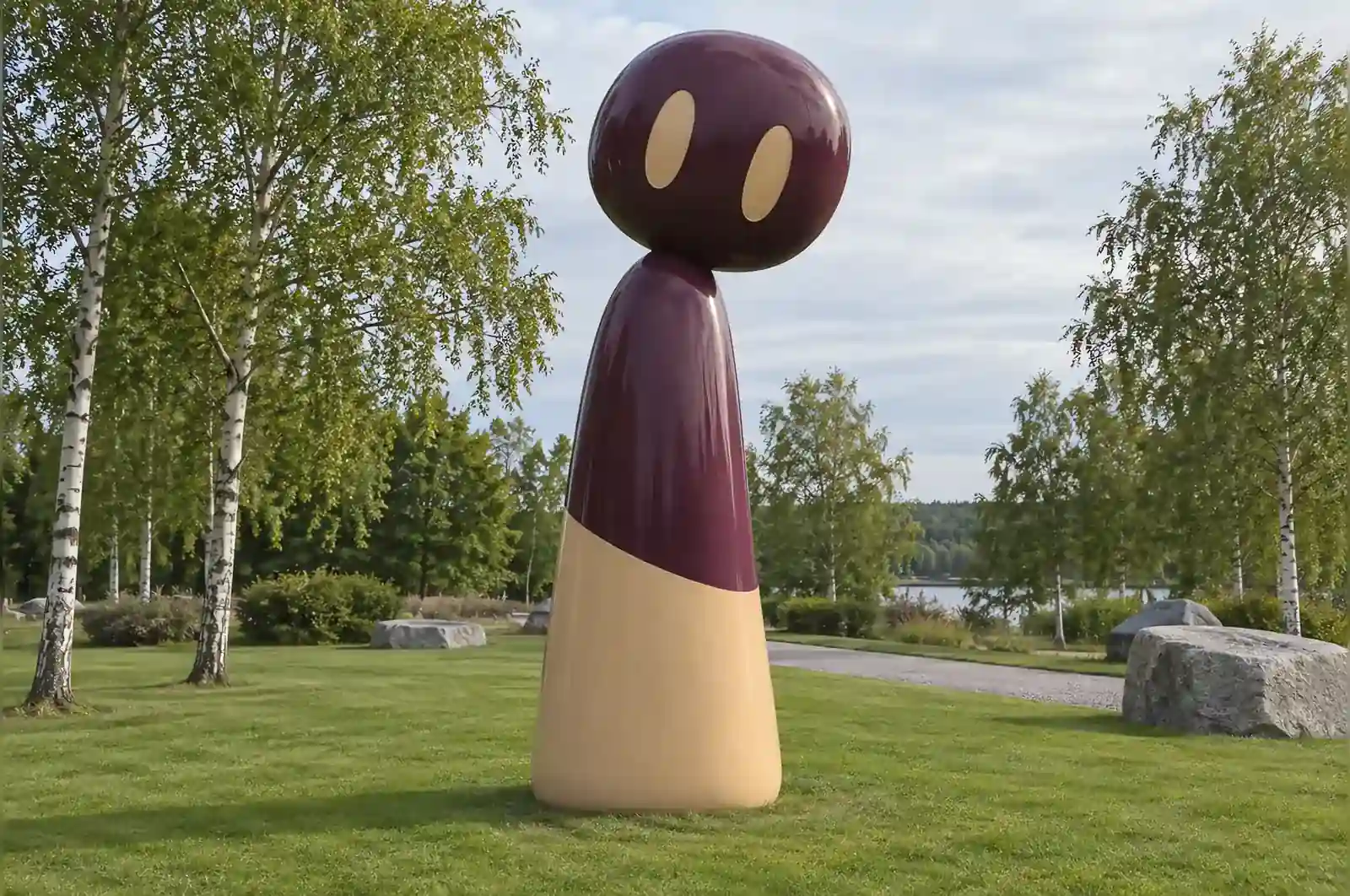
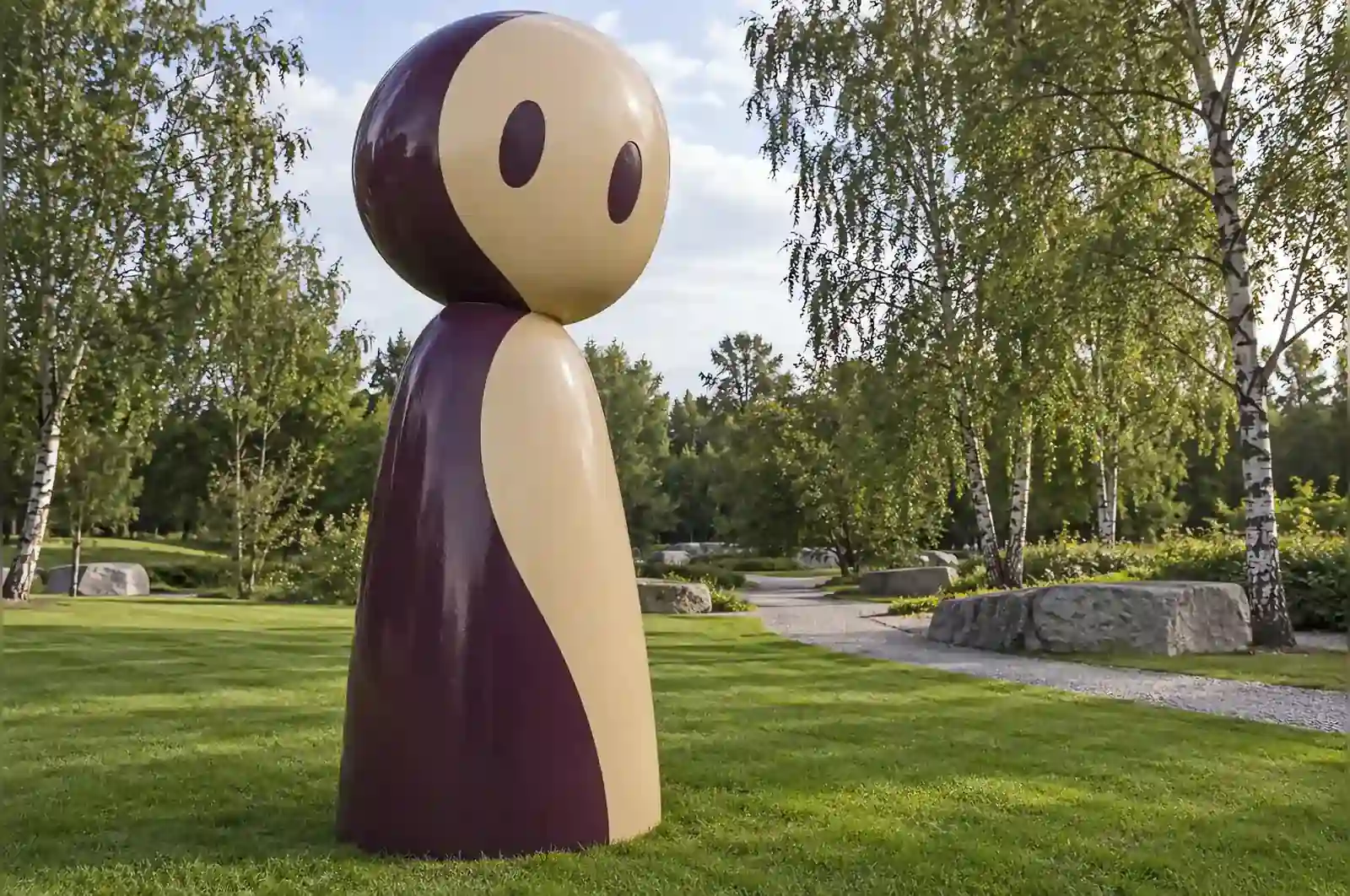

The trust had a lawn, a budget, and one instruction that shaped everything: nothing that could be mistaken for a portrait of anybody in particular. They wanted a character, not a likeness.
The brief
A single tall cartoon character, roughly 3 m, that would hold its own against mature birch trees without competing with them. It had to be recognisably cartoon — playful, rounded, something a child would name — but with no facial features beyond two simple eyes and no costume, no props and no story.
How far to simplify a cartoon character
That last requirement is the difficult one, because a cartoon character normally carries its personality in its face and its clothes. Take both away and the character has to survive on proportion alone: an oversized rounded head, a body reduced to a tall column of two soft volumes, and a very slight tilt of the head to one side. We built three versions of that tilt in 3D before the client agreed on one, and it is the whole content of the piece — change the tilt by five degrees and it stops being a character.
What the brief fixed
The one instruction that shaped the piece — nothing that could be mistaken for a portrait of anybody in particular — was the fixed point of this commission, and it was non-negotiable. Everything else was allowed to move around it. That is worth stating plainly, because it is the reason the character had to survive on proportion alone rather than on facial features, costume or props.
If that instruction had not been there, the piece would have changed in three obvious ways. Drop the height below the roughly 3 m mark and it stops holding the treeline: the mature birch trees are what set the size, and at 1.8 m the silhouette would sit below the canopy line and be lost against the trunks. Change the finish to a single flat colour and it reads as an abstract form rather than a character, because the two-colour split is what separates head from body. Move it indoors and both the UV clear coat and the low dark plinth become unnecessary — under a roof there is no sun load to protect against and no treeline to read the silhouette against, so it would be set directly on the floor at a lower height and a lower cost.
The finish
Gloss-painted fibreglass in two flat colour fields, deep aubergine and warm sand, under a UV clear coat. Two colours rather than one was a deliberate decision: a single colour reads as a form, two read as a character with a head and a body. Fibreglass is the material for this, because it is the only one that holds a specific colour exactly.
Keeping it right in a coastal climate
Ålesund sits on the Atlantic coast, so the piece works in salt air, steady wind and a great deal of rain, and the maintenance question is a real one. The part that does the work is the clear coat. The two colour fields are automotive paint — a very precise and very hard-wearing system — but it is the UV clear coat over them that actually protects the pigment and the gloss in an exposed outdoor position. It is the sacrificial layer: the part that takes the UV and the salt, degrades slowly, and gets renewed when it is eventually cut back and re-sprayed. That is effectively the whole maintenance schedule for a piece like this — an annual wash and inspection, and a clear-coat refresh at some point well into its life.
The flat colour fields make that refresh practical. Two flat, single-tone fields are straightforward to colour-match and re-spray in isolation; a mottled or airbrushed finish would be far harder to repair without a full repaint. The steel frame is the other part worth understanding. At 3.2 m tall and only 0.9 m wide, the figure is a slender column in a windy park, and the engineered steel frame inside is what carries the wind load — the fibreglass shell is a skin over it, not the structure. That is why the frame was engineered rather than simply fabricated.
Siting
Set on a low dark plinth against the treeline rather than in the open, so the silhouette has a dark backdrop to read against. Craned in over the path on a single morning; the plinth was poured and cured three weeks earlier.
What it cost
Above 2 m, fibreglass surveys between $5,000 and $15,000. This commission came in at $13,400 delivered and installed, fourteen weeks from 3D approval.
Three questions to settle before you ask for a quote
The first is whether your character can read without a face and a costume. That is the single biggest cost driver in a piece like this, because facial features, clothing and props all mean more 3D modelling, more mould work and more surface detailing. If your character can be identified by proportion, silhouette and colour alone — as this one is — you remove a large share of the build cost before the quote is written.
The second is height, because height is what moves the price. Above 2 m, fibreglass surveys between $5,000 and $15,000; this commission sat at 3.2 m and came in at $13,400 delivered and installed. If you do not need to clear a treeline or a roof, a smaller figure will come in considerably lower, and it will also be easier to lift into position. Set the height against the space it has to hold, not against an idea of scale.
The third is what the piece will read against. A dark plinth against a treeline gives a silhouette a solid backdrop; set against open sky, the same figure has to work much harder to read. Siting is a design decision, and it costs nothing to settle before the build starts.
It is obviously a cartoon character and obviously not a portrait of anyone. Children name it, adults walk around it slowly. Both were the brief.
A sculpture park trust in Ålesund