
Oversized & Giant Cartoon Statues, 3 m and Above
Eight landmarks between 3.0 m and 6.5 m — engineered for wind load, foundation and crane access, in gloss-painted fibreglass.
Above about three metres a cartoon sculpture stops being a scaled-up model and becomes a small structure. The character stays the same; almost everything underneath it changes.
What actually changes above 3 m
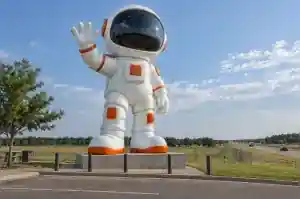
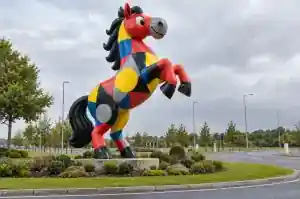
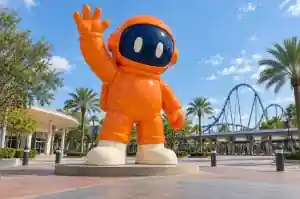
Under 2.5 m a figure can be carried down a path by two people and stood on a paving slab. From 3 m up it has to be laminated in sections that fit on a truck, bolted to a foundation sized for the wind load on its own surface area, and lifted into place by plant. The three largest pieces on this site are a 6.5 m astronaut on a highway plaza in Oklahoma, a 5 m horse on a roundabout in Milton Keynes and a 4 m astronaut at a theme-park gate in Orlando, and each needed a different answer to the same three questions: how it travels, how it is held down, and how anyone reaches it afterwards.
Wind becomes the governing load
At 6.5 m the Oklahoma astronaut is limited not by its own mass but by wind. The figure is laminated at 14 mm nominal skin over a galvanised 114 mm tube armature, bonded to a cast-in base plate on eight M24 anchor bolts. The waving arm is the critical element: it presents 2.4 m² of flat surface on the end of a 3.1 m cantilever, so the shoulder was built as a closed box rather than as a shell, and the assembly was load-tested and signed off at 45 m/s. That sentence is missing from most quotes for a sculpture over 3 m, and it is the one that decides whether the piece is still standing after its first winter.
The foundation is half the job
A roundabout island has nothing to bolt into: it is a mound of compacted fill. The 5 m horse on the Milton Keynes gateway weighs 340 kg as a shell, and with its armature it lands inside a 2.2 m pad 900 mm deep — a foundation the crew who built the island could pour themselves. It also sits on a frangible stainless base designed to shear at a defined load, so a car leaving the carriageway takes the base bolts with it rather than the sculpture. Above 3 m the base and the frame are designed before the character is finished, not after.
Size decides who the piece is for
The 4 m theme-park astronaut keeps its plinth at 200 mm, deliberately low, so visitors walk around it instead of queueing to look up at it. The 6.5 m highway figure stands at the edge of a pull-in, angled eight degrees off the road so that the waving arm faces oncoming traffic. Neither decision is about the character design. Both are about the site, the sightline and the speed at which the piece will be read.
What we need before quoting an oversized piece
Three things decide the price band above 3 m: the site (ground conditions, distance to the nearest vehicle access, whether a crane can reach), the wind region, and how the figure breaks down for transport. Send photographs of the location and we will tell you which of the three is the constraint before you commit to a size. Eight pieces between 3.0 m and 6.5 m are documented below, with their lead times and their real dimensions.
Size — Material — Price At Landmark Scale
| Size | FRP Fibreglass | Stainless Steel — for comparison |
|---|---|---|
| 2.0–3.0 m | $5,000–$15,000 | $15,000–$28,000 |
| 3.0 m + | $15,000–$150,000+ | $55,000–$350,000+ |
* This price is for rough reference only; a detailed quote will be provided based on the specific details of each project.
Which Size Class Fits The Site?
Frame, Base And Coat Above 3 m
Galvanised steel armature, not a thicker shell
At 6.5 m the internal frame is 114 mm galvanised tube bonded to a cast-in base plate on eight M24 anchors. Adding skin thickness instead of a proper armature is the most common way a large quote is made cheap, and it is the first thing that fails in wind.
Closed-box extremities
A waving arm carrying 2.4 m² of flat surface on a 3.1 m cantilever cannot be a hollow shell with a bolt through it. Where a limb projects, it is built as a closed box so the moment transfers into the shoulder and not into the paint line.
Frangible and designed bases
Roundabout islands, roadside verges and podium decks are usually compacted fill or a suspended slab. The base is either a designed pad (2.2 m × 900 mm on the Milton Keynes gateway) or, where vehicles can strike it, a stainless base that shears at a defined load so the piece can be re-bolted rather than rebuilt.
Coat life at landmark scale
Multi-layer automotive paint under a UV clear coat, with hand-painted detail. Outdoor life is 15–20 years before the coat needs refreshing. Every oversized piece on this page was specified for permanent outdoor siting with no power supply.
Landmarks Built Between 3.0 m And 6.5 m




Oversized Sculpture FAQ
How much does a 3 m cartoon statue cost?
In fibreglass the band above 3 m starts around $15,000 and runs past $150,000. The spread is not the character — it is the wind region, the foundation, the crane access and how many sections the piece has to break into for transport. A 3 m figure on a suburban forecourt and a 6.5 m figure beside a highway are not the same project at different sizes.
Can a large cartoon statue be built in sections?
Yes, and above 3 m it usually has to be. Sections are sized to travel on a standard truck, laminated with a bonded flange joint, and bolted on site over the armature. The joint is designed at the same time as the armature, because the seam has to land where the moment is lowest.
What foundation does an oversized sculpture need?
It depends on what is under it. The 5 m roundabout gateway piece sits inside a 2.2 m pad 900 mm deep in compacted fill; the 6.5 m highway piece uses a cast-in base plate on eight M24 anchor bolts in a concrete plinth. We supply the anchor pattern and the load figures, and the pad is poured locally to that drawing.
How is it lifted and installed?
Every piece above 3 m ships with a lifting plan: pick points, sling angles, the weight of each section and the order they go up. The crane is booked locally against that plan, because the plant that is available on site always beats the plant we would prefer.
How long does an oversized commission take?
The eight pieces on this page ran 14 to 18 weeks from 3D approval. The upper end is the 5 m and 6.5 m landmarks, where the frame, the base and the load test are part of the build rather than a formality at the end.
Will it survive coastal or exposed wind?
That is what the load test is for. The 6.5 m astronaut was tested and signed off at 45 m/s, with its projecting arm designed as a closed box specifically because that arm takes the worst of the load. Tell us the site's design wind speed and the quote is built around it.