
Giant Cartoon Astronaut — Plaza Landmark Sculpture, Oklahoma
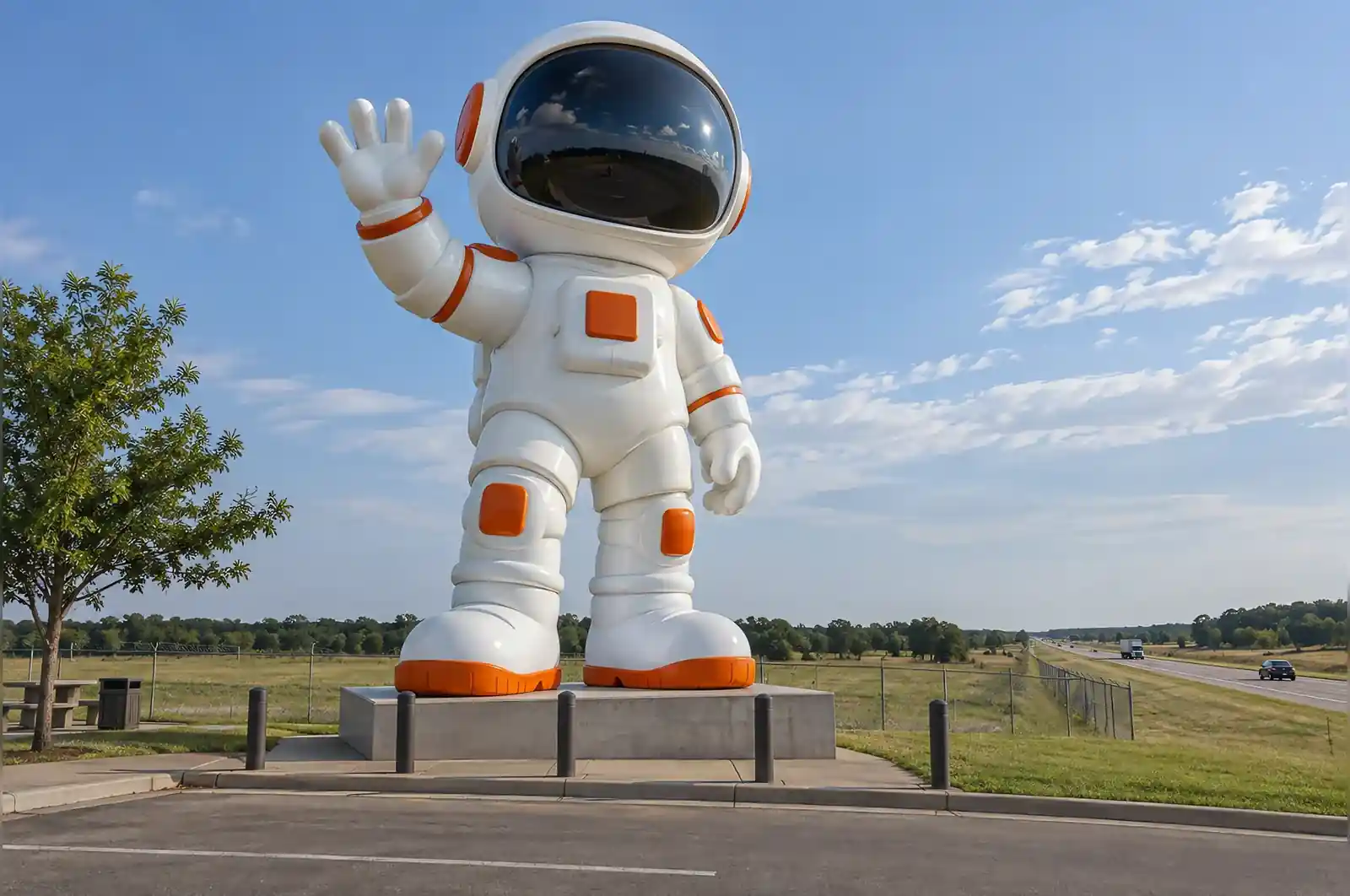
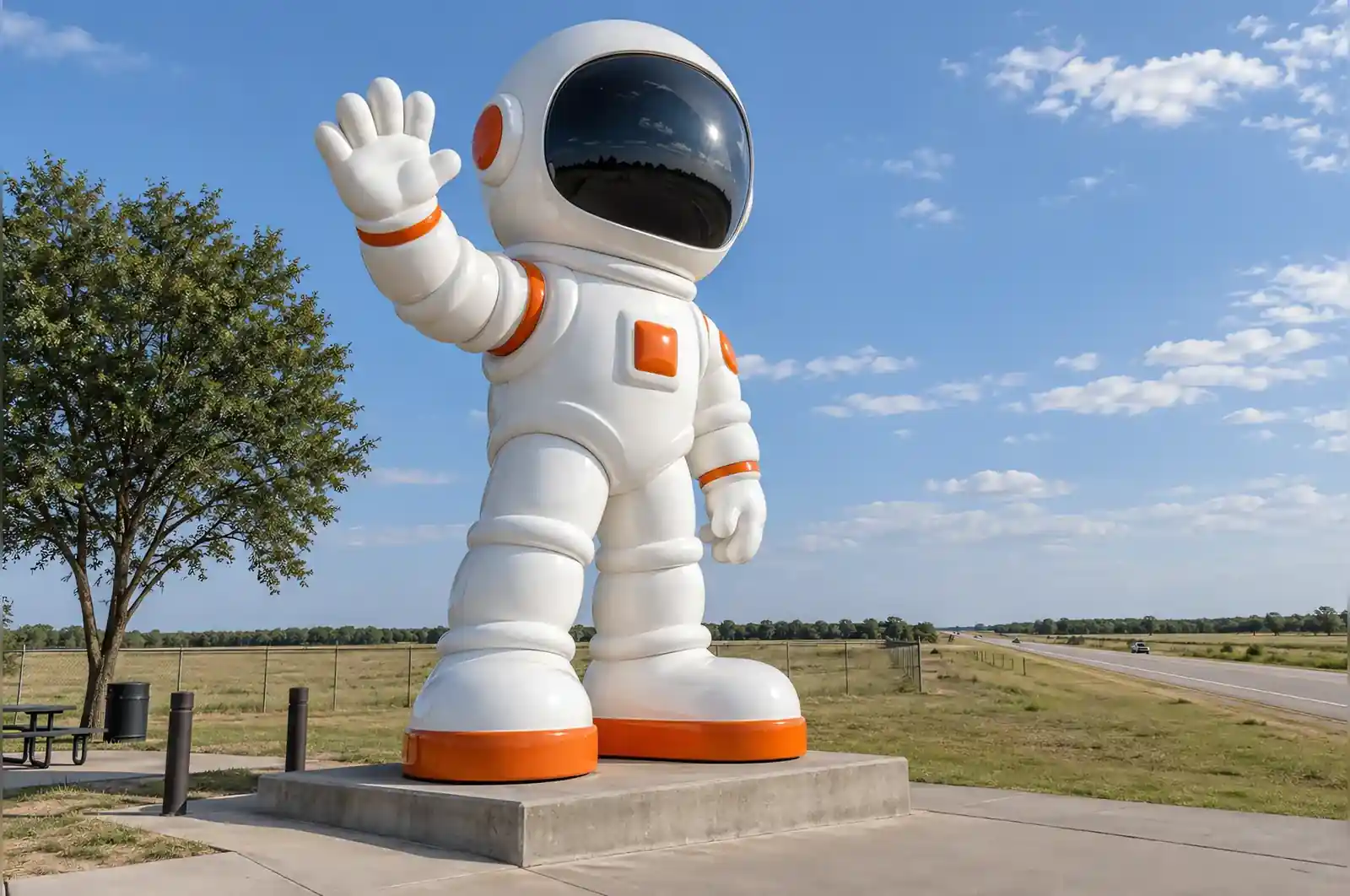
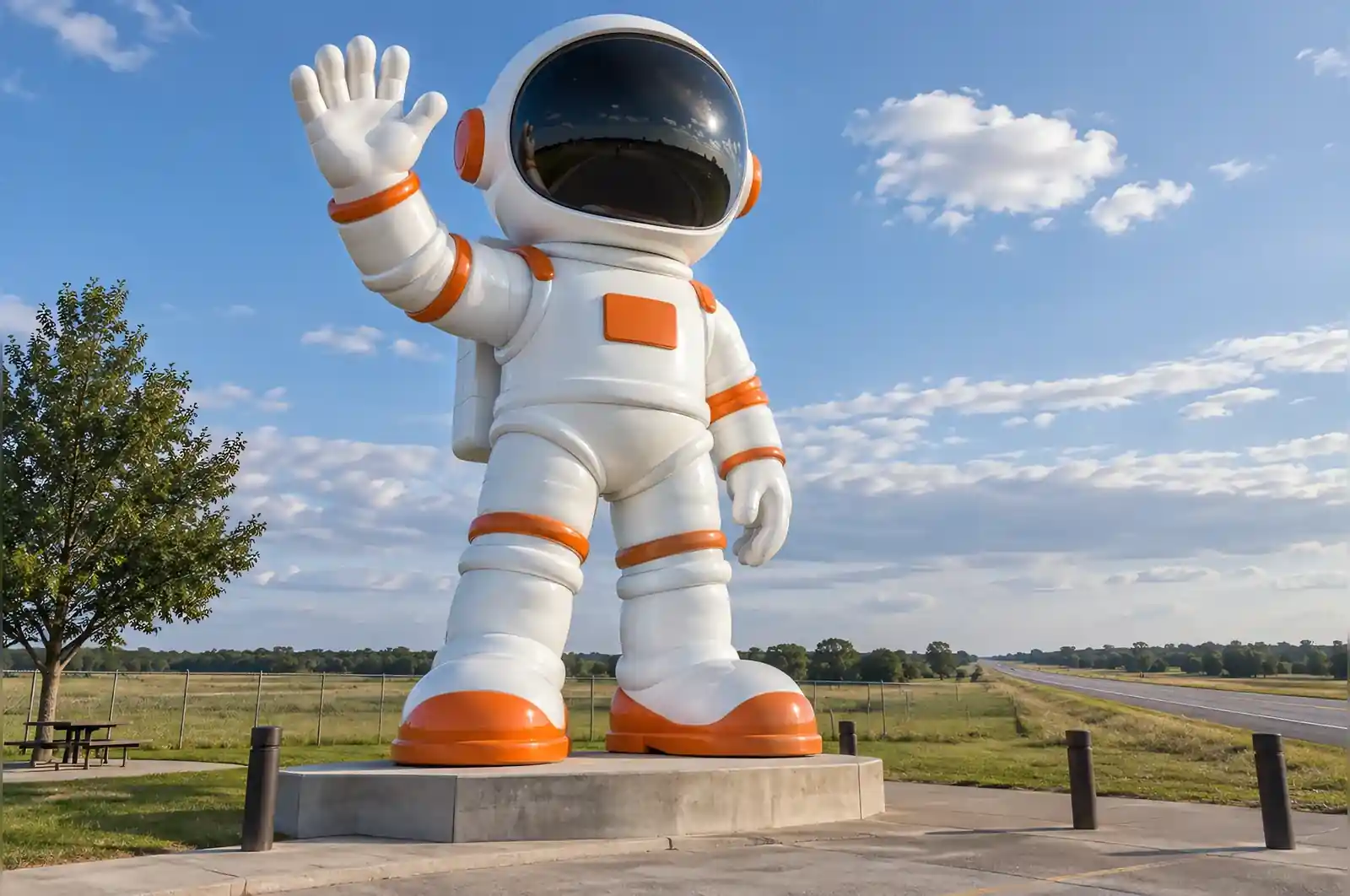
A six-and-a-half-metre astronaut is a piece of engineering that happens to look like a cartoon. Most of what we did on this job was work out whether it would still be standing in thirty years.
The brief
A town on a highway that once carried the whole country asked for something visible from a car at 100 km/h that would read as a landmark rather than as an advertisement. The subject was settled on quickly: a giant cartoon astronaut, waving. The only firm instruction was that it must not look like a sign.
Wind, not weight
At 6.5 m the governing load is wind, not the sculpture’s own mass. The figure is laminated at 14 mm nominal skin thickness over a galvanised armature of 114 mm tube, with the armature bonded to a cast-in base plate on eight M24 anchor bolts. The waving arm is the critical element: it presents 2.4 m² of flat surface on the end of a 3.1 m cantilever, so the shoulder was built as a closed box rather than as a shell and the arm carries a stainless steel core through its whole length. The assembly was load-tested and signed off at 45 m/s.
Reading at distance
Cartoon proportions do not scale for free. Signals that charm at 2 m disappear at 6.5 m, so the visor band is 620 mm deep, the limb ring joints are 180 mm proud and the boots were oversized by about 15% against the approved drawing. There is one accent colour, a safety orange used on four patches and on the boot soles, and it is the only colour on the piece that is neither white nor near-black.
Why not stainless
Stainless steel was considered and rejected, not on cost but on reading. At this scale a mirrored metal figure reflects the sky and the road and resolves into a grey mass from a passing car, where a painted fibreglass shell holds its shape and its colour in exactly the conditions that matter.
On the plaza
It stands on a low concrete plinth at the edge of the pull-in, angled eight degrees off the road so that the wave faces oncoming traffic. What the town did with it afterwards is in the panel above.
The size was set by the road
Three things on this commission could not be traded away, and each one is a consequence of the site. The height is the first. A figure that has to be read from a car at 100 km/h cannot be a garden piece; at 6.5 m the wave arm carries a 2.4 m² presented face on a 3.1 m cantilever, which is what forced the closed-box shoulder, the stainless core through the arm and the 45 m/s load test. Drop the size to 3 m and that whole structural budget disappears — the arm presents a fraction of the area, the cantilever shortens, and the build becomes an ordinary fibreglass shell. The road is why none of that was available.
The finish is the second. The brief’s single firm instruction was that it must not look like a sign, and the gloss white space-suit finish with one safety-orange accent is what delivers that. A mirror stainless figure would have resolved into a grey mass at speed, and a plain matte white would read as a painted advertisement. The finish and the reading are the same decision here.
The placement is the third. The wind load, the 14 mm laminate, the galvanised armature and the eight M24 anchor bolts all exist because this stands in the open on a highway plaza. Moved indoors, the same figure could have been built considerably lighter, and the structural effort spent here would instead have gone into surface and detail. What could not be given away was the site itself.
Gloss white in the Oklahoma sun
The part that wears is not the figure, it is the clear coat. A gloss white shell standing on an exposed plaza takes full sun, and a plain white gelcoat yellows and chalks within a few seasons at this latitude. The UV clear coat is the sacrificial layer: it absorbs the ultraviolet and dulls before the white beneath it does, and it is the layer you re-coat rather than the laminate. That is the one item of maintenance this piece actually demands.
Gloss white also shows what the road throws at it. At the edge of a pull-in the figure collects diesel film, tyre dust and insect strikes far more visibly than a dark or a matte finish would, and the dark reflective visor shows the same traffic grime as a smudge. The ring joints at every limb and the chunky boots are the natural washing points, and because the plinth is low concrete at the edge of the pull-in the whole surface is reachable from the ground — no scaffold, no specialist access, just a mop and a ladder. The armature underneath is designed for decades; the upkeep is the coat and the wash.
Three things to settle before the quote
Before asking for a quote on something similar, settle three questions. First, where will it be seen from, and at what speed? This piece was sized by a car at 100 km/h; a figure read from a garden path or a forecourt does not need 6.5 m, and one read from a road cannot be smaller. The viewing distance sets the scale, and the scale sets the structure.
Second, what is the governing environment? On an open plaza the governing load is wind rather than weight, which is why the laminate is 14 mm, the armature is galvanised tube and the shoulder is a closed box. Indoors the load is the sculpture’s own mass and the build gets lighter. Settle this before the quote, because it changes the structure rather than the look.
Third, what must it read as, and is the finish fixed? This client said “not a sign”, and the gloss white with a single accent colour is what delivered that. A mirror finish reads differently at speed, and a matte finish reads as paint. The reading and the finish are the difference between a landmark and a grey mass, so fix both before you ask.
People stop, get out and stand underneath it. Nobody does that for a sign, and that was the whole argument for building it.
A city tourism board in Oklahoma, USA