
Dripping-Paint Cartoon Astronaut — Planetarium Forecourt, Leiden


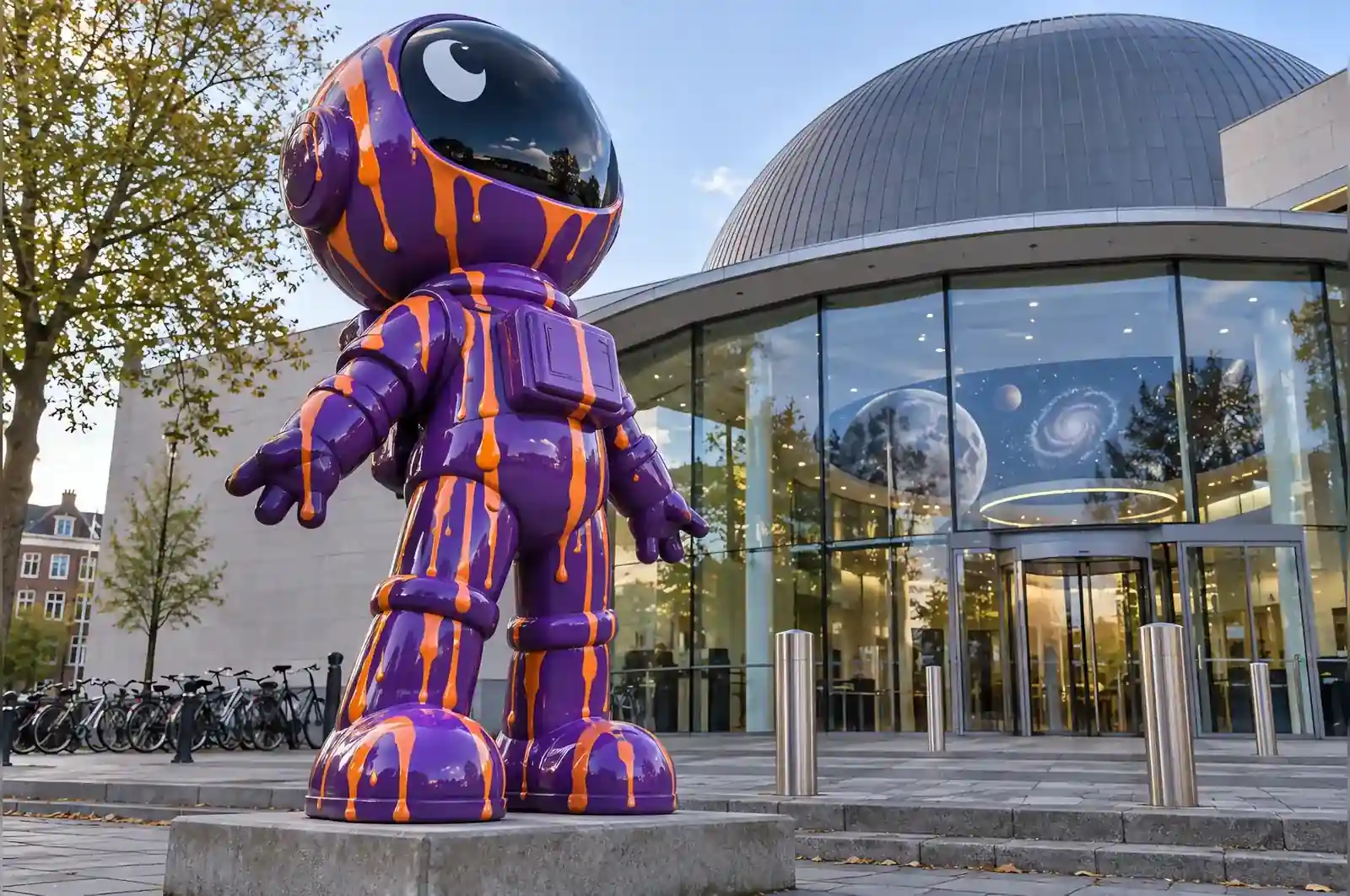
A planetarium wanted a figure for the forecourt that would still work for the six-year-olds who arrive in the morning and the adults who leave at eleven at night, which is a longer day than one idea usually covers.
nn
The one joke, told properly
n
The astronaut is finished to look as though the paint is still running: a saturated ground with long vertical drips of a contrasting colour frozen mid-run down the body and the legs, each one finishing in a rounded bead. Nobody commissions a still-wet sculpture by accident, so everything else about the piece is played completely straight. It is one joke told well rather than four jokes told quickly, and the difference shows up in the fact that the piece also works for somebody who never notices the joke at all.
nn
Drips are a lighting problem
n
A drip only reads as a drip if it stands proud of the surface. Each one was built as a raised ridge about 4 mm high with a bead at the lower end and then painted in the same pass as the ground, so that the film runs unbroken over the edge. Painted flat, they vanished completely beyond about four metres, which is a distance this forecourt is never viewed from.
nn
By day and by night
n
The forecourt is floodlit, and a raised drip under floodlight throws a hard shadow that roughly doubles its apparent depth. The bead at the end of each drip is 9 mm, which is the smallest size that still casts a readable shadow from the far side of the forecourt at night.
nn
Why 2.4 m, and not the four metres everyone asks for
Every conversation about a forecourt figure starts at four metres and this one stopped at 2.4 m for a reason that has nothing to do with budget. The doors are two metres from the figure and the canopy is four, so anything taller would have been cropped by the canopy from the road and lit unevenly from below at night. At 2.4 m the piece sits entirely inside the floodlight cone, which is what makes the drips work after dark. Size here was set by the building, not by ambition, and a taller figure on the same spot would have been a worse piece rather than a bigger one.
The difference between a wet look and a wet object
A gloss coat alone does not read as wet, because wet paint has depth: it pools, and a pool has a shadow at its lower edge. That is why each run is a raised ridge with a bead at the end rather than a painted stripe, and why the gloss level is specified per colour instead of once for the piece — the drip colour is glossier than the ground it runs over, which is physically wrong for paint and completely right for what the eye is being asked to believe. Finishing the whole figure in one gloss would have made it look varnished, which is a different and much cheaper idea.
Cleaning a sculpture with grooves in it
Sixteen vertical ridges collect dust and, on a forecourt, rubber dust from tyres, which is grey and sticks. The piece is washed every quarter with water and a soft brush down the length of each ridge, and the beads are the parts that need attention: a bead is a small overhang, so it holds water and, in a hard-water city, limescale. The clear coat is what takes the brushing, and it is inspected yearly. Nobody has yet tried to wipe a drip off, which was the design risk — a raised form is not a stain, and a well-meant polish with a cloth over a bead is the fastest way to flatten the shadow that the shape depends on.
Briefing a paint joke to a fabricator
A finish like this fails at the drawing stage, not in the paint shop. Two numbers have to be on the drawing before anything is moulded: the viewing distance the joke is written for, and the height of the light it will be seen under. Beyond about twelve metres the drips resolve into a pattern and the piece becomes an abstract figure, which is fine if the far view is a bonus and fatal if the far view is the brief. Ask your fabricator what distance the finish is drawn for, and ask for the bead or ridge dimension in writing — those two answers separate a wet-looking piece from a striped one.
Two more numbers are worth asking for in writing. The coat build over the ridge, because a thin coat over a raised edge wears through first and a worn drip is a grey drip. And the cure time before the piece may be washed, because a forecourt figure is usually cleaned within a few weeks of going in and a solvent wash on an under-cured clear coat takes the gloss off permanently. Neither figure appears in a normal sculpture quote, and together they decide whether the joke still reads after the first winter of traffic dust.
On the forecourt
n
It stands at 2.4 m beside the doors rather than in front of them, so arriving visitors pass it on the way in and leave past its back, which carries drips running the other way. The planetarium’s note about what the children do with it is in the panel above.
nn
Children tell their parents not to touch it because the paint is wet. Some of the parents check.
A public planetarium in Leiden, Netherlands