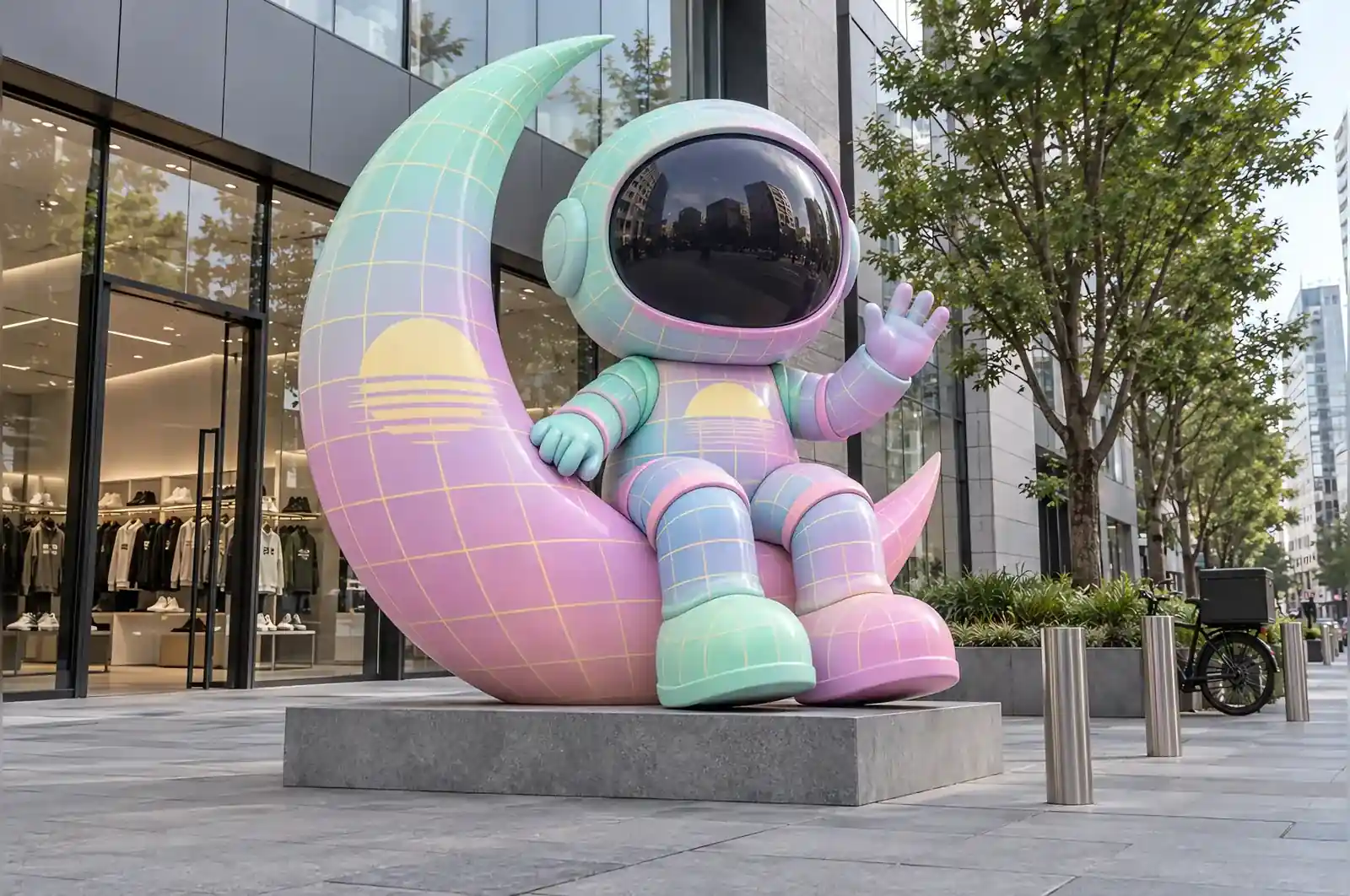
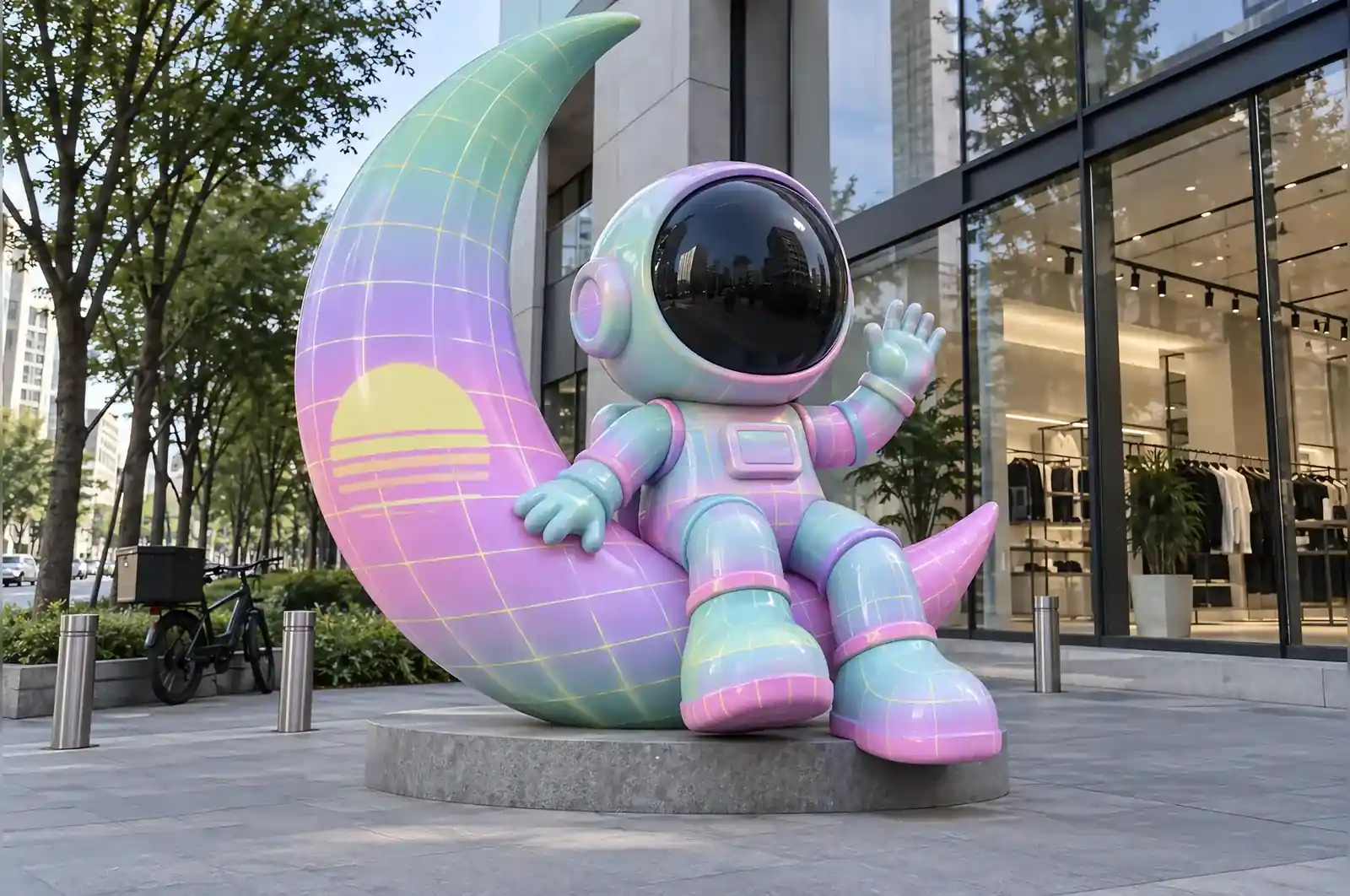
Astronaut Cartoon Mascot — Storefront Sculpture, Seoul
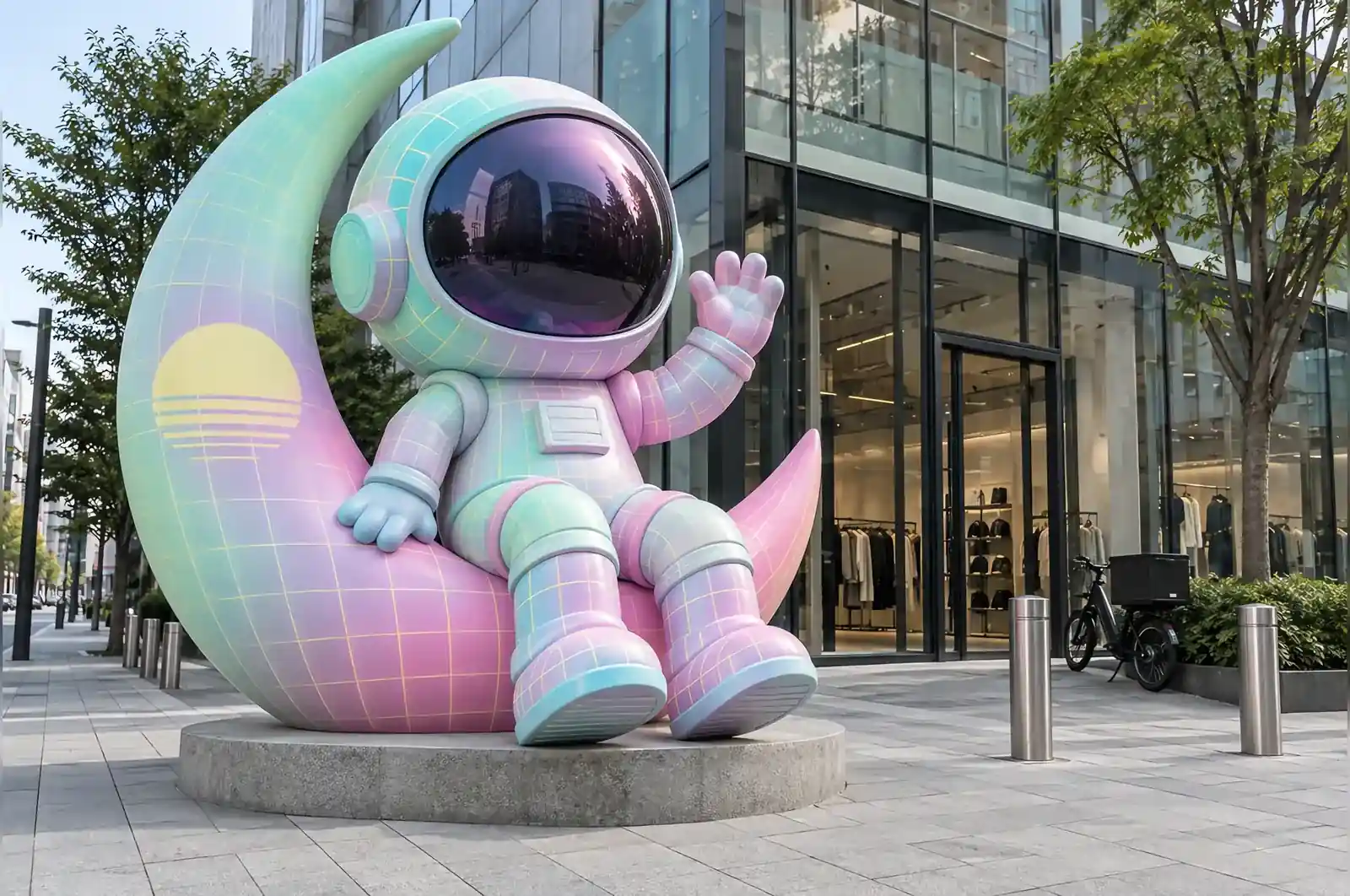
The brief came from a shop rather than a museum, which changes what the piece has to do. A museum sculpture is looked at once by each visitor. A storefront sculpture is walked past by the same people every day, and has to survive that.
What they asked for
A seated figure, 2.6 m, on the pavement outside the entrance, close enough to the glass that it appears in every photograph taken of the shopfront. The model was to be an astronaut, and the instruction on the face was the same one we get from almost every retail client: no face at all. A helmet and a dark visor, so that whoever is looking at it can imagine themselves inside.
What was non-negotiable
The brief settled three things before any modelling began, and they are the three things this piece cannot be without. The height: at 2.6 m the seated figure clears the people walking past it and holds its own against the window behind it, where anything under about two metres would have read as furniture rather than a landmark. The face: no face at all, a helmet and a dark visor, so that the piece stays a mirror and never dates to a trend. The placement: on the pavement, close enough to the glass that it appears in every photograph of the shopfront.
If any one of these had given way, the commission would have changed shape. Bring it inside and the finish could have been specified for display rather than for touch, because it would no longer be washed and brushed by the street. Drop it below two metres and it would have disappeared into the window display rather than standing in front of it. Give it a face and it would be a character from one moment, where a visor is a character from every moment.
Sitting on something
Adding the moon gave the piece its height without making it tall. The crescent is 1.6 m across, laminated as a separate shell and bolted to the figure at four points through the hips and calves, so the sculpture is structurally a seated figure on a beam rather than a figure holding its own weight out in the air. The inner curve of the moon sits at 480 mm from the ground, which is exactly seat height, and the shop’s staff noticed this within a week.
The finish, and why not white
A white space suit was the obvious answer and the wrong one for this location, because the shopfront is white. The scheme is a smooth airbrushed gradient running from mint at the boots through lilac to pale pink at the shoulders, with a fine neon wireframe grid laid over the whole body and a low half-sun disc sitting inside the curve of the moon. The grid lines are 3 mm and were masked rather than hand-drawn, because a wireframe that wobbles stops reading as a grid.
Finishing for a pavement
Everything on a pavement gets touched. The surface is a two-pack polyurethane under a UV clear coat, specified for hand contact rather than for weather alone, and the seams on the moon were filled and flatted so that there is nowhere for grime to collect along the top edge.
How it stands up
The figure carries its weight on the frame, not on the shell. The internal steel frame runs up through the legs and the spine, and it is the part that is anchored to the ground, so the whole piece is fixed to the pavement rather than standing on it on its own. The fibreglass is hand-laminated over that frame and gloss-painted, which is what gives a 2.6 m figure the rigidity of a solid object while keeping it light enough to be moved and set by a small crew. The moon is a separate shell bolted through the hips and the calves, so the load from the crescent passes into the frame rather than hanging off the surface finish.
What the finish has to survive here is Seoul, not just a weather forecast. The site sees hot, humid summers and cold, dry winters, and a pavement piece is walked past and brushed every day. The UV clear coat is the sacrificial layer, and it is the one part of the piece that gets maintained: a wipe-down and a light polish with the seasons, and a re-coat when the gloss starts to dull. That is the whole aftercare schedule.
What this means for your own brief
Three things to settle before asking for a quote on something like this.
The first is how close people will get. This piece stands on an open pavement and is touched daily, so the surface had to be specified for hand contact — a two-pack polyurethane under a UV clear coat rather than a decorative paint. If yours is behind a barrier or above head height, the spec changes and so does the finish that has to be specified.
The second is what it will be seen against. This shopfront is white, which is exactly why the suit is not. The mint-to-lilac-to-pink gradient and the 3 mm wireframe are there to separate the figure from the building behind it. Tell us the wall colour, not just the site.
The third is the face. The no-face instruction here was deliberate: a helmet and a dark visor, so the piece stays a mirror and never dates to a trend. If you want a character with features, say so at the start, because it changes the modelling as much as the finish.
And allow for the lead time. Fourteen weeks from 3D approval is the schedule this piece ran to, and a pavement installation needs a window in the site’s own work.
Afterwards
It has been photographed more than the window display it stands in front of. The client’s own note is in the panel above, and it remains the most accurate description of the piece we have.
Customers sit on the moon rather than next to it. We have stopped pretending that is not the reason we commissioned it.
A streetwear label's flagship store in Seoul, South Korea