Blueprint Cartoon Astronaut — Company Plaza Sculpture, Toulouse
An engineering company asked for a mascot and then specified that it must not look like a mascot. What they actually wanted, once it had been worked out in a second meeting, was a sculpture that looked like one of their own documents.
nn
Cyanotype, and why this company recognises it
n
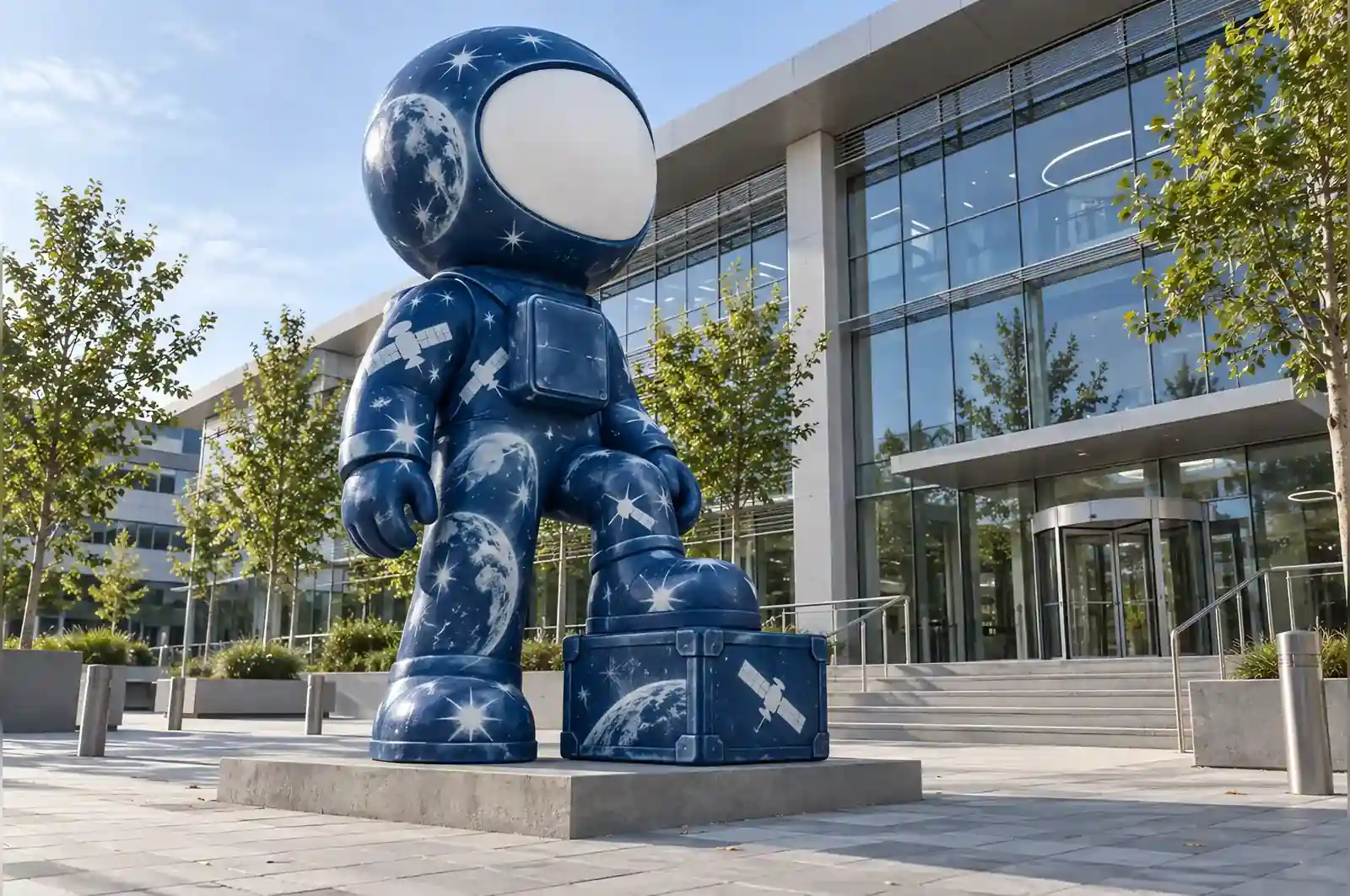
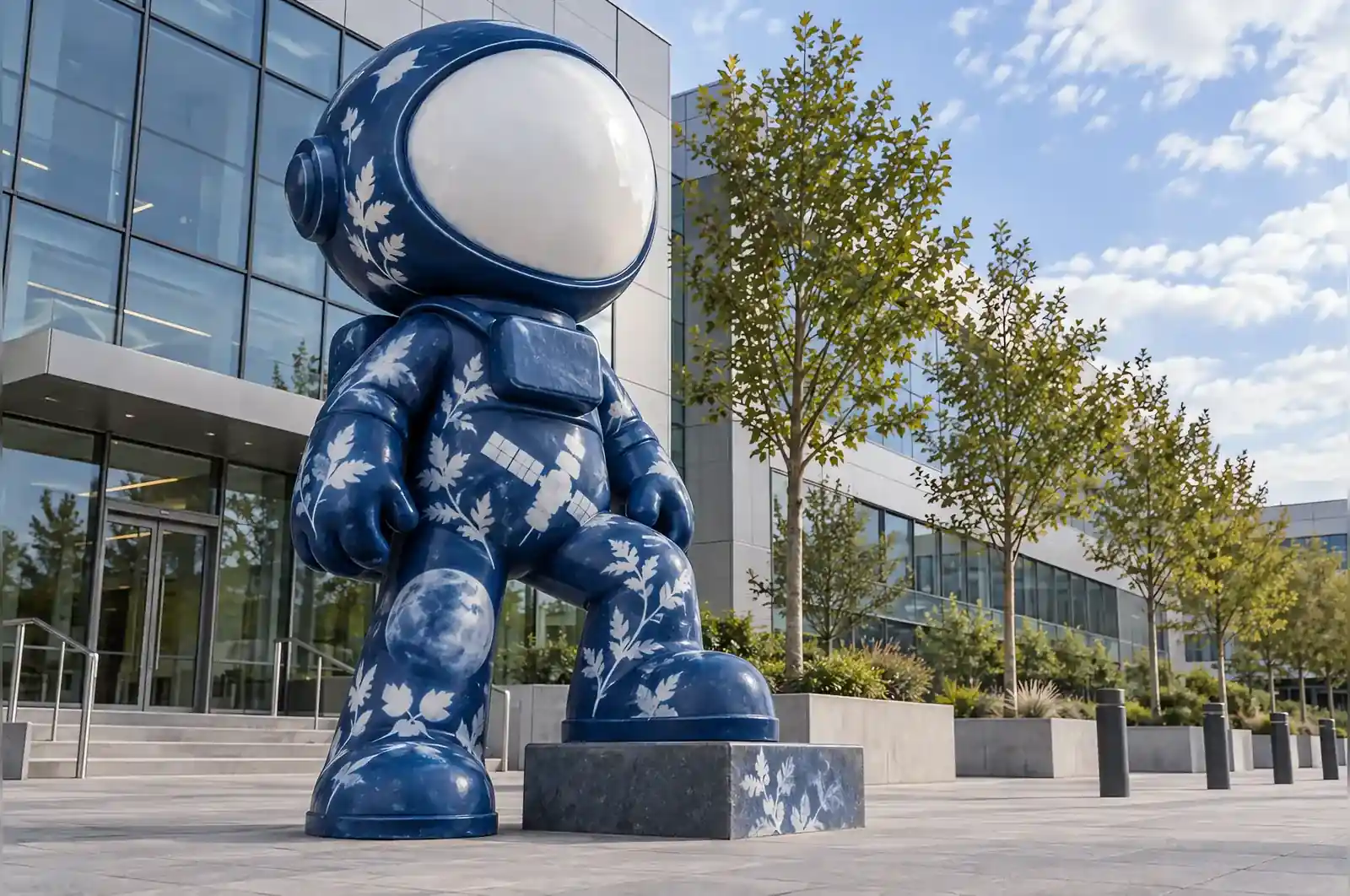
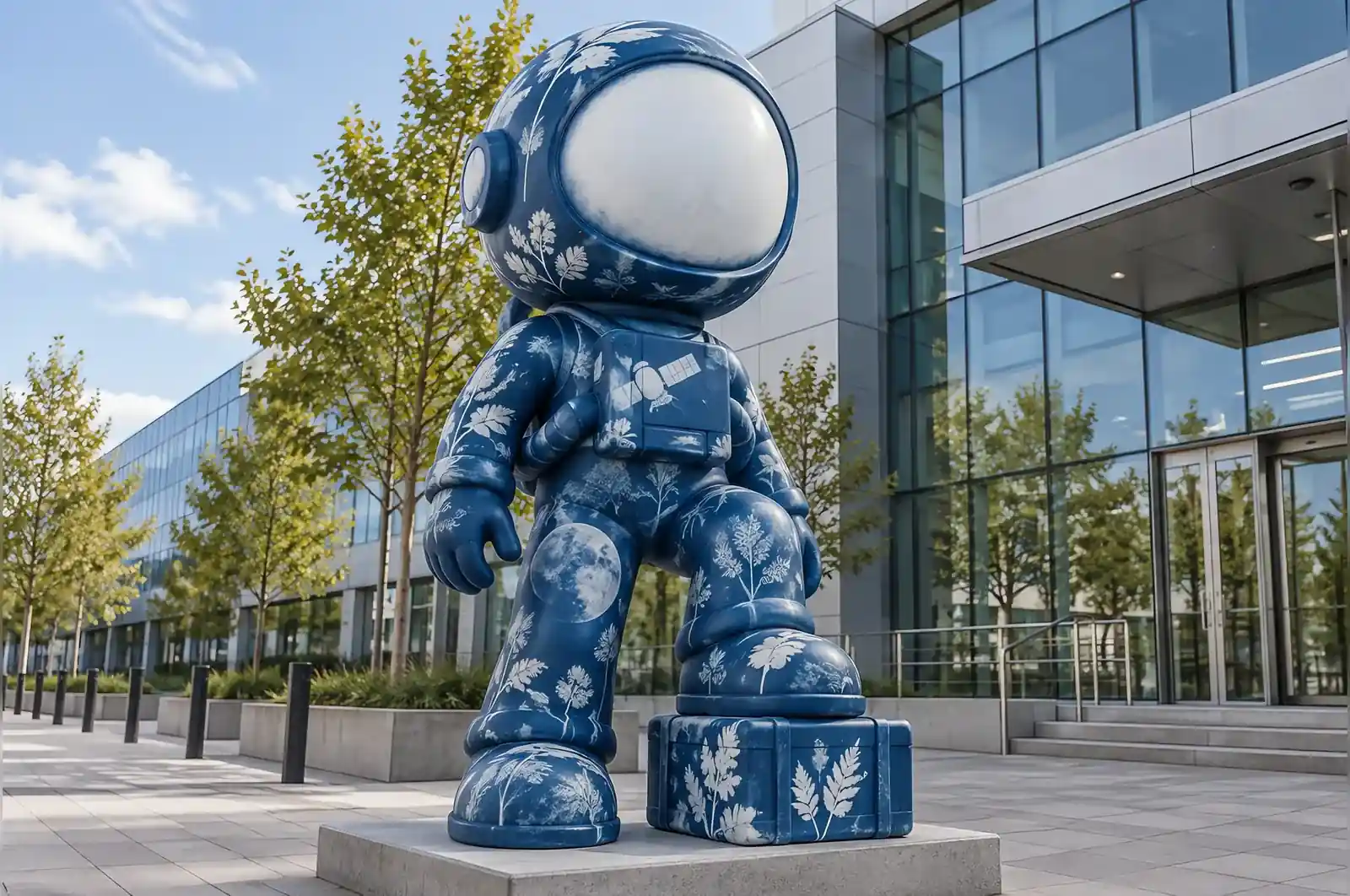
The finish is a sun print: a deep Prussian-blue ground carrying ghostly white silhouettes, with the soft blurred edges and the uneven blotchy staining of a print exposed by hand. Before digital reproduction, every drawing a company like this produced was copied that way, and the reference was understood instantly by everybody in the building and by nobody outside it. The piece is an in-joke for the people who work there, which is the correct audience for a plaza sculpture.
nn
Surviving outdoors as a print
n
A cyanotype’s whole character is its unevenness, and unevenness is exactly what a paint shop removes by default. The ground went on in five overlapping passes with deliberately inconsistent film thickness, so the stain blotches sit in the paint rather than on it, and the white silhouettes were then painted back as soft-edged shapes rather than sharp ones. The whole piece is closed under a UV-stable clear coat, which is what stops a Prussian blue from going grey outdoors inside two years.
nn
Three metres of silhouette
n
At 3.2 m the figure has to read as a shape in the plaza before it reads as an astronaut, so the helmet and the chest pack were both enlarged against the drawing and the limbs thinned slightly. The visor is a blank white oval with no face in it, which is the one place where the print convention and the cartoon convention want the same thing.
nn
What the brief actually ruled out
The first useful instruction was the negative one: it must not look like a mascot. A mascot is designed to be photographed beside a product, and this square is the approach to an office, so a waving character with a permanent smile would have read as marketing the company had bought rather than as a mark of what it does. Taking away the wave, the smile and the saturated colour left almost nothing of a conventional mascot, which is why the piece ended up as a document instead — a flat, still, deliberately unanimated object that happens to have the outline of a person. When a brief opens with “not a mascot”, the answer is usually to make the piece refer to something the company already makes or already knew, and then to keep the character completely still.
Why a built figure and not a printed panel
The obvious cheaper route was a large flat panel printed with the same image, bolted to the plaza. It was rejected for two reasons. A flat panel has an edge, and on a forecourt every edge collects a silhouette of dirt that no print can hide; a moulded figure has no edge facing the weather. More importantly, a print is a picture of a person and a moulded figure is an object in the square, and the company wanted the second thing. The cost difference at 3.2 m was wide enough that the decision was argued, and the argument was settled by walking the plaza at the hour the staff arrive.
Looking after a surface that is meant to be uneven
The finish is five overlapping passes of deliberately inconsistent film, and every one of those passes is somewhere dirt can sit. It is cleaned twice a year with water and a soft brush — never a pressure washer, because a jet lifts the thin areas first and the unevenness is the whole design. The Prussian blue holds under its clear coat; the coat is the thing being maintained, so it is inspected annually and re-applied on the schedule in the commission file rather than once the colour has already moved. A repaint at that point is not a repair, it is a different print.
If you want this treatment on your own building
Three things have to be fixed before a sun-print sculpture can be quoted. The reference: a real document, drawing or blueprint out of your own history, because an invented one reads as decoration and the point is that the staff recognise it. The viewing distance: the silhouettes are soft-edged by design and dissolve into the ground at roughly twenty metres, so this piece was drawn for the approach and not for the road beyond it. And the light: a print finish depends on the sun crossing it, which is why the composition faces the direction the light actually arrives rather than the direction the entrance faces.
One note on sequence, because it catches people out: the reference has to be agreed before the 3D model is approved, not after. A sun print is a composition of shapes, and once the figure is modelled those shapes are fixed. Changing the source document later means re-cutting the silhouettes and re-doing the five-pass ground, and that ground is the expensive half of the finish — the mould is the cheap part by comparison.
On the plaza
n
It stands at 3.2 m on the main approach, oriented so that the sun crosses the silhouettes around the middle of the day, which is when the building empties and refills. The company’s own note is in the panel above.
nn
New starters are told it is a drawing of the building. It takes most of them a fortnight to work out that it is a statue.
A satellite engineering company in Toulouse, France