Plume — Cartoon Peacock, Zoo Entrance Lawn, Singapore
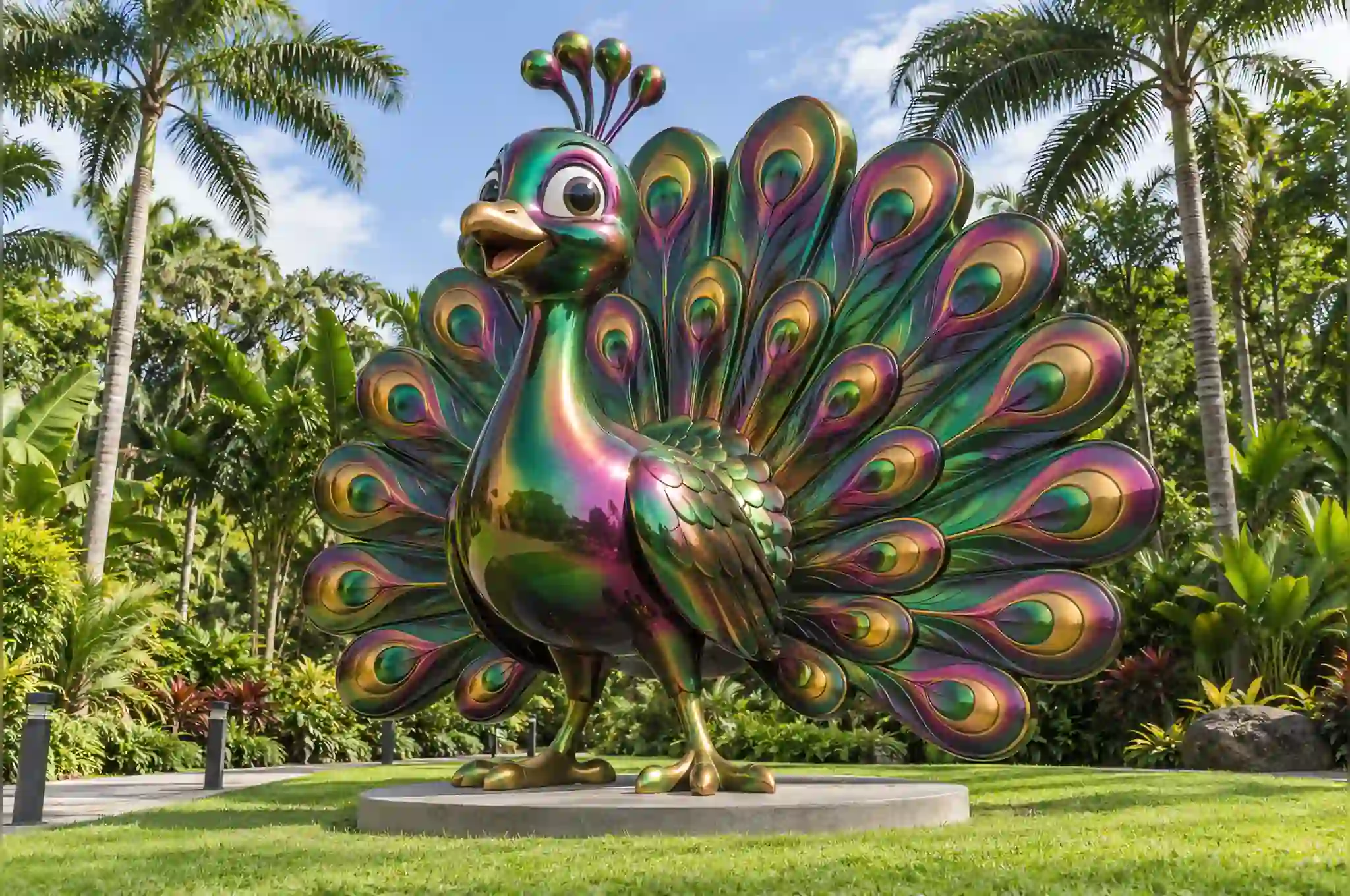
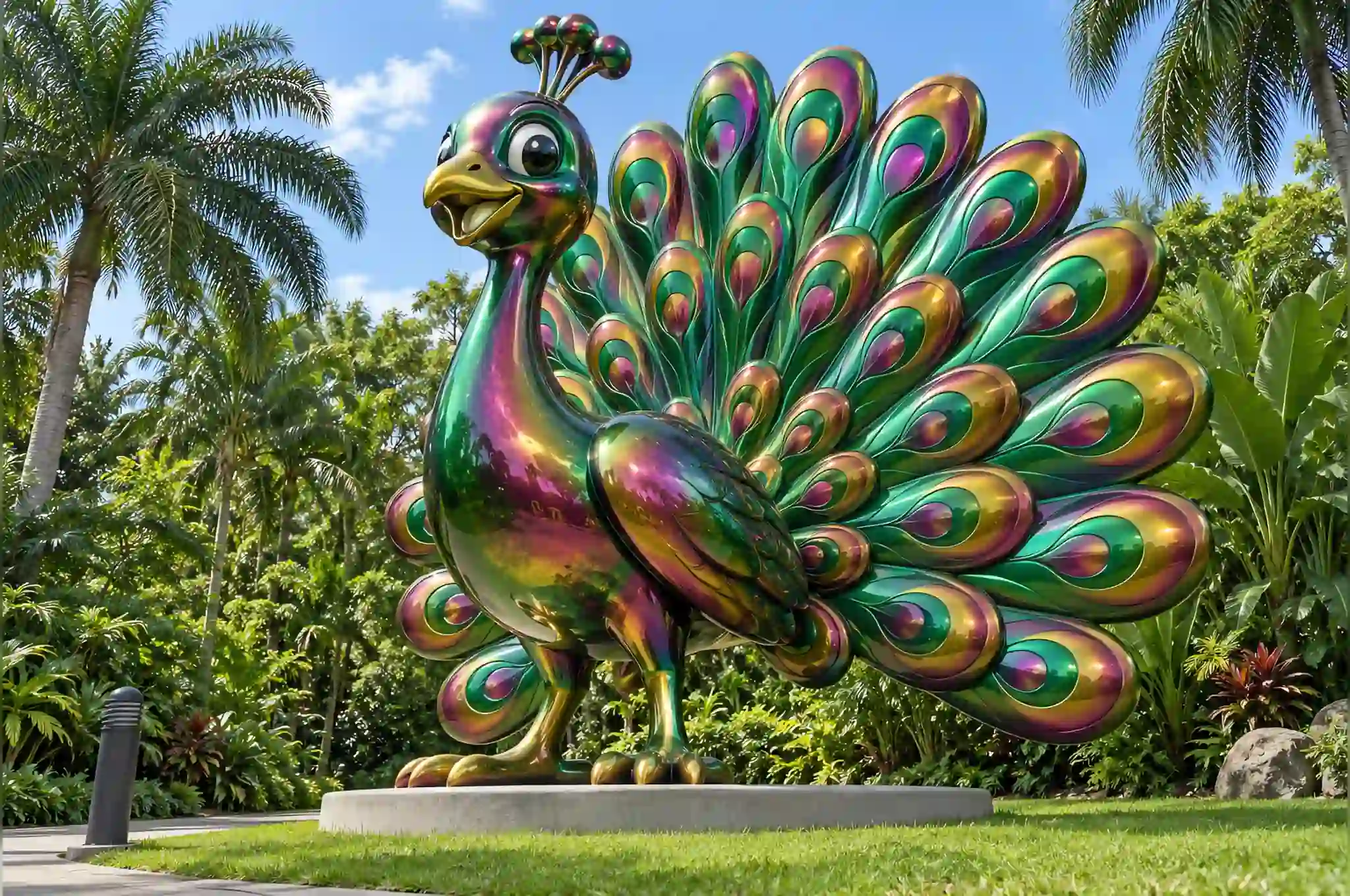
A peacock is mostly a tail, and a tail is mostly a cantilever. That is the entire engineering problem of this piece.
The brief
A zoo with a free-roaming peacock population wanted an entrance figure that announced birds before a visitor reached the ticket desk. Not a realistic peacock and not a costume mascot — a cartoon peacock, 3.2 m to the crest, on the lawn between the gate and the car park. It had to survive a tropical outdoor site with no shade and no maintenance contract beyond a wash twice a year.
The tail as a structure
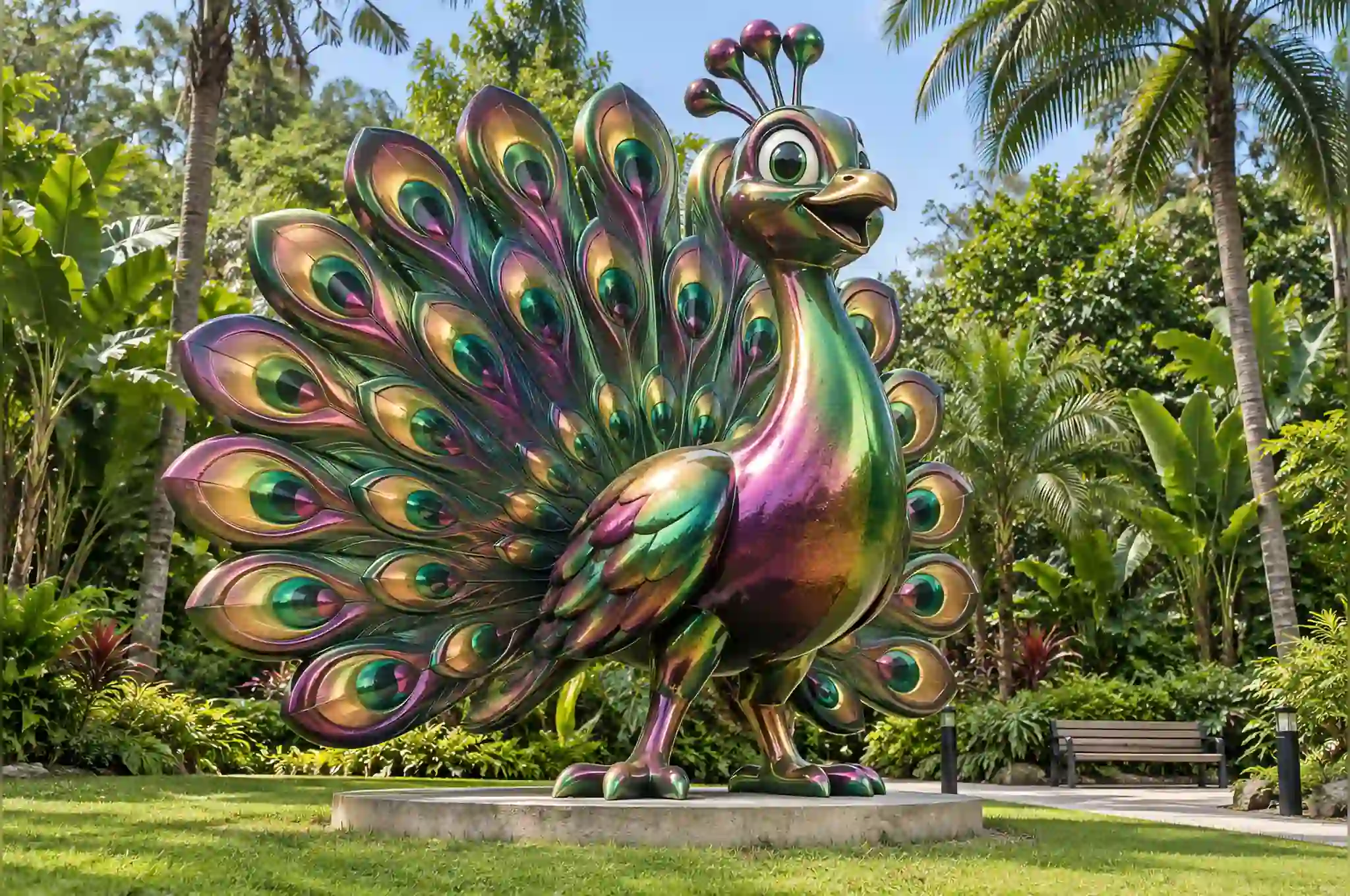
The display fan is 2.6 m long, 1.9 m wide and starts 1.7 m off the ground. It is a flat plate on the end of a long moment arm, which is the worst possible shape to leave standing in a monsoon gust. Rather than a solid fan, the tail is a 55 mm sandwich cored with end-grain balsa between two glass skins, and it carries no load back into the body: the fan’s own spar runs down its centre and lands on a stainless steel bracket bolted to a rear leg, so the tail is propped rather than hung. The body shell bears none of it. The assembly is rated for 32 m/s with a factor of 1.5.
Iridescence that does not drift
The instruction that mattered most was colour. Real peacock blue is structural colour — it comes from feather geometry, and no pigment reproduces it. The finish is a holographic flip paint over a dark ground: interference layers that shift through emerald, magenta and gold as the angle changes. On a curved surface under a tropical sun it moves the way the bird moves. A pigment match was tested first and rejected; it read as flat turquoise from every direction.
No perching
The site has real peacocks, and anything that looks like a ledge will be used as one. Every upward-facing surface on the piece is either narrower than 30 mm or raked back at 30 degrees, and the crown of the head is a single smooth dome. Droppings, not weather, were this finish’s real enemy; the clear coat is a two-part polyurethane chosen for how it wipes.
On the lawn
It stands in a planted bed eighteen metres inside the gate, turned three-quarters to the approach so the tail reads broadside from the queue. The zoo’s own note about it is in the panel above.
A visiting child asked where the bird's legs went. That is how our gardeners knew the pose was finally right.
A zoo in Singapore