Kiwi — Cartoon Parrot for a Hotel Lobby, Bristol
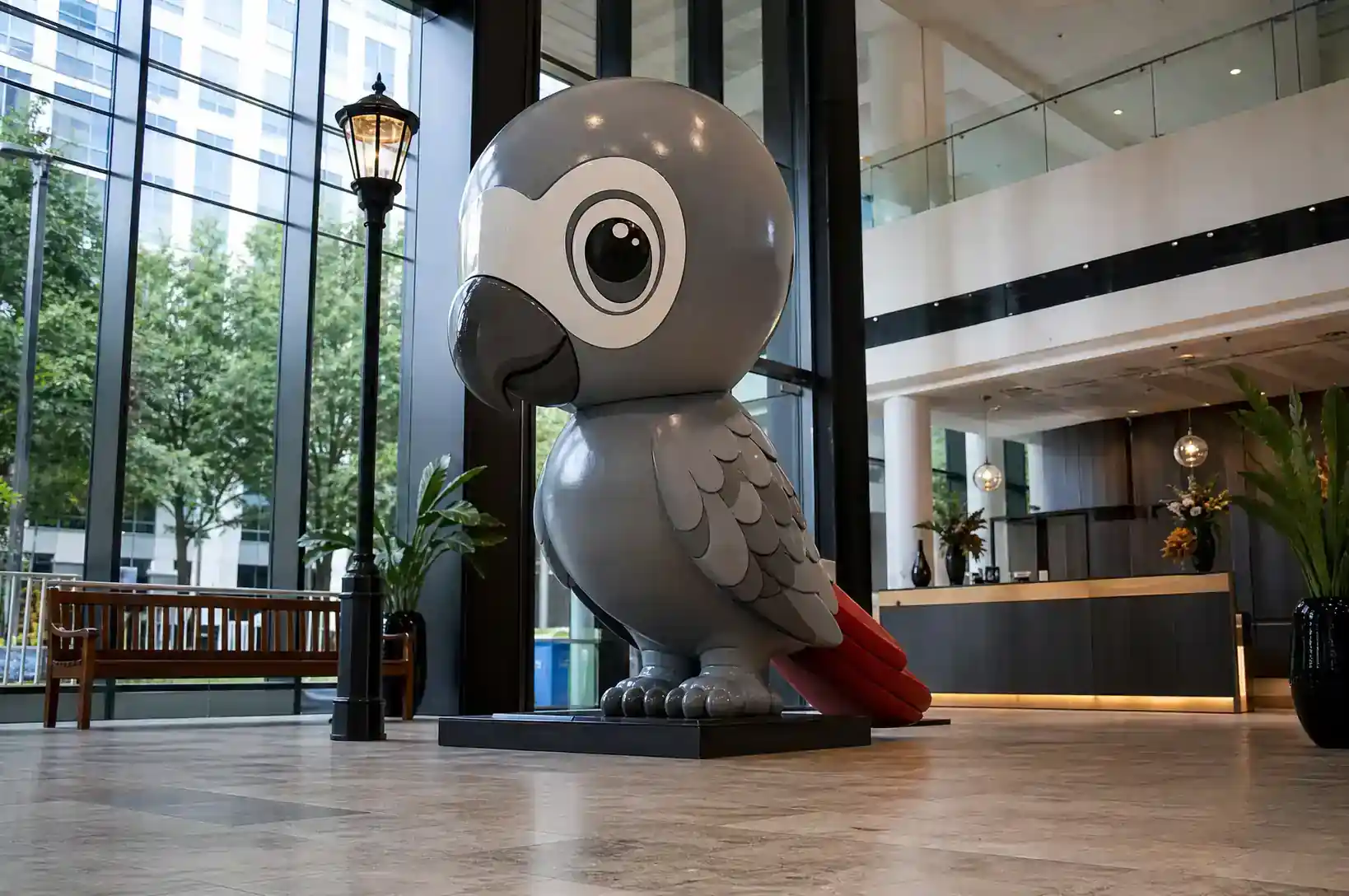
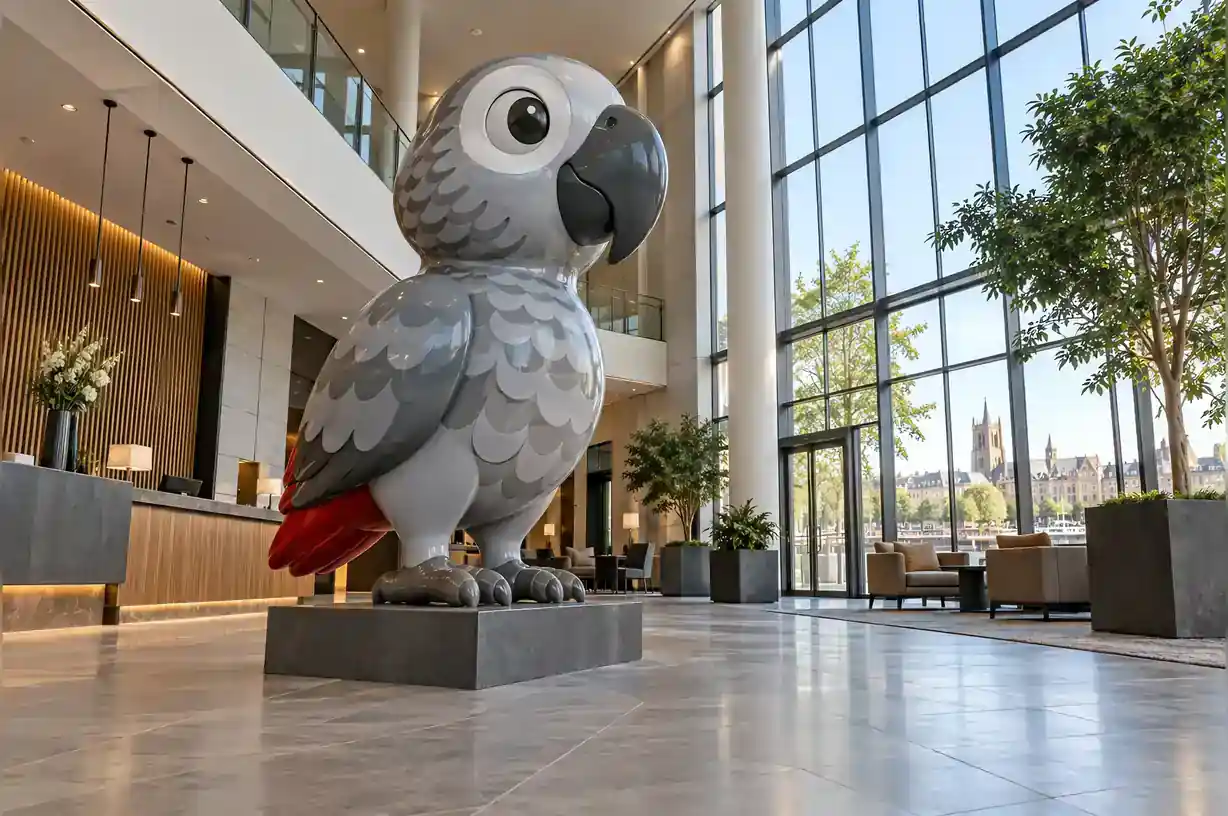
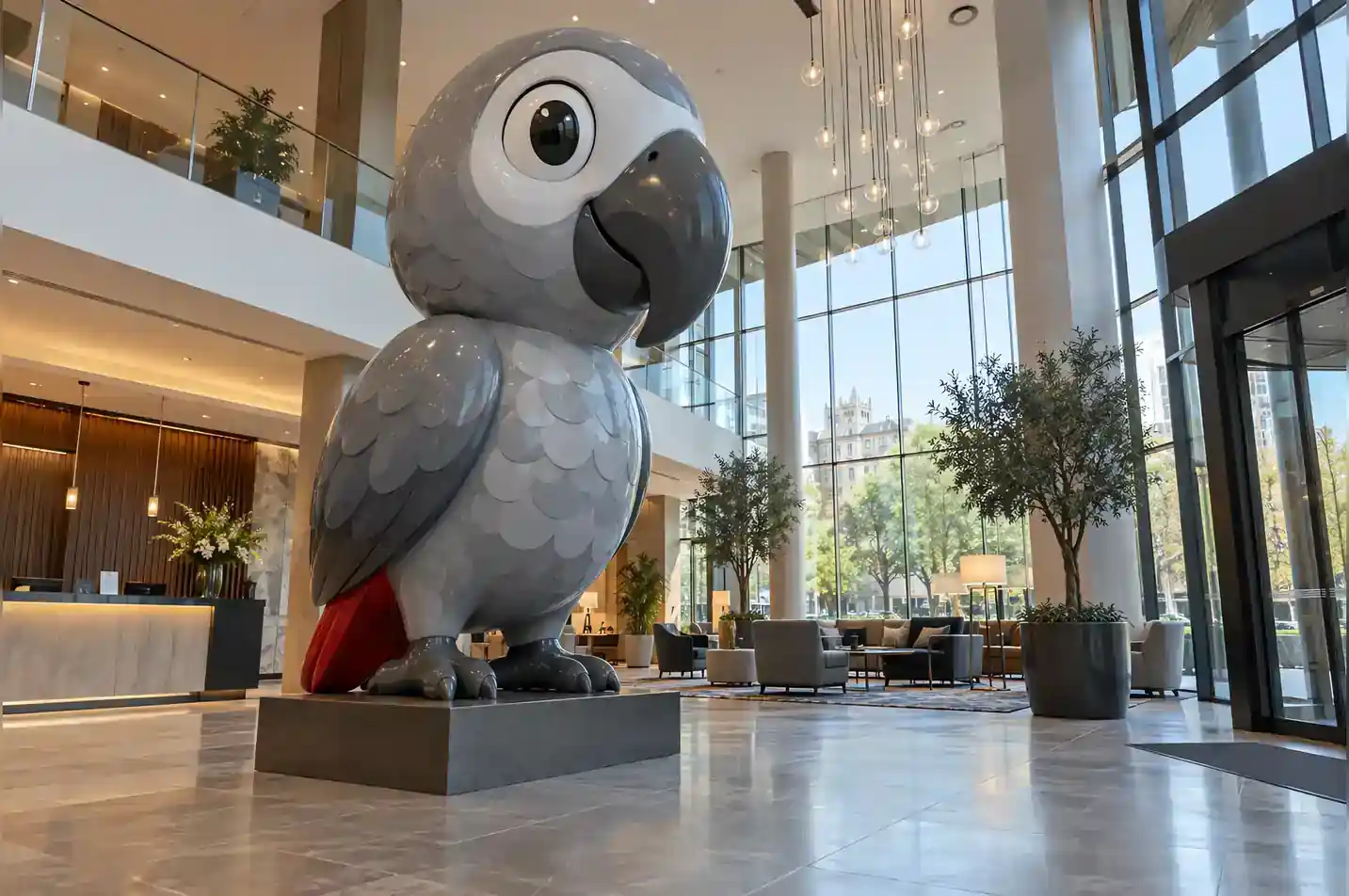
A hotel in Bristol had refurbished its lobby and found the space still felt like a corridor. The owners had an African grey parrot called Kiwi who had lived in reception for years, and they wanted a piece that acknowledged him without being a portrait.
What they asked for
A large cartoon parrot, roughly 1.8 m, sitting on a plinth in the double-height lobby. Friendly proportions, big head, simplified feather shapes rather than fine detail. Somewhere guests would photograph.
Building it at full size
At 1.8 m the piece carries a steel frame. Because it lives indoors, the brief was lighter on weatherproofing and heavier on surface finish: no UV clear coat needed, so we put the budget into painting depth instead.
The finish
Hand-painted feather shapes over a grey base with the red tail panels masked and sprayed separately. The simplification is deliberate — cartoon feather shapes read better at 1.8 m than an attempt at realism, which would only look approximate.
Why the 1.8 m indoor placement was the non-negotiable part
The double-height lobby fixed the commission before we quoted. At 1.8 m the parrot reads across the width of reception, and it is that scale — not the detail — that makes guests stop to photograph it. That was the one thing the owners would not trade away, and three things follow from it.
Had the size been dropped, to say 1.2 m, the piece would have been viewed at arm’s length rather than across a room and we would have spent more of the budget on surface and less on presence. Had the placement been outdoors instead of in the lobby, the finish stack would have changed first: the UV clear coat we set aside for an indoor piece would have become mandatory, the gloss automotive paint would have been swapped for a system rated for years of direct sun, and the steel frame would have been hot-dip galvanised rather than painted. Had the piece gone into a ground-floor corner instead of the double-height volume, it would have been smaller and cheaper.
None of these change the cartoon; all of them move the number. On this commission the indoor, double-height, photographic placement was fixed first and everything else followed from it. The owners were as interested in how the piece would hold the corner as in how it looked up close — a 1.8 m bird that reads instantly from the door but stays convincing when a guest walks up to it, which is a different requirement from a smaller figure that only has to work at arm’s length.
The frame and the finish, in service
At 1.8 m the shell is not self-supporting. The FRP is laminated over a welded steel armature that carries the load down to the plinth and the floor; the fibreglass is a skin, not a structure, and the frame is what keeps a bird this size from flexing in a draughty double-height lobby.
That matters more than it sounds because of how the piece is used. Guests touch it, housekeeping dusts it daily, and the gloss automotive paint is tough enough for that but it is not self-healing. Fingerprints and light scuffs lift with a soft cloth and a non-abrasive cleaner. A deep scratch would need the affected feather panel masked and re-sprayed rather than the whole bird repainted, which is exactly why the feather shapes are built up as separate coats and not a single covering.
The same construction makes the piece light enough for two people to shift it on the plinth when the floor behind it needs cleaning, and light enough that the bolted fixing is there to stop it tipping rather than to hold a weight up. It also means the plinth carries most of the visual mass, so the bird itself can stay slender without looking unstable — a useful property in a lobby where guests pass close and the silhouette has to work from every angle, not just the front.
Installation
Craned in through the lobby glazing before the final fixings went in, then bolted to the floor. For indoor pieces above 1.5 m the access route is usually the constraint, not the weight.
What this means for your own brief
If you are commissioning something like Kiwi, three questions settle the price before any drawing is done.
First, is it indoors or outdoors? That single answer decides the finish system and the frame, and after size it is the largest cost driver on this type of piece. Second, what is the scale relative to the room? A double-height lobby wants a piece that reads from a distance, which is why this one is 1.8 m rather than 1.2 m; the difference is how the object sits in the volume, not a preference for bigger. Third, how does it get in? On this job the route through the lobby glazing was the constraint, not the weight — a piece that has to come through a door, up a stair or over a balustrade often has to be built in sections and joined on site, which changes both the timeline and the cost.
Settle those three before you ask for a quote and the figure you receive is the figure you pay. The one thing not to do is leave access to the last minute — a piece already laminated at 1.8 m cannot be made to fit through a door it was never measured against, and cutting it apart after the finish is the most expensive way to solve a problem that costs nothing to answer on the first call.
What it cost
This one sits in the 1.5–2.0 m fibreglass band, which surveys at $900–$5,900. It came in at $4,600 delivered, eight weeks from 3D approval.
Guests photograph it more than anything else in the building. It has done more for our social media than the refurbishment did.
Ms H. Ferreira