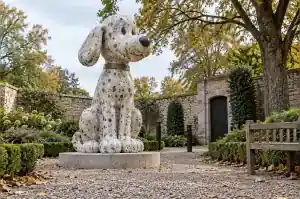
Painted Porcelain Cartoon Swallow — Hotel Garden, Delft



Delft has been painting birds on white clay since the seventeenth century, and a hotel two streets from the market square wanted a swallow that would not look out of place next to the real thing.
Fibreglass pretending to be clay
This is the only kind of commission where we routinely set out to be mistaken for another material. The ground is a chalk-white two-pack, deliberately not quite the white of the hotel’s own tiling, and the decoration is hand-painted cobalt in the same vocabulary a delftware painter actually uses: a feather scroll on the wing covers, a banded collar at the neck, and a narrow double border running the length of the tail. The cobalt is applied in one pass and left slightly uneven, because a perfectly even painted line reads as a transfer or a print instead.
Why the cartoon judgement matters here
A realistic swallow at 1.5 m would be a natural history exhibit. The head is enlarged to about 22% of the total height, which is far beyond an actual swallow, and that single proportion is what separates a decoration from a model. The decoration was then laid out over the enlarged form rather than scaled up with it, so the scrollwork is proportionally finer than it would be on a real bird.
Glaze, without glaze
Real delftware is glazed and the glaze pools slightly at the base of every painted line. That pooling was reproduced with a brush and a second thin pass of darker pigment along the underside of the main scrolls, which is the one place we allowed ourselves to copy a defect on purpose. The whole piece is then closed under a high-gloss clear coat for weather.
In the garden
It stands at 1.5 m on a low plinth among clipped hedging, at the point where the garden path turns, so that it is seen edge-on first and only resolves into a bird as the guest walks past. What the hotel says about it is in the panel above.
What could not change
The finish was the non-negotiable. The hotel’s brief was a swallow that would sit beside real delftware, and the chalk-white ground carrying hand-painted cobalt is what carries that reference; remove it and the piece becomes a white garden bird with no connection to the town. That drove two further decisions. The decoration had to be painted in one pass and left slightly uneven, because a machine-perfect line reads as a transfer rather than a glaze. And the clear coat had to be high-gloss, because the pooling under the scrolls only reads correctly through a reflective surface; a satin or matte coat flattens the effect.
If the finish had been different, the rest would have followed. A plain white bird would have allowed a natural head proportion and a shorter lead time, since the head enlargement and the fine scrollwork are both there to sell the ceramic read. A piece going indoors would not need the weather-grade clear coat at all, because the outdoor coat exists to keep rain and frost off the paint rather than to protect a material that needs it. The size, however, was fixed by the plinth and the hedging at 1.5 m; moving it inside or shrinking it would have changed how it sits in the space, and the 12-week lead time from 3D approval followed from the painting rather than the moulding.
Build and aftercare
The piece is built the way the finish demands. The form is hand-laminated FRP over an internal steel frame, and at 1.5 m H × 1.1 m W × 0.8 m D the shell is thin enough to hold its shape only because the frame carries the load; the frame also stiffens the wing so the enlarged head does not make the bird top-heavy on its plinth. The painted surface is the weatherproofing. The chalk-white ground and cobalt scrolls sit under the high-gloss clear coat, and in a Dutch garden that coat has to resist rain, frost and UV. Delft winters are wet and the piece stands on a low plinth among clipped hedging, so the underside stays off the soil and the coat is the only barrier between the paint and the weather. Maintenance is therefore about the coat, not the paint. A soft rinse removes dust and pollen, the hedge is trimmed clear so no branch abrades the gloss, and the coat is checked for chipping at the tail and collar where the decoration is densest. Because the decoration is paint rather than fired glaze, any repair is a repaint of a small area followed by a local clear-coat patch, not a re-fire; the patch is blended against the surrounding uneven cobalt so it does not show as a flat rectangle.
What this means for your own brief
Before asking for a quote on a painted porcelain-style piece, settle three questions. First, is the blue-and-white finish the point, or is a plain painted bird acceptable? The finish is the single largest driver of labour: the ground, the one-pass cobalt, the second darker pass under the scrolls and the clear coat are each a separate operation, and removing any of them takes most of the painter hours out of the job. Second, where will it stand? A garden bird needs the weather-grade clear coat; the same piece indoors does not, and that decision changes the build. Third, what proportion should the head be? The enlargement to about 22% of the height is a modelling decision, not a painting one, and it cannot be corrected once the FRP is laminated. Settle those three and the quote is straightforward: 12 weeks from 3D approval, delivered as a finished piece.
Guests assume it is original to the building. The building is from 1974 and the sculpture is two years old.
A hotel in Delft, Netherlands