
Mosaic Cartoon Penguin — Aquarium Plaza Sculpture, Genoa
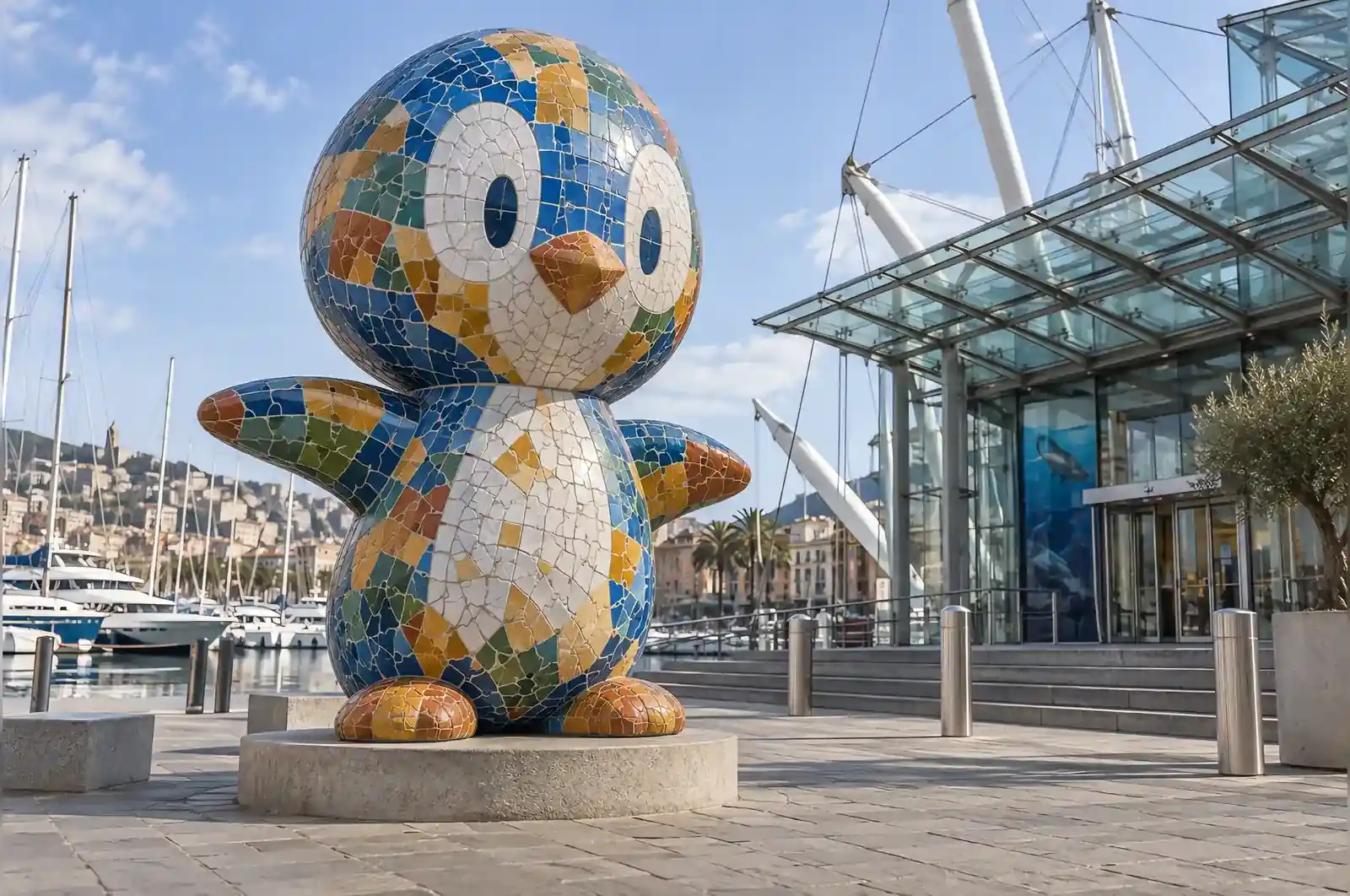
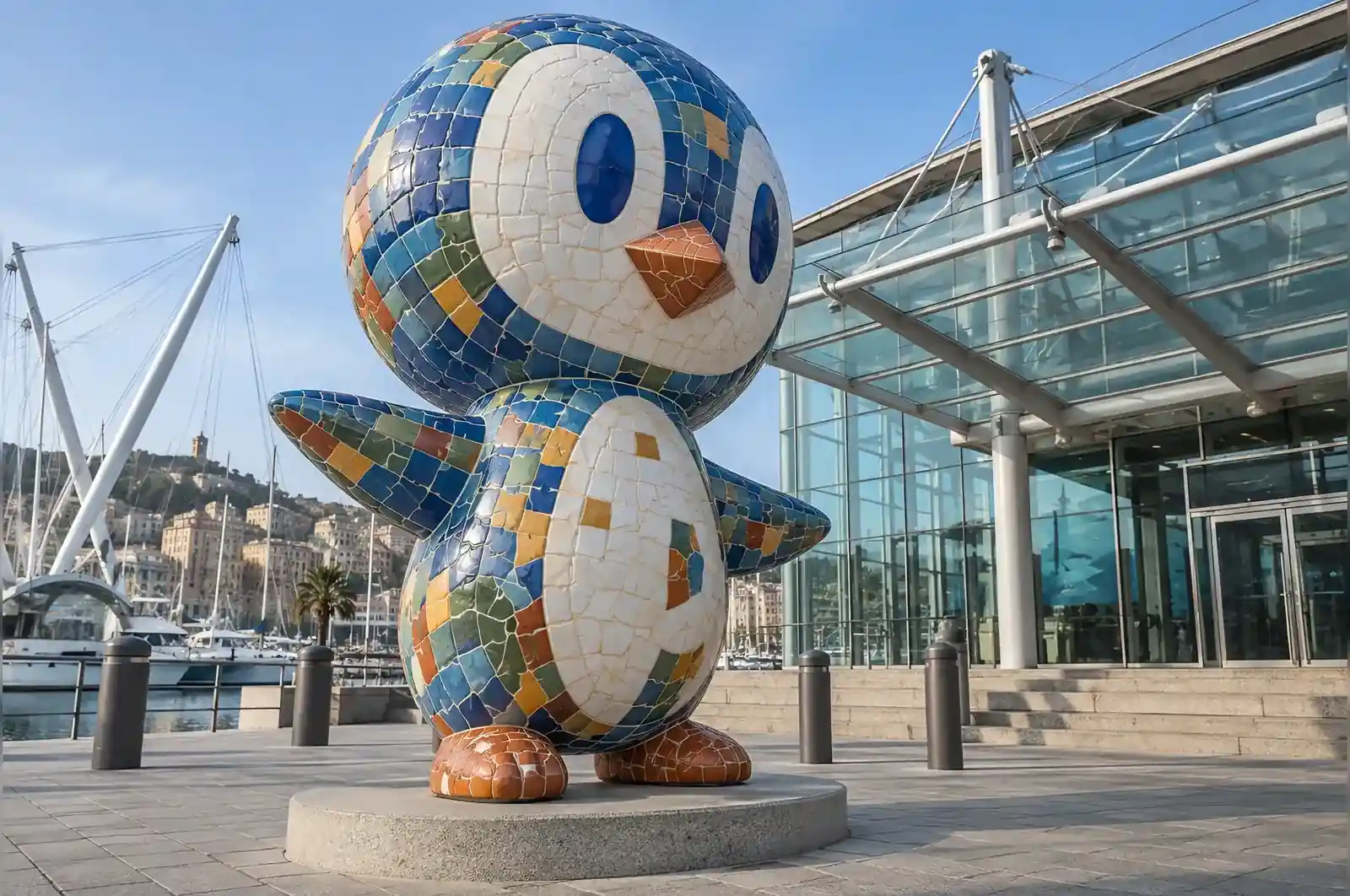
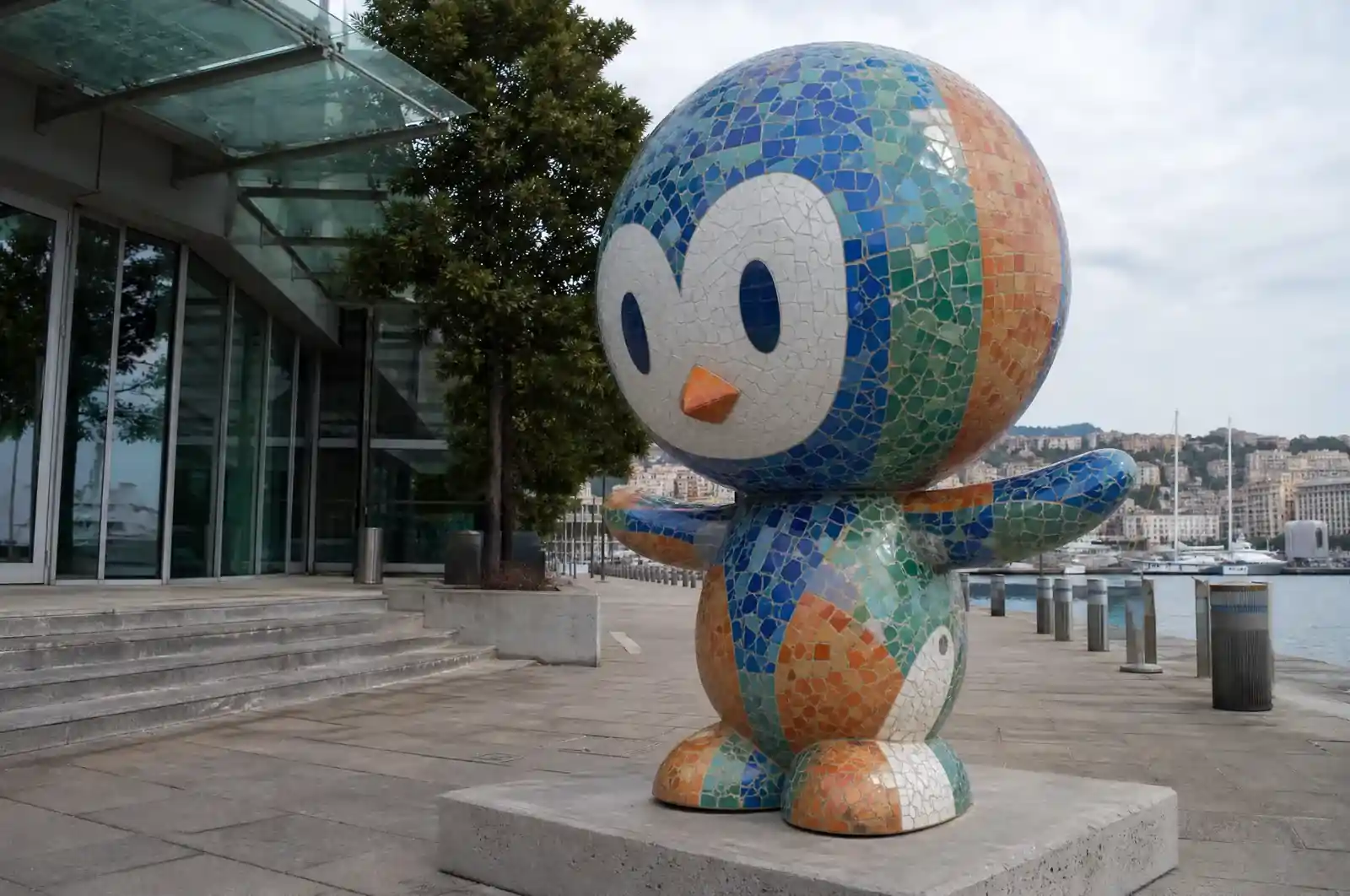
An aquarium in the old port of Genoa wanted a penguin, which is the most over-supplied subject in the world, and the only way to do it was to change the material out from under it.
Why mosaic, and why it is not decoration
Genoa has been laying mosaic for centuries and the city reads as a mosaic from the pavement up. Setting a penguin as tesserae also solves a real problem: a 2.6 m penguin painted in flat black and white is a large dark object that photographs as a silhouette, whereas a penguin cut into eleven thousand small pieces moves as you walk around it, because every tile sits at a slightly different angle to the light.
Laying a mosaic on a bird
The shell is fibreglass and the tesserae were cut by hand from 4 mm ceramic, roughly 18 mm square and deliberately not uniform, then bedded in a flexible adhesive in a bed about 3 mm deep over a scored ground. The grout is recessed 2 mm below the tile face, which is what gives the surface its shadow and is the part that most people do not notice and would immediately miss if it were flush.
No repeating pattern
Eleven thousand tiles in five colour families, laid with no module repeated anywhere on the piece. The blue family carries the back and the head, the warmer tones are concentrated on the belly and the feet, and the layout was worked out on the finished form so that the density of the pale tiles increases where the light falls off, which keeps the silhouette readable from across the plaza.
One tile out
There is a single white tile on the left flank set 1.5 mm proud of its neighbours. It was left in after it refused to bed down, and the client asked for it to stay. Children find it within ten seconds of arriving, which is a better engagement device than anything we could have designed on purpose.
On the plaza
It stands at 2.6 m just inside the entrance canopy, facing the water rather than the doors, so that it appears in the background of photographs taken by people photographing the harbour. The client’s own note is in the panel above.
What the placement decided
The position was the fixed point, not the sculpture. The client wanted a penguin in the background of photographs of the harbour, so it had to sit just inside the entrance canopy and face the water, and it had to be tall enough to read over the heads of a crowd — hence 2.6 m, which is roughly the height of the canopy and is why the figure is a touch under 1.3 m across the flippers rather than a full wingspan. If the site had been indoors, under the flat light of a gallery, the mosaic would have been the wrong decision altogether: tesserae need moving light to do their work, and a penguin in eleven thousand pieces under a skyless ceiling would read as a grey lump instead of a bird. If the budget had locked the size at half of this, the same eleven thousand tiles would have crowded into a figure too small to resolve at arm’s length, and the piece would have been better off painted in the flat black and white the mosaic was brought in to replace. The finish was chosen because of where the piece stands, and if the position had changed, the finish would have changed with it.
Grout, salt air and the harbour
The piece stands metres from the sea in a working port, so the finish has to take salt-laden air, wind, and the swing between a Mediterranean summer and a winter harbour. That is why the tesserae are bedded in a flexible adhesive rather than a rigid cement: the shell and the tiles expand and contract at different rates, and a flexible bed absorbs that movement without fracturing the tile face. The grout is recessed 2 mm rather than flush, which does two jobs — it casts the shadow line that makes the surface read, and it lets rain run off the face instead of pooling in a continuous line at the tile edge, where salt would dry and deposit. At 2.6 m the whole surface is reachable from a small platform, so the annual check is a straightforward one: walk the piece, look for a tile lifting or a hairline in the grout, and re-bed anything that has worked loose. Nothing on the surface is out of arm’s reach, which is the practical advantage of the height here — a monument twice this size would need a scaffold for the same inspection.
What to settle before you ask for a quote
Three questions decide most of the budget and most of the risk on a piece like this. First, where does it stand and in what light? A mosaic needs daylight that moves across it; if the piece is indoors or in shade, ask instead whether the surface should be painted, because a tiled finish under still light gives you eleven thousand pieces and none of the effect. Second, will people touch it? On a plaza that is certain, so the tiles need to be bedded well and the grout recessed far enough that fingers catch on the piece rather than the joints — and decide in advance whether a tile set deliberately proud is a fault or a feature, because that decision was made on site here and it is now the part of the penguin that children remember. Third, what is the grout line doing in your climate? Coastal salt and frost both attack a flush joint, so the recess depth and the adhesive should be set by the site, not by a sample board. Settle those three and the quote becomes a number you can compare.
Children run their hands over it to find the one white tile that is slightly proud. There is one, and it is deliberate.
An aquarium in Genoa, Italy