Origami Cartoon Crane — Station Plaza Sculpture, Hiroshima
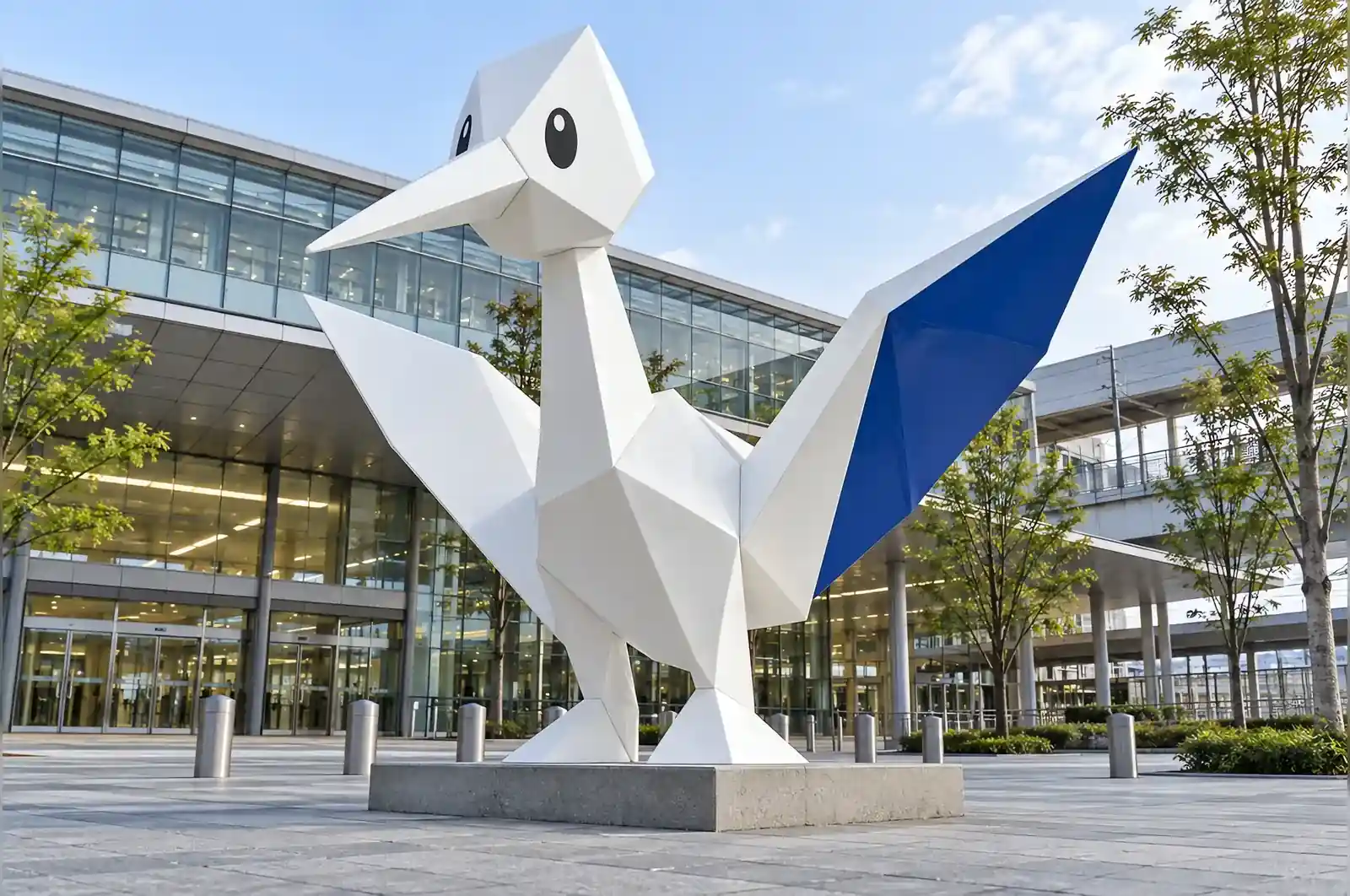
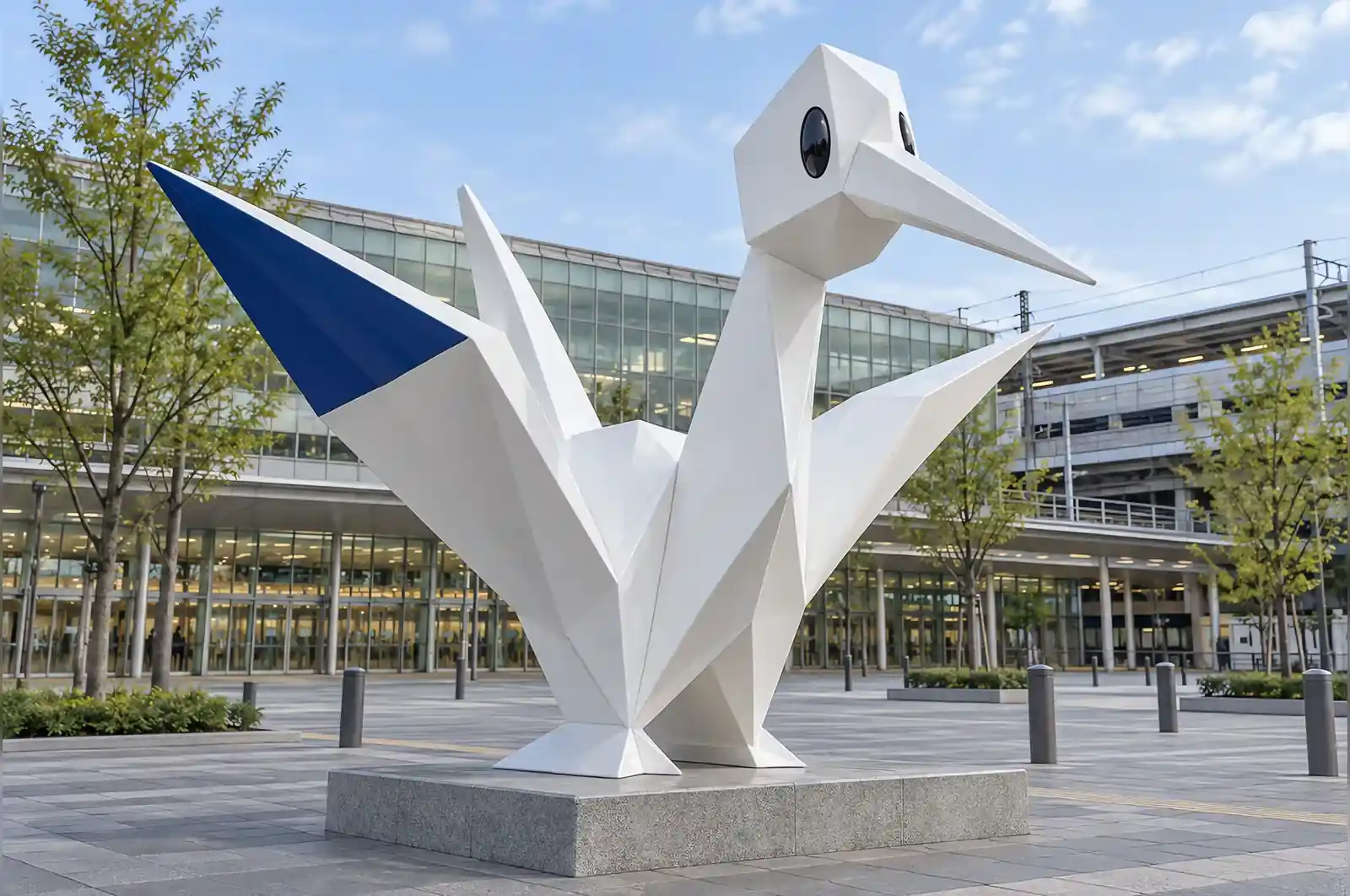

This is the one piece in the whole portfolio where the object is already a sculpture before anybody makes it. An origami crane is a folded sheet of paper, and the brief was to make one that would stand on a station plaza for twenty years.
Cast, not folded
The crane is hand-laminated fibreglass, not folded sheet, and the whole job turned on making that invisible. There are 31 visible creases. Every one of them is a real edge in the mould, cut at the true dihedral angle of the fold rather than being sanded in afterwards, because a crease that is a groove instead of an edge catches the light in the wrong way from every angle except one.
Paper behaviour at two metres
Real folded paper is 0.1 mm thick and holds a crease because the fibres have yielded. Scaled to 2.2 m, that same geometry would be 55 mm thick and would read as machined plate. The shell is therefore 8 mm to 14 mm, which is about the thinnest hand-laminated shell that survives a person leaning on it, and the fold lines were sharpened slightly beyond true so that they still register at ten metres.
Two small lies
The first is the eyes. Folded paper has none, and the piece has two plain ovals, because without them the object reads as a bird-shaped object rather than as a character. The second is one folded panel across the left wing, in indigo, which is not part of the standard fold at all. Both were approved by the client in the same meeting and both are the reason the piece is remembered.
On the plaza
It stands at 2.2 m between the concourse doors and the taxi rank, where every departing passenger walks past it, facing slightly back towards the doors so that it is met head-on on the way out. The authority’s note on what happened next is in the panel above.
Why the finish was the brief
Three things could not be given up, because the crane is a read rather than an object. The first was scale. At 2.2 m it stands taller than a person, which is what lets it sit in a station plaza and still read as a crane instead of as a desk ornament; shrink it towards a metre and the silhouette stops carrying at the distance the concourse doors demand. The second was the finish. Paper-white with a single saturated indigo accent is not decoration, it is the whole point, because the piece has to read as folded paper. Any satin or weathered surface would read as painted stone or metal instead, and the object would turn into a bird-shaped something else.
The third was the crispness of the folds. The 31 creases are cut at the true dihedral angle so that the piece reads as folded rather than as moulded, and that crispness is what the gloss clear coat protects. If the commission had gone indoors, the geometry would have relaxed and the shell could have been thinner, with less to engineer. If the client had accepted a different finish, the build would have been simpler, but the piece would have lost its reason to exist. On a working plaza none of the three could move, and the brief was set by that.
Keeping the paper-white in a working plaza
The piece is gloss-painted over an 8 mm to 14 mm fibreglass shell, and the clear coat is the part that has to work hardest. A white gloss surface between the concourse doors and the taxi rank sits in the dirtiest position on the site: rail dust, exhaust from the rank and road grime all settle on it, and on white they show as a grey film before they show on any darker finish. The sharp creases are where it shows first, because each real edge is a narrow shelf that catches the deposit.
Maintenance is therefore mostly about keeping that surface clean so the paper read survives. A wash and a polish on the gloss coat keeps the white reading as paper rather than as a slightly dirty bird, and it is worth doing on the creases first rather than last. The indigo accent fold is the easiest part to refresh, being a single panel; if it fades in the sun it can be re-sprayed on its own without touching the rest of the finish. The internal steel frame and the shell thickness are what carry the twenty-year life, and neither needs anything beyond the wash that protects the coating over them.
Settling a folded-paper brief
Three questions do most of the work before a quote is requested on something similar. First, what must it read as, and from how far? The scale and silhouette here were set by the plaza, and the 2.2 m height is what makes the crane read from the doors. Decide the reading distance before the size, because the size drives the mould, the shell and the frame, and it cannot be corrected cheaply afterwards.
Second, how many ways will it be seen? This piece stands where people walk past it, so it has to work from more than one angle, and the creases had to be cut true all round rather than only on the side facing the main approach. A piece meant to be seen from one direction is cheaper than a piece that has to hold up from every side.
Third, what is the finish for? A single accent colour is a small cost against a full surface treatment, and it is what lets the piece be remembered without repainting everything. Settle whether the accent is doing a job before the mould is cut, because it is far easier to include it than to add it later. The 13-week lead time runs from 3D approval, so the brief should be closed before the mould, not after it.
People check the creases to see whether it is folded or cast. It is cast, and the creases are the part we spent the longest on.
A transport authority in Hiroshima, Japan