
Orbit — Abstract Character for a Playground, Vienna
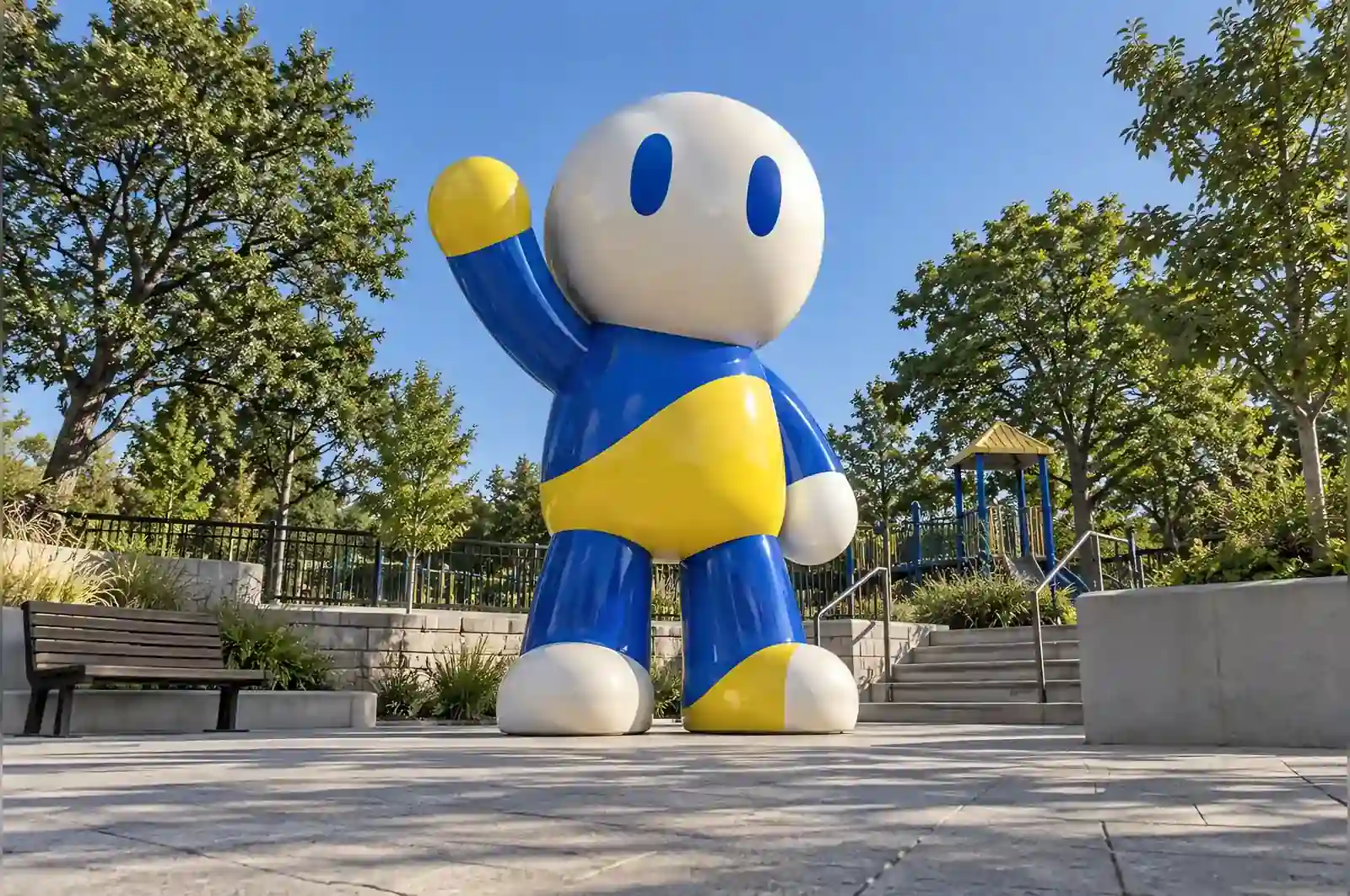
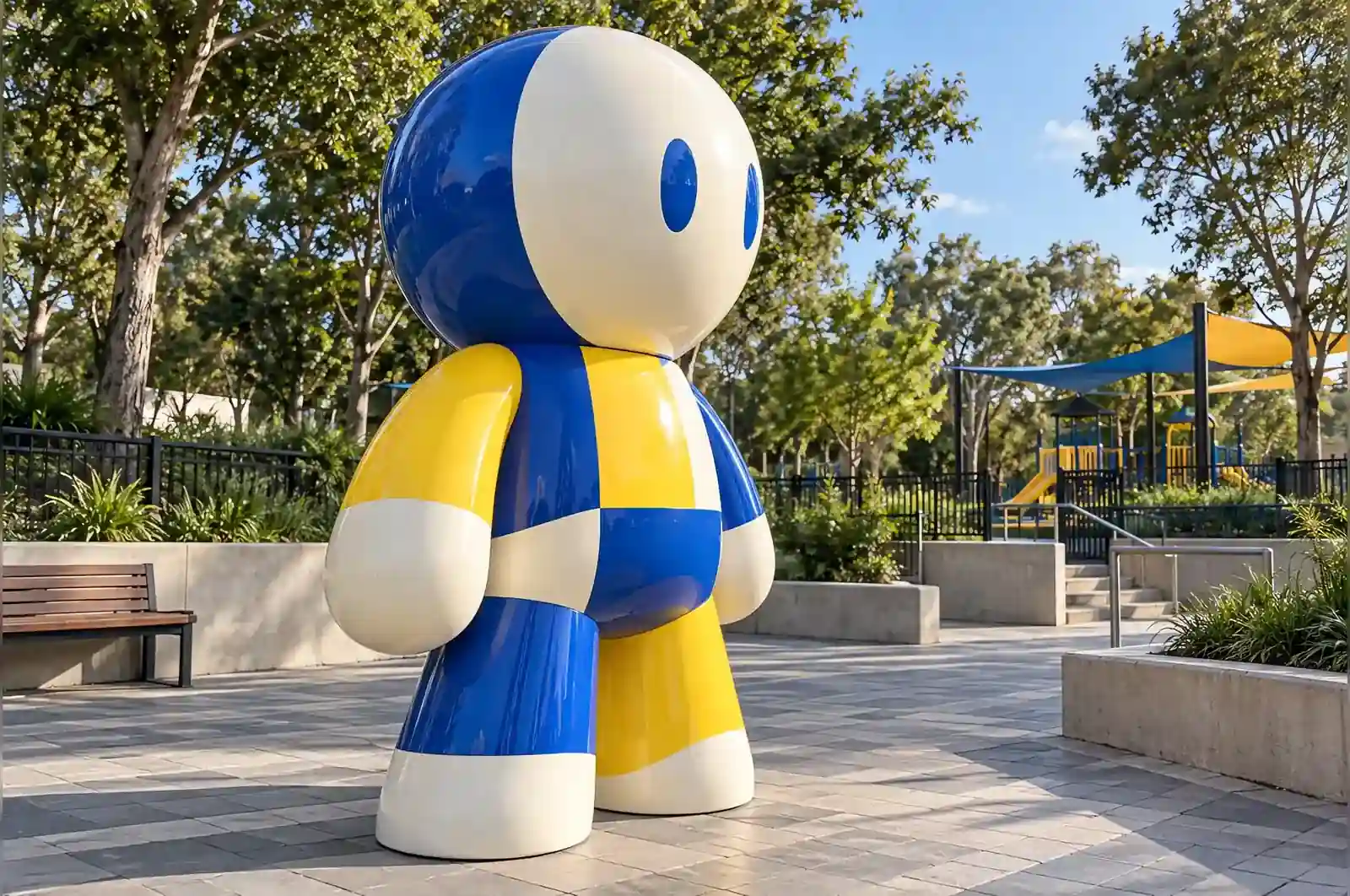

A district council in Vienna wanted something at the entrance to a rebuilt playground that would read as a landmark from the street, survive children, and not depict anyone in particular.
What they asked for
A large abstract character, roughly 2.4 m, built from bold geometry and flat colour. The council was clear about three things: no recognisable face, no single figure it could be tied to, and nothing that would date. They wanted a shape that could belong to the district rather than to a person.
Engineering for public use
At 2.4 m the piece carries an engineered steel frame, and this is where a public commission differs from a private one: the sculpture has to tolerate being leaned on, climbed near and washed by maintenance crews. The frame accounts for 10–20% of the cost and it is the part a cheap quote leaves out.
The finish
Gloss-painted fibreglass, colour-blocked in cobalt, warm yellow and off-white, sealed under a UV clear coat for 15–20 years outdoors. The clear coat matters more on a public piece than a private one, because it is what allows the colour to be brought back rather than repainted.
Installation
Set on a prepared concrete pad on the entrance plaza, bolted through, positioned off the gate line so it never obstructs the way in. The pad was poured three weeks before install, which is the part councils most often forget to schedule.
What it cost
Above 2 m, surveyed fibreglass ranges run $5,000–$15,000. This commission came in at $11,800 delivered and installed, eleven weeks from 3D approval.
The non-negotiable constraints on this site
Three things were fixed before design began, and none of them came from taste — they came from the site. The first is the height. A piece at a playground entrance that has to read as a landmark from the street cannot be a tabletop figure. At 2.4 m the mass sits above head height and clear of the gate line, so it registers as a marker rather than a decoration. Had the height been dropped to about 1.2 m, the brief would have changed from “landmark” to “ornament”, the steel frame would have been lighter, and the whole commission would have read differently for roughly half the price.
The second is the finish. Because the piece stands outdoors through Vienna’s cycle of freeze-thaw winters and hard summer UV, the multi-layer automotive paint had to sit under a UV-stable clear coat. If the same sculpture had gone into an indoor atrium, a simpler paint system would have been acceptable and the budget would have fallen with it. The third is the placement itself. Bolted through a pad on a plaza entrance, off the gate line, the piece had to tolerate being leaned on and climbed near by children on the way in — which is exactly what demanded the engineered steel frame rather than a shell-only build. None of these were stylistic choices. Each one was imposed by the site, and each one is a lever a buyer could pull to change the cost.
Maintaining a gloss finish through a Vienna winter
Vienna sits in a continental climate, and a gloss-painted fibreglass piece on an open plaza takes the full cycle of it: freeze-thaw through the winter, hard UV through the summer, and rain and road dust the rest of the year. The finish was specified as a multi-layer automotive paint under a UV clear coat precisely because of that cycle. The clear coat is the sacrificial layer — it is what takes the UV and the abrasion, and it is what allows the colour to be brought back rather than repainted.
On a piece this size the practical routine is an annual wash and inspection. That means a soft wash to lift dirt before it embeds, a check of the coat for chalking or micro-cracking, and a local re-coat of clear on any area that has been scuffed by hands or prams. Because the coat is a system rather than a single layer, a damaged area is spot-repaired and re-cleared rather than stripped back to the shell. The steel frame inside is protected separately: the bolted-through base is sealed at the pad and the shell keeps the frame dry, so rust is not the maintenance problem it would be on a fully exposed steel sculpture. In practice the owner’s job is small, and the clear coat is what keeps it that way.
Settling your own brief before the quote
This commission is a useful template, but only if you settle the same three questions before you ask for a number. First, what does the piece have to do? Here the answer was “read as a landmark from the street”, which fixed the height at 2.4 m and pushed the build into a framed, bolted-down structure. If yours is a garden figure or an indoor piece, the same design language will cost less, because it will need less structure and a simpler finish.
Second, who is going to touch it? A sculpture at a playground entrance is public-use equipment: it gets leaned on, climbed near and washed by maintenance crews. That dictated the engineered steel frame and the impact-tolerant coating. A hands-off piece, on a plinth behind a barrier, can use a lighter shell and a more decorative paint. Third, what is the environment and how long does the finish have to last? Outdoors in a continental climate the UV clear coat is not optional — it is what carries the colour for 15–20 years. Indoors you can trade that away. Settle these three and the quote follows; leave them open and you will be quoted a range you cannot act on.
The children named it within a day of it going in. That is the whole point of a piece like this.
A district council in Vienna