
Cartoon Couple — Art-Deco Sculpture, Hotel Terrace, Budapest

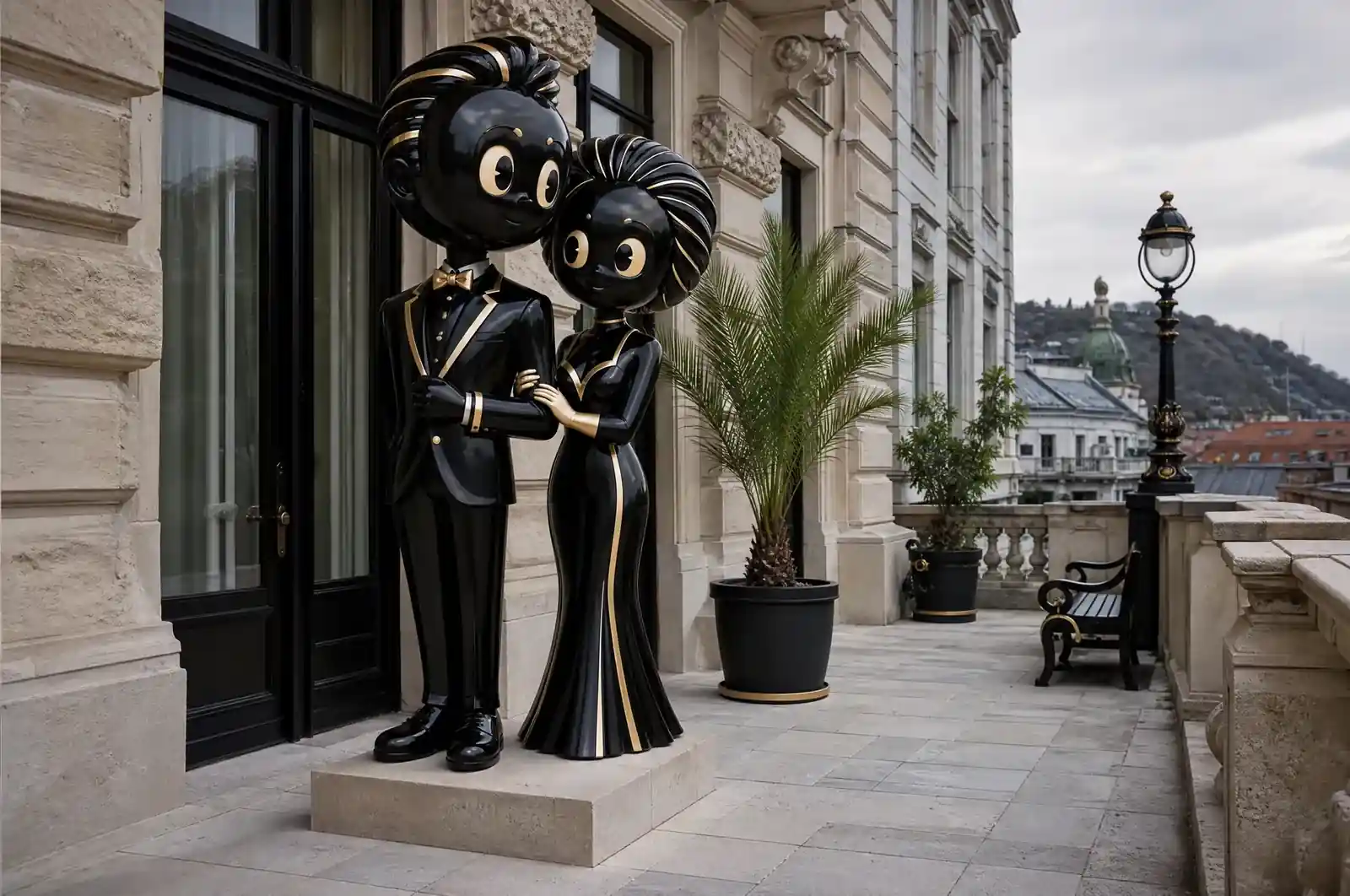
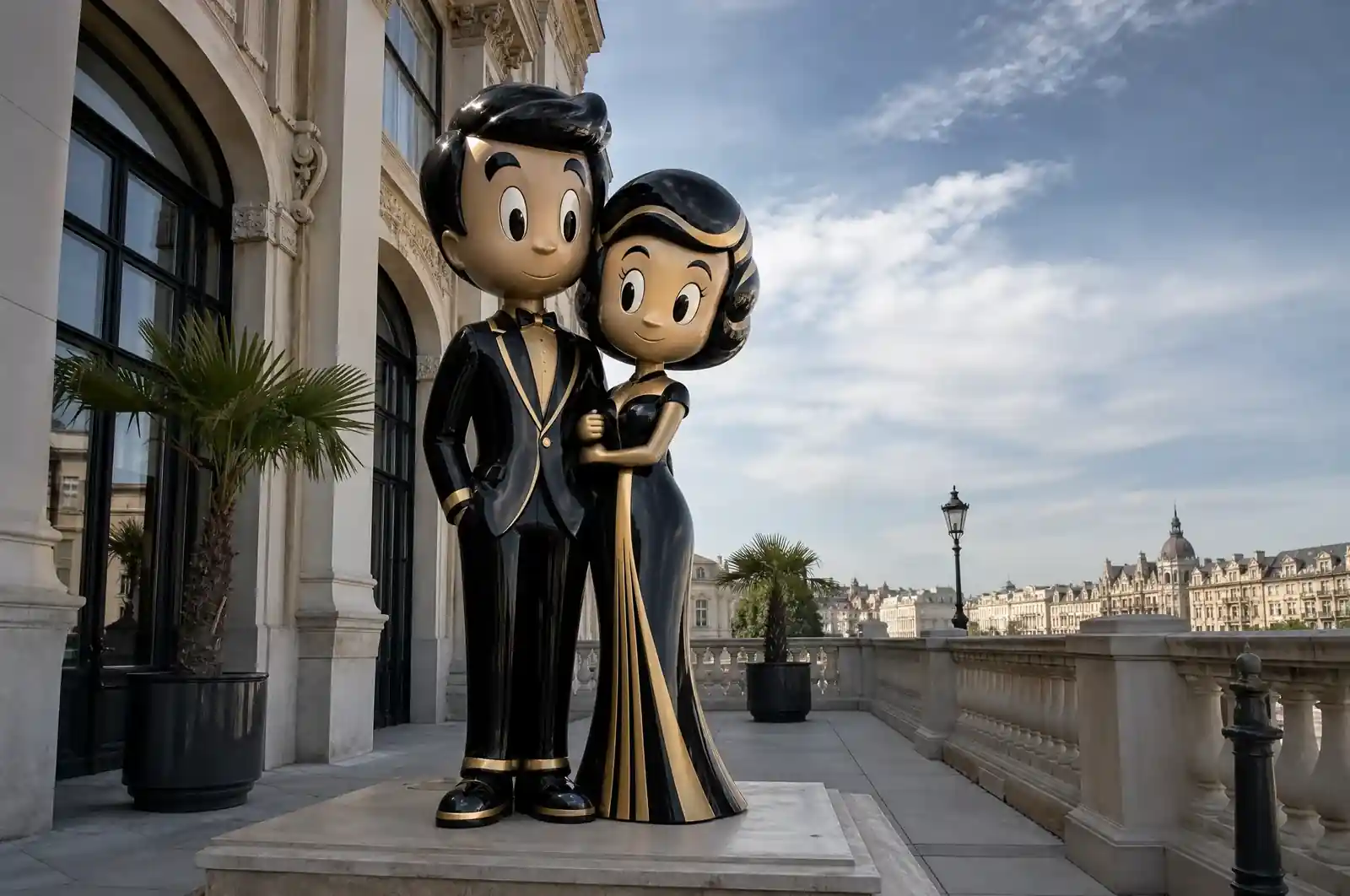
The hotel opened in 1936 and has been restored twice. The terrace is the building’s best feature and the one thing on it that was not original was a photograph of the founding family in a frame nobody looked at.
The brief
A couple, on the terrace, about 2 m, in the visual language of the building. The general manager was explicit that she did not want a portrait of the founders. She wanted a couple that could have been any two people who dined there in 1936.
Building in deco geometry
The two figures are the same cartoon construction as everything else we make — oversized heads, reduced bodies — but their silhouettes are cut with the period’s toolkit. Both gown and jacket are built as stacked stepped bands, four on the gown and three on the jacket, each band lipped about 4 mm proud of the one beneath. The shoulders are squared rather than rounded. The heads are left smooth, because that is where the cartoon has to survive.
Her hair is a fluted bob: a series of narrow vertical ridges, which is the one place on the piece where the fluting runs against the direction of the form instead of with it.
Black, and a little gold
Deep black lacquer, built up in nine coats and hand-flatted. The gold leaf is restricted to the earrings, a single band at the waist of the gown, the cuff links and two narrow bands on the hem, and it is applied over red bole so it has a warm weight to it rather than a yellow sparkle.
On the terrace
It stands at the eastern end of the terrace, where the late sun rakes along the fluting and the stepped bands throw real shadows. The hotel has not publicised it and reports that guests find it on their own, which is what they wanted.
What the brief fixed, and what it did not
The brief was settled before we modelled anything: it would be deco, it would stand about 2 m, and it would live outside. Those three decisions carried the commission, and each carried the other two.
Size first. At 2.2 m the stepped bands and the fluting are spaced far enough apart to read as geometry from across the terrace and from the steps below. Had the couple been commissioned at 1.2 m, the same four bands on the gown and three on the jacket would have been pressed too close together, the 4 mm lips would have read as one texture rather than a set of steps, and the fluted bob would have been a surface finish rather than a form. The deco vocabulary needs the height to work.
Finish second. Nine coats of black lacquer, hand-flatted, is what lets each stepped band hold a clean edge under a raking sun. A satin or textured finish would have softened those edges, and the gold would have sat on a less controlled surface. The gold sits over red bole deliberately: a cold, bright leaf would have matched the building’s brass but not its weight.
Placement third. Outdoors, on an open terrace, the piece takes sun, rain and the freeze-thaw of a Budapest winter. That decided the construction as much as the styling did — it is why the figures are laminated over an internal steel frame rather than being hollow shells, and why the lacquer is a gloss that sheds water rather than an absorbent one.
Surviving a Budapest winter on an open terrace
This is not an indoor commission that happens to stand outside. The terrace is fully exposed, and Budapest sits on a continental cycle — hot, dry summers and winters that drop well below freezing, with repeated thaw cycles at either end. The piece is built for that.
The internal steel frame carries the wind load and the dead weight of the two figures, and it is what lets the sculpture stand at the eastern end with no secondary support. Because the figures are hollow laminated FRP over that frame, the shell moves with temperature without cracking: the gloss lacquer is flexible enough at this thickness to ride the freeze-thaw cycle, and the black surface is dense enough that it does not pick up the grime a matte surface would.
The parts that need care are the parts that catch things. The 4 mm lips on the stepped bands and the vertical flutes of the bob are ledges where rain and dust settle, and the gold leaf is the most exposed surface of all. The routine is simple: a soft rinse and a wipe across the bands and the fluting, no abrasives and no solvents on the gold, and the leaf touched up over the same red bole if it is ever knocked. The hotel maintains its own facade, so the instruction to us was that the sculpture should not add a specialist maintenance job to it — and in that gloss and that geometry, it does not.
What to settle before you ask for a quote
Three things decide a commission like this before any numbers are discussed, and they are worth settling in your own brief.
The first is scale. The deco detail here is tuned to 2.2 m. If you want the same stepped-band construction at 1.2 m, the bands and the flutes have to be re-spaced, not shrunk, or they collapse into texture. Say the height you want and where it will be seen from, and the geometry follows.
The second is the finish, and how much gold. Nine coats of black lacquer with a restricted gold scheme is one reading; more gold, or a brighter gold, is another. Because the leaf is laid by hand over red bole, the amount and the placement is a decision you make early, not a default — and the same goes for how the lacquer’s gloss sits against the building’s own materials.
The third is whether the piece lives inside or out. An indoor piece at this scale can be a lighter construction and a softer surface; an outdoor piece takes the freeze-thaw and the wind, and it is built and finished differently. The same couple, the same size, the same finish will not be built the same way for a lobby as for a terrace. Settle the environment, then the size, then the finish, and a quote follows without ambiguity.
Guests photograph it from the terrace every evening at exactly the same time, when the sun lines up with the fluting.
A heritage hotel in Budapest, Hungary