Cartoon Wedding Couple — Kawaii Sculpture, Taipei
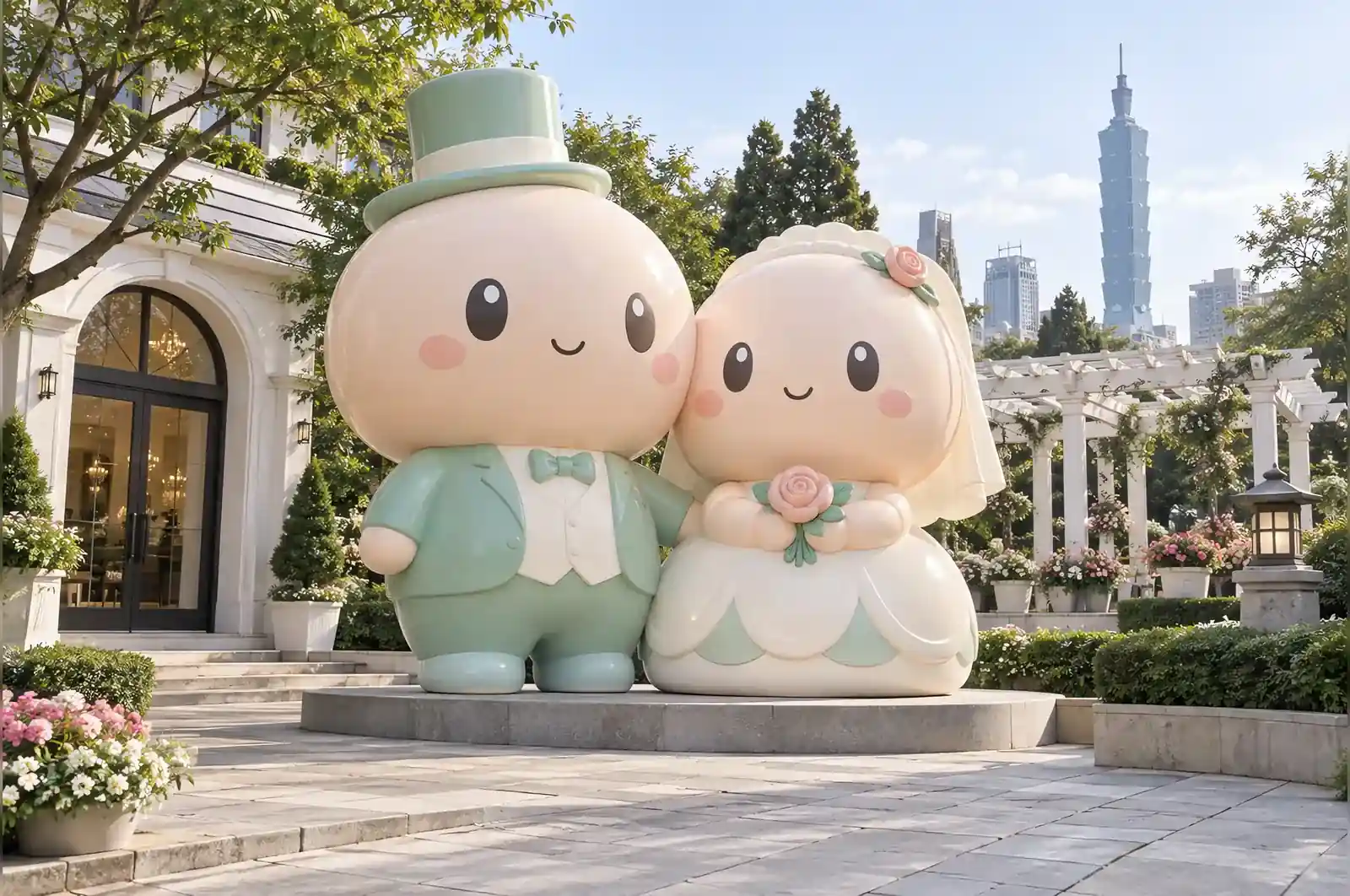
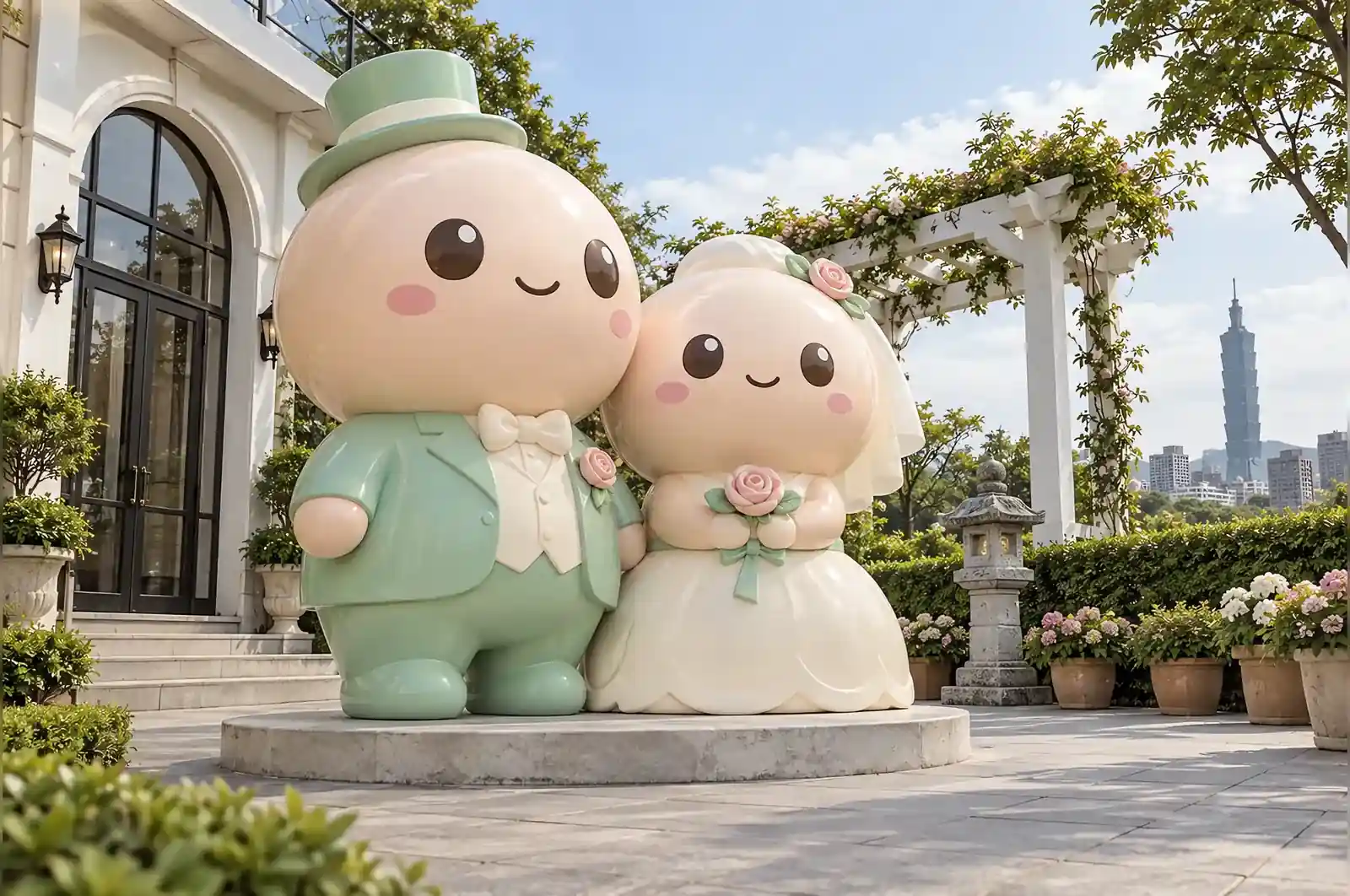
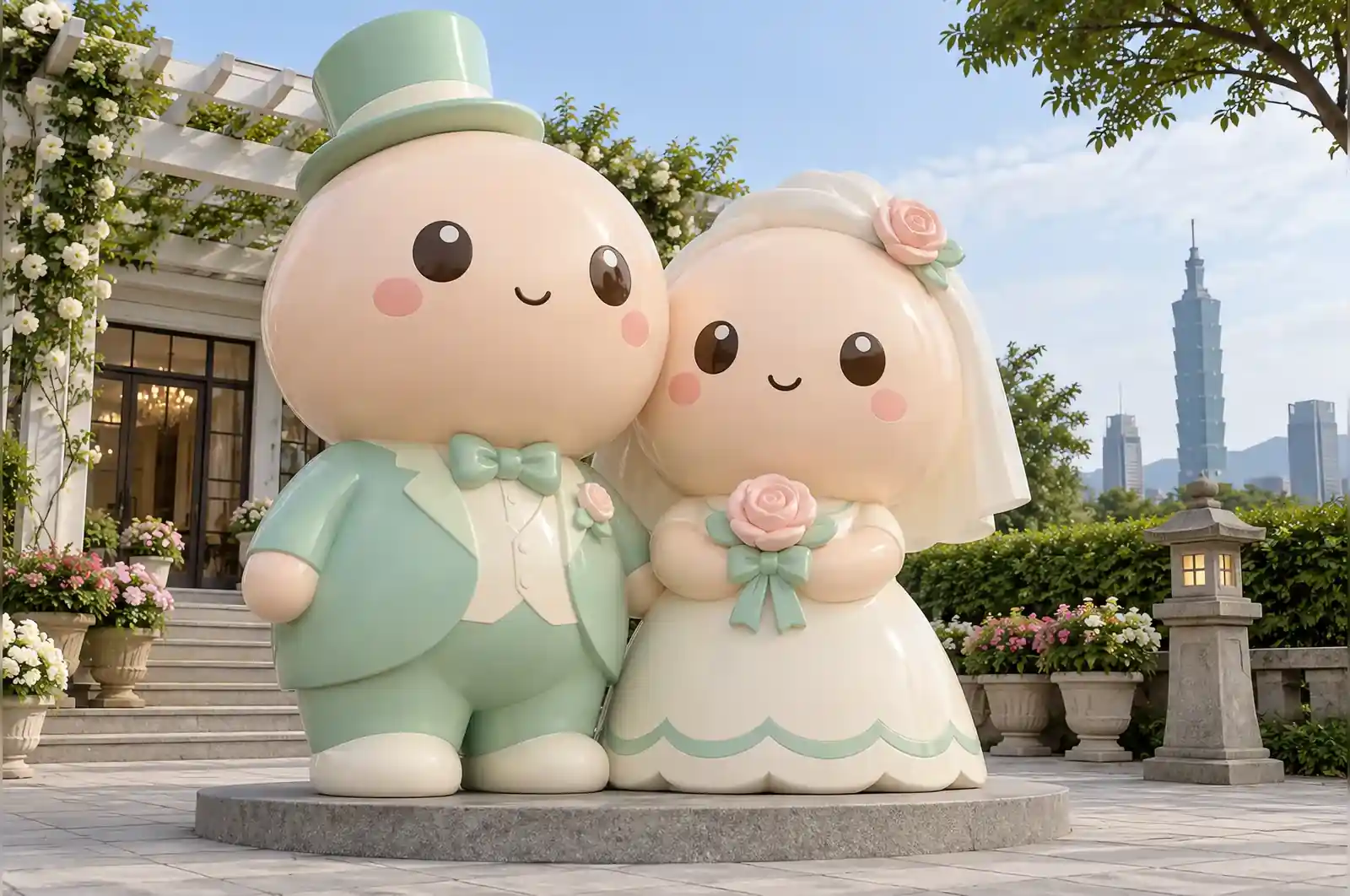
The venue hosts about two hundred weddings a year. Their problem was not attracting bookings; it was that every couple had their photograph taken in the same four places, and the fourth one was a brick wall.
The brief
Something in the garden that couples would choose to be photographed with, at about 1.8 m so that two people standing either side fit in a phone frame. Not realistic. Explicitly, and with some force: not realistic.
Making it deliberately unphotogenic-proof
The trick with a piece designed to be posed beside is proportion. We made both figures shorter and much wider than they would really be, and pushed the head up to roughly 45% of the standing height. That combination does two things at once: it makes the sculpture read as harmless, and it brings the faces down into the frame of a phone camera held at standing height.
The blush ovals do more work than anything else on the piece. They are the only element that is pure decoration, roughly 90 mm across, and they are the reason people smile when they see it.
Rounded, and safe
A sculpture in a wedding garden gets leaned on, sat beside and occasionally climbed by small guests. Everything is radiused, the rose in the bride’s hand is modelled into the hand rather than being a separate piece, and the top hat is laminated as part of the head. There is nothing to snap off.
In the garden
It stands under the white pergola, and the venue has put a small mat down in front of it because of the number of photographs taken from that spot. They have told us it has become the fourth place, and that the brick wall is now empty.
What the 1.8 m height and the satin finish fixed
The commission had two numbers the venue would not give up: the 1.8 m overall height and the satin finish. Each was set by the photograph, not by taste.
The height was set by the frame, not the garden. At 1.8 m, two people standing side by side with a little clearance above the heads still fill a phone frame held at chest height. Drop the piece to 1.4 m and the figures read as children, and the couple disappears into the background instead of being the subject. Push it to 2.2 m and the faces rise out of frame and the pose becomes a distant event. 1.8 m is the height at which a wedding couple fits the shot without the photographer stepping back off the mat.
The finish was the second number. A wedding garden is photographed in hard midday light and in evening flash, and both turn a gloss surface into a bright spot that sits over the faces. The satin finish keeps the blush peach, mint and cream readable at every light angle, and the UV clear coat is what lets that satin live outdoors in Taipei’s humid, sunlit garden without the pastels bleaching.
Had the piece been moved indoors — into the venue’s entrance hall — the UV clear coat could have been dropped entirely and the satin swapped for a deeper gloss that reads better under warm interior light. It stayed outside, so the coat stayed.
The steel frame and the UV clear coat in a Taipei garden
Two things do the work on this piece, and neither is visible: the internal steel frame and the UV clear coat.
The shell is hand-laminated FRP over an internal steel frame. At 1.8 m with a head pushed up to roughly 45% of the standing height, the piece is top-heavy, and a wedding garden is a place where guests lean, children climb and a photographer will grab a shoulder to steady a shot. The steel frame is what takes that load and keeps the fibreglass from flexing; the shell does the shape, the frame does the strength. That is also why the rose is modelled into the hand and the top hat laminated into the head — anything that protrudes is a point where a climb concentrates stress.
The UV clear coat is the part that wears. Taipei is humid and sunny, and the palette is deliberately pale: blush peach, mint and cream are the colours most likely to bleach first under UV. The clear coat is the sacrificial layer — it takes the ultraviolet and the airborne grime, dulling slowly over a few years, while the pigment beneath stays saturated. Re-coating is a straightforward maintenance job: clean, lightly key the surface, apply a fresh coat, and the colours read as new.
In a cooler, drier climate the coat would last longer, but the venue was not going to change its weather, so the coat is specified as the wearable part of the commission.
Two questions to settle in your own brief
If this commission is a model for what you want, two questions decide most of the job before a single drawing is made.
The first is the height. This piece is 1.8 m because it is posed beside, in a frame with two people. If your sculpture is instead a backdrop that couples stand in front of, or a piece that only needs to read from across a lawn, the height changes the whole proportion and the steel-frame schedule. Settle whether people stand beside it, inside it, or merely near it before you ask.
The second is the finish, which is inseparable from the climate. A satin finish with a UV clear coat is the right call for an outdoor piece in a humid, sunny place like Taipei. If yours is indoors under controlled light, you can use a gloss that reads deeper. If yours is in a high-UV, salt-air or frost-prone site, both the coat and the palette need to be specified for that. Pastels bleach faster than deep colours, so if the pastel palette is what you want outdoors, say so early.
Two questions — height and finish — settle more than anything else about how a piece like this is priced and built.
Couples queue to be photographed with it before the ceremony. We have had to put a small mat down for the shoes.
A wedding venue in Taipei, Taiwan