
Cartoon Couple — Gold-Leaf Sculpture, Temple Courtyard, Bangkok


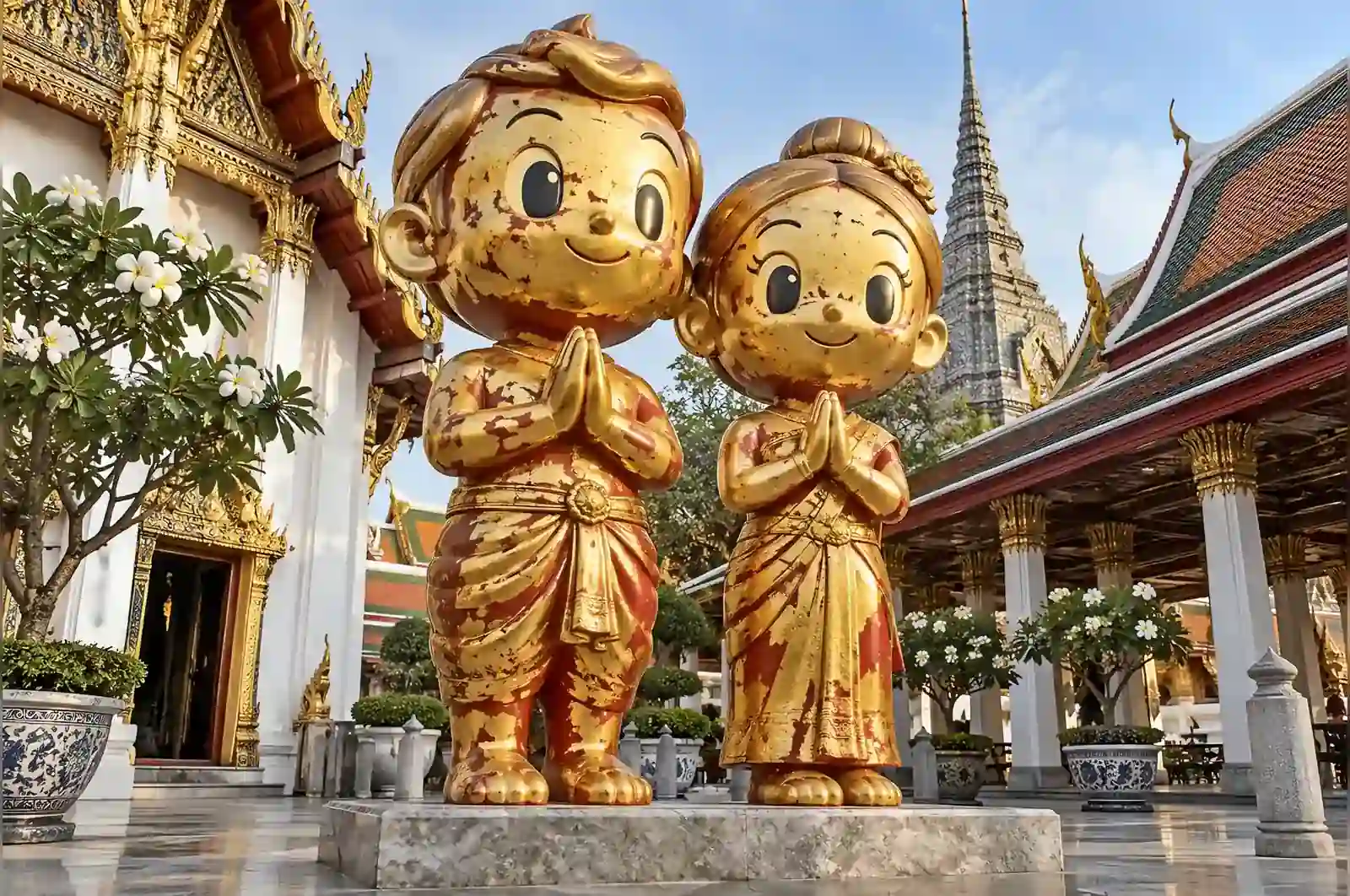
Gold leaf in Thailand is not a decorative choice. It is an act. People apply it to images as an offering, sheet by sheet, and the accumulated result is uneven, thick in the places people can reach and thin in the places they cannot.
The brief
A couple at their golden wedding, in a temple courtyard, about 2 m, cartoon proportions. The foundation’s instruction was a single sentence: make it gold in the way the temple is gold.
Why the patchiness is the whole piece
The obvious way to make a gold sculpture is to spray it with a metallic coating, which gives a perfectly even, rather cheap-looking surface. The temple is not like that. Its gold is layered, irregular and heavier where hands have reached.
So the piece is finished in real leaf, laid in overlapping squares about 80 mm across, over a deep red bole. Roughly 4,000 sheets. We controlled the patchiness deliberately: the leaf is doubled and solid at shoulder and hand height, and left thinner at the crown of the head and the lower body, with small areas of red ground visible. The result is a piece that already looks as though it has been cared for by a community for some years.
Making it survive outdoors
Real leaf outdoors is fragile, so the whole surface is sealed under three coats of clear with a UV package. The leaf is under the coating, which means it cannot be rubbed off, and the coating is thin enough that the edges of individual squares still catch light and still feel raised to the fingertip.
In the courtyard
It stands at 2 m on a marble plinth along the walkway, where visitors pass on the way to the main hall. The foundation reports that people have begun leaving flowers at its base, which was not asked for and was not discouraged.
The patchiness was the part I argued for. Gold laid perfectly flat looks like a paint finish. Gold laid by hand looks like an offering.
A family foundation in Bangkok, Thailand