Cartoon Couple — Fiftieth Anniversary, Adelaide
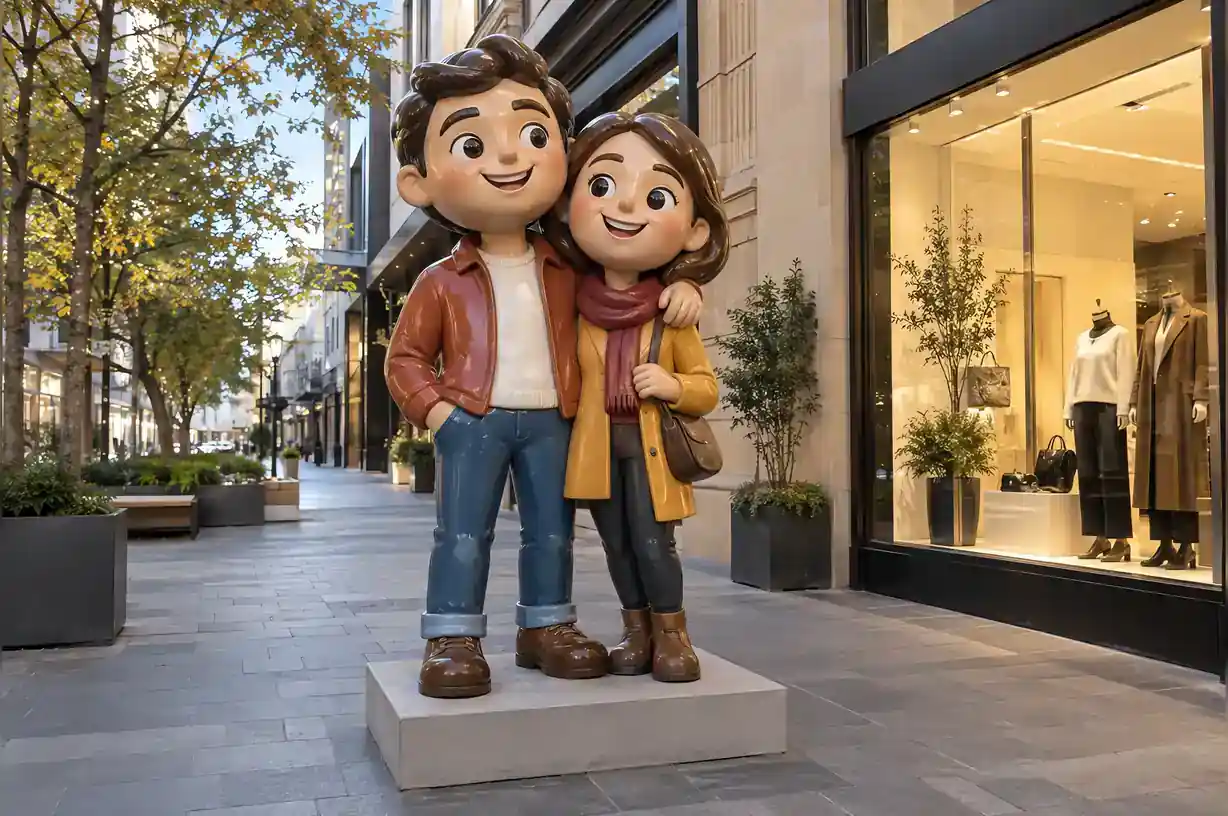
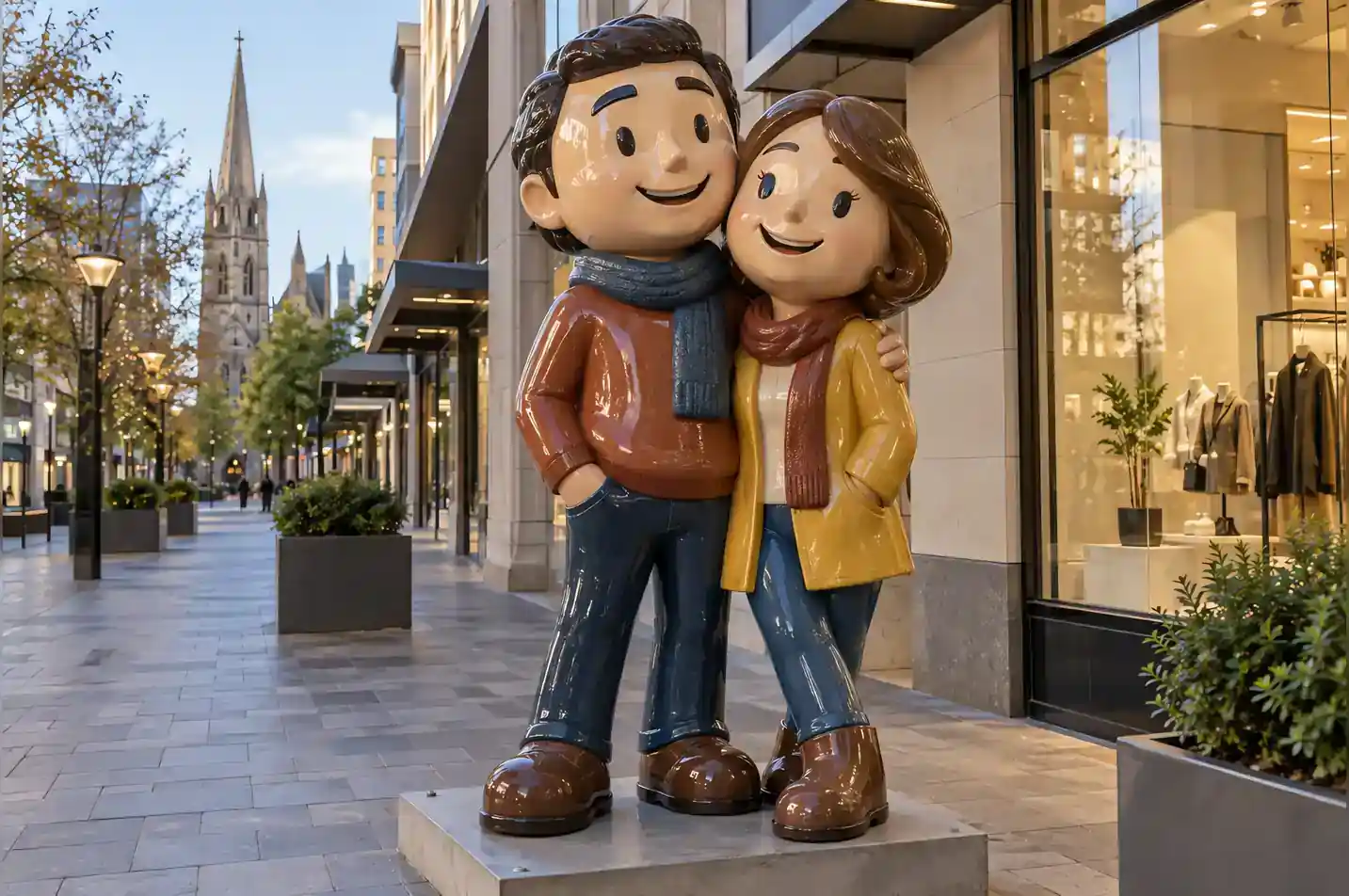
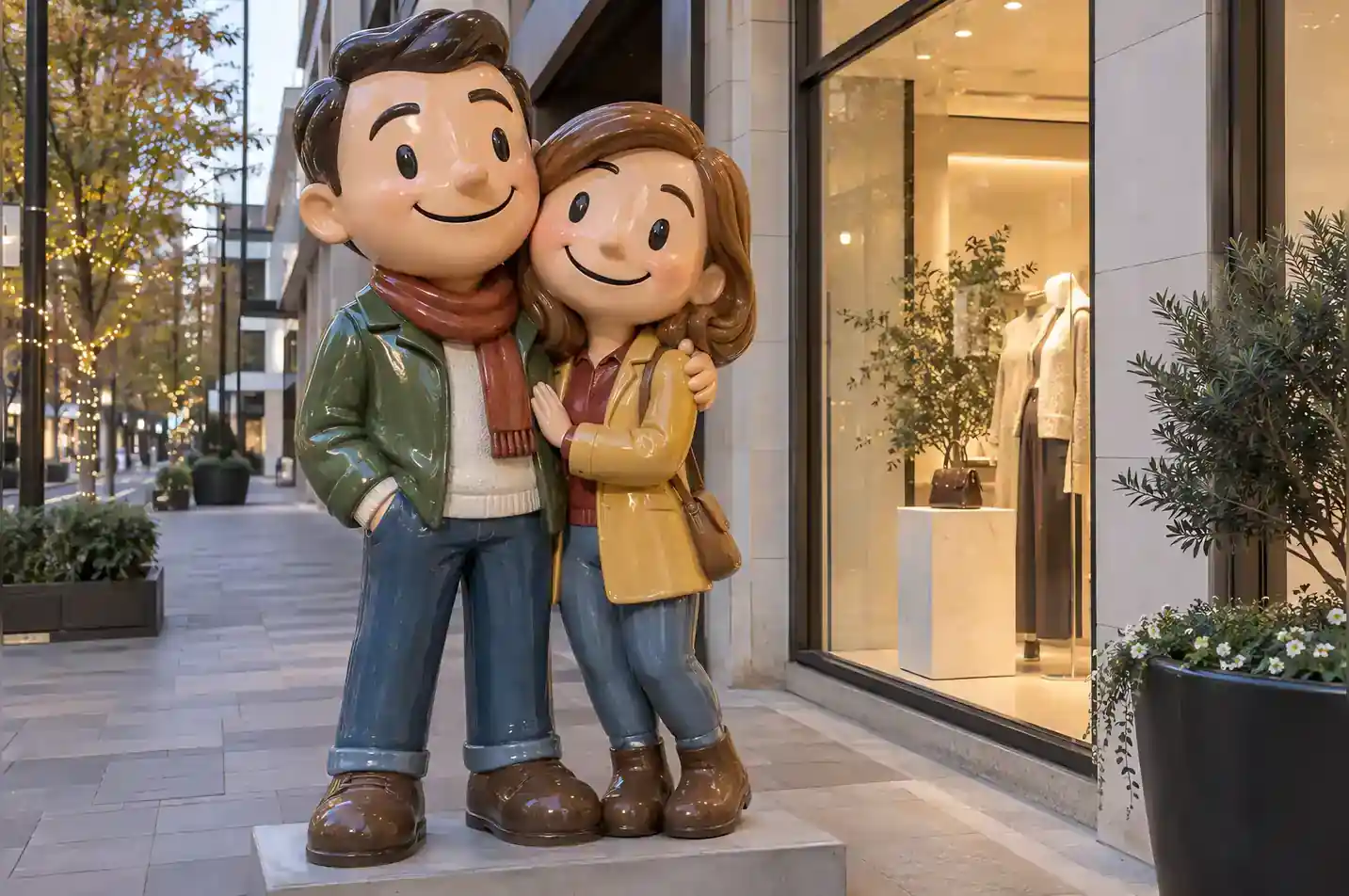
A couple in Adelaide had been married fifty years. Their children wanted to mark it with something that was not a photograph album, and asked for the two of them as they actually stand — which is to say, always slightly leaning into each other.
What they asked for
A cartoon couple at roughly 2.2 m, two figures composed as one piece on a shared base, both smiling, arms around each other. Placed in front of the family’s retail storefront.
What was non-negotiable on this site
On this commission the placement decided everything, and the family was clear about it from the first call: the piece had to stand in front of their shop, not in a garden or a foyer. That one decision fixed the size. At 2.2 m the couple sits above the pavement line and reads across the street, in shop-window reflections and in the evening light; at head height it would have read as a window display rather than a landmark for the storefront. Because the site was not going to change, the height, the width and the depth were settled before we modelled anything. With a piece like this, the site decides the dimensions, not the other way round. The 0.9 m depth mattered as much as the height: the base had to fit the pavement without crowding the shop entrance, and the family had already measured the concrete pad before they called us.
The finish followed the same logic. The storefront sits on a lit shopping street, so a gloss surface was a requirement rather than a preference — a flat or matte finish swallows the shop light and the figures would disappear after dark. Multi-layer automotive paint with a UV clear coat is what keeps that gloss from dulling under a strong Australian sun. If the piece were going indoors into a covered atrium, we would have left the UV-stabilised topcoat off the spec and the price would have come down; on this site it was never optional.
Building it at full size
At 2.2 m the shared base carries an engineered frame for both figures together, which is a different problem from two separate pieces: the composition has to hold as one silhouette while each figure still reads individually. We build a group in 3D first and you approve the arrangement before anything else starts.
The finish
Gloss-painted fibreglass in warm contemporary clothing colours, hand-painted detail, UV clear coat. Because the piece sits on a lit shopping street it needed to read well at night as well as in daylight, which is a painting decision as much as a lighting one.
Maintaining a gloss finish on a retail street
A gloss automotive finish is not a one-time job; it is a surface that has to be looked after, and at 2.2 m in front of a busy shop it takes a fair amount of handling. The clear coat does most of the work — it is the layer carrying the UV protection and the scratch resistance. The instruction we gave the family is a short one: wash the figures with mild soapy water and a soft cloth, never an abrasive pad, and re-wax the surface once a year with a paste wax rather than a spray can. In a UV-heavy climate like Adelaide’s, that yearly coat is what stops the gloss from turning chalky and the hand-painted detail from fading.
The second thing to know is the assembly. The piece went up in three sections, and every joint is a potential water path into the shell. We sealed each one with a flexible sealant that moves with the fibreglass rather than a rigid filler, so thermal movement in summer heat does not crack it open and let moisture in behind the paint. We asked the family to have the joints checked and resealed at the same time as the yearly wax, because a clean, sealed gloss surface is what protects the work underneath. The one repair that is genuinely easy on this finish is a scuff: because the paint is multi-layer automotive, a light abrasion can be machine-polished back to gloss without a full repaint — but only if the clear coat has not been worn through, which is exactly what the yearly wax prevents.
Installation
Delivered in three sections and assembled on a concrete pad in front of the storefront. The pavement was reinstated around the base.
What it cost
Above 2 m, survey figures for fibreglass cartoon groups run $3,800–$15,000. This commission came in at $9,600 delivered and installed, twelve weeks from 3D approval.
What this means for your own brief
Three questions settle most of the cost on a commission like this, and it is worth answering them before you ask for a quote.
The first is where the piece will stand. A sculpture that lives indoors does not need a UV-stabilised clear coat or the same thickness of fibreglass, and that difference is real money; a piece on an open street or in a shopfront needs both. The second is the composition. A two-figure group at this size has to hold as one silhouette, which means an internal frame carrying both figures, and the frame is priced separately from the modelling. Decide whether you want one piece on a shared base or two separate figures, because they are not the same job.
The third is access to the site. The piece arrives in sections and is assembled where it stands, so how the site is reached — level paving, a narrow doorway, steps, a raised plinth — decides whether that is straightforward or needs lifting equipment. If you can answer those three, the quote you get back is the quote you actually pay.
Fifty years is a lot to get into one piece. They found it in the way we are standing, which is how we have always stood.
The Papaioannou Family