
Cartoon Family Group — Folk-Painted Sculpture, Village Square, Maramureș
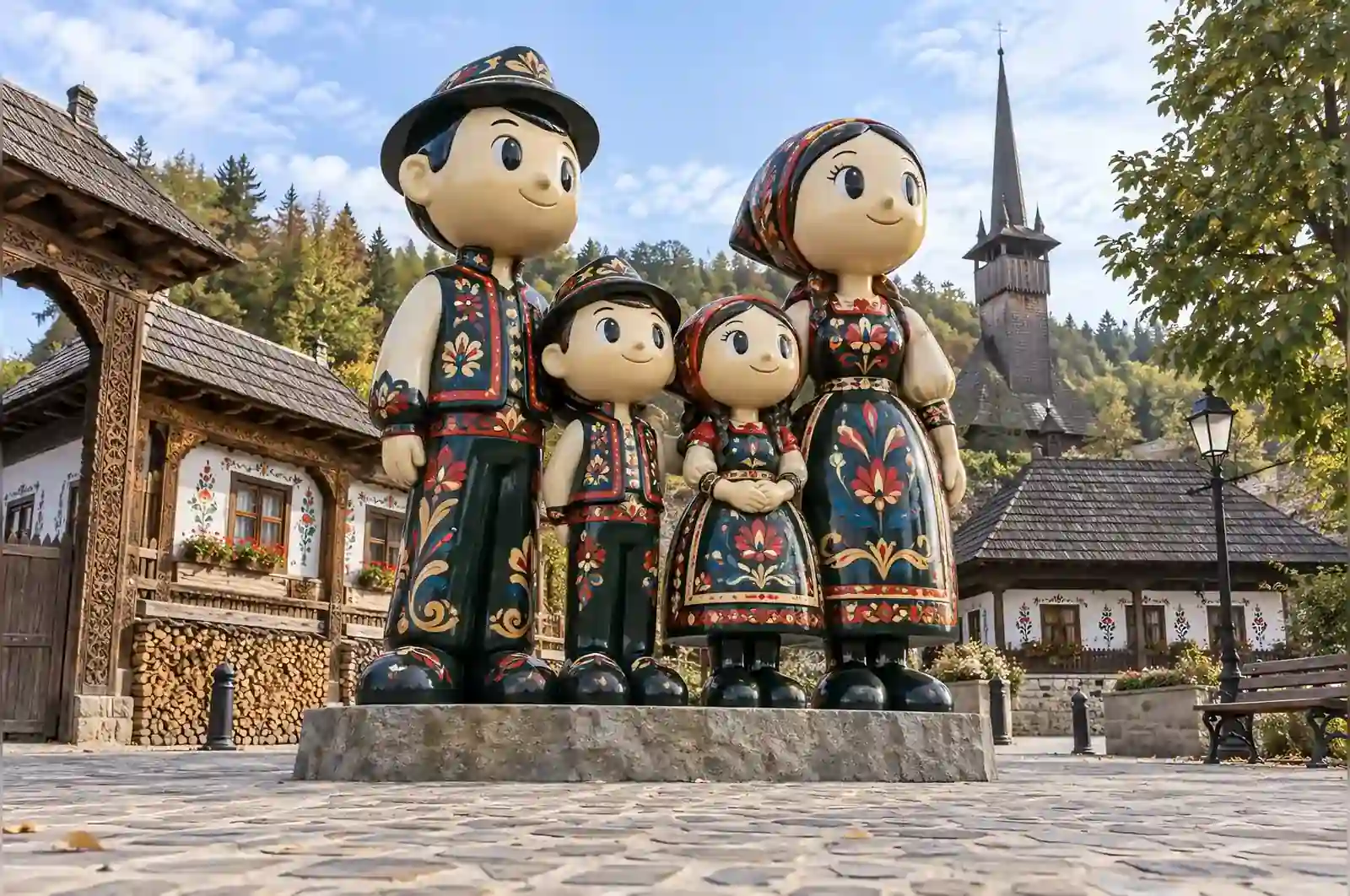
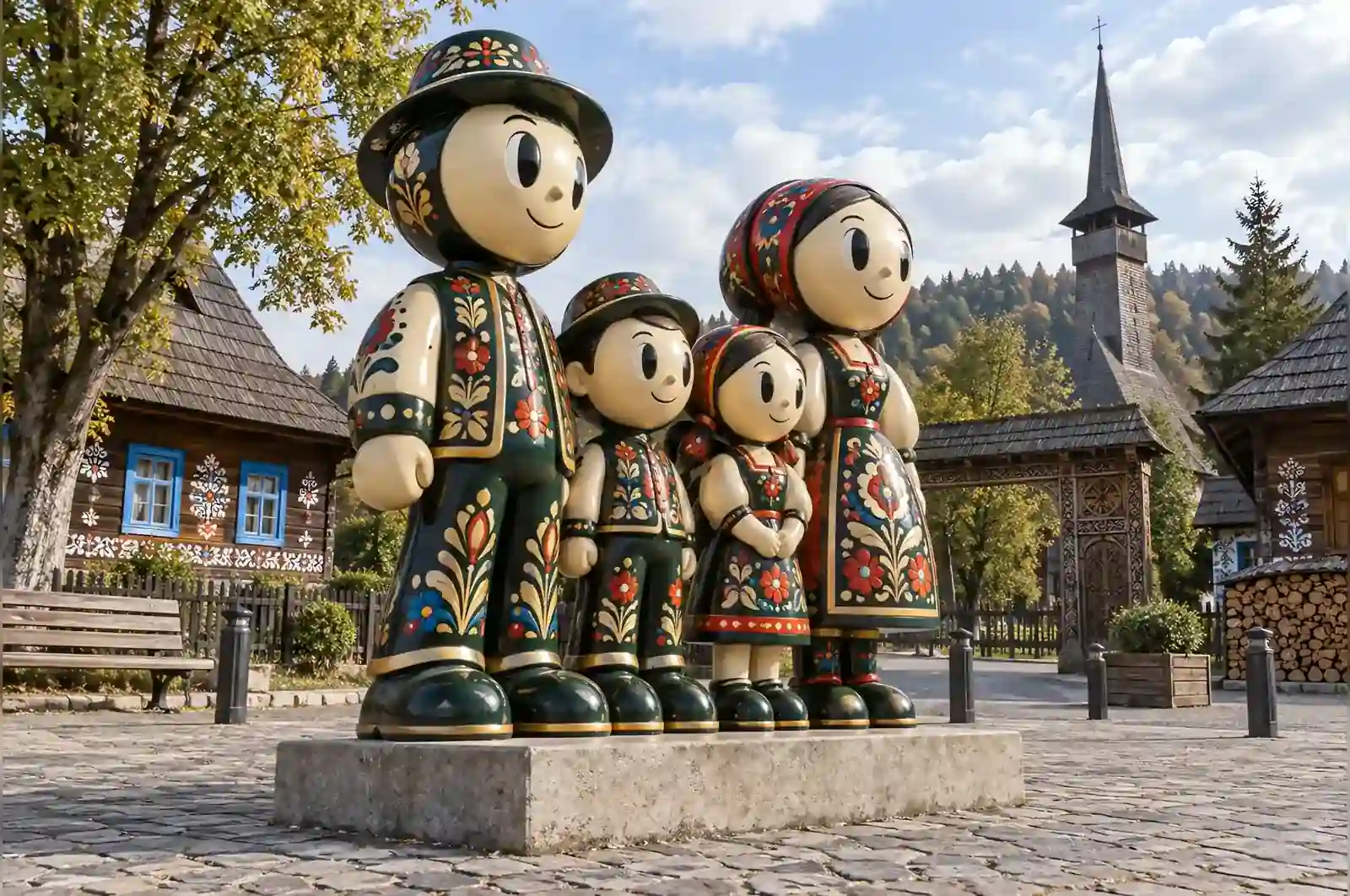
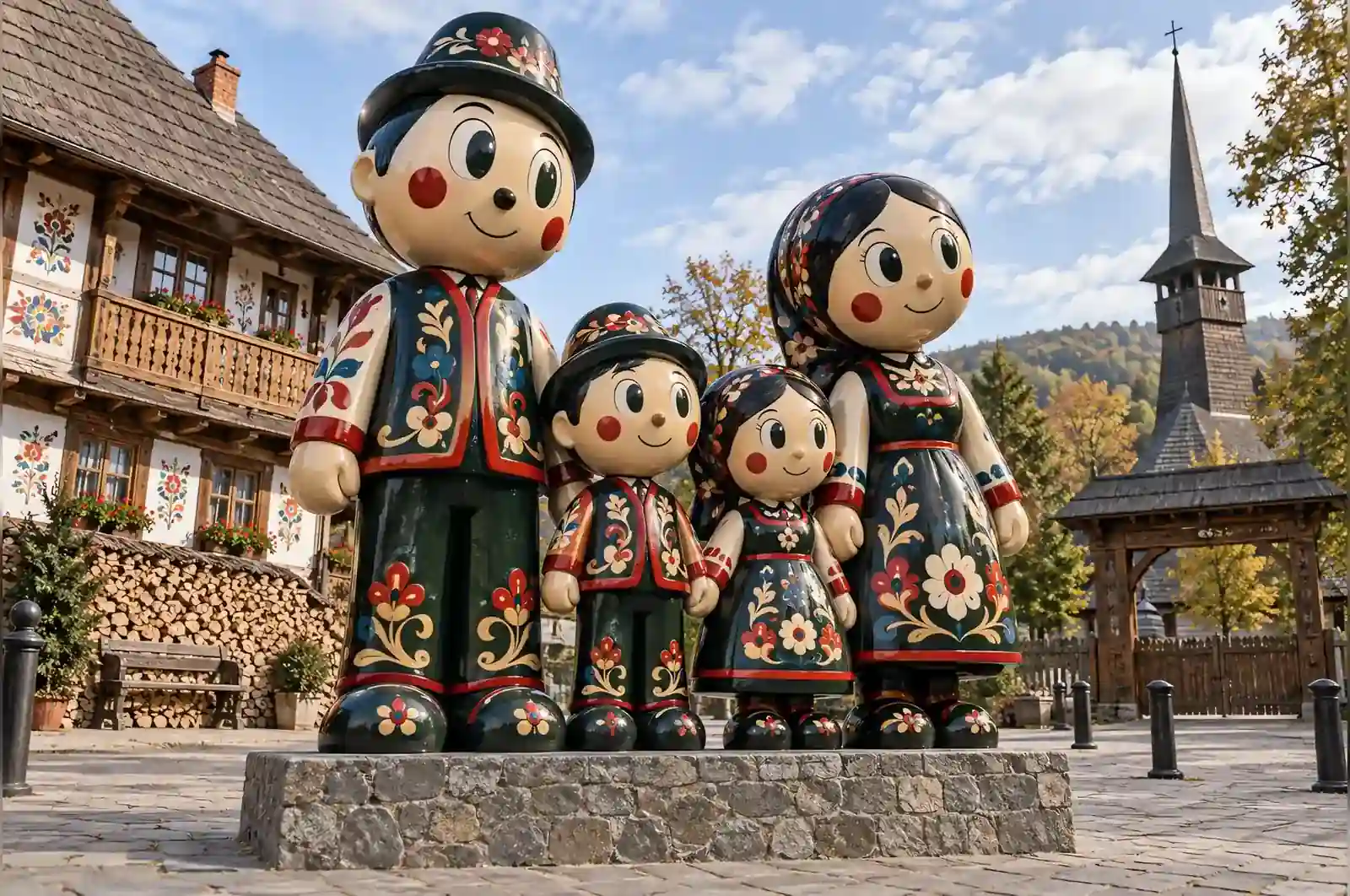
The village had one square, one carved wooden gate at each end of the main street, and no public art of any kind. When they decided to commission something, the discussion in the council lasted nine months and was almost entirely about whether a modern sculpture would be an insult.
What resolved it
A proposal to make it cartoon in form and traditional in surface. The proportions would be playful and unmistakably contemporary; the paint would be hand-applied in the local decorative idiom, in the same colours and with the same motifs as the carved gates.
The four figures
Two parents and two children in a line, about 2.3 m, standing close. Their heads are enlarged to roughly 40% of standing height and their bodies reduced to a single rounded volume, which is the construction we use whenever a group has to read from a distance. The compositional decision that mattered was putting the parents on the outside: with the taller figures at the edges, the group has a stable silhouette and the children are framed rather than hidden.
The painting
A painter from the village, who has decorated the gates on the main street for thirty years, worked on the piece for eleven days. Scrollwork runs up the outside of each parent figure. The children carry petal and dot motifs rather than scrollwork, because the same motifs are used on children’s clothing in the local tradition and she made that distinction herself.
The ground is a very dark green rather than black, which is what the older gates use, and the whole piece is finished in a gloss clear coat so it can be washed down after the winter.
In the square
It stands beside the church path, on a stone base from the old market. There is no plaque. The village school now uses it for drawing lessons, which the council had not considered and has enthusiastically allowed.
What the square made non-negotiable
Three things were settled before any figure was modelled. The first was the surface. Because the council’s worry had been that a modern sculpture would be an insult, a contemporary finish was never an option, and the folk-painted idiom in the same colours and motifs as the carved gates was effectively the price of the commission. The second was the size. At 2.3 m the group reads across a square, from the church path and from the ends of the main street, and a smaller piece would have been swallowed by the open ground. The third was that it had to be washable: it stands in the open, in a region where snow and grit are a fact of winter, so the gloss clear coat was not a refinement but a requirement of the placement.
Had the finish been anything else, the piece would not have been made. Had it been smaller, it would have read as a garden ornament rather than public art. Had it been moved indoors, it would have lost the use the council now gets from it — the drawing lessons happen because it is in the square, reachable, and part of daily life.
The placement also fixed the base. A freestanding group on a village square is not bolted to the paving; it sits on a stone base from the old market, which lifts the figures clear of puddles and gives the group a footing that belongs to the square rather than to the sculpture. That decision was as much about permanence as about looks.
Keeping a painted figure through a Maramureș winter
The piece is hand-laminated FRP over an internal steel frame, which gives it the stiffness the 2.3 m height needs without the weight of solid casting. The depth is only 0.5 m, so the group is a shallow form read from the front, and the base takes the load rather than the figures themselves. The painted surface is the part that needs the most attention. The ground is a very dark green rather than black, so the red, deep blue, cream and gold motifs sit against a colour that holds up in daylight, and the whole piece is finished in a gloss UV clear coat. That coat does two jobs: it keeps the reds and blues from bleaching in the summer sun, and it gives a smooth surface that can be washed down after the winter, when snow and grit have settled in the scrollwork. The painter who decorated it works locally, so re-touching a scuff is not a matter of shipping the piece anywhere. It is worth checking the clear coat each spring, because a single nick in a gloss finish lets moisture reach the paint beneath, and that is the only realistic route to damage on a piece like this.
The questions a buyer has to answer first
Before asking for a quote on something similar, three things are worth settling. The first is the surface: do you want the decoration to match a local tradition, as this council did, or a contemporary look? The answer decides who paints it and how long it takes. The second is the reading distance. A group that has to be understood across a square needs enlarged heads and a stable silhouette, exactly as this one does; a piece for a corridor or a foyer can be far more detailed because it is seen up close. The third is the environment. Is it outdoors in a climate with real winters, and will it need to be washed down? If so, a gloss UV clear coat is not an upgrade, it is part of the specification. Settle those three and the brief is nearly complete — the rest is the subject, the number of figures and the colour palette.
It looks like something carved in our grandfathers' time and painted by our grandmothers. That is exactly what the village asked for.
A village council in Maramureș, Romania